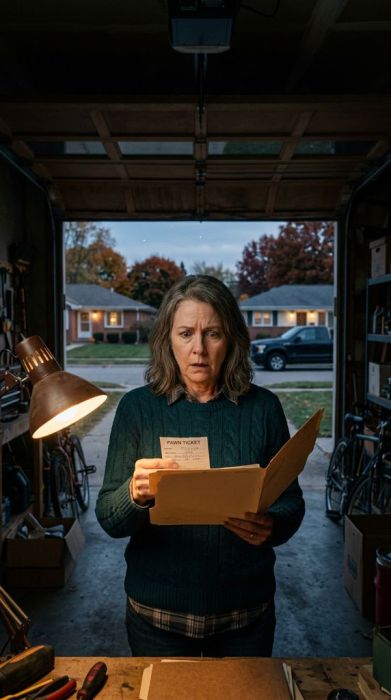
The pawn ticket was sticking out of the folder like a tongue. I almost didn't open it. I'm not a snoop, and my mother raised me to give people the benefit of the doubt. But it had fallen open on my garage workbench, and the word GOLDEN caught the light, and the date caught my eye, and then I couldn't stop reading even though I wanted to.
Golden Oak Pawn, Dayton, Ohio. One week after Mrs. Hartwell's robbery. "Vintage pearl choker — $175."
I stood there with the folder shaking in my hands, and the strangest thought went through my head: I should call Dale. Dale would know what to do. Dale was the neighborhood watch captain, the man everyone on Dogwood Court trusted with their spare keys and their children and their darkest secrets. Dale was the one who'd fixed my back gate and checked my alarm system with his own two hands, refusing money, refusing even cookies.
And Dale was the one who had left that folder behind.
The first thing Dale Whitfield ever said to me was "Welcome home, neighbor. We take care of our own on Dogwood Court." I remember thinking how good that felt. How safe. My mother had been gone six months by then — cancer, quick and quiet — and I'd sold my little apartment in Toledo to come back to Fairview, Ohio, to be near my daughter Erin and my grandson Noah. The house smelled like lavender sachets and old books. The porch swing creaked exactly the way it had when I was a girl. I told myself I could be happy here.
And for a while, I was. Dale was everywhere, and he was wonderful.
He'd been captain of the Dogwood Court Neighborhood Watch for eleven years, and he took it seriously. "A safe street starts with a watched street," he'd say, tapping his clipboard the way a preacher taps a Bible. He organized the meetings in his garage, made the flyers, kept the blue-and-white WATCH signs bolted at both ends of the court. He knew everyone by name — their kids, their dogs, their surgery schedules. When Adele Hartwell's hip went bad, Dale shoveled her walk in January before the sun came up. When the Meyers' golden retriever got loose, Dale drove around for an hour with a bag of treats until he found her at the schoolyard.
The free security survey was his signature thing. He'd walk your property with you, test your locks, check your sight lines from the street, then hand you a typed checklist with little boxes — deadbolt plate, motion light, garage door sensor. He never charged a cent. He never even took the cookies Adele offered him every single time.
Dale made us all feel like we lived on the luckiest street in Fairview. And that is the part that still makes my stomach turn — because the last thing any of us expected was the night Adele Hartwell was robbed.
She'd gone to Pittsburgh for her sister's funeral. Whoever walked into her house through the back door didn't break anything. No glass, no jimmied frame. They went straight upstairs, straight to the little blue box beside her bed, and took the pearl choker her mother had worn in the 1948 wedding photograph. The officer who came said the same thing detectives always say in these stories: whoever did this knew the house. Knew Adele was gone. Knew exactly where she kept her mother's pearls.
Our court huddled in Dale's garage that night, three dozen of us in folding chairs, everyone talking at once. Dale stood in front of his workbench with his hands raised, and he let us talk until we wore ourselves out. Then he said, "We're going to get through this. But we have to be smart. We have to watch each other's houses like they're our own."
And then he said the thing that changed the temperature of the whole room.
"It's somebody who knows our routines. Somebody who watches." He let that hang in the air. "That young nurse at the end of the court — Kendra Velez, the night-shift girl — she moved in four months ago. She's new. She'd know when every house on this street empties out."
He didn't accuse her. He didn't have to. He planted it with the skill of a man who'd spent eleven years convincing people to trust him, and it took root overnight.
Kendra Velez brought me zucchini bread the week I moved in. She works overnights at Fairview Memorial and volunteers at the church food pantry on her days off. She is the sweetest person on this street, and by that Saturday, half the neighborhood was looking at her like she was a burglar. She stopped coming to the meetings. I brought her a plate of my mother's brownies and told her I didn't believe a word of it, but I saw how she thanked me — too quickly, like a woman practicing to be grateful to people who'd already hurt her.
I should say it plainly: I did not suspect Dale. Nobody suspected Dale. That is the terrible, clean truth of it. When he offered to give my house a free security survey two weeks later, after the Meyers got hit over their long weekend at the lake, I hugged him.
The Meyers' robbery was the second one. They came home to find their emergency cash box gone from the top dresser drawer and their daughter's school laptop missing from the kitchen counter. Dale had joked about their trip at the meeting — "better pack extra sunscreen" — and everybody had laughed. Nobody laughed after that.
And then, three weeks later, the third house was mine.
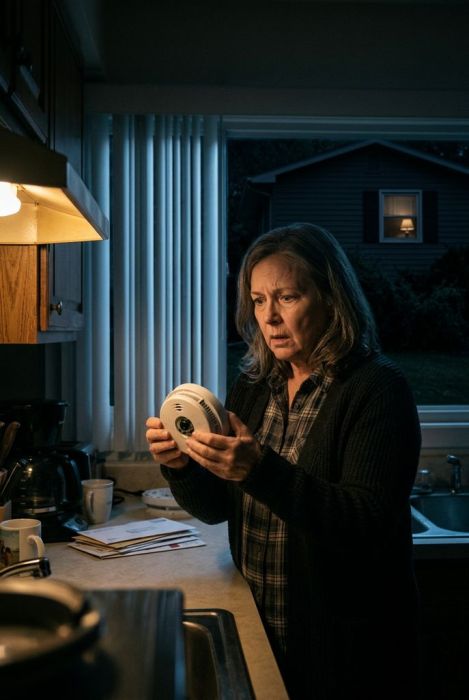
I was at Noah's spring recital, watching him play the recorder terribly and adorably in the back row, when Erin got the call from the alarm company. The alarm had gone off at 7:14. My mother never trusted alarms, but after the Meyers' robbery I'd had one installed, and Dale had personally walked the installer around the yard telling him where the motion lights ought to go. By the time I got home, the cruiser was already there with its lights off, and the house was quiet.
They took my mother's jewelry box. The whole thing — the blue velvet tray of cameos, the gold bangle my father had given her, and the locket. Oh, the locket. My mother wore it in every photograph I have of her. Inside is a picture of her and my father on their honeymoon in 1958, both of them laughing at something the photographer said. I'd worn it on a chain under my sweater since the day I found it in her drawer after the funeral. I'd taken it off that morning to shower, and I'd forgotten to put it back on, and that is the kind of small, stupid detail that will haunt a person forever.
The detective asked the same questions. Locked doors? No forced entry. Anyone with a key? No. Any idea who might target you? None. I cried in my mother's kitchen and told him I'd only lived here eight months. Who does this to a woman who just lost her mother?
The only person in the world who seemed to know what to say was Dale. He was at my door at seven the next morning with kolaches from the bakery and a new deadbolt bought with his own money. "I'm going to fix this, Claire," he said, and I believed him with everything I had. He spent two hours on my doors and windows, testing every lock, reading notes into a little recorder. He even took my back gate off its hinges so it would stop squeaking. "A squeaky gate is a burglar's best friend," he said, winking.
He set his clipboard down on my garage workbench to fix that gate, and he forgot it. That's how I came to be standing there with the pawn ticket. That's how I saw the rest of what was inside.
Because underneath the ticket was a survey sheet for my own house — but the handwriting in the margins was not the neat block print he'd shown me before. It was his other hand. Quick. Slanted. Intimate. "Claire — alarm code 7114. Keys in bowl by kitchen door. White jewelry box, attic. Tuesdays, recital 6–8."
It was my life, written down. The times I left the house. The things I kept, and where. The alarm code he'd watched me punch in with his head politely turned away.
And clipped to that page was a second schedule, dated two days before the Meyers' weekend, in that same messy hand. "Lake house Sat–Mon. Cash box top drawer. Dog to vet Friday."
I stood in my garage with the folder shaking in my hands and understood that I was holding the playbook of every burglary on Dogwood Court. And the author was the man who had shoveled Adele Hartwell's walk in January. The man everyone called our guardian angel.
My first instinct was to confront him. My second was to run. I did neither. I called Frank McCoy instead, because Frank was the only person on the street — the only person in the world — I trusted with my life.
Frank is three houses down. He's a retired sheriff's detective, a widower who lost his wife the same year I lost my mother, and he knows what it feels like to be alone in a house full of memories. We sat on his porch swing with the folder between us like a live snake, and he read it three times, slowly, the way men who worked cases read things.
"He's left-handed," Frank said at last. "The survey pages are right-handed. Tidy. Practiced. But when he's in a hurry, when he's writing about other people's houses in the dark, he falls back on his real hand." He tapped the messy page. "Same man. Two lives."
Then Frank told me something that made my blood run cold. He'd been up early the morning of the Meyers' robbery — his insomnia is legendary — and he'd seen Dale's pickup backing out of the Meyers' driveway at 5:40 in the morning with a duffel on the passenger seat. "I told myself he was checking on the house," Frank said. "That's what he wanted everyone to think. So that's what I thought."
Frank made the call I couldn't make. He called a detective he'd worked with for twenty years — a man named O'Malley, young enough to still believe in patterns — and O'Malley came to Frank's house that night with the car parked two streets away. He read the folder. He looked at the pawn ticket. He said, "This is enough for a warrant, but warrants don't catch him in the act." He looked at me. "You'd have to be the bait, ma'am."
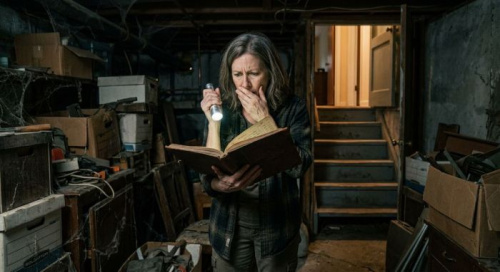
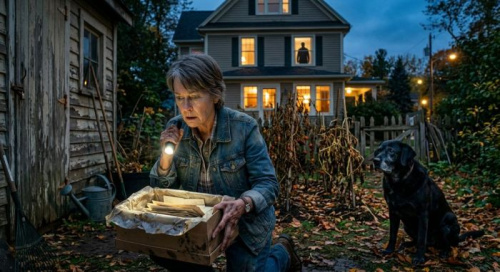
The plan was O'Malley's, but the heart of it was Frank's. I let it slip at the next block watch meeting — the way a grieving daughter naturally would. I said I'd found a second tin of my mother's things up in the attic while looking for Christmas lights. Costume jewelry, mostly, but a little white box with a sapphire ring. I showed the tin around — empty, but nobody knew that — and put it back under the attic stairs. "I don't know why I can't leave it alone," I said, dabbing at my eye. "I just can't stand to lose anything else of hers."
Dale was the first one on his feet with a hug. "We'll get you a lockbox for that, Claire."
I smiled at him with my whole face and let him hug me, and I told him I'd be out all Thursday — a cardiology appointment in Columbus — and that Erin had a key, just in case.
Thursday morning, I really did drive to Columbus. I sat in the waiting room. I got my blood pressure checked. I drove home. And O'Malley's people were already in place — a white utility van parked a block away, a "lineman" on the pole behind the court, and Frank on his porch with his coffee, doing what he'd done every morning for thirty years.
Dale came through my back gate at 11:15. The gate he'd fixed himself, with his own hands, while his folder sat on my workbench.
The deputies let him do all of it. They watched him cross the yard, watched him let himself in through the kitchen door with the key Erin didn't know she'd never been given, watched him climb the attic stairs — not the bedrooms, not the jewelry box I'd left out on purpose, the attic, because he'd been in this house before and he knew what was valuable. Eighteen minutes later he came down with my mother's tin under his arm. He was almost to his truck when the van doors opened.
"Drop it, Dale," O'Malley said. Not loud. The calmest voice I've ever heard, and it stopped a man who had never once been stopped.
They found Adele's pearl choker at his house, wrapped in tissue paper in a little blue box. He kept the good things, you see. He wrapped them up like he was going to return them someday — his own private museum of everyone else's losses. And in his dresser drawer, inside a wool sock, they found my mother's locket. The detective held it up in an evidence bag, and I went weak. My mother's face. My father's face. Both of them laughing in 1958, safe at last.
The gambling debts came out at the trial. That was the why, and the why is always smaller and sadder than the crime. A bookie in Dayton, two years of losses stacking up like unpaid bills, and then a man named Whitfield realized that an eleven-year neighborhood watch captain holds a key that fits every house on the street. Not the metal key. The better one. The trust. The schedules, the hiding places, the alarm codes, the nights when nobody would be home.
He was sentenced to nine years. The judge called him "a wolf who sold the street his own howl," and for the first time all year I saw half the courtroom nod.
Kendra Velez told me later that she'd started packing boxes the week before the arrest. She'd decided she couldn't live on a street where everyone looked at her like a thief. Instead, in March, the neighborhood threw her an apology barbecue, and the blue-and-white signs came down, and Frank and I took over the watch together. Frank said we'd be co-captains. I said we'd be co-captains with one new rule: nobody does a free security survey without a second set of eyes.
My mother's locket sits in my jewelry box now, next to a framed copy of that 1958 photograph. I opened it this morning. They're still laughing. Dogwood Court goes dark at ten, and the porches are full again, and when a young couple moved into number 24 last month, I was the one with the welcome basket. I brought kolaches. I told them to lock their doors, yes — but I also told them the truth I learned in the worst year of my life. The sweetest, most helpful, most trusted face on any street is exactly the one worth keeping an eye on.