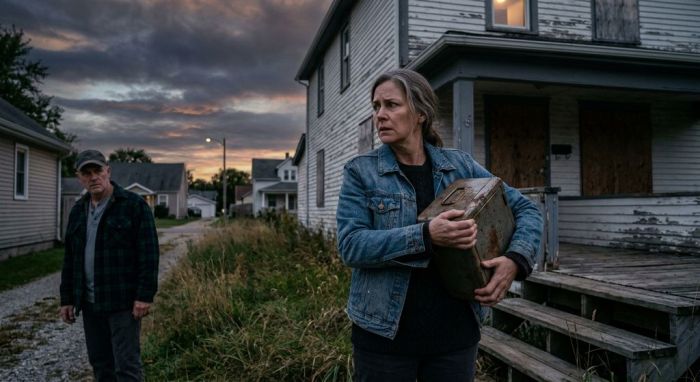
The crush of gravel stopped me cold. I had one foot on the porch of my aunt's house, the key she'd pressed into my palm still warm from two years in a memory-care nightstand drawer, when a door slammed behind me and a voice called out, "You must be Carol."
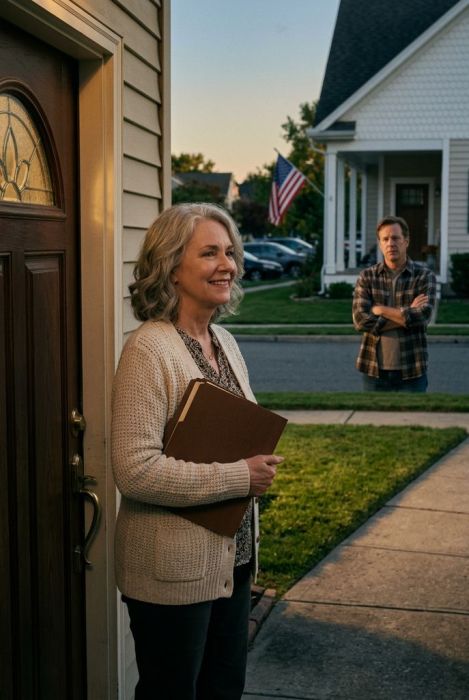
Roy Dunmore came up the walk with a paper cup of coffee and that easy, church-pew smile I'd seen in a hundred family photographs. Aunt Rose had loved him. He'd fixed her porch, mowed her lawn, and driven her to Sunday services for twenty years. Everyone on Hummingbird Lane called him her guardian angel.
"Place is a nightmare, you know," he said, not waiting for me to answer. "I've been keeping an eye on it since Rose went into the home. Roof's shot. Foundation's shifting. Town's about ready to condemn it."
He set his coffee down, grabbed the porch railing with both hands, and gave it a violent shake. The whole thing wobbled like a loose tooth. "Tell you what," he went on. "I'll take it off your hands today, cash. Save you the taxes and the heartache. Say… eight thousand."
Eight thousand dollars. For a house. I laughed, because I didn't know what else to do, and something in his eyes went hard for half a second before the smile snapped back into place.
"Aunt Rose left it to me," I said.
"She left it to you," he repeated, and his gaze drifted over the boarded windows like a man counting money he'd already spent.
At the reading of the will, the lawyer had apologized for the size of my inheritance. "The house and its contents, and her personal effects," he'd said. "That's all there is, Carol. I'm sorry it isn't more."
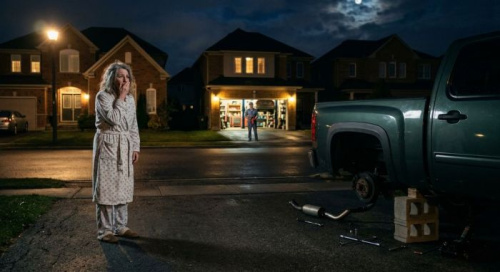
Everyone said Aunt Rose had nothing. She'd been a school librarian in our little Ohio town for forty-one years and lived like a woman afraid of spending a dollar. After Uncle Walt died, she boarded up the upstairs windows to save on heat and mostly stayed inside with her books and her roses. When her mind started to slip, I was the one who found her wandering in her bathrobe at midnight, and I was the one who signed her into the memory-care facility. She went without a fight, which frightened me more than the wandering ever had.
I knew her history better than anyone. My parents died in a car crash when I was nine, and Rose took me in without hesitation. She gave up her bedroom and slept on the pull-out couch for five years so I could have a room with a door. She sewed my prom dress from a bolt of clearance fabric. She was the only family I had left, and when she stopped recognizing me on Tuesdays, I still drove forty miles every week. I owed her that.
The last visit before she died, she'd been having one of her clear days. I'd brought her a slice of lemon pie from the diner she loved, and she'd eaten the whole thing with her fingers, laughing at me for fussing with a napkin. Then she'd grabbed my wrist so hard the pie plate rattled.
"The house is for you," she'd said, her eyes suddenly sharp. "Everything in it. Don't let Roy."
I'd leaned in. "Don't let Roy what, Rose?"
But the sharpness had gone out of her eyes like a light switched off, and she'd started humming a hymn, patting my hand as if I were the confused one.
I thought about that moment constantly during the first week of cleaning. The house wasn't a nightmare, no matter what Roy had told me. It was dusty and cluttered, but the plumbing worked, the furnace hummed, and the roof didn't leak once. What I found instead were signs of something else entirely. A porch board that had clearly been pried loose with a crowbar, the splinters still pale and fresh. Rust-colored drips running down the siding, like spray paint washed off before it dried. And a kitchen pipe with a clean, deliberate gash in it, as if someone had taken a hacksaw to it, right before the water heater burst all over the new linoleum.
Roy called three times that week. Eight thousand became twelve. Twelve became fifteen. "Sweetheart, I'm doing you a favor," he said, and something in the word sweetheart made my skin crawl the way it does when a stranger on the bus sits too close. "Rose and I had an understanding. She told me years back the place would be mine for all the work I put into it."
"What understanding?" I asked, gripping the phone.
A pause. "Just something between old friends. You weren't around, Carol. You were off living your fancy city life. I was the one who changed her light bulbs and shoveled her walk."
It was true, and it stung. I'd lived in Columbus for thirty years — college, work, a marriage, a daughter. I called every Sunday, but I hadn't shoveled anybody's walk.
Still. Something was wrong. Fran Delgado, who lived across the street and had been Aunt Rose's closest friend since Nixon was president, pulled me aside at the gas station.
"Your aunt and Roy Dunmore had a falling-out," Fran said, lowering her voice. "Years ago. She wouldn't tell me what about, but I remember she stopped letting him set foot on the property. Told me he wasn't welcome. I thought it was the confusion talking, but now I'm not so sure."
She told me something else, too. Roy's truck had been parked outside Rose's house at two in the morning the very night the water heater burst. "I couldn't sleep. Sciatica. I looked out and there he was, just sitting there with the engine off. Watching the house like he was waiting for something."
That was the moment I stopped cleaning and started searching.
The pantry was a narrow closet lined with dusty canning jars that had probably been there since the Eisenhower administration. I took every jar down, wiped every shelf, and was about to give up when my knuckle rapped against a panel at the back that sounded hollow. The panel wasn't nailed in. It was held by two little brass hooks, hidden behind a row of preserved peaches.
Behind it was a wall safe the size of a breadbox, painted the same pale yellow as the pantry so it blended right in. Taped to the top of the safe, in Aunt Rose's neat handwriting, was a single word: Carol.
Inside was everything the lawyer hadn't known about. The deed to the house, paid in full, dated 1974. A life insurance policy worth one hundred twenty thousand dollars, with my name in the beneficiary box. Envelopes of silver dollars and savings bonds going back fifty years. A velvet pouch of my grandmother's gold jewelry, the kind I'd been told had been sold to pay for a funeral.
And a letter in a sealed envelope with my name on it.
I sat down on the pantry floor with the letter in my lap and cried before I even opened it. Because I knew, the way you know things in your bones, that this was her way of saying goodbye on a day she could remember to say it.
Dear Carol, the letter began. If you're reading this, I'm gone, and I want you to know I went with a full heart. You were the best thing that ever happened to me. Now listen, because I need to tell you about Roy Dunmore.
I caught him in Walt's shed in the spring of 1994, loading my husband's tools into the back of his truck. Our good table saw, the drill set, a box of brass fittings. He told me he was "borrowing" them, but I'd seen the For Sale ad he'd placed at the feed store with my husband's name scratched out.
When I confronted him, he laughed at me. Called me a confused old widow to my face. So I called the sheriff, and the sheriff made him bring back every piece, and Roy Dunmore has hated me ever since. Not the way normal people hate. The patient way. He told everyone I was senile and that the house should have been his for all his help. He's been circling this property like a buzzard for thirty years, Carol, waiting for the day I die so he can finally have it.
Don't let him. The house is paid for. The money is yours. And if he ever comes at you with a paper, you show them this letter, and you show them the truth.
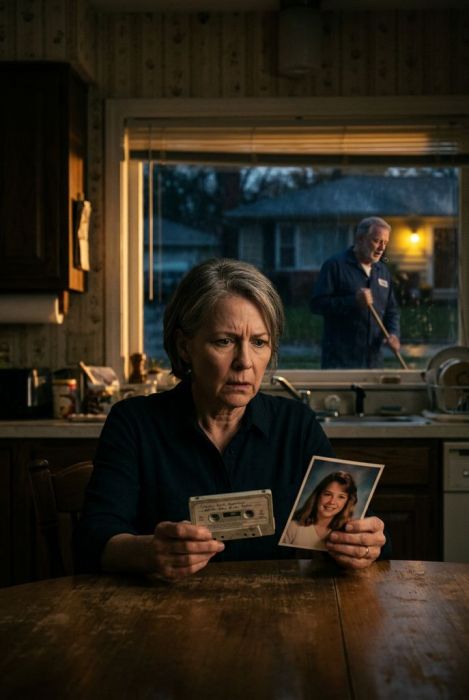
There were two more things in the safe. A faded Polaroid of Roy Dunmore loading a table saw into his truck in 1994, taken through the kitchen window. And a receipt from Pruitt's Hardware, dated one week before the water heater burst, for a can of black spray paint and a hacksaw.
I called my son-in-law Mike that night. Mike is a paralegal at a real-estate firm in Columbus and the closest thing our family has to a bloodhound. He listened to the whole story, then said, "Put that letter somewhere safe. I'm coming up Saturday."
Saturday never came. The certified letter arrived Thursday.
It was from a firm in the county seat, three pages of dense legal language that boiled down to something I couldn't quite make myself believe. Roy Dunmore was claiming title to Aunt Rose's house under something called adverse possession. He said he'd openly maintained, improved, and occupied the property for more than twenty years with Rose's knowledge and permission, and that the house was therefore his under Ohio law. His lawyer was offering me ten thousand dollars to "resolve the matter amicably" and walk away.
I read it three times, and by the third time I wasn't scared anymore. I was angry. The kind of clean, quiet anger that makes you see everything clearly.
"He's lying," Mike said when I reached him. "Adverse possession requires open, notorious, continuous, hostile possession. You can't claim to have 'maintained' a house while you're sneaking around in the dark cutting its pipes and spray-painting it to look condemned. And you can't claim your occupancy was with Rose's permission when she told the whole street he wasn't welcome."
He paused. "But here's the thing, Carol. It'll be his word against a dead woman's. We need him on camera."
We had the letter, the Polaroid, the hardware receipt. And we had Fran, who swore she'd tell the magistrate exactly what she'd told me: that Rose had publicly banned Roy from her property years before her memory started going, and that Roy had bragged at the church picnic that Rose's place would be his one day, no matter what that niece of hers thinks.
So we set a trap the way Rose would have set it: quietly, carefully, and in writing. Mike filed a response disputing Roy's claim and requested a hearing. I told Roy's lawyer I was "willing to talk." And I bought a trail camera from Pruitt's Hardware — the same store where Roy bought his spray paint — and mounted it in a birdhouse on the corner of Rose's garage, aimed straight at the porch.
For nine nights, nothing. Moths, raccoons, and my own cat. I started to wonder if Roy had gotten wind of something. On the tenth night, at 1:58 in the morning, a figure came up the walk.
The footage is grainy in the way all night footage is grainy, but there's no mistaking the shape of him, the roll of his shoulders, the plaid jacket. He set a toolbox down on the porch, pried a fresh board off the front window with a crowbar, and tossed it into the yard. Then he pulled a can from his jacket — the black spray paint — and wrote one word across the front door in dripping letters: CONDEMNED.
He stood back to admire his work. And in that moment, a porch light clicked on across the street, and a voice with a sixty-year accent hollered, "Roy Dunmore, I've got you on my phone! I've got you, you worthless scoundrel!"
Fran. Bless her sciatica and her ever-loving heart.
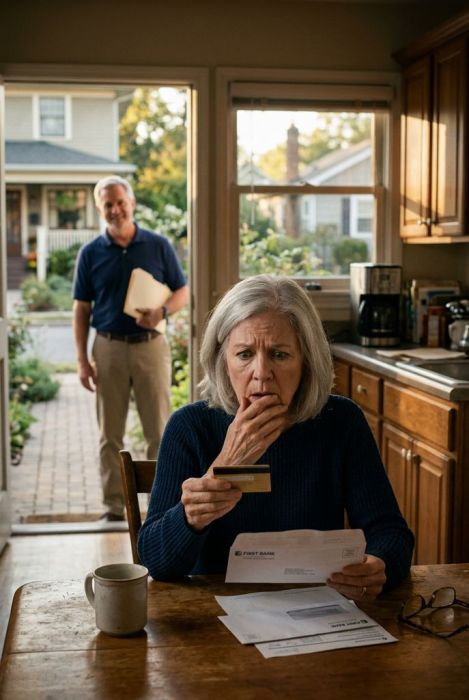
He didn't run. He stood there, frozen, looking from Fran's porch to the door and back, like a man trying to decide which lie would fix this one. Then he walked off down the drive with the spray can still in his hand, and I sat in my kitchen with my hand over my mouth, watching the whole thing from three houses away.
The hearing was two weeks later, in a stuffy county courtroom that smelled like floor wax and old coffee. Roy brought a lawyer in a shiny suit, arms crossed, the picture of wounded innocence. His lawyer told the magistrate that Roy had been a devoted neighbor and that his client's continuous possession of the property was a matter of public knowledge.
Then Mike stood up, and he did something I'll be grateful for until the day I die. He played the trail-cam footage on a screen the clerk had rolled in. The courtroom watched two minutes of a man in a plaid jacket prying boards off the very house he claimed to have lovingly maintained for two decades.
He played it twice.
After that, the magistrate didn't have a single question about adverse possession. She asked what the footage was, asked Roy if that was him on the porch, and watched him go the color of old dishwater. She dismissed his claim with prejudice, ordered him to pay my legal fees, and told him he should thank his lucky stars she wasn't the one deciding whether to charge him with perjury.
Two patrol officers met him in the hallway. He was arrested for vandalism, attempted fraud, and filing a false claim, and the county prosecutor's office added a charge of witness tampering when they learned he'd called Fran the night before the hearing to "refresh her memory."
Word travels on Hummingbird Lane faster than the mail. By the time Roy posted bail, the men who'd drank coffee in his driveway every Saturday morning had found other driveways. Six months later, there was a bank sign in his front yard. He'd borrowed against his own home betting on mine, and when the bet went bust, the bank took what he'd never really owned.
I didn't gloat. I didn't have to. The house did it for me.
I spent the spring fixing it up with my daughter Jenny and my granddaughter Emma, who announced the front room was "giving library" and therefore hers. We painted the porch the color of Rose's favorite peonies, unboarded every window so the light could get in, and planted roses where the grass had been trampled. The insurance money paid for Emma's college fund and left a little extra for the furnace. The silver dollars went on the mantel next to the strongbox, which sits open now, the letter inside in a plastic sleeve. I read it sometimes when I need to remember that being quiet isn't the same as being weak.
Emma asked me once what Aunt Rose's best quality was. I thought about the pull-out couch, and the prom dress, and the forty-mile drives, and the way she'd grabbed my wrist and said, Don't let Roy.
"She knew things years before the rest of us caught up," I said.
Roy Dunmore's case goes to trial this summer, and the neighbors have asked me to save them seats. On warm evenings, I sit on that porch with Fran and watch the whole street come alive — kids on bikes, dogs on leashes, lights going on in windows that used to be dark. The house everyone called a nightmare is full of noise and life now, and Roy Dunmore is the only thing on Hummingbird Lane that truly turned out to be worthless.
I never did take his eight thousand dollars. But I did take his advice, in the end: the place was worth saving the heartache for. It just wasn't his heartache to save.