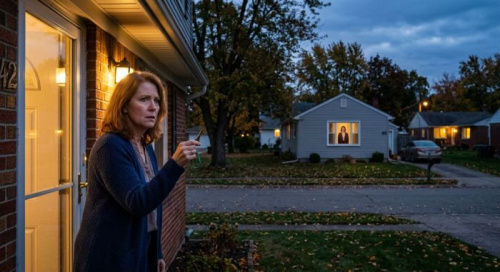
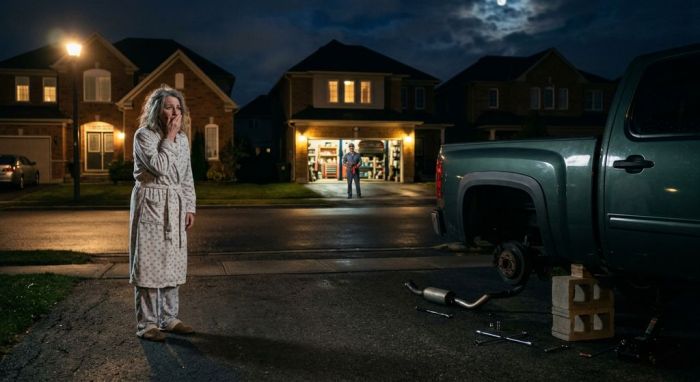
The screech of metal on metal at 5:38 in the morning is a sound you don't forget. I was already awake — I'd been awake for weeks — but that noise pulled me out of bed and down the stairs and out the front door with my robe half tied, into the cold blue dark of Stonebriar Court.
My son's truck was up on blocks.
Cody had parked it at the curb in front of our house the way he always did when he came for Sunday dinner and stayed too late. Now it sat like a wounded animal — rear wheels gone, both cinder blocks exposed, the exhaust cut clean and bright as a fresh scar. And across the street, behind the two windows of number 12, I watched the light in Marty Rourke's garage snap off.
By the time my husband Ray got outside with a flashlight, I was already staring at that dark garage, my heart slamming against my ribs, because I knew exactly whose hand had done it. I just had no way in the world to prove it. Not yet.
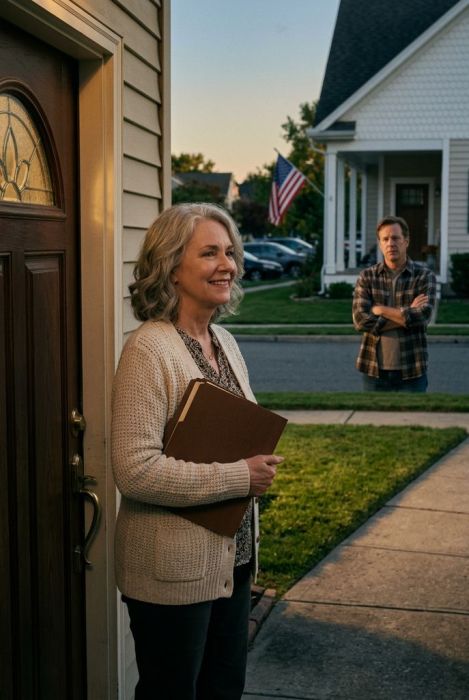
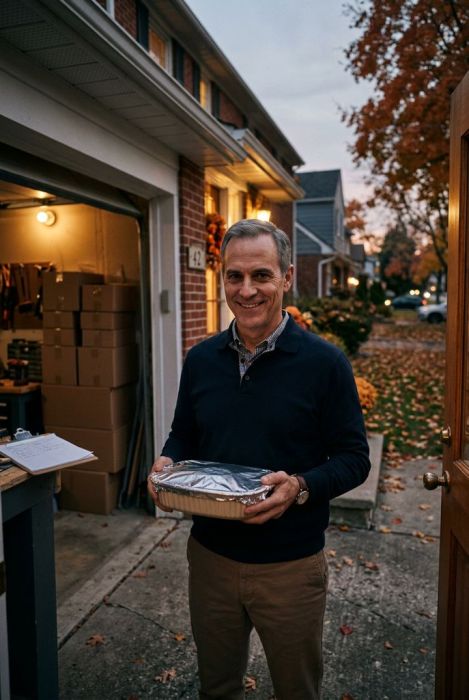
Marty Rourke had moved into number 12 eight months earlier, in the gray of an early spring, and within a week he'd made himself the most beloved man on the street. He was forty-nine, sandy-haired, with a wide, easy grin and hands permanently stained with engine grease. His wife had left him; his kids were grown; he said he just wanted a quiet cul-de-sac and a small business.
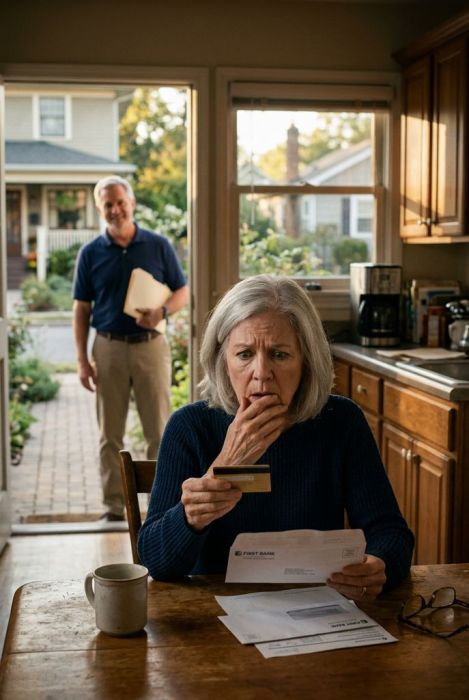
"Marty's Mobile Auto Care," read the magnetic sign on the side of his pickup. He did the Hendersons' brakes for free. He jump-started Priya's sedan at two in the morning without being asked. He fixed the latch on my own storm door just because he noticed it sticking.
"Neighbors help neighbors," he'd say, wiping his hand on that same red rag and offering it for a shake.
Nobody suspected a thing. Why would we? He was the kind of man you hand your keys to.
And that's exactly what every one of us did — which is the part I still can't say out loud without my face getting hot.
I should have known. Not because of anything I saw, but because of something I felt: a small cold prickle at the base of my neck every time Marty was a little too available, a little too generous, a little too eager to be inside our garages. But in August you don't listen to your neck. You hand the man a cold bottle of water and tell your husband, "Aren't we lucky."
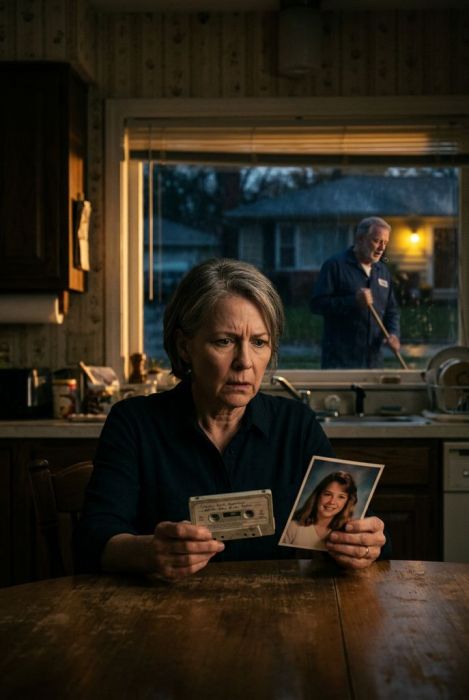
The truck he took from us wasn't just a truck. It was Ray's father's — my father-in-law, who drove it for thirty-one years, who taught Cody to weld in a shop that smelled like hot metal and burnt coffee. When he passed, Cody spent two years and most of his savings bringing that old Silverado back to life. He'd shot it a deep forest green. He'd welded a little brass plate under the hood with his grandfather's initials. Losing it wasn't losing a vehicle. It was losing a piece of my family.
What Marty took that first night was the catalytic converter — a part I couldn't have pointed to a month earlier if you'd paid me. But the deputy who came out explained it patiently, in the tone of a man who had explained it too many times that month. A small crew could crawl under a car at night, cut the converter off in ninety seconds, and sell the precious metals inside for hundreds of dollars in cash.
"The metal's worth more than the part," he told me, tired and apologetic. "Happens all over the county now. We can't keep up."
Then it happened again. The Hendersons' van. Priya's sedan. Two cars on the street behind us. Always at night. Always converters. Always within a whisper of Stonebriar Court.
And every single time, the first person to show up with sympathy and a wrench was Marty Rourke.
He helped the Hendersons install "protective cages" for two hundred dollars apiece — cash, so he wouldn't have to "deal with the paperwork." He offered to weld a thick steel plate over Ray's car, and when Ray asked the cost, Marty clapped him on the shoulder and said, "For you, Ray? Whatever you can spare."
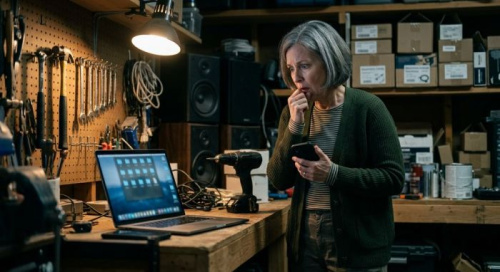
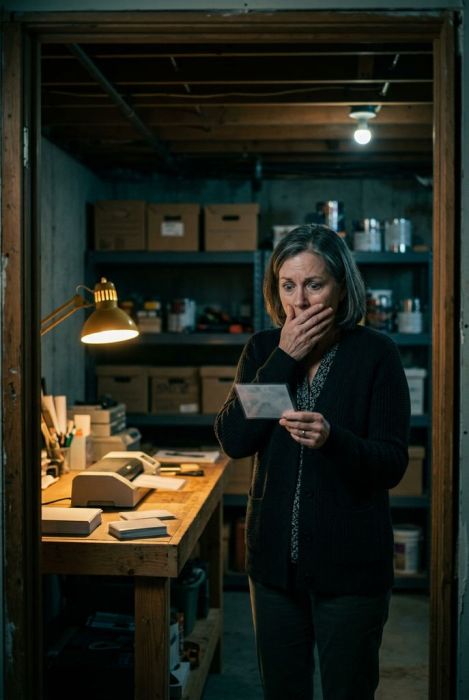
I started keeping a notebook. Old habits from years of keeping attendance and lunch counts don't die; they just find new work. I wrote down dates. I wrote down which cars were hit, and at what hour. I wrote down what Marty said the morning after, and that's when I noticed something: it was always the same line.
"Whoever's doing this must be casing the whole county."
Not the neighborhood. The whole county.
When I finally said it out loud — to Cindy Henderson, over the shared fence, the way you do when a thought has been chewing on you for weeks — I learned a fast lesson about the truth.
"Donna," Cindy said, with that pitying tilt of the head you give a child, "Marty cut the cage off my van himself last month and didn't charge me a dime for the rework. Do you hear yourself? You're accusing the only person on this street who's actually done anything for anybody."
Word travels on a cul-de-sac faster than fire on dry grass. Within a week, half the neighborhood was giving me the cold shoulder at the mailbox. Marty heard about it, of course. And then he came over himself — all gentle concern — and leaned on my porch rail like an old friend.
"I heard what you've been saying about me," he said quietly, and his eyes did that hurt-puppy thing. "I don't know what I did to make you think so poorly of me, Donna. But if it would help you sleep, you can search my garage. Any time you want. Front to back."
That offer froze the blood in my arms, because a guilty man never offers. And a man who offers is either innocent — or he is very, very sure of the one door he isn't offering. The big roll-up door he'd installed himself at the back of his garage. The one that stayed shut all day and clicked open some nights after midnight.
Two nights after he invited me in, Ray's brakes went soft at the bottom of Miller Hill. He's fine — he managed to roll it to a stop in the church parking lot and sat there shaking — but he came home white as paper, gripping the wheel of our car like it might bolt.
"It's a coincidence," he said. "Old car. Old brakes."
And when Marty strolled over the next afternoon — "Heard about Ray's brakes, buddy, want me to take a look? No charge, obviously" — I stood in the doorway between the two of them and thanked him so sweetly that my own jaw ached. He smiled back at me.
"Suit yourself, Donna." Then, softer, almost kind: "You know, brakes are funny things. You can't always tell when somebody's been in 'em."
He walked back across the street whistling.
Something in me stopped being afraid and started being angry, and anger, it turns out, is a much better engine.
That was the week I finally knocked on the door of number 3, where Walt Fenner lived alone with his bird feeders. Walt is seventy-two, a retired state police detective, and the kind of neighbor who waves but never chats. I told him everything — the notebook, the timing, the missing cages, the roll-up door, all of it. I expected him to pat my hand and send me home.
Instead he listened the way a man listens when he's already thinking about warrants. When I finished, he held out his hand.
"Show me the notebook," he said.
Then we did what I should have done from the start. We stopped guessing and started watching. Walt knew how real investigations worked, and he drilled it into me: dates, times, plates, patterns — no feelings, just facts. We set a cheap trail camera in the alley behind our fence, angled at Marty's back gate. Cody, who'd been quietly furious for weeks, spent his own money on a motion light and a second camera. Priya wrote down every time she left for a night shift, because she'd been leaving at 4:30 in the morning for months — and more than once she'd seen a box truck backing up to Marty's rear gate at that exact hour, its engine idling low.
Walt called an old colleague in the county auto-theft unit. Not a favor, he said — just a man who owed him the truth.
Within nine days we had more than we'd dared to hope. The trail camera caught the box truck's out-of-state plates and a late-night handoff of bare metal wrapped in moving blankets. Walt cross-checked the delivery times against a list of reported thefts across three counties, and the match was exact, every single time. There was a buyer whose name we only ever heard as "Vic," and always the same pattern: the thefts happened on quiet nights, and the truck came in the small hours after.
But the thing that actually ended it wasn't a camera, and it wasn't a plate. It was Cody's converter — the one cut off his grandfather's truck. When Cody rebuilt that engine, he'd welded his grandfather's initials into the flange of the exhaust, a tiny private signature he never told a soul about. No thief would ever think to grind it off. It didn't matter where that part had traveled, or how many hands it had passed through. It carried my father-in-law's name on it, and it could not lie.
The sheriff's deputies came on a Thursday, before dawn, with a warrant Walt's old colleague had made sure was airtight. I stood at the edge of my own lawn in my coat and watched them walk up number 12's driveway. A deputy used a tool to raise the roll-up door, and the whole street, which had finally gathered to watch, went dead silent.
Inside was not a garage for fixing neighbors' cars. It was a workshop built for one thing: crates of catalytic converters, some still tagged with the numbers we'd logged; a hydraulic press; shipping labels addressed to a freight depot two states away; and a fat folder that made my hands shake when I only glimpsed it — registration details for dozens of vehicles across three counties, every one of them matching a reported theft from the past year.
Marty Rourke came out in his bathrobe at 5:15 in the morning and was arrested on his own driveway. He didn't look friendly. He looked small. When his eyes found me standing behind Walt in the little crowd, he looked at me the way you look at someone who has finally seen you clearly — and for once, he didn't have a single thing to say.
Nine of us, our little group of nosy neighbors with a notebook and a trail camera, had done what months of whispered worry couldn't.
The county charged him with running a criminal enterprise, felony theft, and trafficking in stolen property across state lines. The buyer in the next state was arrested a week later. It turned out Marty had a history going back fifteen years — an earlier theft ring, a probation violation, a string of towns where he'd arrived as a helpful stranger and left as a suspect. The quiet little place that had trusted him had been his easiest mark yet.
The neighbors who'd snubbed me at the mailbox that month stood at the ends of their driveways and watched the deputies carry out boxes. Cindy Henderson came over that same afternoon with a casserole I didn't need and an apology I did. She couldn't get through a sentence without her voice cracking.
"We gave him our keys," she kept saying. "We gave him our keys."
I'm not a hero. I'm a retired woman with a spiral notebook and neighbors who finally started looking up. But I did learn something I now pass on to anyone who'll listen, especially anyone my age who thinks bad things only happen in the city. If a stranger to your street becomes too good to be true, write it down. If your gut says something is off, don't wait for permission to check. Keep a record of small strange things, because small strange things turn into patterns, and patterns turn into proof. And never — never — let a warm smile talk you out of what you already know in your bones.
The scariest wolf doesn't come with yellow eyes and a snarl. He comes with a wrench, a red rag, and a free offer to fix your brakes.
Cody's truck sits in our driveway again. It took him months to rebuild it a second time, and it isn't perfect anymore, but it's still that deep forest green, and he welded the little brass plate back under the hood with his grandfather's initials. When I walk past it now, I don't think about the morning I found it up on blocks. I think about the morning the deputies opened a door no one on this street was ever supposed to see.
Stonebriar Court has new streetlights now, and a real neighborhood watch, and a group chat where Priya posts the moment she sees anything strange. We wave at each other a little more carefully. We lock our cars. We listen to that cold prickle at the base of the neck.
And the last I heard, Marty Rourke is doing his time in a state where nobody hands anyone a free wrench.
That's worth more to me than anything he ever stole from us.