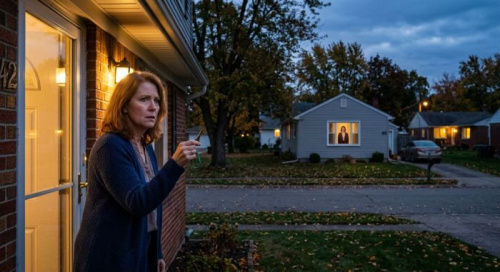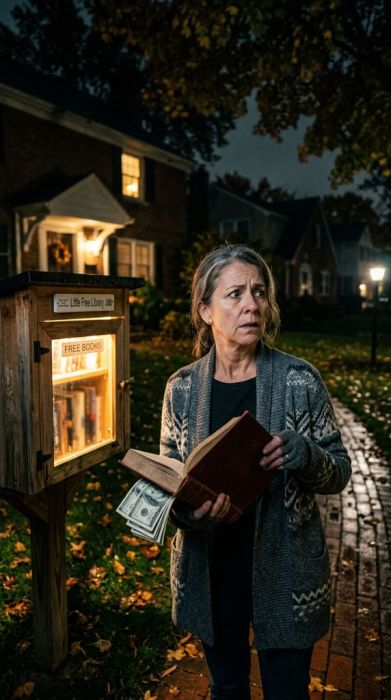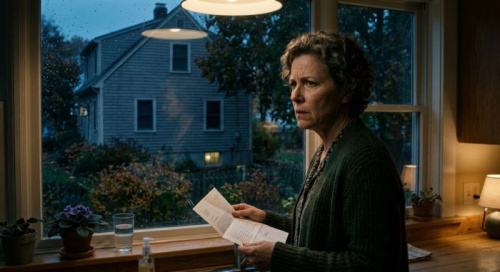
I was sixty-two years old before I understood that the kindest man on Magnolia Ridge had been humming my sister's song right outside my kitchen window for eight years. It was a Thursday in early October, still dark, and I stood at the sink watching the shapes of the oaks come back into the world. Then I heard it — a low, wandering whistle drifting over the fence line from the gray house at 12 Magnolia Ridge Lane.
The melody was old and slow and strange, the kind of instrumental that had no words because the sadness was the words. Sleep Walk. Santo and Johnny, 1959. My mother had played it on the kitchen radio the whole autumn my sister disappeared. I set my coffee down, and my hands weren't steady anymore.
Most people wouldn't know that song if it sat in their lap. It isn't on the radio much. It isn't in movies. It's a ghost of a tune, remembered only by the people who had reason to remember it. And the only other person I ever heard whistle it the way my neighbor whistled it — same pauses, same long sighing slide on the third line — was a man I never saw and never caught, on a cassette tape I had kept in a shoebox for forty years.
Let me back up. My name is Diana Whitfield. I live at 11 Magnolia Ridge Lane, a brick ranch house on a street thick with live oaks and Spanish moss, twenty minutes outside Savannah. I'm a retired school nurse. I raised two children here with my late husband, Tom. None of that is the important part. The important part is my twin sister, Rachel.
In October 1984, Rachel was nineteen and driving home from a friend's house across the county line. She never made it. Her car was found two mornings later, parked neat as you please in a gas-station lot off Route 17, doors locked, her purse still on the passenger seat. Rachel was found three weeks later, and the county called it a homicide, and then the county called it a cold case, and then the county stopped calling at all. My mother died in 1998 with Rachel's name still in her mouth. My father in 2005. I am the last person alive who sat in that house the night Rachel called.
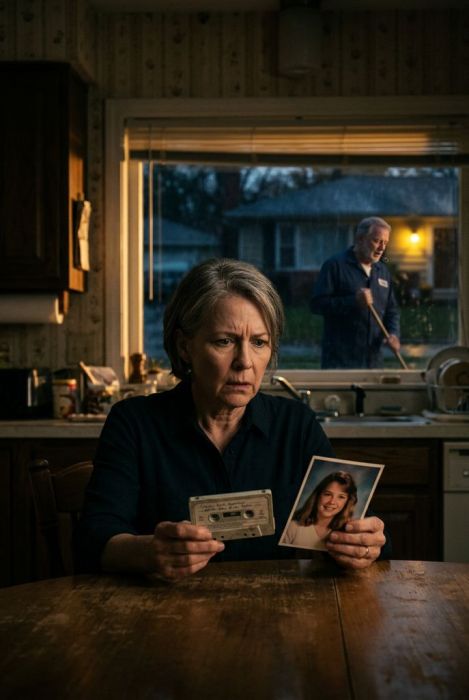
Because she did call. That's the part I never let go. On the last night of her life, Rachel phoned our family's answering machine to say she'd be home late. She was nineteen, so she was cheerful and a little scattered, telling my mother not to wait up. That tape was fuzzy and thirty seconds long. But behind her voice, in the background, you could hear the murmur of a gas-station forecourt and, beneath it, a man softly whistling. A slow, sad, wordless tune. My mother kept that answering-machine tape in the same drawer as the good scissors. When she died, I took it. It sat in a shoebox under my bed for years, and every so often I would take it out and simply hold it, the way you hold a hand you can't hold anymore.
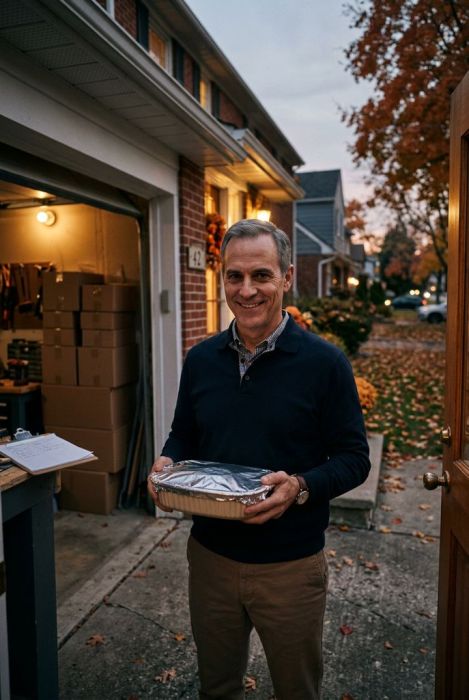
Now, eight years ago, a widower named Ted Barlow bought the gray house beside mine. He was a retired school custodian, quiet, gray-eyed, perhaps sixty-five. From the first week, Ted Barlow was the best neighbor any street has ever had. He fixed my sticking porch door without being asked. He repaired Mrs. Okoye's fence after a storm. He changed out Mr. Delgado's porch bulb and refused money, every time, with a shy wave of his hand. He was the man you'd call at midnight if your car wouldn't start and you'd feel silly for even hesitating.
Everyone called Ted Barlow a blessing. I did too. The only thing odd about him — and I ignored it for years, the way you ignore a small stain on a ceiling — was that he whistled. One song. Always that same slow, sad, wordless song. Over his tools. Over his mailbox. Over the hydrangeas he planted along our shared fence.
Sleep Walk. The song from my sister's tape. I told myself it was nothing. Voices hum what they hum. Sad old men hum sad old instrumentals. Twice I almost asked him where he'd learned it, and twice I reminded myself I was being morbid, the way grieving people are always morbid. My daughter, Kim, used to say, "Mom, not every coincidence is a clue." She was right. Except when it is.
The other small thing was the burn. A wrinkled, old scar the size of a quarter on Ted's left forearm, the kind that suggests a cigarette, or a hot pan, or a man who once put his arm somewhere it shouldn't have been. He kept his sleeves down most of his life. Once, pruning his roses in June, he rolled them up, and the mark caught the light, and something cold walked the length of my spine — because the only description of a person-of-interest the old case file ever had was a man with a burn scar who'd been seen arguing with a girl in a station lot on Route 17 that autumn.
A rumor and a scar and a song. I told myself it was grief reaching for a shape. I told myself for eight years. Then the county reopened Rachel's case. That's what changed everything.
It came together the way cold cases do now — DNA, digitized files, one stubborn detective with too much coffee and not enough sleep. His name was Marcus Reyes, and he had a stack of old cases connected by a pattern nobody had bothered to connect in 1984. He came to my door on a Tuesday afternoon, apologetic, carrying a laptop. Mrs. Whitfield, he said, we found your family's answering machine tape in the archived file. We enhanced it.
He played it. My sister's cheerful voice, forty years old, telling my mother not to wait up. And then, underneath, that slow sad whistle. Reyes had run the recording through a forensic audio specialist. The tune had been identified. Sleep Walk. And the specialist had also picked up two things we never heard on the old machine: a man's voice saying a single word, and a distinctive phrase — two notes, a little rise, a little fall, held just a beat too long before the melody resumed.
I began to shake. Because I had heard that exact hesitation in that exact place for eight years, over my own fence, from the hands of the man who fixed my porch door. "That's Ted," I said. "My next-door neighbor. That's how Ted Barlow whistles." Reyes didn't laugh at me. That's why I trust him to this day. He took out a notebook and asked one question at a time.
What followed felt less like detective work than like pulling a thread on a sweater that had always been loose. Reyes ran the name. Ted Barlow's Social Security number, it turned out, had been issued in 1991 — which was strange, given that Ted claimed to have been a custodian in the same county school system since the mid-1970s. Before 1991, officially, Ted Barlow did not exist. And behind the name sat another one: Gerald Pyle, a man who had been questioned — questioned, never charged — in an assault in a neighboring county the year before Rachel died, and who had dropped off the face of the earth shortly after. A dead man's identity, borrowed. A life built in a new county, in a new century, around a football field and a school hallway where nobody asks hard questions about the gentle man who mops the floors.
I asked Reyes what we could prove. He said we could prove a name that didn't fit and a tune that did. What we needed was the one thing Ted Barlow had spent forty years never giving anyone: himself, under a microscope. So I did what the women of my family have always done. I planned a grocery list and a barbecue.
Our street holds a fall block party every October. I hosted it that year. I made sure Ted Barlow came, and I made sure he was comfortable and happy, because a comfortable man relaxes, and a relaxed man leaves things behind. He ate two of my burgers and drank two bottles of water, and when he set his plate down to help Mr. Delgado move a folding table, he left both bottles on my kitchen counter with his fingerprints and his lips all over them. I have never in my life felt more like a criminal. I have also never in my life felt more like a soldier.
Reyes collected the bottles himself, gloved, from a cooler I'd saved, and sent them to the state lab. Three weeks later he called me at nine at night and told me to sit down. The cells on the water bottle matched evidence recovered from Rachel's car — a small amount of skin, preserved for four decades, waiting with the patience of a thing that knows it will eventually be asked a question. The match was conclusive. And the audio specialist, comparing the enhanced tape to a new recording I'd captured on my phone of Ted whistling at his mailbox, found the same unmistakable hesitation, the same two-note sigh, in both — forty years apart.
Gerald Pyle, who had lived beside me for eight years as Ted Barlow, had been in that gas-station lot the night my sister last spoke.
The morning they came for him, the sky was the color of wet slate. I was awake, of course I was awake. No sirens, no shouting — the county doesn't do that when it doesn't have to. Just four unmarked cars sliding quietly into the cul-de-sac at six, and officers in soft voices at the gray door of 12 Magnolia Ridge Lane. Ted Barlow came out in handcuffs with his head held in a way I will never forget: not bowed, not shocked, but resigned, like a man who had been waiting at a bus stop for forty years and had finally seen his bus. On the walk to the car, he turned and looked at my kitchen window. I stood there and did not look away. I hope he saw that I was not afraid of him anymore. I hope he saw Rachel's face in mine.
The neighbors stood on their porches in bathrobes, stunned. For a week, no one knew what to say. Mrs. Okoye cried. Mr. Delgado said over and over, "But he fixed my porch light." That, I think, is the horror of it. The monster fixed porch lights. The monster brought your mail in from the rain and remembered your dog's name.
The trial took eleven months. I will spare you the courtroom, partly because it still belongs to my family, and partly because the important part isn't the gavel. The important part is that Gerald Pyle — a man who had stolen a dead man's name, a predator who had buried himself in the safest, most ordinary life a person can manufacture, beside the one witness who had unknowingly kept his voice in a shoebox — was convicted. He is gone now, into a cell the color of wet slate, and he will not come out. When the verdict was read, my daughter Kim held my hand, and my granddaughter, Maya, twelve years old, leaned over and whispered, "Grandma, you did it." I didn't do it alone. But I did do it.
Here is what I want to tell you, and then I'll let you go. The street where a bad man hides is never the scary street. It's the friendly one. It's the cul-de-sac with the block party and the spare keys and the man who waves with a pair of pruning shears in June. Evil doesn't usually announce itself; it mows its lawn and fixes your gutter and asks after your grandchildren.
And here is the other thing. Cold cases don't stay cold. They wait. They wait for a water bottle and a DNA lab and one detective who won't let them go, and for a daughter or a sister or a neighbor who keeps a tape in a shoebox because she cannot make herself throw love away. If you have a question you've never let yourself ask, ask it. If a small thing has bothered you for years, it might not be grief. It might be a clue. The dangerous neighbor isn't always the one who looks the part. Sometimes he's the one everybody calls a blessing.
This October, I dug up the shoebox from under my bed one last time. I took the answering-machine tape out into the yard and sat with it on my lap while the light went long and gold, the way it does on Magnolia Ridge in autumn. Then I played it one final time — my sister laughing, promising she'd be home soon — and when I heard the whistle underneath, I didn't flinch. I just nodded, the way you nod at someone you're finally allowed to miss.
Maya has learned Sleep Walk on her grandmother's old piano. She plays it too slow, and it's beautiful. I told her she could change the end. She'll never have to know the man who whistled it first, and that, right there, is the whole reason I did any of it. The porch door still sticks a little. I fixed it myself. Some things, you take back.