Everyone on Juniper Lane knew the story of the Little Free Library, because Dan and I built it the summer before he died. It was his idea, a butter-yellow book box with a little glass door. "For the kids," he'd said, "and for the old folks who can't drive to the county library anymore." He died in September with a crossword on his lap, and for months afterward the library sat untouched, gathering rain.
Then Gene Huber came home from the hospital, and somehow that changed everything.
Gene had lived at the end of Juniper Lane for thirty years, a retired postal carrier with a bad hip and a face like a kindly jack-o'-lantern. After Dan died, he started appearing at my door with covered dishes and offers to rake leaves. "Dan would've wanted someone to look after his little library," he said one afternoon, patting the glass door like it was a dog. "Let me keep it stocked. It'll give me something to do."
It was the kindest thing anyone had said to me in months. I cried, and he pretended not to notice.
Gene was wonderful at the library. He printed a laminated sign — TAKE A BOOK, LEAVE A BOOK — and painted the post green when the wood split. When kids dropped off worn copies of Charlotte's Web, he'd wipe the covers and set them face-out like a real bookseller. By spring, folks from three streets over called him the Librarian of Juniper Lane. I called him my blessedly normal reminder that the world kept turning.
And for a while, that's all he was. I want to believe that. I still do.
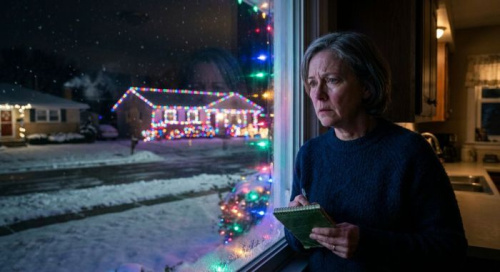
The first wrong note came in July. I woke at three in the morning to headlights climbing my bedroom wall. A silver sedan rolled past my house and stopped at the far end of the street, idling dark at the curve where the library sat. A man got out, walked to the library, opened the little glass door, and placed something inside. Then he drove away without taking a single book. I told myself he was a night-shift nurse dropping off a paperback, because that's what you tell yourself when you live alone and you'd rather believe the world is kind.
Then it happened again. And again. Twice in August, once in September, always between 2:45 and 3:15 in the morning, always the same sedan, always no lights. One night I walked out in my robe to look. The library looked exactly as it always did — well-loved paperbacks, a worn atlas nobody ever took. Nothing new had been added.
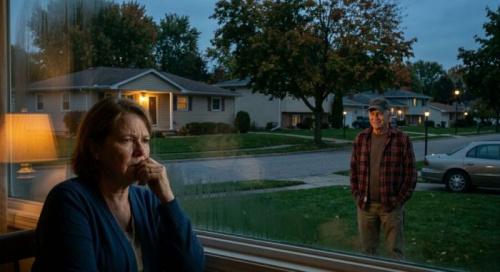
I mentioned it to Gene at the mailbox, casual, almost laughing about my night owls. Something flickered behind his eyes, so brief I talked myself out of it, and then his face went perfectly, dangerously still. "Must have been the Muller kid sneaking a smoke by the fence," he said, and changed the subject to tomatoes. But his hands were shaking when he picked up his mail, and I had the strangest feeling I'd told a secret to the wrong person.
If only I'd listened to that feeling.
By the following spring, Gene's Book Nook was booming. That was his home business — he'd sold used books online for years, mostly old people unloading their parents' collections. But that winter the operation doubled overnight. He built shelves in his garage and bought a used van. "Estate sales," he'd explain when anyone asked, waving a hand. He paid kids five dollars to fetch boxes from his porch, and a scanner beeped all night like a tiny fire alarm. I was happy for him. A man his age with a new purpose. That's what I thought.
Meanwhile, little things started going missing on Juniper Lane. Mrs. Petraki's late husband's watch — she swore she'd left it on the dresser. The Fosters' lawnmower. A diamond earring from Mr. Crane's daughter. Nobody filed reports, nothing big enough to make a headline, just careful people double-checking their locks. I had a thought once, a horrible ungrateful thought about my neighbor, and I pushed it so far down I almost forgot I'd had it.
The night everything caught up with me started with an atlas. Gene was taking a few days to visit a nephew in Pittsburgh. Would I mind restocking the library? Of course not. It was the one job I loved.
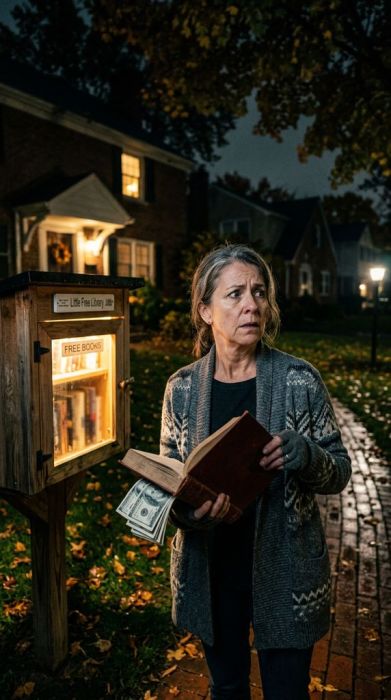
It was after dark when I walked out with a tote of donations from the church rummage sale. I was sliding a copy of a 1978 atlas onto the top shelf when something felt wrong — the book was too heavy. Not heavy the way a big book is heavy. Heavy the way a box is heavy. I opened it in my lap, and the pages fell away on both sides, because the middle had been hollowed with a razor into a perfect compartment. Inside, wrapped in a bread bag, was a stack of hundred-dollar bills held by a rubber band, and beneath it a white pharmacy-style bag heavy with something that crunched.
I sat on the curb and counted four thousand dollars with shaking hands, my porch light turning the bills yellow. I didn't sleep that night. I kept the atlas hidden where I used to keep Dan's cufflinks, and I told myself I'd give it to Gene in the morning, because he'd know what to do — because he was the Librarian of Juniper Lane, and he would fix it.
Gene got home two days later, and I did the stupidest thing I ever did. I brought him the atlas.
I wish I could describe the look on his face. For one long second, nothing. Then he smiled, and it was a smile I'd never seen on the man who brought me soup. "Barbara, sweetheart," he said softly, "this is old stock. Estate stock. I must have left it in the box by mistake." He took the book from my hands, gently, the way you take something from a confused child, and I let him. Thirty years of neighborly kindness is a hard thing to throw away in a single moment. But I couldn't shake the feeling I'd just handed him proof of something, and he'd counted on exactly that.
What happened next, I still can't describe without my hands getting cold.
I thought he'd forget about it. Instead, the neighbors turned on me with a speed that made my head spin. Helen Foster stopped waving. Mr. Crane started parking his truck across my driveway by accident. And worst of all, sweet Dorothy Petrilli, my bridge partner for a decade, told my daughter Claire at a wedding shower — in front of everyone — that she'd been worried about me since the funeral, bless her heart. I was imagining things, she said. Mixing up medications. Claire called me from the hospital, where she worked the night shift, and her voice had that careful, soothing tone you use with a lost child.
"Mom, maybe you should come stay with us for a while."
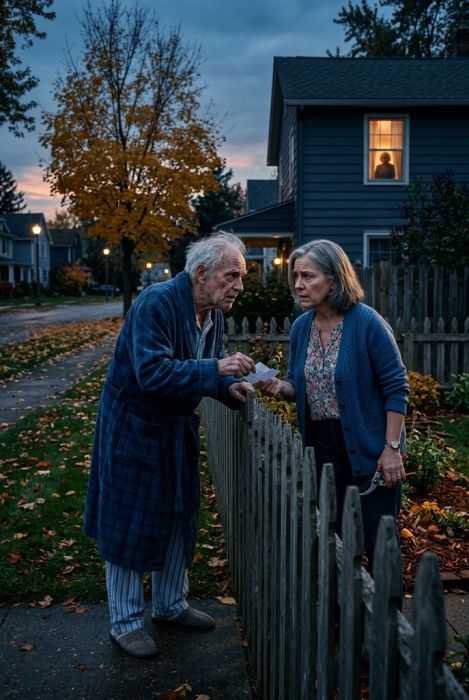
I asked her if she'd noticed anything odd about Gene's house. There was a silence on the line that told me everything. Gene had gotten to her too. He'd told the whole street at the block-watch meeting that poor Barbara had come to him with a book of monopoly money, and it was so sad how she wasn't handling widowhood. He'd even bought pepper spray for the street's widows, just in case.
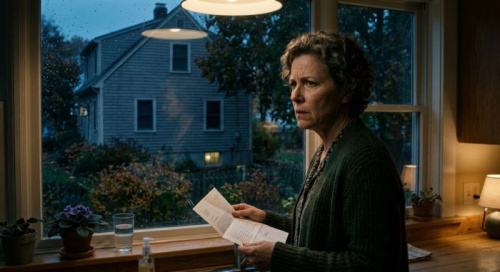
That was the moment I stopped being grateful and started being angry. I am sixty-one. I taught middle-school English for thirty-two years, and I know manipulation when I survive it. I started looking.
I crept out to the library at two o'clock that Friday with a flashlight and a screwdriver from Dan's toolbox. The bottom shelf lifted right out, and under it I found a ledger so neat it would have made my old principal proud — dates, initials, amounts, street names. Names I knew. Bobby from the corner house. The Hendersons' son. One initial that made my blood run cold: C. My daughter's name is Claire. It wasn't her, I know that in my bones, but that initial sat on the page like a cigarette burn, and I wanted to burn the whole street down.
I called the only person I trusted. Her name is Margaret Kowalski. She was in my sixth-period English class in 1994, a quiet girl who wrote the best "What I Did This Summer" essay I ever read, and now she's a detective with the county sheriff's office. I know how convenient that sounds. But Marge was real, and I taught her, and she cried at Dan's funeral, and she was the only person who answered her phone at 2:30 in the morning without asking if I'd taken my medication.
Marge didn't laugh at me. She listened to the whole thing — the hollow book, the money, the 3 a.m. sedan, the false shelf — and then she asked about the library's little glass door. When I told her it locked with a simple pull-latch, she went very quiet. "Barbara, that latch has been jimmied. The strike plate's been filed down. Someone's been opening that door without a key for a long time." She sent a patrol unit to watch at three in the morning, and they got lucky — not with the sedan, but with a black SUV that pulled up, parked dark, and sat for eight minutes. When the spotlight hit the glass door, the SUV left fast enough to kick up gravel.
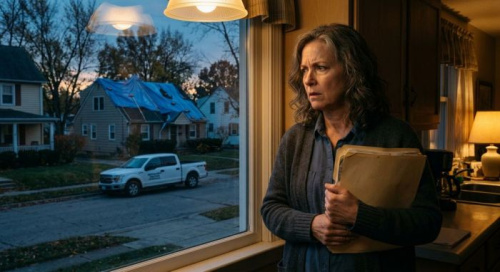
Marge came by the next afternoon with a manila envelope. The county had been watching a distribution ring two towns over, and their surveillance turned up a face they couldn't place — an elderly man who visited the unit before dawn, always carrying a milk crate of books. She laid a photograph on my table. It was Gene's van, at 4:40 in the morning, backing into a bay rented, per the paperwork, to a G. Huber. She didn't say the rest. She didn't have to. "We can't search without probable cause," she said. "But we can watch. And Barbara, we'd like you to help us watch."
What she asked me to do was terrifying in its simplicity. She gave me a small wildlife camera, brown and unassuming, and asked me to set it in the hedge behind the library, aimed at the glass door. Not to catch Gene — to catch the man in the sedan, the one who'd been borrowing books at three in the morning for a year.
Two nights I slept with that camera in my purse. On the third, I set it in the hedge, and I swear it clicked into place like a verdict being written.
For a week, nothing. Then, on a Thursday, trash night of course, the sedan came back. Marge called me at seven in the morning, and her voice was different. Flat. Professional. The voice she used in court. "Barbara, we got him. We got the whole exchange, face to face at the glass door. And Barbara, that buyer is a man we've been wanting for three years. We couldn't have touched him without that camera."
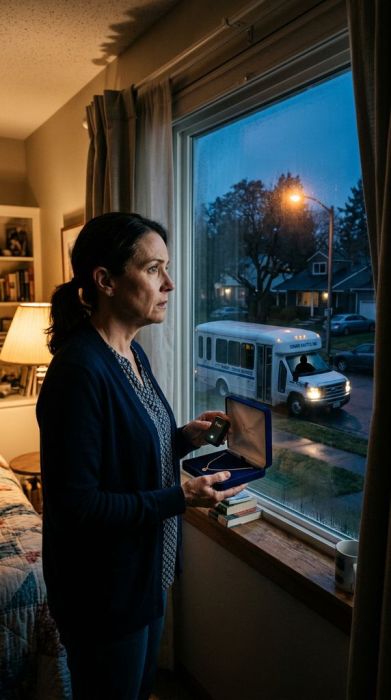
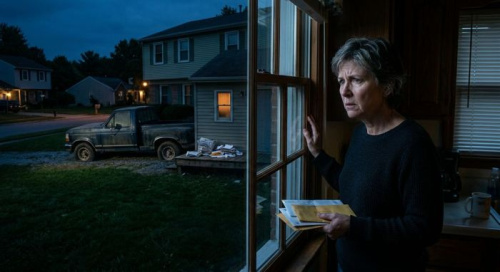
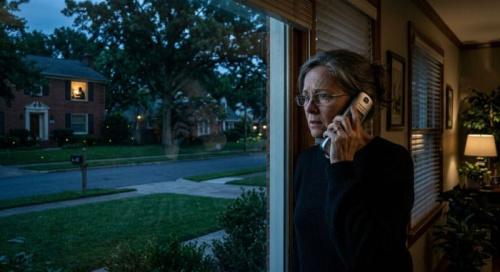
The raid was scheduled for the next Friday morning. I should have been relieved. Instead, I spent the week scared out of my wits, because Gene knew. He had to know. He'd stopped waving from his porch. He'd started parking his van in front of my house, just sitting there with the engine off. And two days before the raid, I found a note tucked under my windshield wiper, printed, no signature.
"WIDOWS SHOULD MIND THEIR OWN GARDENS."
It was the word widows that did it. Gene had never called me that to my face. It was the word he used about me to other people — always kind, always bless-your-heart. Whoever left that note knew my every habit and my worst fear. And I realized, standing in my driveway, that the gentle librarian who'd brought me soup had been studying me for two years the way he studied his hollow books. Preparing me, in case I ever became a problem.
On Friday morning, I drank my coffee black and watched from my kitchen window as two unmarked cars and a marked cruiser came around the curve without sirens. Gene came out on his porch in his bathrobe, carrying a milk crate of hardbacks, and I watched the whole thing the way you watch a storm from a window — close enough to see, far enough to survive. They didn't need the books. They had the camera footage, the ledger, the storage unit, and a getaway driver who'd agreed to talk. The last thing I saw before the door closed was Gene's face as he realized he'd been watched, and I knew that look. I'd seen it in forty years of students caught passing notes. It wasn't anger. It was shame, finally finding its way home.
The neighborhood learned the truth slower than I wanted — slow enough for me to watch the apologies arrive, door by door. Helen Foster brought a casserole and couldn't look me in the eye. Dorothy Petrilli stood at my counter and said at least three times, "I just thought you were confused, Barbara, I swear." Claire cried on my shoulder and told me Gene had called her, months ago, "as a friend of the family," to warn her I'd been acting erratically. That scared me most. He'd played my own daughter so smoothly, because that's what predators do. They don't hide in shadows. They hide in kindness.
The trial took a year. Gene pleaded guilty to part of what they'd found, but the part was enough, and he's serving federal time. Juniper Lane doesn't have the Little Free Library at the corner anymore. The county moved the box to the community center lawn, repainted it forest green, and hung a small brass plaque on it: IN MEMORY OF DAN WHITFIELD, WHO BUILT THIS FOR HIS NEIGHBORS. My grandson Mason asked me if I was sad that the box wasn't on our street anymore.
"No, honey," I said. "It's safe now, and that's what Dan would have wanted."
The truth is, I do miss it. But I sleep at night now — really sleep, for the first time in two years. I keep a small camera of my own in the hedge and move it to a new angle every few months, because learning to trust a street takes practice. When I look at the empty corner where the butter-yellow box used to stand, I don't see an empty curb. I see Dan's smile in the fall sunlight, and a parking spot where a silver sedan used to sit dark, and I know the difference.
That afternoon at the community center, a man from three streets over — I'd only ever seen him at the library, bending down to return a bestseller — stopped me on the sidewalk. "Your husband's library probably saved a few of us from falling for worse," he said, and something in his voice said more than the words did. I thanked him and walked home alone, but not lonely. On Juniper Lane, the neighbors wave again. They knock before they enter. And when it rains, they check on me, the way they used to check on Gene.
Maybe that's the part I'm proudest of. He used our kindness to hide a darkness, and for a while he almost convinced us I was the broken one. But a neighborhood that remembers how to say I'm sorry is a neighborhood that remembers how to be a family. Dan's little library taught ours that, in the end. That's his real legacy, and we didn't have to carve it on any plaque.