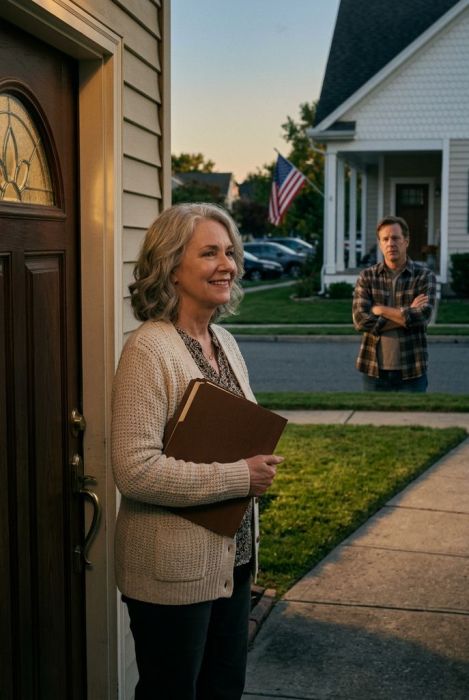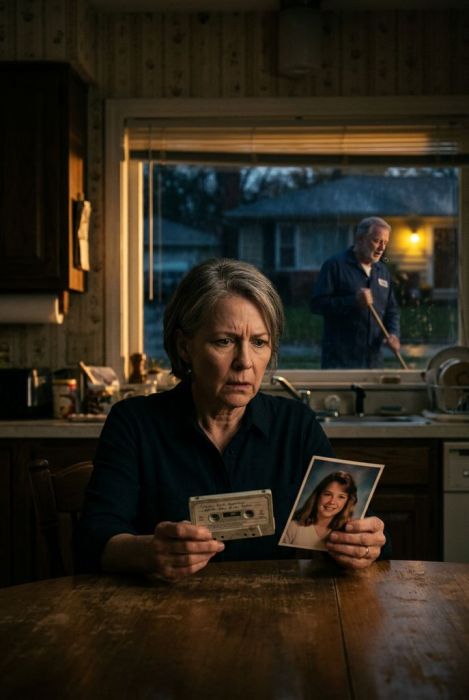
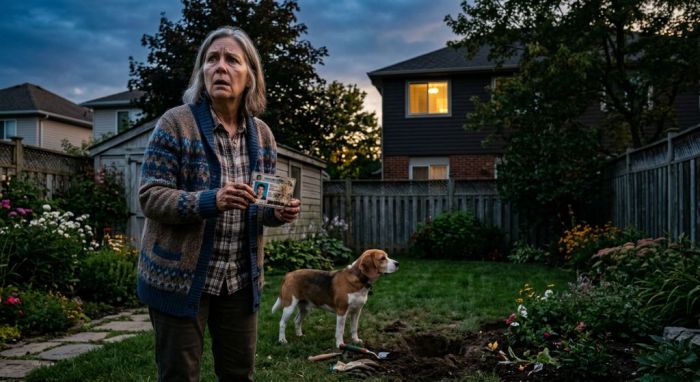
The day the Brocks moved in, Cora stood at my mailbox with a plate of lemon bars and told me all about her daughter Maya. Homeschooled, she said. Shy as a field mouse. Still adjusting after a rough couple of years. I nodded and smiled and said we'd be happy to have them on the street. I didn't think anything of it. Three years later, my old beagle Buddy dug a laminated card out of my petunias, and I found out that every word Cora Brock told me was a lie.
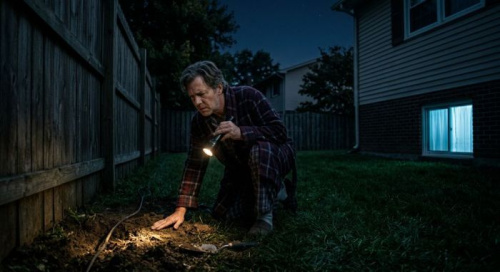
Buddy had been at it all morning, grumbling and scrabbling at the dirt the way he does when he smells something buried. I came out with my coffee and told him to quit, but he wouldn't. He's twelve now, and when a beagle decides something is down there, arguing is a waste of breath. So I knelt beside him, ready to scold, and watched him drag a plastic-wrapped rectangle out of the soil.
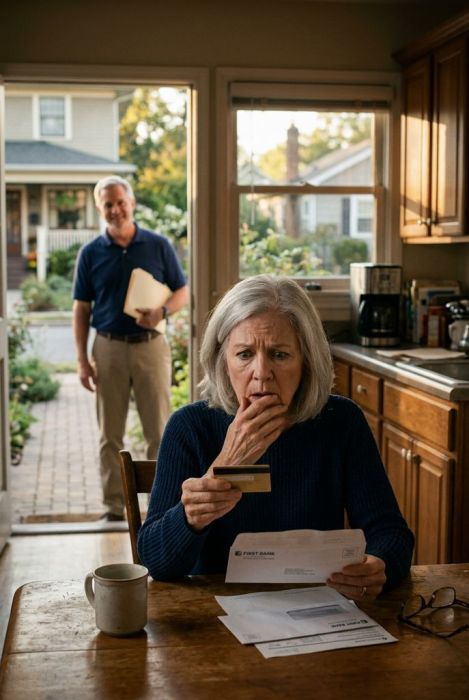
I thought it was a credit card at first. Somebody's lost wallet, maybe. I peeled the plastic off and turned it over, and the world went very quiet. It was a student ID card, laminated, the kind they give out at American high schools. The photo showed a girl with dark hair and a small birthmark above her left eyebrow. She was smiling just a little, the way teenagers do when they're humoring the camera. The name printed beneath the photo said Kelsey Porter. Lincoln High School. Dayton, Ohio.
The girl in that photo was the same girl I'd seen once, three years ago, in the upstairs window of the house next door.
I'd lived at 18 Wexford Lane for thirty-one years, and I'd seen a lot of neighbors come and go. My husband Frank passed eight years ago, and the house got quiet after that, but I liked quiet. I liked my garden, my book club, and the way Buddy flopped across my feet on cold nights. When the For Sale sign went up next door, I'll admit I was curious. The place had sat empty for a while, and the street was hoping for a young family with kids who'd fill the cul-de-sac with bicycles again.
The Brocks didn't have bicycles. They had a moving truck, a contractor's van, and a girl we never once saw.
Dale Brock was a big, easygoing man in his late forties who waved at everyone and fixed Mrs. Ortega's mailbox before she even asked. Cora was smaller, softer, always carrying something — a casserole dish, a bundle of herbs, a stack of old magazines she'd "finished with." They told the neighborhood that Dale did remodeling work, that Cora had been a teacher, and that their daughter Maya was being homeschooled because she was brilliant and sensitive and didn't do well in crowds. Allergies, they said. Migraines. Anxiety. The poor thing barely left her room.
And that was that. We're a friendly street, but we're not nosy, and nobody wanted to be the one who made the new family uncomfortable. So we smiled when Cora deflected, and we accepted that Maya Brock was a name without a face.
Except that I'd seen a face.
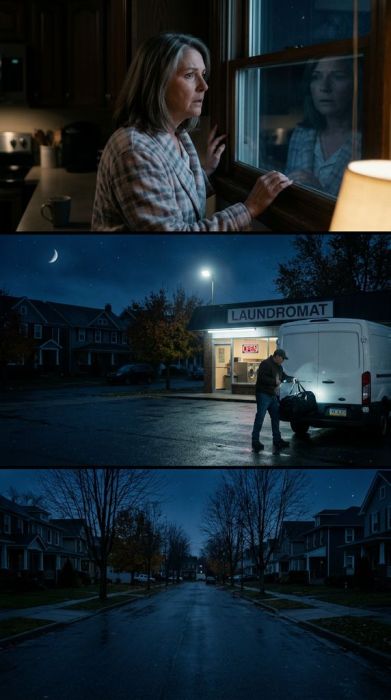
It happened in the first week. I was watering my roses, and I looked up at the house next door just as the blinds in the corner bedroom twitched. For one second, a girl's face appeared in the gap — pale, watching me — and then the blinds snapped shut. I remember thinking she looked too old to be a little kid and too young to be so locked away. And I remember the birthmark above her eyebrow, because it was the kind of detail you notice and then file away without meaning to.
I told myself it was just a shy teenager peeking at the new neighborhood. I told myself that for three years.
The little things were easy to ignore at first. The way Cora's eyes went hard if anyone asked about Maya's schoolwork. The way Dale's van came and went at odd hours, always with the back windows blacked out. The way the corner bedroom stayed dark during the day, light on at night, blinds always drawn. Once, I heard Cora call her "Maya" and then correct herself to "Emma," and when I mentioned it later she laughed and said she'd been talking to her sister's cat. I laughed too, because what else do you do?
But the night I found that ID card, I stopped laughing.
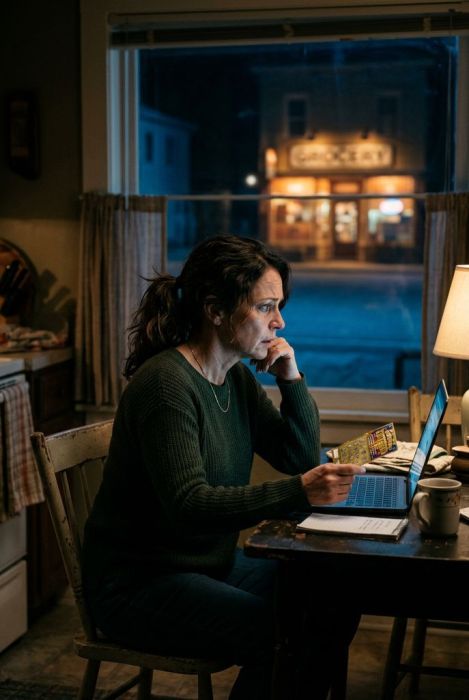
I went inside and sat at my kitchen table with Buddy's muddy discovery in front of me. My hands were shaking, which felt ridiculous, because an ID card is just an ID card. But I couldn't shake the feeling that I was holding something that belonged to a girl who wasn't allowed to exist. I turned on my laptop and typed the name into the search bar. Kelsey Porter, Dayton, Ohio.
The first result was a news article from six years ago. A twelve-year-old girl named Kelsey Porter had vanished from a park near her home in Dayton. No witnesses, no leads, no trace. Her mother, Dana Porter, had pleaded on television for anyone with information to come forward. The case went cold. The article had a photo — a twelve-year-old with dark hair and a birthmark above her left eyebrow.
I closed the laptop and sat in the dark for a long time. Then I called the one person I knew would take me seriously: Hank Kowalski, two doors down, retired county detective and the closest thing this street has to a guardian angel.
Hank came over that same night. He's seventy-two, built like a fence post, and he doesn't miss much. He looked at the ID, listened to my story about the window and the blinds and the corrected name, and he didn't laugh once. "Ruth," he said finally, "do you know what the statistics say about missing kids?" I didn't want to hear it. "The good ones get found," he said. "The lucky ones get found alive. But they don't get found if nobody looks."
Over the next two weeks, Hank worked quietly. He made calls, called in favors, and eventually put me on the phone with a detective in Dayton who had reopened Kelsey Porter's file. The detective sent me a picture of Kelsey's mother — a woman who had aged twenty years in six, who still kept her daughter's room exactly as it had been the day she disappeared. And she sent me the flyer, the official one, with KELSEY PORTER written above that same face.
I stared at the flyer until I knew every line of it. Then I did something that scared me more than anything I'd done since Frank died. I started watching the house next door.
Not the way you'd think. I watched with my eyes open, the way women of my generation learned to watch. I kept a little notebook in my apron pocket. Tuesday: van left at 9:14, returned at 4:40. Wednesday: blinds in the corner room opened a crack at dusk, closed at 7. Saturday: Dale carried groceries in, but the bag with the pharmacy label went straight upstairs. The pharmacy bag was the detail that nearly broke me, because I remembered Cora saying Maya had everything she needed and never left the house.
The Brocks must have felt the change in the air. One evening Dale came over with a six-pack, all smiles, leaning on my fence. "Heard your dog's been digging up your flower beds," he said. "Anything good down there?" I told him it was an old bone, probably a raccoon's, and that Buddy was a menace and I loved him anyway. Dale laughed and said the same thing happened at his place, and then he looked at my house for a beat too long, like he was measuring it.
The blinds in the corner bedroom twitched while we talked. Somewhere behind that glass, a girl was watching a man pretend he didn't know her real name.
The call came at 5:40 on a Thursday morning. Hank's voice on the phone, low and steady: "They got the warrant, Ruth. They're moving in twenty minutes." I sat up in bed with my heart slamming against my ribs, and I told myself the same thing I'd told myself every morning for two weeks: don't you dare hope yet.
I didn't watch the raid on television. I watched it through my kitchen window, with Buddy pressed against my leg. Three unmarked cars and a county sheriff's cruiser rolled up without sirens. Men in windbreakers moved up the driveway of the house next door, the house with the perfect lawn and the lemon bars and the girl who never came out. There was no violence, no shouting, nothing like the movies. Just the flat, final sound of authority arriving.
The front door opened. Dale Brock came out first, in handcuffs, his face the color of old paper. Cora came out behind him, and for once she wasn't carrying anything or smiling at anyone. A detective led them to separate cars. I didn't feel triumphant. I felt hollow, the way you do when you realize how close a thing came to going the other way.
Then an officer walked to the back of a van, and the door opened, and a girl climbed down with a blanket around her shoulders. She was thin — thinner than any girl that age should be — and pale, and she blinked at the morning light like she'd forgotten what it looked like. She was alive. That was the first miracle.
The second miracle was Dana Porter. She came running across the wet grass before anyone could stop her, calling her daughter's name in a voice that cracked wide open, and the girl in the blanket turned, and the two of them held each other on the front lawn of the house that had been a prison. The whole street was out by then, standing in bathrobes and slippers, and nobody said a word. There was nothing to say. We had all lived next door to it for three years, and none of us had known a thing.
The officers found Kelsey in a finished room in the basement, behind a shelving unit that swung open from a hidden catch. The window in that room had been painted over from the outside. The detective told me later that the Brocks had taken her from a park in Dayton six years ago, raised her as their own, moved her across state lines when they got nervous, and started again every time someone got curious. She wasn't their daughter. She was their secret.
The charges were everything you'd expect — kidnapping, unlawful restraint, identity fraud, a federal count for crossing state lines. They pleaded guilty, both of them, and the judge read the sentence like he was reading a grocery list, and Dale and Cora Brock were led away to the part of the world where people like them belong. The house went up for sale. The street held its breath, then slowly started breathing again.
Kelsey went home to Dayton with her mother. The last time I saw her, she was standing in my doorway in a yellow sundress, holding flowers, with Dana beside her. She hugged me so hard I felt her ribs. She said Hank and I had saved her life, and I told her no — she saved it herself by surviving, by keeping herself alive long enough for someone to finally look.
We still talk, Dana and I. Every few weeks my phone rings and it's her, or Kelsey — she's eighteen now, graduated, the whole senior class cheering for her at the ceremony. She sends me pictures of her room, which is no longer the room of a girl who vanished, but the room of a girl who came home.
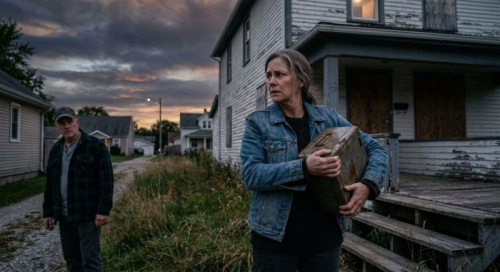
I used to believe the scariest houses in America were the abandoned ones, the ones with the sagging porches and the boarded windows. I don't believe that anymore. The scariest houses are the ones that look exactly like yours — the ones with the welcome mats and the fresh mulch and the friendly neighbor who brings you lemon bars. I walk Buddy past that house every evening now, past the new family with the bicycles, past the open windows and the voices of kids playing in the backyard. And every time, I say a small, quiet thank you to a beagle who wouldn't stop digging.