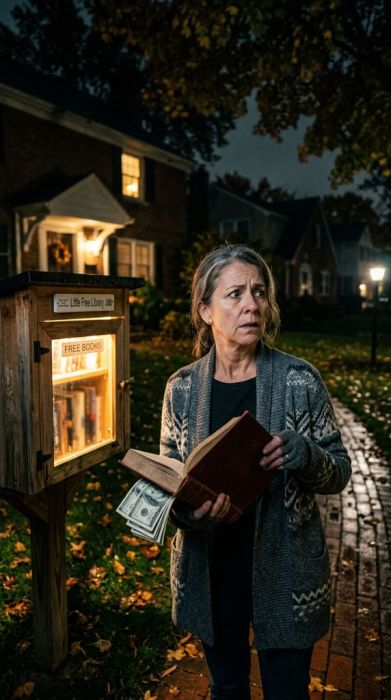
The morning the gold card arrived, I was standing at the end of my own driveway in my slippers, staring at an envelope that felt heavier than a single piece of mail had any right to. It was addressed to Roy Marsh. My husband had been dead for nine months and four days. In the upper corner, in crisp blue type, sat the name of a bank I had never once used in my life.
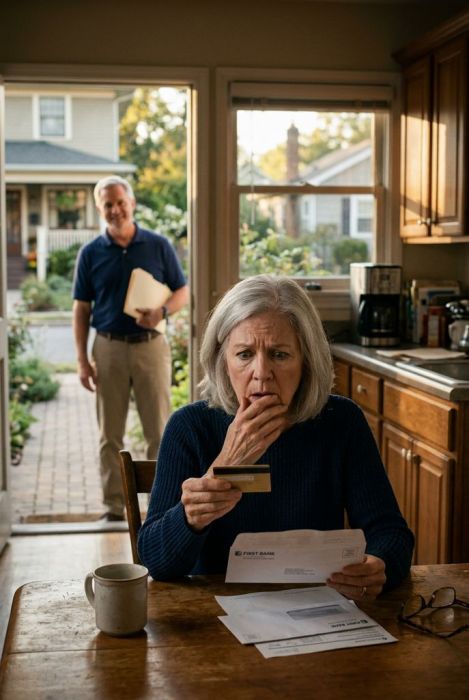
I hadn't opened a new credit card since 2011. I hadn't asked for this one. And when I finally slid my thumbnail under the flap — standing right there in the cold, because my feet simply wouldn't carry me back inside — I found a gold card embossed with Roy's name and a spending limit printed in the corner that made my stomach drop. Fourteen thousand dollars. For a man the county had buried back in March.
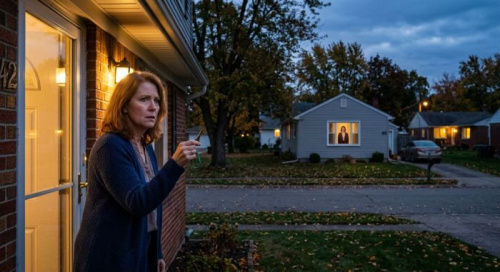
I sat down on the porch step and did what I do now whenever something doesn't make sense. I looked down the street. I looked at the house two doors down, at the tidy gray pickup in the driveway and the little sign by the front walk that read, Peyton Notary & Estate Services — We Handle the Hard Parts.
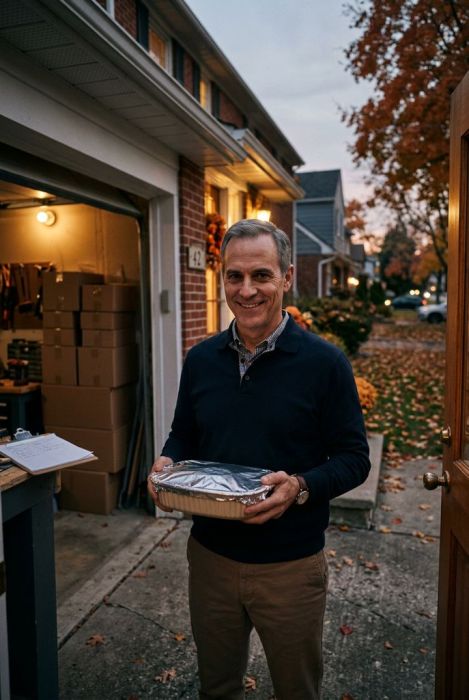
Vince Peyton had been our neighbor for eleven years. He was fifty-six, soft-spoken, with the kind of easy grin that made people hand him their troubles before they'd even asked. He ran his business out of a converted garage office with a good coffee maker and a leather chair, and whenever somebody on Wren Hollow Court lost a spouse, Vince was usually at the door before the flowers arrived.
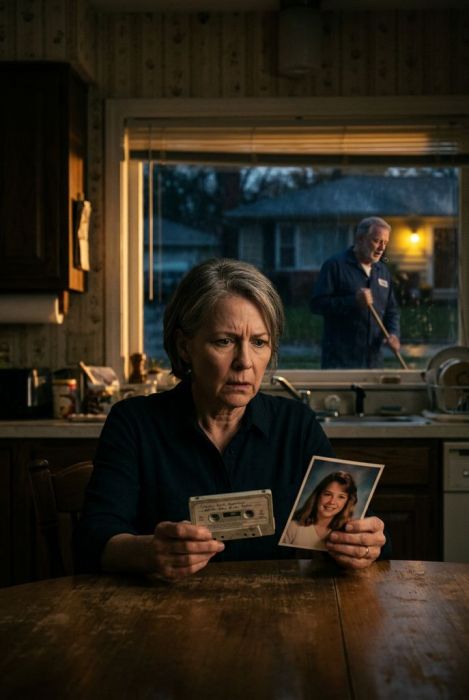
When Roy died, Vince was the first person to show up. He brought a casserole I never managed to eat and a manila folder he called "the boring stuff." He sat at my kitchen table and told me I didn't have to face any of it alone. Death certificates, bank notifications, the mail-forwarding forms — he'd take care of everything. Free of charge. Neighbors help neighbors, he said, and he patted my hand the way you'd pat a child's.
I let him. God help me, I let him. I was sixty-one and I had just lost the man I'd slept beside for thirty-eight years, and Vince was the only voice in my house that sounded calm. He became a fixture. He showed up on Tuesday mornings with nothing but a smile and an offer to run my errands. He was the one who volunteered to collect my mail when I drove to my sister's in Ohio. He was the one who offered to "shred the sensitive documents for free," so I wouldn't have to worry about identity thieves — and he said it jokingly, as if the very idea were ridiculous.
Looking back, the clues were everywhere. Vince knew Roy's Social Security number before I could find it in the files. He knew the date on the death certificate without ever being handed a copy. He was never, ever in a hurry to leave.
That night I called the number on the back of the gold card. The woman on the line was patient and professional, and after six minutes of security questions I couldn't quite answer, she told me something that made the kitchen tilt. The account had been opened three weeks earlier, online, "by the cardholder." A cash advance of $9,800 had already been taken out.
"Ma'am," she said gently, "has your husband misplaced his identification?"
"My husband," I said, "is in the ground." There was a long pause on the line, and then she told me, in the kindest voice I'd heard in weeks, to call the police and then the credit bureaus.
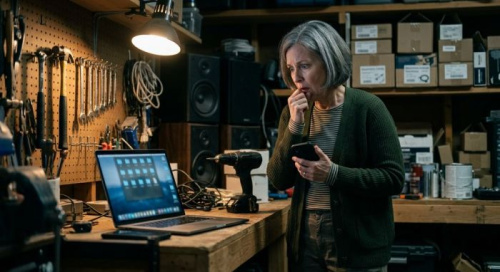
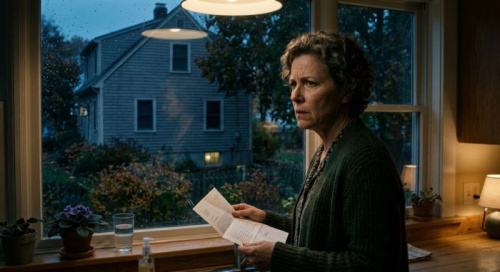
I didn't sleep that night. I sat at the kitchen table with every piece of mail I could gather and began to sort. That's when I found the second thing: a billing statement from a big-box hardware store, addressed to Roy Marsh, for a riding mower and a set of cordless tools I had never once seen in my garage. Two thousand one hundred dollars, charged five weeks before. And then a third envelope, folded into the stack as if it had been waiting for me — a notice from a company I'd never heard of, thanking "R. Marsh" for a recent property inquiry.
Nobody buys a riding mower from a dead man. And nobody runs a property search on a man who's been gone nine months unless they're trying to build something out of his name.
The next morning, I walked two streets over to the little blue house on Alder Bend, where Walt Brennan lived. Walt was seventy-four, retired from the United States Postal Inspection Service, and Roy's oldest bowling partner. He had driven me to the funeral and then stood at the back of the church the entire time, because he said he couldn't sit still through it.
I handed him the envelopes without saying a word. Walt read them slowly, twice. Then he took off his glasses, laid them on the table, and said the sentence that changed everything.
"Diane," he said, "I worked these cases my whole career. When a person dies, their name doesn't. It just sits there — quiet and clean, waiting. And there's always somebody on the street who knows exactly how to pick that lock."
He explained it to me while the coffee went cold. They call it death-record identity theft, and it is one of the cruelest crimes there is, because it reaches straight into a family's worst moment and steals from it. The thief needs only four things: a name, a Social Security number, a date of birth, and a date of death. And all four flow through one place, over and over, in every household that ever loses someone. Paperwork. The one thing every grieving family hands to somebody they trust.
I thought about that manila folder Vince had carried into my house. The forms he'd walked to the county office "to save me the trip." The shredder he had promised to run everything through — the one I had never, not once, actually heard turn on.
Walt told me to pull my full credit report. What I found there took the breath out of me. In nine months, my dead husband had apparently opened three credit accounts, leased a storage unit, and applied for a home equity line on a property that had never been his. To the world, Roy Marsh had been very busy since March. To me, he was a man who had left his breakfast dishes in the sink the morning his heart stopped.
We didn't go to the police first. Walt wanted proof that pointed in a single direction, and he wanted it the quiet way. So he taught me a small trick that I'm still proud of. He had a friend at the county records office print a "certified" copy of an estate notice on official-looking paper, and we mailed it to the address on the credit application — which was, of course, mine. Only this copy carried a faint watermark, invisible to the eye but perfect on a photocopier. Then we waited. Three days later, Vince Peyton walked out of his garage office with a stack of papers and drove straight to the copy shop, where he ran every page through the machine while Walt sat parked across the street and watched.
I confronted him the only way I dared — softly. I asked him, over the low fence between our yards, whether the mail had ever gotten confused around the time Roy passed. Vince went very still. Then he laughed, and offered to "handle the whole credit card mess" himself, because it was "probably just a mix-up," and he'd "hate for me to worry." That was the moment I knew. A good neighbor offers to help you carry boxes. He doesn't offer to bury the evidence.
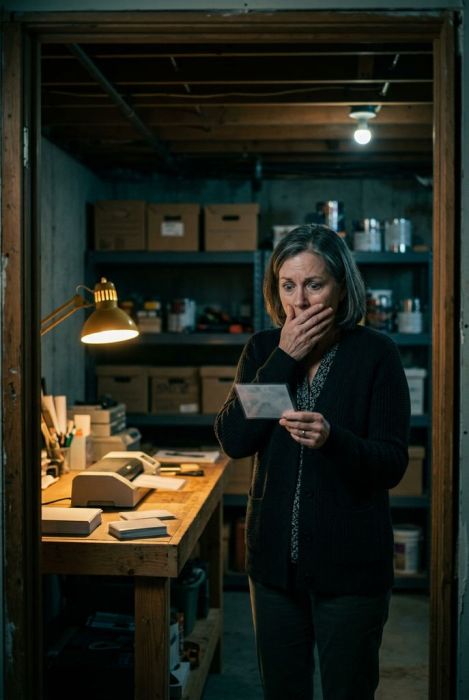
But the thing that finished it wasn't the mower or the storage unit or the gold card. It was the day I offered to help Vince clean out his office. He'd told the whole street he was "reorganizing," and I said, neighbor to neighbor, that I'd come carry boxes. His filing cabinet was locked. It should have been enough for me to turn around and walk out. Instead, I waited until he stepped into the backyard to take a phone call, and I opened the drawer with a butter knife from his own break room — the same knife I'd used a hundred times to spread cream cheese on the bagels he brought to every block party.
Inside were folders. Dozens of them. Every folder was a person. Every person was someone from our street, or the next one over, who had died in the last four years. There was Mr. Alvarez, who used to wave from his porch every single morning. There was sweet Norma Fenwick, who made the applesauce for every funeral. There was a folder for every name I'd ever seen printed in the church bulletin on the week of a burial. And near the front, in a plastic sleeve, was one that read MARSH, ROY — with his date of birth, his Social Security number, the date he'd died, and, in Vince's small, tidy handwriting, a sticky note: CARDS OPENED. LINE PENDING. WATCH THE WIDOW.
I stood in that garage and I could hear Roy's voice in my memory, and I think I aged ten years in ten seconds.
Walt took my photographs straight to the Postal Inspection Service. What happened next, everyone on Wren Hollow Court heard before they understood it. On a Tuesday morning in October, three unmarked cars pulled up to Vince Peyton's tidy gray house. Two officers knocked on the door. Neighbors stood in their yards with their hands over their mouths as the man we'd all called a blessing was led out in handcuffs, still wearing that easy smile.
They carried seventeen boxes out of that converted garage. Seventeen. Some families on our street only learned that afternoon that their mothers and fathers and husbands had been robbed from the grave — and some of them, God forgive us, had never had anyone watching out for them at all.
The prosecutor said Vince had been at it for years. It started, they believe, with his own aunt's estate — an easy thing to fudge when you're the one holding the papers. From there, it became a business. He picked his clients the way a fisherman picks a quiet pond: older widows and widowers, people alone, people trusting. He opened accounts, took cash advances, bought tools he resold, and once, they said, tried to stitch together a false identity clean enough to carry a mortgage.
When the judge asked him why, Vince talked about debt — a boat he couldn't afford, a gambling habit that had grown teeth. But then he said something that stopped the whole room. He said he'd spent a decade caring for his own difficult father, and he'd watched other people inherit houses and savings while he got nothing but the exhaustion. Somewhere in there, he decided the world owed him. He just found the cruelest way to collect.
Roy's name was on his list, and mine was right underneath it, circled. What stopped him, I believe, was nothing more than a gold card that came to the wrong address — and a woman in slippers who finally got curious.
Vince Peyton pleaded guilty to identity theft and mail fraud. He lost his notary commission and the business that had paid for his fishing boat and his winters down in Gulf Shores. The court ordered him to pay restitution to every family he'd robbed, a debt that will follow him for the rest of his life. And he was sentenced to prison — led away in a white county van while our street watched in silence, no longer smiling for anyone.
It took me five months to untangle Roy's name. The bank, the credit bureaus, the county — I called every one of them, sometimes twice, and I kept every confirmation number in a little spiral notebook I still have. When the last fraudulent account was finally closed and a letter arrived confirming that my husband's record was clean again, I sat out on the porch and cried, and for the first time they weren't only sad tears.
Walt and I walked the block one Saturday and knocked on every door we'd once waved across. We left a one-page sheet — no scare tactics, just quiet facts. When someone you love dies, freeze their credit. Notify the credit bureaus. Ask who is actually handling the sensitive pages, and ask to see them shredded with your own eyes. Help the person next door, but never, ever hand your trust to a friendly face without also watching where it goes.
Our street came in closer after that, the way people do when they find out something bad lived two doors down and nobody saw it. We started a phone tree. We started asking each other the names of our dead, out loud, the way you're supposed to.
There's a rose bush by my front walk that Roy planted the spring before he died. It isn't much — two stubborn canes and a single bloom that only shows up when it feels like it. But it came back this year. And I stood in the very same driveway where I once read a dead man's name on a gold envelope, and I looked down the street at Vince Peyton's empty office window, and I thought: I caught him.
I caught him because I didn't stay quiet. Because I didn't let a calm voice tell me what to do with my own husband's name. Roy deserved better than to be a folder in somebody's cabinet. Now he's just a man with a stubborn rose and a wife who finally understands that "we help each other" is not a promise you make without watching where your trust goes.