I was carrying a tray of coffee into my own living room when the newest woman on Aspen Court called my husband by a name that lives behind a locked door in my heart.
"Danny-Bear, would you pass the cream?"
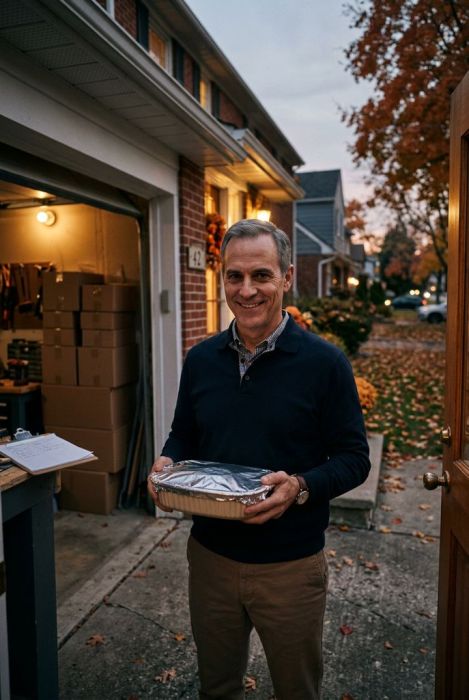
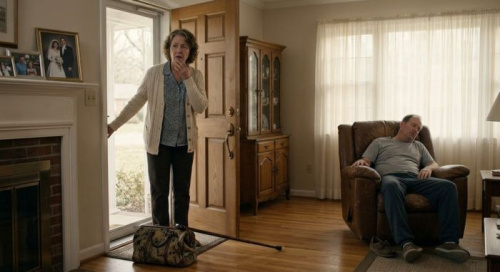
The six of us who make up the Thursday Book Club didn't even blink. Why would they? Carla Marsh had lived at 31 Aspen Court for six months by then, and she had settled into our street the way cream settles into coffee — easily, naturally, as if she'd always been there. But Dan's hand stopped above the sugar bowl. He glanced at me, then at her, then back at me, the way a man looks when he's certain he misheard.
I had not misheard. No one calls my husband Danny-Bear. Not his mother, eleven years gone. Not our daughter Becca. Not his brothers, who would chew glass before they'd say it. That name is something I whisper when the world has been unkind to him — the night we lost our first baby, the morning our son TJ shipped out, the day Dan's father died. It lives in our house and nowhere else.
Carla smiled at me over the rim of her mug, and her smile was so warm, so familiar, that for one dizzy second I wondered if I had said it myself.
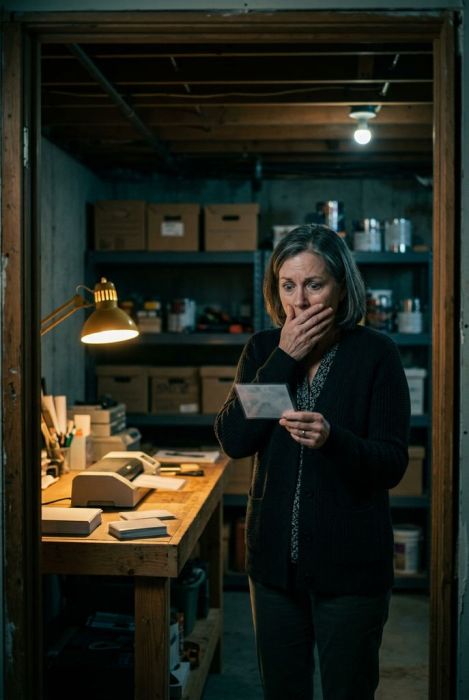
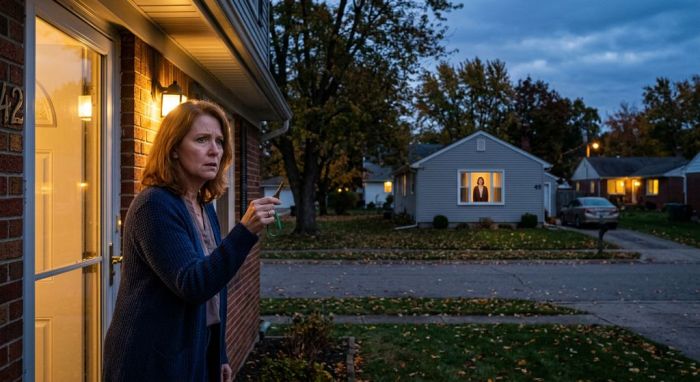
Three days later I stood in Carla's kitchen returning a casserole dish, and I found the answer hanging on a hook by her back door. A brass key with a green rubber band around its neck — my green rubber band, the one I'd wrapped around my spare key years ago so I could find it in the dark. The spare I kept buried in a fake rock beside my hydrangeas.
Her key rack was full of keys. That one was mine.
I didn't say a word. I drove home with my hands shaking on the wheel and stood in my own hallway, listening to my own house, feeling like a stranger in it. Carla had been inside. Not once — many times. And every version of the last six months I had built in my head came apart at the seams.
You have to understand what our street was like before her. Aspen Court is eight houses on a cul-de-sac in a Columbus suburb, the kind of place where the mail carrier knows your dog's name. Dan runs a heating-and-cooling business he built with his own hands. I retired early from the county library after thirty years of shelving other people's stories. We raised two kids here, buried a dog, planted a maple that now shades the whole front yard. It is a small, ordinary, precious life. I had never once thought of it as something someone might want to take.
Carla moved in the spring, into the pale gray rental house that had sat empty for a year. She arrived with two suitcases and a rescue cat and a story about a divorce that had left her with nothing. Within a month she was everyone's favorite. She baked. She remembered birthdays. She volunteered at the food pantry. She joined my walking group and my book club and the committee that hangs the flags on the veterans' graves. My neighbor Vivian, who has never trusted anyone under sixty, said Carla was "a dear." Even Dan liked her, and Dan doesn't like most people.
The copying started so small that I might have imagined it. A compliment on my haircut in April — and by May her hair was the same shoulder-length auburn, the same soft waves. A comment on my perfume, the lavender one I've worn since 1998, discontinued and bought in bulk off eBay — and then that summer the exact scent trailing behind her at the farmers market. She bought a car the same shade of forest green as mine. She started saying "well, shoot" the way I say it. "Bless his heart" the way I say it. My daughter noticed before I did.
"Mom," Becca said during one video call, squinting at the screen, "why does your neighbor have your hair?"
I laughed it off. Imitation is flattery, I told her. Becca didn't laugh.
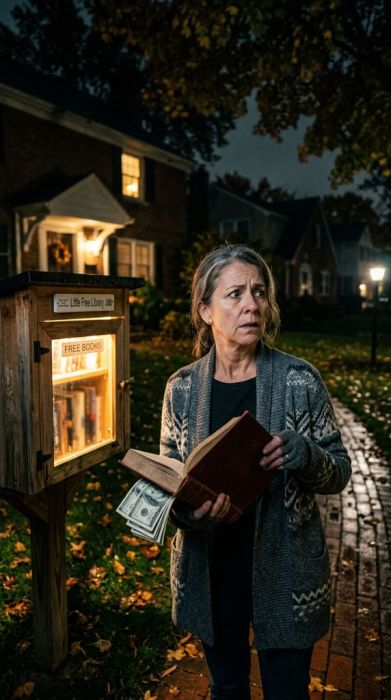
The strange things piled up like snow. My mother's cameo brooch vanished from my jewelry box the week after Carla admired it at a cookout. The anchor wind chime Dan made me for our anniversary disappeared from the porch. A bundle of my old family photograph albums — the ones I'd donated, years ago, to the county library's local-history archive — turned up displayed on Carla's coffee table, which she explained away with a shrug and a laugh: "I'm such a history nut, I must have bought them at a yard sale."
Then, in September, my sister Diane called from Cleveland, unsettled.
"I saw you yesterday at the grocery store," she said. "In Worthington. With a man I've never met. I waved, and you looked right through me like I was a stranger."
I hadn't been in Worthington. I'd been home all day with a cold.
I sat down at my kitchen table and made a list, and the list made me cold. There had been a charge on my card for a salon two towns over, on a day I hadn't left the house. A census envelope with my name on it had arrived at Carla's address. Vivian had sworn to me that she'd seen "me" standing on Carla's porch one evening, and had called out a greeting — and Carla had answered in my voice, "Oh, just me, Viv, borrowing a cup of sugar," before the door closed.
I went across the street to Art Kowalski's house. Art is seventy, a retired Columbus police detective whose wife died four years ago; he spends his mornings on his porch with coffee and a crossword and sees everything on this street. I told him everything. He didn't laugh. He wrote notes in a small green notebook the way he must have done for thirty years, and at the end he looked at me and said the sentence that changed my whole autumn.
"Lynn, I've been watching that woman since July," he said. "And honey, the name 'Carla Marsh' belongs to a woman who's been dead since 2009."
What Art found over the next two weeks, quietly and through old favors and public records, turned my quiet neighbor into something out of a nightmare. "Carla Marsh" had a Social Security number belonging to a deceased woman from Youngstown. "Carla Marsh" had no work history, no credit, no past — nothing before eight years ago. But before "Carla Marsh," there had been a woman named Claire Dawson in Kalamazoo, Michigan, who had spent four years quietly devoting herself to another family, another woman — a nurse named Teresa, whose hair she copied, whose church she joined, whose mailbox she opened. It had ended when Teresa went to the police. Claire's request? She had wanted to be closer — to live inside a life that looked better than her own. A judge had signed a stalking protective order. Claire left town, changed her name, and found us.
She had found me because I was soft, and settled, and happy. She had found me because I was easy to love and easy to fool.
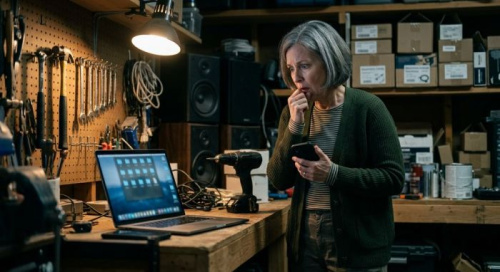
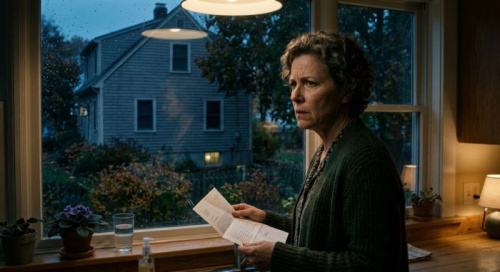
The rest of what we learned I keep in a folder now, and I open it only when I need to remind myself that I was not crazy. Because in October, after I quietly had my locks changed and a small camera installed above my kitchen window, I understood the truth. Carla had been watching us for months — photographs taken through the windows of our home at night, dozens of them. Copies of our mail. My old check stubs. A printout of my mother's obituary, folded in the pocket of a coat. And a single sheet of paper in her neat handwriting: a schedule. When Dan leaves for work. When I walk the dog. When the house on Aspen Court is empty.
I went to the county sheriff's office with Art's notes and my folder. A young deputy, a woman named Ruiz, listened to me for two hours without once telling me I was imagining things. What I hadn't known until that day was that the protective order from Michigan was still active, and that Claire Dawson had never once checked in with her probation officer. She'd been a wanted woman for eight years — and she'd been living in a stranger's name, across the street from me, pointing a lens at my kitchen.
Now I am not a brave person by nature. I am a woman who alphabetizes her spices and cries at the national anthem. But when Deputy Ruiz asked me, gently, whether I was willing to give them a trap, I said yes so fast I startled both of us. Together we built one.
The Thursday Book Club came to my house one last time in November. Six women, tea, cake, the usual chatter. I wore a thin recorder pen in my cardigan pocket, loaned to me by Becca's husband, who is a state trooper. And when the others drifted to the dining room to look at the new books, I sat down beside Carla and asked her, plainly, about my mother's brooch.
She smiled at me — that warm, borrowed smile — and for a moment the mask slipped, just at the corner.
"You know," she said, softly, as if we were old friends sharing a secret, "Danny-Bear only stays because he's loyal. He told me so himself. You've gotten comfortable, Lynn. You don't deserve the life you have. Someone should take better care of it." She reached over, and she touched my sleeve, and her voice dropped. "I'd take very good care of it."
I kept my face still. I thought about the maple tree and the wind chime and the name I whisper when my husband is hurting. I thought about how close I'd come, again and again, to swallowing my own instincts to keep the peace.
Then I lied to her, beautifully. I told Carla — and later, casually, to the walking group, loud enough for her to hear — that Dan and I were driving to Hilton Head for our anniversary the following weekend. That the house would be dark and empty.
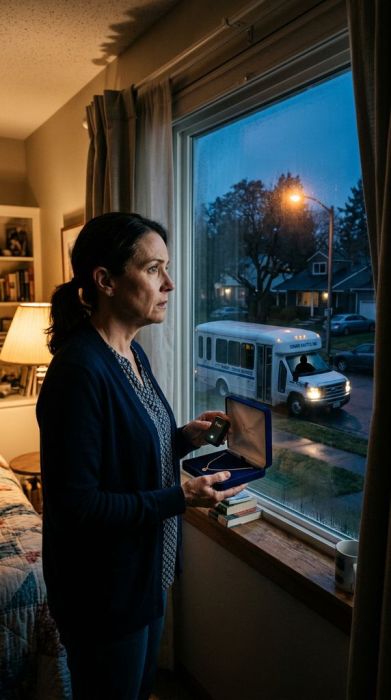
It was not empty. Dan stayed in the house. Deputy Ruiz and two other officers waited in an unmarked car on the corner, and Art watched from his porch light with a cup of coffee gone cold. At eleven forty on Saturday night, Carla Marsh walked up my driveway with a brass key in her hand — my key, the green rubber band still around its neck — and let herself into my house.
She got three steps into my kitchen. Then the lights came on.
I watched from the hallway, my heart pounding so hard I could feel it in my ears, as she turned and saw what she had never imagined: her own reflection in the dark window, framed by the backs of four people who were not afraid of her anymore. She didn't scream. She just looked at me, across the room, with something worse than anger — a kind of hurt, as if I had broken a promise I never made.
They found the key in her hand. They found the folder in her car, and the camera, and the list of our windows. I won't repeat everything the deputies pulled from her trunk, because this is a family story and I don't want to put that in your mind at your own kitchen table. I will only say that when Deputy Ruiz later described it to me — quietly, in her office, with a hand on my arm — I understood how narrowly we had walked a line, and I felt the floor of my ordinary life below me for the first time in months.
Claire Dawson went to trial that spring. Identity theft. Aggravated burglary. Menacing by stalking. Violation of a protective order she had never once respected. The court heard from Teresa, the nurse from Michigan, who flew in to testify, and stood beside me in the hallway afterward and cried and hugged me like a sister. Claire's lawyer talked about her childhood, her loneliness, her lost custody, the husband who had left her for someone else. The judge listened with real patience. Then he gave her six years, and told her the only thing I think she ever truly needed to hear: that you do not get to take another person's life because yours went wrong.
They returned my mother's brooch. They returned the wind chime, the albums, the little things I had grieved in silence because they seemed too small to make a fuss about. Fussing, as it turns out, is exactly what saves you.
The house at 31 Aspen Court got a new owner and a row of cameras by the door. Vivian still walks with me, and tells everyone who will listen that she knew all along. Becca came home for Thanksgiving and put a deadbolt on our front door herself, and did not say I told you so, which I love her for. Art Kowalski and I have coffee on his porch most mornings now, and he has started a little neighborhood safety circle, nine houses wide — the kind of place where if a car idles too long, four phones light up.
And me? I keep my spare key in my own pocket now, where it has always belonged. I have learned to trust the small voice that says something is wrong, even when the whole street is saying how sweet and how generous and how kind. I have learned that the most dangerous neighbor is not the one who scowls at you over a fence. It is the one who smiles too long, and agrees too much, and studies you like a door she is planning to open.
Our maple is bare now, and the days are short, and my husband still calls me the name he has called me since we were twenty-three. At night, when the house is dark and quiet and ours, I lock the door, and I listen to nothing, and nothing is exactly what I hear. There is no brass key on my mat. There is no woman at the window.
It is the sweetest sound in the world.