The first time Dean Purcell fell in my driveway, I ran outside in my slippers with a bag of frozen peas pressed to my chest and a heart full of guilt.
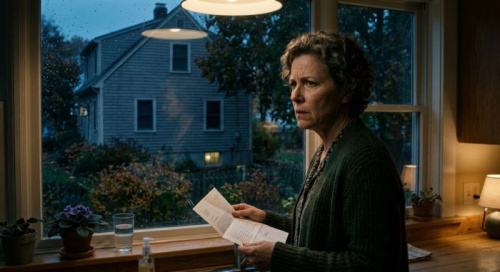
It was a Tuesday in late September, the kind of soft gray afternoon in Bellehaven, Ohio, when the maples go gold and everybody pretends they can't feel winter coming. I was at the kitchen sink — the window where I still half-expected to see my late husband, Walt, coming up the walk with the mail — when I saw Dean go down hard on the concrete I'd been meaning to have repoured.
He lay there in a clean polo shirt, one leg twisted, his palm pressed to his lower back. "Oh, Lord," he groaned. "Oh, Lord, Janice, don't move me."
I didn't move him. I knelt beside him and apologized — for the driveway, for the slope, for the crack in the seam where the frost had worked in. Fourteen months after losing Walt, I was a woman who apologized for concrete.
Dean had been the best neighbor a widow could ask for. Fifty-eight, divorced, "retired" from something vague in safety compliance, he had a gift for appearing exactly when a person needed him. After Walt died, Dean trimmed my hedges unasked. He fixed the gutters. He brought lasagna the week of the funeral and again the week after, and when my son, Ethan, said, "Mom, that's the same lasagna," I told him to hush. Kindness is kindness.
So I took his fall like a coat someone handed me. I called the ambulance. I rode with him to Mercy General. I sat in a plastic chair for three hours while they X-rayed a back that, I would later learn, had been X-rayed many times before.
The lawsuit arrived eleven days later, in a manila envelope with a Columbus law firm's name embossed across the top. Dean was suing me for four hundred thousand dollars, and he was asking the court to place a lien on my house — the house Walt and I bought in 1988, the house where we raised Ethan, the house I had just finished paying off the spring before Walt died. My driveway, the complaint said, was "a known and foreseeable hazard." I had "willfully neglected" it. Dean had suffered "catastrophic and permanent injury."
I read it at the kitchen table with shaking hands. Then I read it again, and something colder than grief moved through me, slow as a draft under a door.
Because that driveway had never tripped anyone. And Dean — Dean who had walked those hedges with a trimmer for an hour the day before the fall, Dean who had jogged up my porch steps that same morning to hand me a misdelivered package — had gone down like a man who'd practiced.
I told myself I was being paranoid. Grief does that. It makes you suspicious of kindness because kindness was the thing that left.
But suspicion is just a mind doing arithmetic it doesn't want to finish.
The first thing that didn't add up was the witness. A young man named Theo Marsh, who lived three streets over and had never spoken to me in my life, swore in a signed statement that he'd seen me "ignore a visibly broken walkway" and that he'd watched Dean fall "from across the street." Ethan pulled up the neighborhood on satellite and frowned. "Mom, from where he says he was standing, you couldn't even see your driveway. There's a hedge."
The second thing was Grady Ruiz. Dean introduced him as his physical therapist, a slim young man in scrubs who began visiting Dean's house every single day, always carrying a black briefcase, never a gym bag. Once, while I waited at Dean's screen door with a get-well casserole he hadn't asked for, I heard Grady's voice through the mesh, low and businesslike: "Get the file to Hollings by Friday. Don't email. Bring it." Then footsteps, and the briefcase snapped shut, and Grady came out smiling so wide it looked borrowed.
The third thing was the notebook. But I'll get to that.
Because for six weeks, I lived inside a machine built to squeeze me. My insurer, a patient woman named Ms. Okafor, called to say Dean's claim was "complicated." My premium would rise. A settlement might be cheaper than a trial, she hinted — but something in her voice told me she'd seen him before. A lien on the house, the complaint said. My neighbor, the man who bragged about his burgers at the block party, wanted my home.
Dean never acted angry with me in person. That was the strangest part. He'd wave from his porch. He'd leave a note in my mailbox — "Thinking of you, neighbor" — in the same week his lawyer was demanding I disclose every penny I had. He brought another lasagna. I finally understood Ethan's joke: it was always the same lasagna, the same frozen tray, the same cheap foil — and I had been so hungry for kindness that I'd eaten it and thanked him.
The bitterness came when I pressed him. On a bright October morning I walked over and asked, plainly, why.
Dean leaned against his doorframe and smiled the way you smile at a slow child. "Now, Janice, be fair to yourself. You neglected your property. A person gets hurt. There are consequences." He glanced at my house. "You don't need all that space anymore anyway. It's a lot for one widow."
That word — widow — came out of his mouth like a tool he'd measured me with.
I went home and locked the door, though it was eleven in the morning and the sun was out.
Then, on the second Sunday of October, I found the notebook.
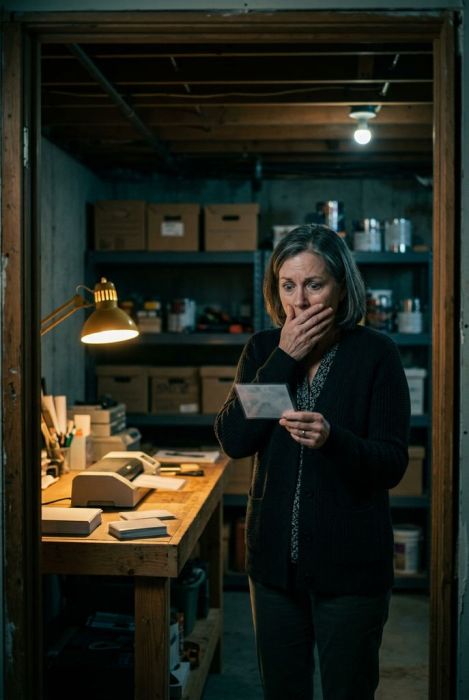
Dean had borrowed my wheelbarrow to move a load of old flagstone, and he returned it — as he always returned things — with the kind of generosity that asked for nothing on its face. But he'd left a canvas jacket on the handle, and when I lifted it, a small spiral notebook slid out of the pocket onto my garage floor. I meant to run it over to him immediately. I swear I did. But it fell open, and I saw my own name.
Janice H. — Aster Ln. Fall 9/23. Back. Photos: T.M. (witness). PT: G.R. Med $$: 12k est. Insurance: Statewide. Target settle: 150-250k. Asset: paid-off home. Timeline: push hard.
Below me on the page were other names. Ruth Alvarez — Birchwood. Slip, wet floor, bath. Settled 90k. Gerald Pines — widower. Fall, porch. Dismissed — deceased. Corinne Bode — widow. Trip, curb. Settled 140k. On and on, a tidy column of the old and the lonely, each with a number beside it like a price tag on a jar of preserves.
My hands were so cold I could barely turn the pages. There were dates, initials, dollar amounts, and notes — "cry in depo," "get neighbor to testify," "find prior injury." And on the last used page, in a different pen, a heading simply reading QUEUE. Six names beneath it, including mine, including two others right here on Aster Lane.
I stood in my cold garage for a long moment. Then I did the arithmetic I'd been avoiding. Dean Purcell wasn't a man who fell. He was a man who sold falls. He had turned the neighborhood's widows into an inventory, and I was his next product.
I thought about the black briefcase. I thought about Grady Ruiz with his borrowed smile. I thought about Theo Marsh and his impossible sightline. It wasn't one predator. It was a little company, and it had been running for years, and it had picked the softest targets it could find — people like me, who'd apologize for concrete.
Now, I want to tell you I marched straight to the police. I didn't. I did what a frightened woman of fifty-nine does at first: I sat with it, and I shook, and I called my son.
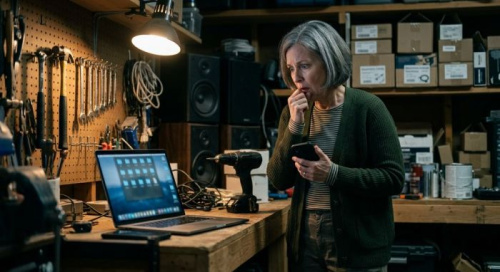
Ethan told me to photograph every page before I did anything. So I did — every name, every number — standing under the garage light like a thief, my phone humming as it copied a stranger's ledger of other people's ruin.
Then I called the one neighbor I trusted with something this ugly: Sal Moretti, two doors down.
Sal was seventy-four, retired, and famously tight-lipped. What most of Aster Lane didn't know was what he'd retired from. Sal Moretti had spent thirty-one years as a special investigator in the insurance fraud division of a major carrier. He was the man they sent when a claim smelled wrong. He'd told me once, over iced tea, that the easiest fraud had nothing to do with technology. "It's the soft claims," he'd said. "The elderly, the grieving, the ones who pay up because they can't face a courtroom. The kindest, gentlest victims there are."
I showed him the photographs on my phone, and Sal Moretti's tired face went hard in a way I hadn't seen before.
"I know this pattern," he said quietly. "Columbus had a crew like this. A capper friends a mark, stages a fall, brings in a fake witness and a fake therapist to inflate the medicals. Then they file and squeeze. There was a claims runner who took the files to different offices so nobody connected them." He tapped the screen, at the initials G.R. "That's the runner. He's been pumping claims through half the county."
"They almost took my house, Sal."
"They will take your house," he said, "unless we're smarter than they are. And we can be. I spent thirty-one years being smarter than men like them. I just had to retire to find one living next door."
That was the night the power flipped. Nothing about my situation changed — the lien request was still on file, the trial date still circled on my calendar. But I stopped feeling like prey. Sal had me call Ms. Okafor at Statewide and ask, carefully, for the claim to be routed to the Special Investigations Unit. Then he made a call of his own, to a former colleague he trusted. And he told me that what we'd need most of all was proof that Dean wasn't hurt — and proof that he was still collecting.
So we gave him a reason to work.
It was Sal's idea, and it was elegant. We put a discreet camera in my porch light and a second one across the driveway, mounted low in a birdhouse, both small enough that Dean — who never actually looked at anything except value — wouldn't notice. Then I did the hardest acting of my life. I let myself look beaten.
I asked Dean to come over. I let my shoulders slump. I told him the settlement was more than I could afford, that the insurance wouldn't cover the lien, that I might lose the house Walt and I had raised our children in. I let my voice break on Walt's name.
Dean Purcell swallowed it like gospel. He got warm. He got helpful. And he made one mistake.
"You know," he said, standing in my kitchen with his coffee, "a lien like that — there's a way to make it go away. Some neighbors handle it privately. Cash, quiet, no court." He leaned in. "Let me talk to my guy. We could clear this up for a much smaller number. Say, eighty. And we'd both walk away clean."
I kept my face soft and my voice steady, and I said the thing Sal had coached me to say. "Could you come Thursday? Look at the walkway again? I want to fix whatever hurt you, Dean. Really fix it."
He said yes so fast it made my skin crawl.
On Thursday, at two in the afternoon, Dean Purcell came to my driveway to perform. He didn't know that the walkway was watched from two angles, that behind my bedroom curtain sat Sal Moretti with a tablet, and that a plain sedan had parked at the end of Aster Lane twenty minutes early, holding two investigators from Statewide's SIU and a sheriff's deputy who owed Sal a favor.
Dean walked my walkway. Then he stopped, checked both directions, and — with the casual grace of a man who'd done it a hundred times — he lowered himself onto the concrete like a man settling into a hammock, arranged his leg, pressed his palm to his back, and began to practice his face. Anguish, then victory. He even laughed to himself, a small private laugh, and reached for his phone to call Grady Ruiz.
The deputy's boots on the concrete were the first sound he'd heard in years that he couldn't control. Dean looked up, saw the camera in the birdhouse, saw Sal Moretti walk out of my front door with a tablet in his hand, and understood — the way a man understands a foreclosure notice — that the arithmetic had turned.
"The claim's done, Dean," Sal said, almost gently. "But we've got the whole ledger. Every name. Every one of them."
Dean sat back down on the concrete. This time, it was real.
What happened next happened without me raising my voice once.
The special investigators matched Dean's notebook to files Grady Ruiz had carried across four counties. Ruth Alvarez, in Birchwood, who had nearly lost her home and been too ashamed to fight. Corinne Bode, who remarried and moved away. And two names on the QUEUE list right here on Aster Lane — a widower and a woman from the church, both of whom had quietly started asking, that same week, why Dean had suddenly begun offering to fix their porches.
The state charged Dean Purcell with organized insurance fraud, attempted theft, and a cluster of related charges. Grady Ruiz was charged as the claims runner. Theo Marsh, the false witness, folded first and testified for the state within a month. The Columbus attorney resigned his practice rather than face the ethics board, and I never had to sit in a courtroom to defend my driveway at all; the lien was withdrawn, the claim dismissed, the whole ugly machine unplugged.
Twenty-two months later, Dean Purcell was sentenced to six years and ordered to repay more than half a million dollars in past settlements. I read it in the paper at my kitchen table — the same table where I'd first read his lawsuit — and I felt nothing dramatic. Not triumph, exactly. Just a quiet, settled sort of peace, like a storm finally moving east.
Ethan flew in to celebrate, though "celebrate" meant the two of us eating cold chicken and watching Sal win three hands of euchre with my dead husband's old deck. The house is still mine. Walt's chair is still by the window.
The driveways on Aster Lane are all getting repoured now, by the way — the whole street decided it was time, and we've made a project of it. Block parties, barrel-chested contractors, kids chalking the fresh concrete before it sets. I planted mums in the bed where Dean used to trim my hedges.
I don't tell people this story to scare them. I tell it because widows and widowers make up a market, and markets get exploited by people with warm smiles and frozen lasagna. I tell it because a slip-and-fall can be a business, and the friendliest man on the street is sometimes the one who keeps a ledger.
I tell it because the softest targets — the grieving, the older, the ones who apologize for concrete — are exactly the ones who've been taught, their whole lives, to be nice instead of careful.
So be careful. Document. Photograph. Call the investigator, not just the neighbor. And when someone too kind shows up right after your hardest season, accept the casserole if you like.
Just don't hand them your house.