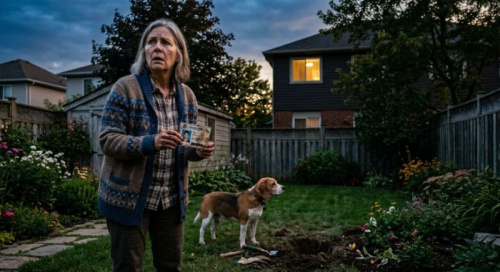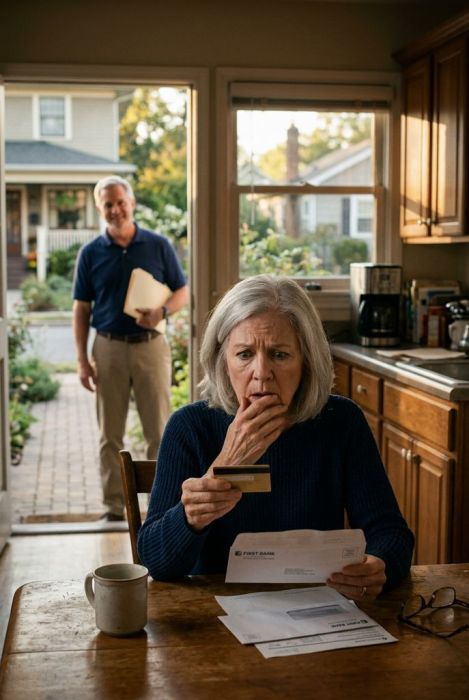
The first time Paul Delaney brought over his famous peach pie, my father said a name he hadn't spoken in fourteen years. "Ray."
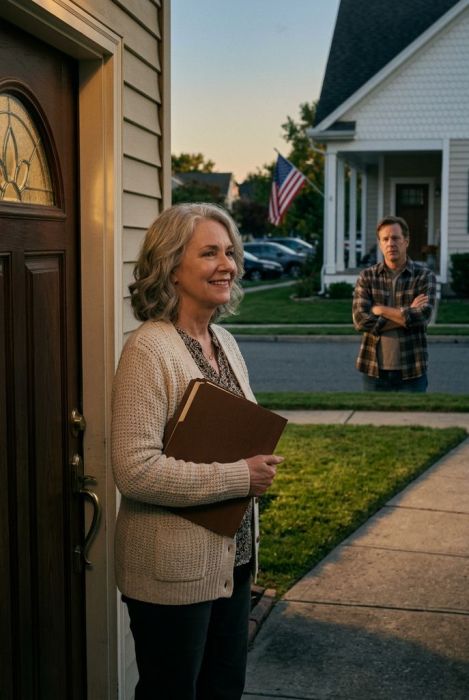
It came out clear as a bell — sharper than any word my father had managed since his stroke — and I nearly dropped the good plates. Paul just stood on my porch with that easy smile, the glass dish sweating in the June heat, steam curling off the crust.
I laughed and apologized. I explained that Walter Porter's brain sometimes grabbed the wrong names, that my father had been a draftsman with a sharp memory for blueprints and a weak one for people ever since the morning in 2010 when his body forgot how to work. Paul Delaney waved it off like it cost him nothing.
"He can call me whatever he likes, Ellen," he said. "Long as he enjoys the pie."
Dad did not enjoy the pie. He pushed the plate away and stared at the far window, his knuckles white on the arm of his wheelchair. I told myself it was just a bad day. It took me two more summers to understand that my father had never been confused at all.
I'm Ellen Porter, sixty-one years old, a retired school secretary who moved back into the house on Birchwood Lane the year my husband Dave died. The house needed a new roof, but that wasn't really why I came home. My father needed me.
Walter Porter built things. Thirty-eight years at the radiator plant as senior draftsman, and after my mother died in 2006, he handed his money to the one man on earth he trusted completely. Raymond Kowalski. Financial planner at Sterling Wealth Partners, downtown Oakmont, above the bakery that smelled like cinnamon every morning.
Dad and Ray were the kind of friends who fished the same lake, golfed the same course, and split a six-pack at the Legion hall every Friday night. "Ray's a straight shooter," Dad used to say, the way other men quote scripture. "Straight as they come, Ellen."
Then came 2009, and the straightest shooter in Oakmont turned out to be running one of the oldest cons in the book. When the FBI arrived downtown with a Ponzi indictment, Raymond Kowalski was already gone. House swept clean. Desk emptied. No forwarding address. He had taken four hundred and ten thousand dollars — most of it my father's retirement, the rest of it the life insurance payout my mother had left with a note inside the envelope.
"Live well, Walt," the note said. Dad could never bring himself to read it again.
He had his stroke four months later. The doctors blamed stress. I blamed Ray Kowalski, and I was never shy about saying so.
But blame doesn't feed a family. Dave got sick, and I drove him to appointments and held his hand through treatments, and then Dave died, and I came home to Birchwood Lane with two suitcases and a grief I carried like a second shadow. I learned how to feed a man who couldn't hold a fork, how to read the weather in my father's eyes, how to say "the plant called, they need you" when he got restless, even though the plant had closed in 2012.
Life on Birchwood Lane was quiet. The street is all older folks — Mrs. Alvarez with her roses, the Bells next door, and the Whitfield house at the end sitting empty for five years with a for-sale sign rusting at its edges.
Then, two summers ago, the Whitfield house sold. And Paul Delaney arrived with a small truck, a nice smile, and a story.
Widower, he said. Retired. A daughter in Oregon who called every Sunday. He told people his wife had died of cancer, and that the grief had taught him something important: life was short, and neighbors mattered. He brought tools. He trimmed hedges. He fixed Mrs. Alvarez's gutter before the first storm rolled in, and he refused to take a single dime.
He became the favorite person on the street without ever seeming to try. His peach pie won the block party three years running. He volunteered at the food bank every Thursday, taught Mr. Bell's grandson how to change a tire on the spot, and once carried Mrs. Alvarez's groceries up her porch steps when her hip was bothering her.
And still, something in me wouldn't settle. He never showed a single picture of his daughter. When people asked where he was from, he waved a hand and said "everywhere and nowhere" — and then he'd steer the conversation toward whoever was asking. He was the most open man on the street, and somehow, the least known.
The scar was the thing I noticed most. On his left hand, between thumb and forefinger, there was a pale crescent of old scar tissue, the kind that comes from a deep cut that healed badly. I asked him about it once, at a block party, and he laughed.
"Fishing knife," he said. "A lake house, years and years ago. I was showing off and the fish won."
For a second his eyes went somewhere else entirely. Then the smile came back, and the moment passed, and I forgot about it.
The garage sale morning changed everything. I had finally gotten around to emptying the attic, and one by one I hauled down the cardboard boxes that had been gathering dust since Mom died. Most were junk. But one box, labeled DAD'S OFFICE THINGS, held the whole of my father's working life inside.
I found the 2009 retirement party photo first. Dad at the podium, the plant foreman beside him, and the partners of Sterling Wealth Partners lined up in their dark suits to shake his hand. And there, at the corner of the frame, was Ray Kowalski — younger, fuller in the face, beaming like Dad was his own brother. He had one hand raised at the edge of a toast, and between his thumb and forefinger sat a familiar crescent scar.
Identical.
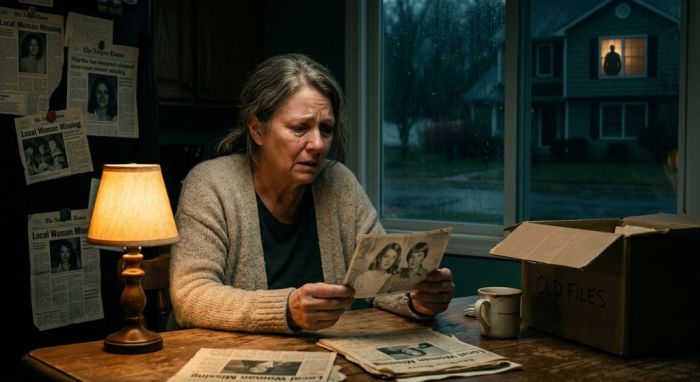
I stared at that photo until my eyes burned, then pulled the rest of it out. The Sterling Wealth newsletter, with the smiling headshots and a feature titled "Meet Your Money Team." Raymond Kowalski, CFP, right there in the middle. And at the very bottom, folded into a tight square, a page from the Oakmont Gazette dated October 2009.
"FBI SEEKS OAKMONT ADVISOR IN ALLEGED PONZI SCHEME."
The face under the headline was the same open, friendly face I had watched eat my pie on my own porch a week earlier. The same smile. The same scar.
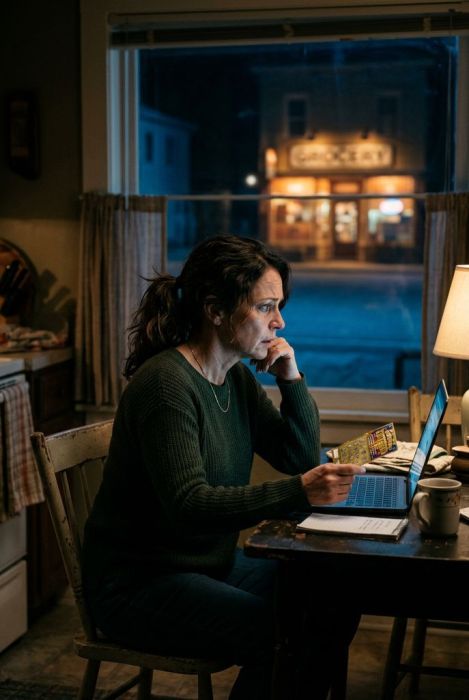
I didn't sleep that night. I sat at the kitchen table with the lamp burning low and lined up the two pictures. 2009 Ray Kowalski. 2024 Paul Delaney. Same jaw under the extra years. He had lost weight, grown a short beard, let his hair go gray and thin. He spoke lower now, slower, like a man who rehearsed his own calm. But the scar didn't change. The eyes didn't change.
In the morning I called Linda Detweiler, who had been Ray's secretary for eleven years, the only person left in Oakmont who remembered what happened and still answered her phone. She went quiet when I told her what I'd found.
"Oh, Ellen," she said finally. "The feds went through Ray's house before his wife could sell it. They found a whole box of names in the garage — driver's licenses, birth certificates, Social Security cards. Paul Delaney was one of them."
"Then he's been walking around Oakmont with a dead man's name," I said.
"Worse than that. The detective told me the real Paul Delaney was a retired salesman who died in a nursing home in Boise in 2001. Ray picked his name because nobody would come looking for a lonely old man who had no one."
I thanked her and hung up, listening to my father hum tunelessly in the front room, and I understood the awful arithmetic of it. The man who stole my father's future had moved in next door. He had eaten at our table. He had smiled at my father — the one man in the world who would have recognized him, if only his stroke hadn't taken the words.
Except that Dad had recognized him. "Ray," Dad had said, the very first day. And I had laughed it off.
The next Thursday, I volunteered at the food bank the way I always did, only this time I made sure the photocopied Gazette article was folded loose in my tote bag. Paul Delaney was there, cheerful behind the canned-goods table, and when I bent to lift a crate of tomatoes, the paper slid out and skittered across the floor.
He picked it up.
For one long second, he just looked at it. The smile on his face didn't fall exactly — it froze, like a snapshot of itself — and the color drained from his neck up into his cheeks. Then he handed it back, smoothed down, and smiled again.
"Old history," he said.
"Old history," I agreed, and my voice didn't shake even though my hands did.
He studied me with those too-steady eyes. "You know, Ellen, some memories are best left in boxes. Digging up old news never did anybody any good."
The way he said my name was like a rope pulling me closer. I smiled back and said nothing.
He came by that evening with the hedge clippers he'd borrowed, and stood on my porch an extra beat, looking past me into the house where Dad watched television in the dark. "I've been meaning to ask," he said, all easy friendliness. "That box of your father's office things. I collect old financial newsletters, for, you know — scrap art. I'd pay you well for it."
"Dad's things aren't for sale," I said.
His jaw tightened. He folded his hands in front of him, left over right, scar tilted toward me like an accusation. "You keep it, then," he said. "Goodbye, Ellen."
That night I locked every door in the house and sat in the dark with the phone in my lap until it was late enough to call the number at the bottom of the article.
It took three transfers and a fifteen-minute hold, and then a quiet-voiced man named Marcus Webb came on the line. Special Agent Webb, fugitive task force, based in Columbus. I told him my name, my father's name, and the name Raymond Kowalski, and he went silent so long I thought I'd lost the call.
"Ma'am," he said at last, "that warrant is fourteen years old, and it is still very much open. The man you just described is one of our oldest unfinished pages."
We worked quietly after that. Webb drove down in an unmarked car and sat in my kitchen drinking cold coffee while I told him everything. He pulled up Paul Delaney's DMV photo on a government laptop, and I nodded before he even asked. That was Ray. That was him, softened by years and a hundred small lies.
"The face could be argued," Webb said. "Faces lie all the time. But Mr. Delaney here just replaced his driver's license in April. We can run the old prints. We just need something with his prints on it."
So the next Thursday, while Ray Kowalski — Paul Delaney — handed out boxes of cereal and joked with the church ladies at the food bank, I picked up the water bottle he'd left on the table and dropped it into my tote. I drove it straight to the state police barracks. Three days later, Webb called me.
"Fingerprints are a match," he said. "It's him. And when I run that DMV photo against the old booking shot, it's him in both."
I sat down on the edge of the bathtub and cried for the first time since Dave died. Then I did what old school secretaries do best: I organized.
Webb told me they could take him at the house before dawn, clean and quiet, and that would be that. I asked him, very carefully, if he could wait a week instead.
"Ma'am, we generally don't schedule our arrests around community events."
"Special Agent Webb," I said, "this man has won a blue ribbon for his peach pie at the Oakmont Street Fair every single year since he moved here. The whole street deserves to see who they've been cheering for."
He was quiet for a long moment. Then he laughed, low and slow. "All right, Ellen. One week. You just make sure he shows up."
The day of the fair was golden and hot. Oakmont shut down Birchwood Lane and two side streets, and the whole neighborhood came out: folding tables sagging under casseroles, a band playing old country songs, kids chasing each other through the sprinklers. I pushed Dad's wheelchair to a spot in the shade at the edge of the pie contest and tucked the 2009 retirement photo into his lap, folded, where only he could see it.
Paul Delaney was at the judges' table, beaming, when they called his name for first place. He had won again, of course he had won. He stepped forward for the blue ribbon with his hands raised in that humble, gracious way that made everyone clap harder.
Two men in navy windbreakers came across the grass from behind the bandstand. They were not carrying pie.
"Raymond Kowalski?"
Paul's smile flickered, held, flickered again. "I'm sorry," he said, pleasant and easy, the same voice he'd used on my porch a hundred times. "You've got me confused with somebody else. Name's Paul Delaney."
The lead agent held up a card. "United States Marshals. We have your fingerprints, Ray. We have your photo, and we have your scar, and we have a warrant from 2009 that says you've got nowhere left to run."
Somewhere behind me, a plate hit the grass and broke. The fiddler stopped mid-note. The whole street went quiet — the particular quiet of a hundred people realizing, all at once, that they had been loving a lie.
Paul looked at the crowd, searching for the face that would save him. Then he found mine.
For a moment, the mask slipped. The easy friendliness drained out of his eyes and left behind a tired man I didn't recognize. And behind me, clear as a bell, my father's voice cut through the silence.
"Ray."
Dad sat up straight in his wheelchair, eyes bright and certain in a way they hadn't been in years. "I knew it was you," he said. "I told her it was you."
Raymond Kowalski opened his mouth, and for the first time in fourteen years, he had no words at all. The marshals cuffed him and walked him off the fairgrounds past the tables of casseroles. Mrs. Alvarez wept into her apron, not because she had lost anything, but because she had loved a lie and never known it.
He pled guilty last fall. Wire fraud, identity theft, the lot of it — and the identity theft charge was the cruelest part, because the real Paul Delaney had died alone in a nursing home in Boise in 2001, and Ray had worn his name like a borrowed coat ever since. He was sentenced to eight years. The marshals found his hidden accounts, and the restitution committee sent my father a check for eighty-seven thousand dollars.
I used it the way he would have wanted. A wheelchair ramp. A new roof. A proper hospital bed with rails that made him feel safe. The rest went into a trust with his name on it.
But the real treasure came the morning after the fair, when Dad ate a piece of my pie — not his, mine, and I burned it slightly — and set down his fork with a clatter.
"You believed me," he said. Not a question. A fact.
"I do now, Dad." I sat down across from him and took his hand. "I'm sorry it took me so long."
He squeezed my fingers with a grip that surprised me. "He was never straight, Ellen. I was just too proud of my friend to see it. But I saw it in the end. I saw it the minute he walked up your walk with that pie."
The neighbors still bring pie, though now it's me who wins the contest, mostly by default. Mrs. Alvarez planted me a row of marigolds. The Bells ask me over for dinner every other Sunday. And sometimes, when the porch light is on and Dad is dozing in his chair, I think about how a con man came home to the very street he'd robbed, certain that fourteen years was long enough for everyone to forget.
He was wrong about us. He just wasn't wrong about me — I keep my father's 2009 photo in the kitchen drawer, scar side up, so that every time I look at it, I remember to check on the old folks on my street, to ask the new neighbor his full name and look it up, and to tell anyone who will listen one simple truth: trust the old man who can't find his words but never lost his eyes. His eyes were the only thing Ray Kowalski couldn't fake.