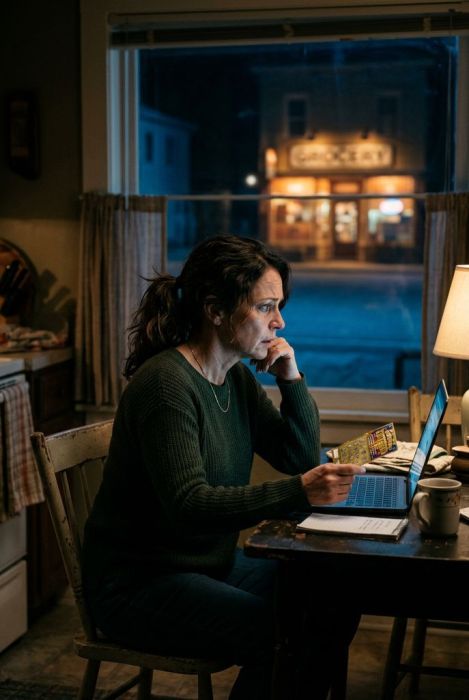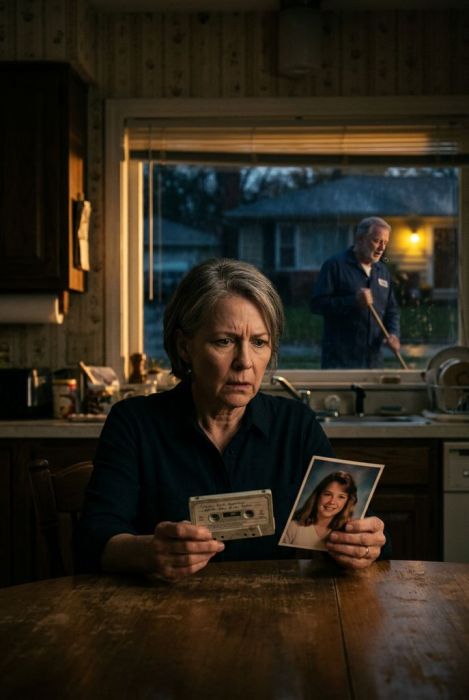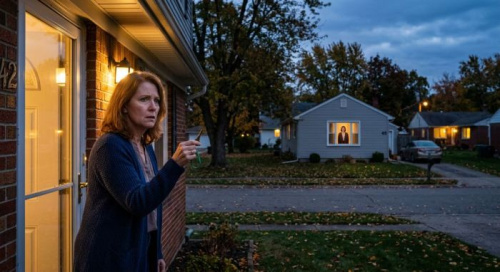
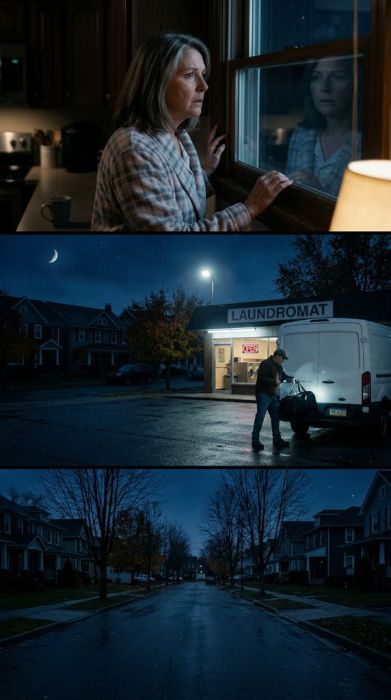
The night everything changed, I stood at my kitchen window at 1:47 in the morning with a cold cup of tea in my hand, watching Dale Kowalski back his white van up to the loading door of his laundromat. The SPARKLE CLEAN sign had been dark for hours, but the bulb above the back door was on, and I could see his silhouette moving in and out of the light. He wasn't carrying laundry baskets. He was carrying a black duffel bag in both arms, bent under the weight of it the way you carry something that doesn't want to be carried. He set it in the van, went back inside, and came out with another. And another.
For ten minutes he loaded duffel bags into a van with no name on the side while the whole street slept. Then he looked up at my window. Just for a second. I stepped back into the dark and held my breath. My heart was pounding for reasons I could not name. I told myself I was being a nosy old woman. I was wrong. I was being a witness.
Dale Kowalski moved onto Maple Street nine years ago, and within a year everyone in Millbrook knew his name. He owned Sparkle Clean, the laundromat on the corner of Maple and Fifth, the one with the mismatched washers and the coffee machine that always worked. He sponsored the little league team, bought a new scoreboard for the high school gym, and shoveled the sidewalks of every elderly neighbor on our street before they even asked. When my husband Frank died two years ago, Dale showed up at my door with a ham and a box of dryer sheets, of all things, and told me not to worry about my wash for a while. "That's what neighbors are for, Mary," he said. He meant it, too. At least, I believed he did.
Everyone called him the Laundromat King. He loved that. He'd stand at the front of his shop in his pressed khakis, greeting customers by name, remembering whose kids were in which grade, asking about grandbabies. There was a photo of him and the mayor on the wall by the register. He was the kind of man you trusted without thinking about it, because everyone else already had.
My daughter Emma worked for him part-time, cleaning the machines and folding for the older customers who tipped in peppermints. She was twenty-four, studying accounting at the community college, and she was the light of my life. She liked Dale. Everybody liked Dale. That's what made what happened next so hard to believe, even for me.
It started with small things Emma mentioned without thinking. Customers who came in at ten o'clock at night with gym bags instead of laundry bags, paid cash with folded bills, and left before their machines finished. A man in a blue sedan who sat in the parking lot every Thursday, never coming in. The back office, which Dale kept locked even when he was standing right next to it. His brother-in-law Russ, who showed up on Tuesdays and Thursdays with the unmarked white van and always used the loading door.
I tried not to read too much into any of it. People are private. Businesses have odd hours. But I spent thirty-four years keeping books for small businesses in this county, and numbers talk to me the way music talks to musicians. One night I sat at my kitchen table with a pencil and a napkin and did the math on Sparkle Clean. I knew what the machines could bring in. I knew what the water bill ran. I knew what a laundromat in a town of fourteen thousand could gross in a year. Dale's laundromat could not pay for the new truck he drove, or the bass boat in his driveway, or the little house on Lake Mercer he mentioned once and then tried to pretend he hadn't.
I told myself he had another business. A rental property, maybe. An inheritance. It wasn't my business. Except that my daughter worked there, and my gut kept whispering that something was off, the way it whispered before Frank's heart attack, the way it whispered the night of my mother's fall. I started watching the laundromat from my kitchen window. Not obsessively. Just often.
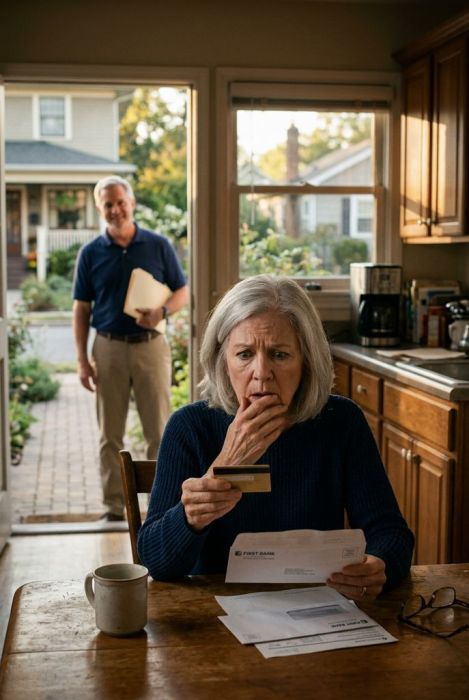
Then came the Thursday that changed everything. Emma came home at 11:40 that night, past her usual time, and she was white as paper. She'd been closing up, she said, when she found a black duffel bag sitting in the top of washer number four, left behind by a customer. She'd grabbed it to put in lost and found, but the zipper was half open, and she'd seen inside before she could stop herself. Cash, Emma said. Stacks and stacks of cash, wrapped in bank straps, plus a spiral notebook. She'd put the notebook back and zipped the bag, but she couldn't stop shaking.
"Mom," she said, "there was a page with dates and machine numbers. And a column that said 'pickup.' And my initials. E.C. My initials were on that page."
I did what any mother with a bookkeeper's brain would do. I had her describe every page until I could have drawn it from memory, and then I wrote it all down in my own notebook, page by page. I photographed nothing, because I didn't want her hands on it twice. But I wrote everything. Dates. Machine numbers. Dollar amounts. The word "pickup" and the initials of four employees, Emma's among them.
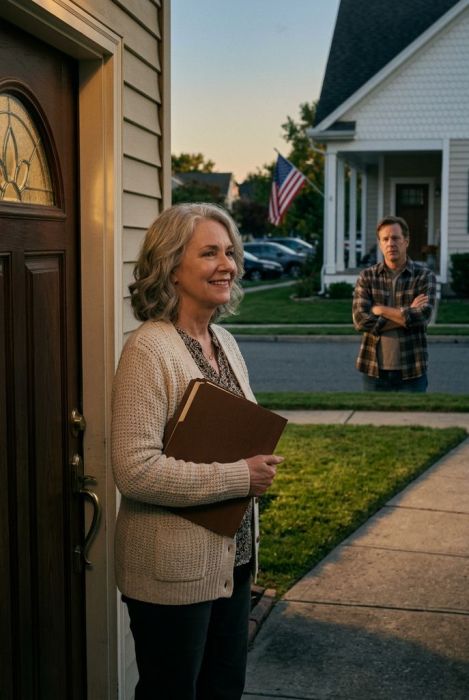
The next morning, before the shop opened, Emma put the bag back exactly where she found it. She called in sick and spent the day with me, jumpy as a cat. That evening, Dale Kowalski knocked on my door with a box of donuts and a smile that didn't quite reach his eyes. "Mary," he said, "you haven't seen a black gym bag around, have you? One of my regulars left it at the shop. Real important to him."
I said no. I smiled. I offered him coffee. And I watched his eyes do something I will never forget — a little flicker, like a shade coming down. He knew. He knew I knew. "Well," he said, "Emma's been a real help to me. I hate to lose her, but hours are tight this month." He said it like he was doing her a favor, and we both knew what it really was. A warning. A leash. He left the donuts on my counter, and I threw them out after he drove away.
Over the next two weeks, Emma's shifts got cut down to almost nothing. Her tires were slashed in the grocery store parking lot, and the police wrote it up as vandalism, no leads. A blue sedan followed her home from the community college on a Tuesday night, and she was so scared she called me from the car, and I stayed on the line with her until she pulled into our driveway. I filed a report. Nothing came of it. I was afraid, but I was also furious, and fury is a very clarifying thing.
That weekend, I took Frank's old tackle box down from the shelf and drove two streets over to Charlie Vogel's house. Charlie was a retired DEA agent, Frank's best friend since before I ever met him. He lived alone now, with a German shepherd and a vegetable garden that took up half his yard. He'd been to our house for a hundred cookouts. I trusted him with my life. I showed him my notebook. I told him everything Emma had seen. Charlie read it twice, slowly, and then he set it down and looked at me for a long time.
"Mary," he said, "the bank straps. Did you get a look at them?" I described them. Charlie nodded. "Those are from a bank that closed in 2008," he said. "A real business doesn't have those. A business that launders money for a network that's been running since before the recession? That's exactly what those straps look like."
He told me the code pattern matched an operation he'd chased for three years before he retired — cash collected from drug spots in the city, washed through small cash businesses in towns like ours, then moved out in the van on schedule. "Sparkle Clean isn't the front," he said. "It's a drop point. Dale's not the boss. He's the wash cycle."
Charlie made one phone call, and two days later two agents from the FBI financial crimes unit sat in my living room drinking my coffee and asking quiet questions. They were polite. They were patient. They told me my daughter should not go back to that laundromat, and I told them she already had — that she'd insisted, because she said she wasn't going to let Dale Kowalski scare her out of a job she'd earned. They looked at each other, and then the older one said, "Then we do this Thursday."
Thursday night, Emma worked the closing shift like nothing was wrong. She folded towels. She swept the floor. She told me later that she sang along to the radio to keep her hands from shaking. At 1:50 in the morning, Russ's white van pulled around the back, and the exchange happened at the loading door, same as always. Only this time, the loading door didn't quite close. And the blue sedan in the lot wasn't alone.
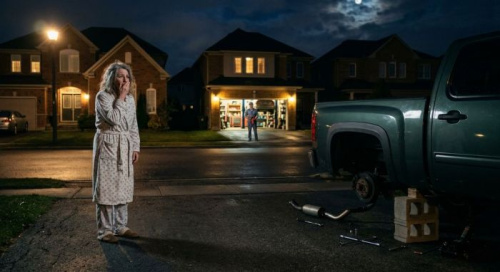
I was watching from my kitchen window, because nothing could have kept me away. At 2:04, the street lit up red and blue. There was no siren — that's how it happens when they want it quiet — just the sudden, silent flood of lights, and men in dark jackets pouring around the sides of the building. The loading door came down hard. The whole block woke up. Porches filled with people in robes, and I stood at my window with my hand over my mouth, watching Dale Kowalski walk out of his own laundromat in handcuffs, looking, for the first time in nine years, very small.
The bust made the front page of the Millbrook Herald and the evening news in the city. Dale Kowalski, the Laundromat King, was indicted for money laundering, along with his brother-in-law Russ and three other men who were picked up in the city the same night. The laundromat was seized. His house on Maple Street went into forfeiture, and the bass boat and the truck and the little house on Lake Mercer turned out to be as much a lie as everything else about him. The trial was quick, the way these trials are when the evidence is a notebook full of machine numbers and a trail of cash. He's serving a long sentence now, and he'll have plenty of time to think about the donut shop he won't be opening.
The hardest part came afterward, when the neighbors found out. Mrs. Petrovic, who'd let Dale keep her spare key for nine years, cried on my shoulder because she'd trusted him. The high school took down the scoreboard. The little league found a new sponsor. For a while, Maple Street felt like a street that had been lied to, and people didn't know who to look at.
But time does what time does. The laundromat sat empty for a year, and then a nice young couple turned it into a coffee shop, and now the corner of Maple and Fifth smells like roasting beans instead of bleach. Emma finished her accounting degree and got a job at a real firm in the city. She's good at it, too. She says numbers tell the truth, and she likes that.
Charlie Vogel started a neighborhood watch that first spring, and he still captains it, walking the block every evening with his shepherd. The blue sedan never came back. The strange customers never came back. And me? I planted roses along the fence Frank built, and I sleep with my windows open, even on Thursday nights.
Dale Kowalski thought he could wash his money clean in the middle of Maple Street and nobody would ever count the loads. He was right about one thing — nobody did count them. He just never figured on a nosy widow with thirty-four years of bookkeeping and a daughter who grabbed the wrong bag.