I was still digging my house key out of my purse when Mom pressed the envelope into my hands. "Sweetheart, I need you to look at this and promise me you won't be upset," she said, and the tremor in her voice made my stomach drop before my eyes even reached the words printed across the top: NOTICE OF FILING. County Recorder. 214 Palo Verde Court. Encumbrance: Fixture Filing — SunBright Energy Solutions LLC, secured party. Three paragraphs of legal fine print sat over my mother's property, and at the bottom was a date that made no sense at all: March 14, 2:15 p.m.
March 14 was the day Ruth Callahan had her right hip replaced. I know because I drove her to the surgical center at five-thirty that morning, held her hand while the nurse started the IV, and kissed her forehead as they wheeled her past the double doors. She was under anesthesia at 2:15. There is no version of that afternoon where she sat at her kitchen table in her church clothes and signed a legal document in front of a notary. But the county had the filing, her signature was on the page, and somebody's official-looking stamp swore it all happened on a day she cannot remember at all.
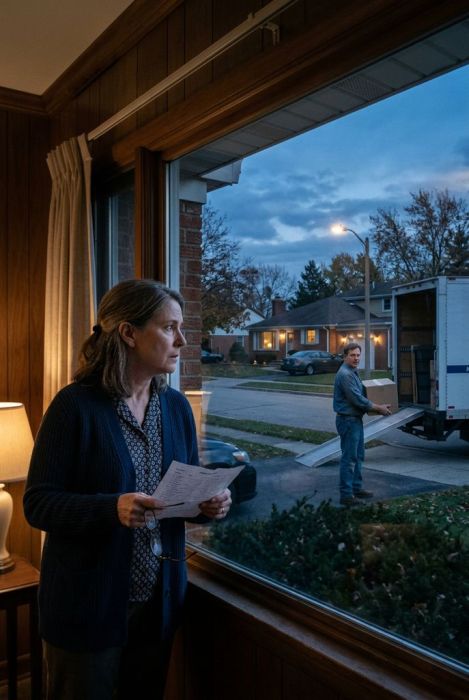
I live in Denver. Mom lives alone in Mesa, Arizona, in the little three-bedroom house my dad paid off in 1998, the year she retired from thirty years as a school secretary. Since Dad died, she has kept the lawn green, the tile swept, and her independence fiercely intact. I visit when I can, and we talk every Sunday night like clockwork. It was one of those Sunday calls that made me drive twelve hours on a workday's notice, because Mom mentioned, almost casually, that a man from the county had mailed her something about "the solar thing" and she couldn't quite make sense of it.
The solar thing. That was Gary Whitfield's doing. Gary moved onto Palo Verde Court eighteen months ago with his wife, Brenda, and their two kids, and within a month he was the most beloved neighbor on the street. He organized the Fourth of July barbecue. He trimmed Mrs. Okafor's palm tree when the monsoon took a frond through her windshield. He started a little "energy savings" club in his garage, complete with a whiteboard and bottled water, where he explained how Arizona sunshine could slash everyone's power bill to almost nothing. And when Mom mentioned on the porch one afternoon that her summer electric bill was pushing four hundred dollars, Gary put his hand on her shoulder and said, "Ruth, let me take care of that for you."
Be clear about one thing: from where I sat in Denver, Gary Whitfield was an answer to a daughter's prayers. He drove Mom to her cardiology appointments when I couldn't. He changed the batteries in her smoke detectors. He shoveled her walk, which in Mesa means he raked the gravel back into place after the wind storms. When Mom's hip started failing and she hesitated to call me, it was Gary who found her a surgeon, Gary who drove her to the pre-op, Gary who visited her in the hospital with a little plastic tray of flowers. I thanked him so many times that my gratitude became its own kind of blindness. I told him he was the neighbor every parent hopes for when their kids live far away. I meant every word. He was laying a trap with those words, and I walked into it with open arms.
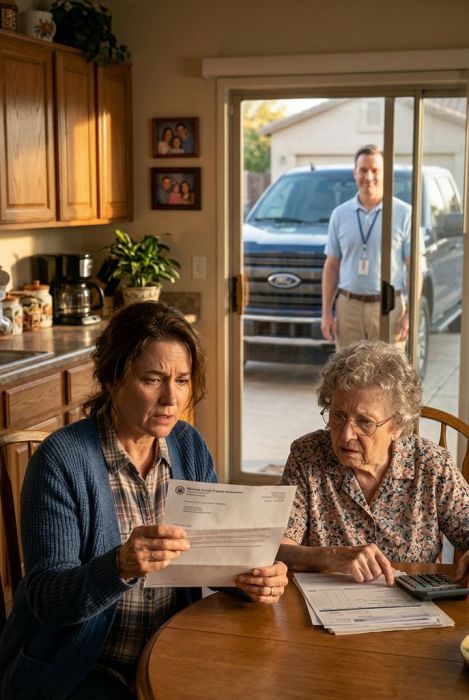
The envelope in my hand was the first domino. The second was the page underneath the notice, a "Notice of Default and Demand" from something called Silver State Recovery, demanding $12,700 for "equipment lease fees and enforcement costs," and warning that failure to cure the default could result in "enforcement of the security interest" — meaning they can come take the panels off the roof and put a lien so deep on the house that no bank will ever touch it. My mother read that letter eight times before she called me. She read it out loud to herself in the kitchen. She was terrified, and Gary Whitfield built his whole empire on that kind of terror.
Here is what I learned over the next forty-eight hours, sitting on Mom's couch with her old laptop balanced on a throw pillow. A "fixture filing" is a document a company files with the county recorder to claim an interest in something attached to a home — in this case, solar panels. It is not exactly a mortgage, but to a title company it looks like a chain around the property's ankle. And Gary's company, SunBright Energy Solutions, had filed them against not just my mother's house. The county's online records showed six filings on Palo Verde Court and the two streets behind it, all dated within the same three months, all with the same secured party. Six neighbors. Six signatures. One of them belonged to a woman who was asleep in a hospital bed while the notary block on her contract was being filled in.
The notary block was the detail that kept me awake that night. The contract, which Mom had signed somewhere in its depths, bore the seal of Brenda Whitfield — Gary's wife — and a journal number. I called the Secretary of State's office the next morning and asked if that journal number existed in Brenda Whitfield's records. When she came back, her voice was careful. "That number doesn't appear in our system, ma'am. And the commission attached to the name you gave me expired in 2021." So Gary had his wife's name stamped on a legal document she was never licensed to notarize, recording a signature that happened on a day when the signer was fighting anesthesia. It was forgery, and it was fraud, and the only person who could prove it was sitting beside me, wearing her good cardigan and looking at me like I was the one who had made a terrible mistake.
I should tell you what happened next, because it is the part that still makes my chest tight. I went to Gary's house. I did not plan a confrontation; I wanted to ask him, plainly, to explain the filing, to show me the paperwork, to make it all make sense. He met me at the door wearing a golf shirt and a smile, and he invited me in like a guest of honor. "Linda, I know this looks scary," he said, pouring me iced tea I did not drink. "But Ruth signed willingly. I have it on video, actually." And he pulled out his phone and showed me a clip: Mom in a hospital gown, groggy and blinking, signing a clipboard on a rolling table while Gary's voice said, "Just there, Ruth, that's it — this just lets the inspection guys on the roof, real quick." She was signing a consent form he had written himself, in a recovery room, without her glasses. He had engineered the clip to look like proof, when it was actually a confession.
I told him, as calmly as I could, that the notary seal was expired and the date on the filing was impossible. And I watched his face change. Not into anger — into something colder, something patient. "You're going to make a lot of trouble for yourself," he said. "Where do you think this ends, Linda? By the time you fight this in court, your mother's house has a lien nobody will touch, her legal fees will eat her savings, and she'll still owe the money. Or you sign this settlement tonight, I make the filing disappear, and Ruth gets to keep her peace. That's the difference between a smart woman and a foolish one." He slid a one-page agreement across the counter. It had a blank space where a house address was meant to go. He wanted my mother's signature on a paper that could be turned into anything.
I left his house with the paper. I did not sign it. I did what I should have done days earlier: I drove to the public records building, pulled every filing SunBright had ever made, and I called the Arizona Attorney General's Elder Fraud Unit. They told me to file a complaint and keep records. They told me these cases take time. And time was exactly what Gary counted on, because time is what makes a frightened widow give in.
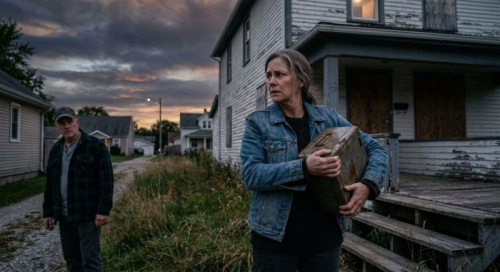
The unexpected weapon arrived in the form of Hank Vasquez, the retired man at 208 Palo Verde Court, the one everyone called "the old grouch" because he kept to himself. Hank found me in the driveway late one afternoon, holding a binder wrapped in a grocery bag. "I worked thirty-one years in the county recorder's office," he said. "I've seen this twice. Once in Pahrump, once in Bullhead City. Same scheme, different company name. Same salesman, different street." He opened the binder: paperwork from two other counties, complaints that never went anywhere, and a posting from a Nevada fraud alert naming a man who pitched rooftop solar to seniors with free ice cream and fine print. The name on the alert was Gary Whitfield. His contractor's license had been revoked in 2018, which he had never mentioned to a single person on Palo Verde Court.
Hank also told me about Silver State Recovery. "You want to know who owns it?" he said, and he showed me the corporation filing. The registered agent's address was 217 Palo Verde Court. Gary's own house. The debt collector threatening to take my mother's roof was Gary himself, sending letters under a second company so he could collect the first company's fake debt — and if a senior paid, the money went straight back to him. The whole thing was a wheel of paper, built to turn a widow's fear into his cash.
Arizona is a one-party consent state, which means you can record a conversation you are part of without telling the other person. I bought a small digital recorder at an office supply store, and I asked Mom if she trusted me enough to let me handle the next conversation. She did. And so, three days before Gary's big neighborhood "Energy Savings Cookout," I stood in my mother's kitchen and asked him, on the record, to explain the March 14 notarization one more time. He repeated his lie: "I was there, we did it at her kitchen table." I said, "Gary, my mother was under anesthesia at 2:15 that afternoon. The surgeon's notes say so. The recovery room log says so." There was a long silence, and then his voice went low and ugly. "Nobody's going to care about your little detective work, Linda. By the time the county figures out what's real, Ruth's house will have a lien on it that outlives her. Sign the settlement, or watch your mother lose everything to legal fees." Fifteen seconds of silence at the end of that file. I have listened to it a hundred times. It is the sound of a man who thought he had won.
The cookout was supposed to be Gary's victory lap. He'd strung up lights over his driveway, pulled out his smoker, and invited the whole court to celebrate "community energy independence," a phrase he'd printed on napkins. But he had also, the night before, sent a group text to the neighbors telling them I was "trying to put Ruth in a home to get her house" and that they shouldn't believe "stories from Denver." Half the street looked at me like a stranger that afternoon. Mrs. Whitaker even told Mom, loud enough for me to hear, that Gary had done more for her in a year than I had done in a decade. Mom said nothing. She just held my arm, which is how I knew she was on my side.
I waited until Gary was mid-sentence, toasting his own generosity, before I stood up and asked for three minutes. He laughed and waved me up like a comedian warming up a crowd. Then I played the recording. His own voice filled the backyard: "watch your mother lose everything to legal fees." The silence that followed was so complete I could hear the barbecue sauce bubbling. Then I held up the binder Hank had given me, and the county printouts, and the corporation filing that showed Gary was Silver State Recovery. And I told the street about the expired notary, the revoked license, the six liens, and the Pahrump and Bullhead City complaints from a decade of doing this exact thing to other people's parents.
Gary was still shouting that it was all lies, that I'd "doctored" the audio, when the unmarked SUVs turned onto the court. The state fraud investigators had been building a file on SunBright for weeks, and my recording, my printouts, and Hank's binder gave them the probable cause they needed. They arrested Gary Whitfield at his own grill, in front of his own neighbors, on charges of aggravated financial exploitation of a vulnerable adult, forgery, and unlicensed contracting. He went quietly — there are no handcuff dramatics here, just a man in a golf shirt being walked to a car while his neighbors watched with their paper plates still in their hands. He pleaded out eighteen months later. Four and a half years for the exploitation, restitution ordered to every family he had filed against, including the five other houses on our street who never knew they were victims until I showed them the papers.
The county released my mother's lien. The Attorney General voided every SunBright contract it could reach, and the collection letters from Silver State Recovery stopped the day a judge froze Gary's accounts. Mom's panel array, which was never finished and never paid for, came down in a cloud of sun-warmed dust, leaving her roof bare and her utility bill back in her name — higher than Gary promised, but honest, which is better. The restitution checks were small but real, and Mom, being Mom, used hers to buy a new kitchen faucet and a framed copy of the Release of Lien, which she hung beside my father's photograph.
It has been three years. Gary's house sold at a loss; Brenda moved out of state with the kids, and I try not to dwell on it, because I also think about the six old people he was ready to bury under paperwork if nobody stopped him. Mom still lives at 214 Palo Verde Court. The neighbors don't talk about the "solar thing" much, but Mrs. Whitaker brings Mom casseroles on Sundays now, and she always says it a little too loudly, which is her way of saying sorry. Hank Vasquez and I have coffee on his porch twice a summer. He keeps a folder of solar scams now, for the community center, and Mom volunteers at his table handing out the county recorder's "check before you sign" checklist to anyone over sixty-five who will take one.
My mother signed a document she never saw, on a day she cannot remember, for a man who knew exactly what he was doing. She got lucky, because I happened to visit and happened to look twice at a date that didn't add up, and because a retired county clerk on the next lot kept a binder full of other people's pain. She would want you to know this: if someone you love ever signs anything in a hospital bed, or in the glow of a free energy seminar, walk it to the county recorder's office and look at the date. Look at the notary. Look at who actually owns the company that's collecting. Kindness with a notary stamp in the fine print isn't kindness at all — and sometimes the only way to beat it is to keep the receipt, tell the truth, and let the people who were always watching do their quiet work.