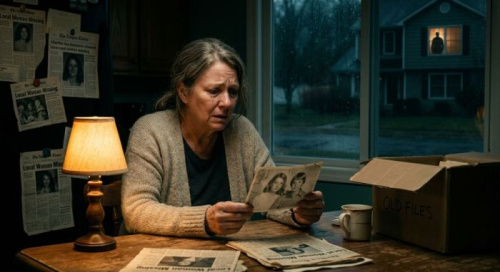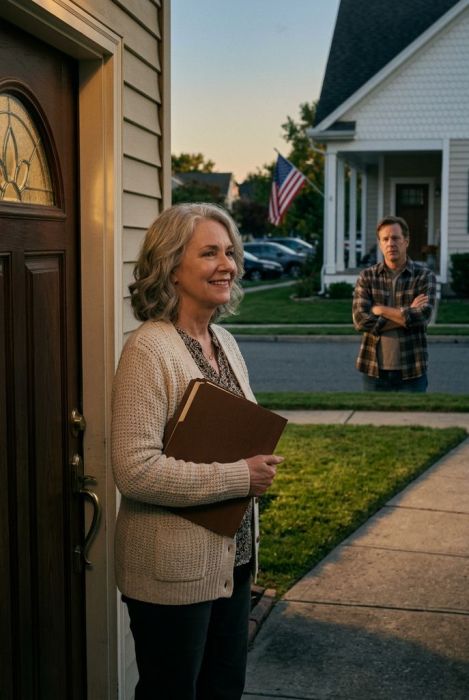
The folder was sitting on my porch in a plastic grocery bag, the kind Ray Kessler used for everything, and I almost threw it out with the recycling. It was Tuesday night, three days before the showcase, and I was still trying to talk myself out of what I'd agreed to. But something made me open it there in the dark, standing under the porch light with my coat still on, and I'm glad I did. Because inside were forty-one folders' worth of photographs, all of them children from our street, all of them with price tags, and Emma's face was on top.
I'd like to say I saw through Ray Kessler the day he moved in, but that would be a lie, and this story is about why good people get fooled. He arrived in our neighborhood two years ago, a retired drama teacher from somewhere back east, with a quiet, courteous manner and the kind of voice that made every sentence sound like a warm invitation. He brought brownies to the block party. He offered to direct the community theater's fall play for free. He watered the Petersons' lawn when they went to Florida, and when my old cat Tater got out, Ray walked the whole drainage ditch with a flashlight until he found him. On Dogwood Drive, we didn't have a neighborhood watch captain because we had Ray.
Emma was fourteen that year, and she was having a hard one. Her father had moved to Phoenix in the spring and called less and less. My daughter Sara worked the night shift at the hospital, which is how Emma ended up at my house most afternoons, doing homework at my kitchen table while I made dinner and tried not to worry out loud. Emma was shy. She wore her hair over her face and got red when anyone looked at her too long. But she loved taking pictures with that little camera of hers, and she loved pretending. She'd put on my old scarves and read aloud from her school books in different voices, and sometimes I'd catch her doing it and laugh so hard I cried.
Ray noticed. Of course he noticed. That was his gift.
"She has the look, Maggie," he told me one afternoon, leaning on the fence while Emma photographed a dandelion. "I don't say that lightly. I've taught thousands of kids in thirty years. She has something."
I told him he'd been watching too many makeover shows. But I was smiling, because it's a terrible thing how much a grandmother wants those words to be true.
He planted the seed gently, the way he did everything. He mentioned a colleague of his — Dennis Whitfield, a talent rep in New York — who was looking for fresh faces from small towns. He showed me a glossy pamphlet with kids on it who looked exactly like the kids on our street, and a picture of Dennis shaking hands with someone who might have been famous. I didn't recognize the famous person, but I didn't want to seem naive. Ray said the first step was simple: a portfolio, honest headshots, a professional comp card. He could do it right there in his garage studio, which he'd converted years ago for community arts projects. He'd charge a small materials fee — a hundred and fifty dollars — and the families who believed in their children could take it from there.
A hundred and fifty dollars. I remember thinking, that's the price of a nice dinner. That's nothing.
I paid it. I paid it in cash, the way he asked, and I sat in his garage studio for two hours while he photographed Emma against a gray backdrop, telling her she was a natural, telling her to give him wonder, give him fire. Emma glowed. She came home walking on air, and for the first time in months, she didn't hide her face.
The next step was the showcase. Dennis Whitfield himself would fly in — Ray said this with real excitement, his voice dropping to the volume people use for secrets — to see the finalists. There were, apparently, finalists. Sara worked double shifts that week, and I was the one who got the email Ray printed out himself, because he knew I struggled with the computer stuff. It said Emma had been selected for the Midwest Rising Talent Showcase that Saturday. The fee to secure her spot was eighteen hundred dollars, non-refundable, payable by Friday, and it included a guaranteed review by Dennis and a career counseling session for parents. It ended with a phrase that I now know came from a script he'd used more than once: a once-in-a-lifetime opportunity for a once-in-a-lifetime child.
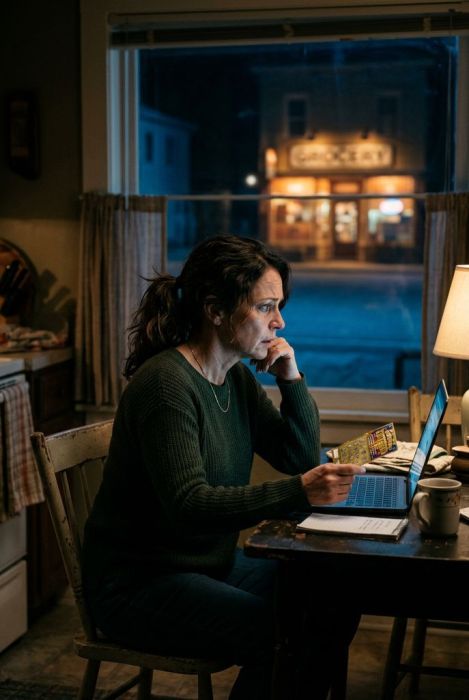
I'll be honest with you. I almost paid it. I had two thousand dollars in savings, most of it from selling my husband's old boat after he passed, and I sat at my kitchen table that Tuesday counting out twenties, telling myself this was the door opening for Emma. What kind of grandmother would I be if I let my shy, hurting granddaughter miss the chance because of money?
What stopped me wasn't wisdom. It was the grocery bag.
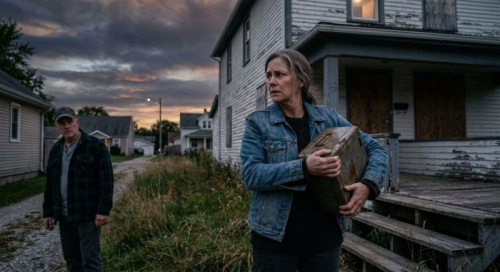
Ray had borrowed my big ladder that morning to clean his gutters, and I'd left the kitchen door unlocked for him to bring it back. I found the plastic bag on the porch that evening, and I assumed it held my ladder's rubber feet, which I'd asked him about. It didn't. It held a folder. And in that folder were the comp cards.
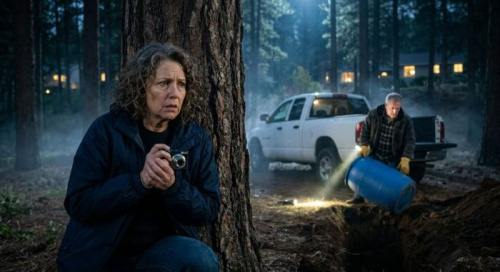
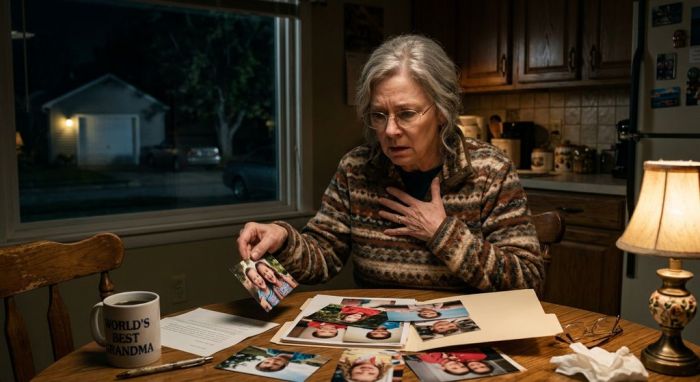
Comp cards, as I now know, are supposed to be a model's business card with their best photos. These were photographs, all right, but they weren't portfolios. They were candid shots. There was the Nguyen boy sledding in his backyard last winter. There were the twins from Number 14 in their church clothes. There was little Rosie Aguilar with cake on her face from her birthday party. And there, on top, was Emma — not in front of his gray backdrop, but sitting on my own front steps in October, the day she'd been crying about her father, clutching her camera. He'd taken it from the street. He'd been taking pictures of our children for over a year, he had forty-one of them in that bag, and every single one had a number written on the back in pencil.
I'm not proud of what I did next. I sat down on the porch steps like someone had cut my legs out from under me, and I went through every one of them. The numbers went from one hundred to two thousand. Some of the backs had notes: father owns bakery, mother hospital night shift, grandmother co-signs everything. Emma's said, grandma has boat money.
I called Frank Delaney that night. Frank lives three houses down and used to be a detective in Cincinnati before he retired to grow tomatoes and complain about his hip, and he's the reason I lock my doors. I'd never called him for anything more serious than asking if I could borrow his ladder. But I read him the list of names, and I heard him set down his coffee cup, slow.
"Don't touch anything else," he said. "Don't call him. Don't go over there. I'm coming over."
Frank came over with a notebook and a very tired look, and we spread the photographs across my kitchen table like a deck of cards. He asked me questions I felt stupid answering. How did you pay? Cash, I said. Did he give you a receipt? He said he'd email it. Did you ever see his teaching license? I said — I didn't. Did you ever meet Dennis Whitfield? I admitted I hadn't. Did you ever visit the agency's office in New York? There wasn't an office, just a website with a P.O. box.
Frank didn't say I told you so. He's too good for that. But he wrote in his notebook for a long time, and then he made three phone calls. The first was to the state education department, which had no record of Ray Kessler ever holding a teaching license in our state — or, when Frank pushed, in the two states before ours. The second was to a county clerk he knew, who pulled the registration for Rising Stars Talent Studio and found it was a hobby business with a single owner and no employees, ever. The third call was the one that changed everything. He called the venue listed on my printed email — a professional showcase theater in Newark — and a very confused man named Gus answered and said, yes, they'd rented their banquet hall for Saturday to a Mr. Whitfield, cash, and no, there were no agents or casting directors on the list, just a DJ.
"You understand what this is, right?" Frank said, hanging up. "There's no showcase. There's no Dennis Whitfield in the industry. There's just Ray, a banquet hall, forty-one families, and whatever cash he can collect by Friday."
I asked what the endpoint was — what happened to the kids after the big night. Frank tapped the folder. "The ones who don't pay get dropped. The ones who do pay get told they didn't make the cut, but there's a premium mentorship program that costs more. It can run a family out of thousands. And by the time anyone notices, the studio's closed and Ray's already rented a house in the next state." He looked at me. "He's done this before, Maggie. He's good at it. Which means we have to be better."
Here's what I want you to understand about the next three days, because it's the part I think about when I can't sleep. I could have called the police and been done with it. Frank wanted to. But forty-one families had handed Ray money and trust, and the police said what police always say: it would be a he-said-she-said, a civil dispute, a collection of fees for a service. Without him caught in the act, with cash, with parents in the room, Ray would pay a fine and open a studio on the next street.
So on Wednesday, I did the most unnatural thing I've ever done. I went over to Ray's house with a cobbler — a real cobbler, because I'm not a monster — and I sat at his kitchen table and I told him, with tears in my eyes, that I'd talked to Sara and she'd agreed, and here was the eighteen hundred dollars in cash, and could he please, please make sure Emma wasn't nervous on Saturday. He was so kind. He took my hands across the table and told me about the girl he discovered in Ohio who was now in a national commercial, and he put my envelope in a metal box without counting it, like a man who'd done this a thousand times. While he was turned away, I saw the edge of the same gray folder, the one with the pencil marks, sticking out of a crate beside the fridge. I didn't touch it. I didn't have to.
Friday night, Frank picked me up at seven. Between us on the seat was a folder of his own: the list of families, the photocopies of the contracts, the flight records and the car rental records and the cell phone records that a very patient retired detective had obtained by being very polite to people he used to work with. In the box that looked like a cobbler container but wasn't, there was a camera, and two officers from the county prosecutor's fraud unit were in an unmarked car across from the banquet hall, ready to move the moment they got our signal.
Saturday came on a cold gray morning, and the banquet hall smelled like old varnish and cheap coffee. Parents in their best clothes sat in folding chairs while a DJ played music with no energy, and forty-one children — I counted them, I had to — sat in neat rows at the front, dressed up, nervous, hopeful, their faces turned toward the empty stage where a man in a borrowed suit would soon tell them how special they were. Ray walked the aisle shaking hands like a politician. He kissed Sara's cheek when she arrived, having no idea she knew everything, and he shook my hand and said, "Big day, Maggie. Big day for your girl."
Dennis Whitfield walked in at ten o'clock sharp with a leather bag and a practiced smile. He was younger than his pamphlet photo, and his suit didn't quite fit, and when he reached the stage and began to talk about the industry and our partners, Frank tapped my arm. I stood up. My voice came out steadier than I expected, loud enough to carry over the DJ's music.
"I'm sorry," I said. "Before we begin, I'd like everyone to meet Dennis Whitfield — Ray's nephew. Real name Danny. He manages a parking garage in Trenton."
The room went quiet the way a room goes quiet when the truth lands in the middle of it. Danny's smile flickered. Ray started laughing — a big, generous, I-don't-know-what-you-mean laugh — and he was still doing it when Frank held up the folder with the photographs, and then the contracts, and then the bank records for a studio that had no license, a showcase that had no agents, and a metal box, found that morning by the county officers, containing forty-one envelopes of cash, including mine, with the serial numbers of the marked bills the prosecutor's office had lent me.
I'll spare you the shouting. I'll spare you the way Danny tried to run for the fire exit with the leather bag. What I'll tell you is that the officers came through the doors before he reached them, and I watched Ray Kessler — the man who'd walked our drainage ditch looking for my cat — get handcuffed in front of every family he'd ever smiled at. The children were sent out to the parking lot with the parents who still had tears in their eyes, and the prosecutor did something I didn't expect: she asked all forty-one families to come back inside, and she told them, gently, that the money was seized, and it was going home.
It took six months for it all to come out, and when it did, it was worse than Frank predicted and better than I feared. Ray — whose real name was Ronald Kessler, which I only learned then — had run versions of the same studio in three states under three different names, always renting a home in a friendly neighborhood, always in the driveway on trash day, always with brownies. The district attorney found eleven prior families across the country, people whose children had almost made it and who had quietly paid for classes that never happened. The trial was quick, because he had no defense, only a lawyer arguing that it was all a misunderstanding with victims who were too eager. Every single parent on Dogwood Drive came to that courtroom. We filled three rows, and we wore red, all of us — our girls' favorite color — and when the verdict came back, you could hear the release of breath from the front row to the back.
Ray — Ronald — got four years for fraud and identity theft, with restitution ordered in full. His house went into a short sale. The studio became a storage unit that smelled like old carpet. And our street, which spent a month not speaking to one another out of shame, slowly remembered how to be a street again. The Nguyens' sled made the rounds. The twins sold lemonade. Rosie Aguilar's birthday party was the event of the fall, and every adult who walked past her house with a gift felt a little lighter.
Emma didn't become a model. I want to be clear about that, because I think it's the most important part. She took her little camera and she kept taking pictures, and that spring the school drama club put on a play and she did the stage crew and then, by accident, a small part, and she found out she liked it. The drama teacher, a real one with a real license, told me Emma had an instinct for the stage — she didn't have the look, she had the work, and that was worth more.
The folder Frank kept is still in his garage, in a box labeled with a name that isn't Ray's. Every now and then one of the parents asks me if I'm sorry I paid the eighteen hundred dollars. I tell them no, and I mean it. That money bought the night I watched forty-one families get their children back from a man who'd stolen their faces, and it bought the only thing that mattered in the end: proof. The next time a stranger on a nice street smiles too long at your child and says they have the look, you'll know what I know now. The look that matters isn't in their face. It's in the folder, in the fine print, in the things they don't want you to see. And it's always, always worth opening.