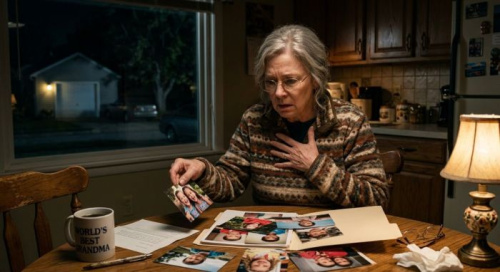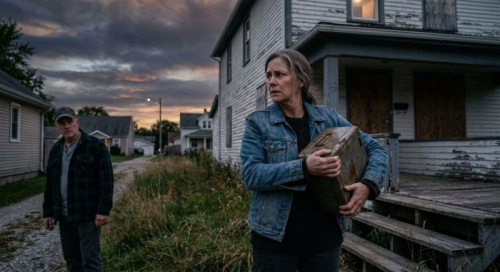
I didn't realize the watch was gone until the day I finally opened the box. The box had been sitting in my hallway for two weeks, ever since Ray Whitlock and his son Tyler had helped me drag it down from the attic. It was labeled TOM — PERSONAL in my own handwriting, and I had watched Ray tape it shut with his big, careful hands. But when I cut the tape and lifted the leather case that had held Tom's Hamilton for twenty years, the watch wasn't there.
The Hamilton was the gold one, engraved "To Tom, Forever, Maggie," the gift I had saved two years of substitute-teaching pay to buy for our fortieth anniversary. Tom had worn it every day until his hands shook too badly to wind it, and then he had wrapped it in a cloth and tucked it into that leather case in the attic, where the light couldn't fade the gold. After he died of a heart attack in the garden fourteen months ago, the case became the holiest thing in my house. I opened it on bad days, just to hold it. And somebody had taken it.
Everybody on Cypress Court knew the story about Ray Whitlock. Whitlock & Sons Moving had carried Millbrook's furniture for thirty years, and Ray gave away more labor than he ever billed. He loaded Mrs. Alvarez's apartment into his truck for free when she downsized to the little place on Fourth Street. He carried the Creswells' piano down two flights of stairs with his own back, refused a penny, and showed up at church every single Sunday wearing the same blue suit. When the hardware store burned and they raised money for old Mr. Felton, Ray's name sat at the very top of the donor board, and nobody had to ask who put it there.
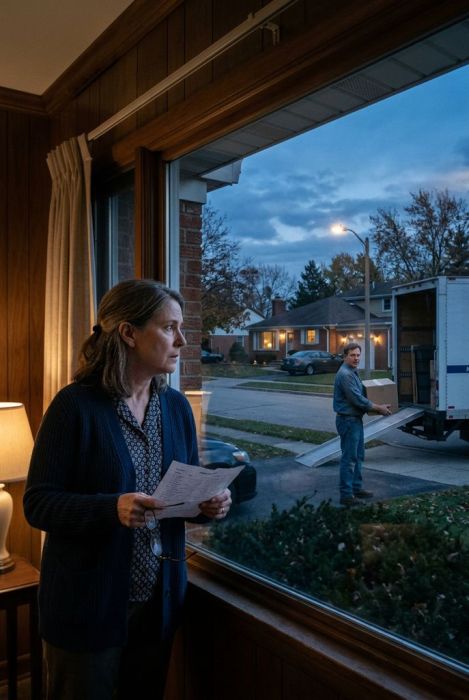
I am Maggie Byrne, sixty-one years old, a retired school librarian. My daughter Lindsay lives in Cincinnati with her husband and the twin boys, and she has called me every night since her father died to make sure I ate something. The house on Cypress Court felt enormous after Tom was gone, and Ray Whitlock made it feel smaller in the best way. He fixed my squeaking porch step. He changed the bulb on my floodlight. When I mentioned that the attic had become a graveyard of Tom's things and I couldn't bear to look at them, he was at my door the next Saturday with Tyler and a stack of boxes, saying no widow in this town was going to haul her own weight. That's what neighbors are for, Maggie.
The attic took four hours. Ray and Tyler sorted, labeled, and carried while I made lemonade and tried not to cry at every dust-covered thing they brought down. And through it all, Ray talked to me — really talked, the way people do when they want you to feel safe. He asked about Tom's collection of coins and where I kept his good cufflinks, and he said it was so they could mark the fragile boxes and make sure nothing got lost in a move. It sounded exactly like a man who had spent his life caring for other people's belongings. It sounded like a blessing.
Looking back, there were signs long before the watch. The Cresswells had used Whitlock & Sons when they sold their house last spring, and Ray had "helped them pack the valuables personally" — his words, at the block party, with his arm around Mrs. Cresswell. Two weeks later, while the Cresswells were closing on their new place out of state, somebody came through their basement window and took only the small things: jewelry, coins, the good silver. The police called it a professional job. The neighbors called it terrible luck. Nobody, absolutely nobody, connected it to the man who had personally packed those valuables.
Then in September, the Parkers moved their mother into assisted living, and Ray helped with that too. The Parkers' mother had a break-in three weeks after the move, and the only things missing were her jewelry box and an envelope of cash she had hidden in a coat pocket. I remember Sam Okafor, the retired detective from number 62, raising an eyebrow at the barbecue and saying it was funny how these things happen in clusters. Sam always saw more than the rest of us. I just didn't know yet that he saw Ray.
A week after the attic, I called Ray about the watch. The silence on the other end of the line was long enough for me to notice. Then he said, warm as ever, that maybe the leather case got mixed into a donation box, and he would tear his warehouse apart personally. He came to my house the next morning to help me search. He looked under the sofa, behind the bookshelf, inside the piano bench, apologizing the whole time with the face of a man who cared. And he kept one eye on my jewelry box the whole hour, which I told myself was just him being thorough about a possible burglary.
He left in a hurry because his wife's car had died and she needed him at the shop. I stood on the porch and thanked him, and he hugged me, and I felt the folded paper he had been carrying fall out of the back of his jacket onto the porch swing. I picked it up to call after him, but he was already in his truck, and the paper had a list of addresses on it, so I put it on the hall table to return the next time I saw him.
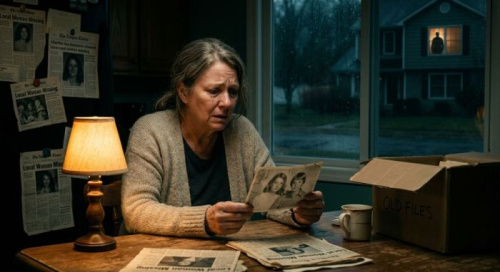
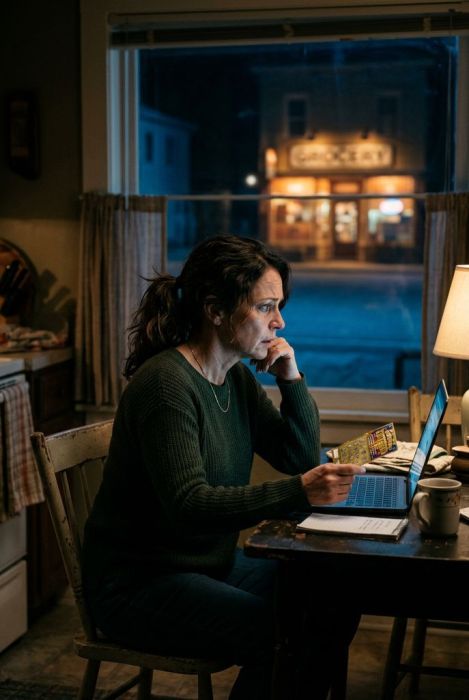
I didn't read it that first night. I was too tired, too sad, too willing to believe the watch would turn up in a donation box. But the next morning it was still there, and I unfolded it over my coffee the way you unfold something you somehow already know you shouldn't.
It was a packing inventory sheet, the kind movers keep. But it wasn't a list of boxes. It was a list of houses. Cresswell — done, with a date in May and a checkmark. Parker — done, September, checkmark. And under those, in Ray's tight handwriting, my address: 58 Cypress Ct — W-1 engraved, J-2, B-1 — 10/29. I stared at it for a long time. W-1. The watch. J-2. My mother's jewelry, which lives in the blue velvet box on my dresser. B-1. The coin collection Tom left me. And 10/29 meant one thing: the date.
I called Sam Okafor instead of the police, because I was shaking too hard to form a sentence, and because Sam was the only person on the street who had ever looked at Ray Whitlock without smiling. He was at my house in ten minutes with a thermos of coffee and a very quiet face. He read the sheet once, twice, and then he said, "Maggie, I've been watching this man for a year. I just never had a piece of paper to prove it." He spread the local crime pages across my kitchen table, and there they were — the Cresswells, the Parkers, and two other families that had used Whitlock & Sons in the past year, every one of them robbed within weeks of Ray packing their valuables. Every one of them small enough that the insurance barely blinked. And my address, scheduled for the twenty-ninth.
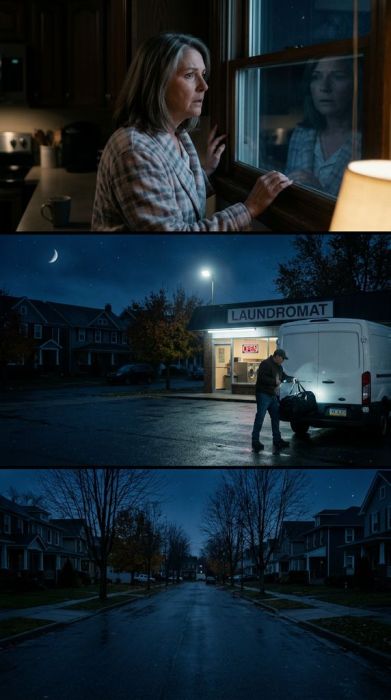
That night I called Lindsay and told her I might be coming to visit after all, for a whole week, starting Thursday. My voice was steady because I had decided to be brave, and because for the first time in fourteen months I was angry, which is its own kind of fuel. Tom's watch was gone, but I was not going to let this man take anything else. I was not going to let him take my sleep, or my street, or the way I remembered the only man who ever truly loved me.
Sam talked to Chief Delgado that same evening. They set up the house like a stage: a decoy lockbox with two thousand dollars in marked bills from evidence, my mother's jewelry box refilled with costume pieces, and cameras in every corner, tiny enough that no one would see them in the dark. I packed one small bag and told the whole neighborhood — including Ray, when he called to check on me — that I'd be in Cincinnati with the twins for a week, and wasn't the house quiet without me.
I did not expect Tyler to knock on my door at dusk the night before I left.
He stood on the porch with his cap in his hands, and I saw the boy he used to be, the one who had carried my lemonade glasses with such care. He said, "Maggie, my dad is not who you think he is." And then he showed me his phone, and I watched a video of his father in the warehouse office, talking to two men I recognized as his weekend helpers, with my address written on a whiteboard behind them. "Thursday, nine o'clock. She'll be at Lindsay's. Basement window, then the bedroom closet. Small stuff only — cash and the lockbox this time."
Tyler told me he had known for two years. He had found the first inventory list when he was cleaning out the truck, and he had said nothing because his mother had cancer bills and his father was the only breadwinner, and because a part of him kept hoping it would stop. It didn't stop, he said. It just got organized. I did not judge him. I hugged him instead, the way I would have hugged my own son, and I told him the exact right thing to do to make it right, and he nodded and said he would do it, no matter what it cost him.
Thursday came the way all Thursdays come, gray and ordinary, and I drove to Cincinnati with my overnight bag and left my porch light off. At nine o'clock I was watching the twins' cartoon with Lindsay, my phone face-down on the arm of the chair, waiting. At 9:14, my phone lit up with Sam's name, and I answered it, and all I heard before he hung up was: "Got them."
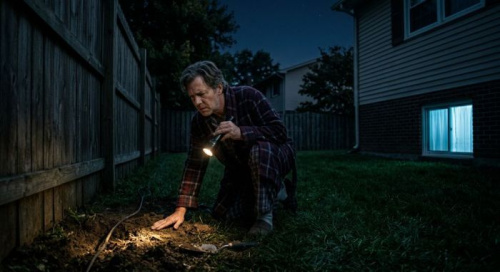
The crew came through the basement window as planned, two men in dark clothes, quiet as church mice. They went straight up the stairs to my bedroom, straight to the decoy lockbox, exactly where the whiteboard said it would be, because Ray had told them it would be there. They never made it back down the stairs. The Millbrook police met them in the hallway with the lights on and the cameras rolling, and the men dropped the lockbox with the marked bills still inside it.
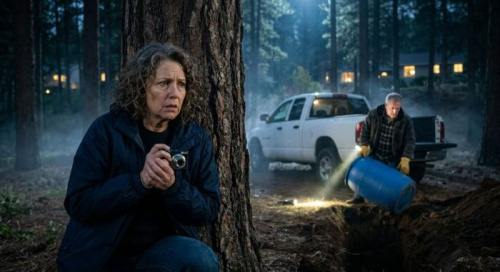
Ray Whitlock was arrested thirty minutes later at his storage unit off Route 9, waiting with the back of his truck open to receive the goods. He hadn't expected the call that came to his own phone at 9:15, but the police had, and they were already there. Inside the unit they found the Cresswells' silver and the Parkers' mother's jewelry box and the coin collection that had belonged to two other families before mine, and on the desk in the corner office, wrapped in a soft cloth in the top drawer, they found Tom's Hamilton watch, still engraved, forever, Maggie.
The jeweler Ray had taken it to had kept it for a month, stalling, troubled by an engraving that said "To Tom, Forever" in the watch of a woman who had just been widowed. He told the police he had suspected something was wrong the whole time, and when they showed up at his shop, he handed it over without a word.
The whole street came to the hearing, and the whole street heard the charges read: burglary, receiving stolen property, and two counts of conspiracy that carried more weight than the cash ever could. Ray pleaded guilty in a voice I almost didn't recognize, and he was sentenced to six years, and the two men in the dark clothes got four each, and Tyler stood in that courtroom and testified against his own father with tears streaming down his face, and the judge thanked him for his courage before giving him probation and a hundred hours of community service.
Mrs. Alvarez got her grandmother's brooch back the following week, and she cried into my shoulder on my porch for a long time. The Parkers' mother got her jewelry box with the little ballerina still on the lid, and the Creswells got their silver back in time to use it for Thanksgiving, which nobody on that street had ever done before. And slowly, wonderfully, Cypress Court started lighting up again at dusk.
Sam Okafor started a neighborhood watch, and forty-two houses joined on the first night. They gave him a clipboard, and he laughed until he cried, and he said he'd retire the clipboard for good the day nobody needed it anymore. Tyler still comes by sometimes to check on me, and he works for an honest moving company now, and when he loads boxes he labels them in the open where everybody can see. He is a good boy, and I have no doubt he always was.
I took Tom's watch to a jeweler downtown and had the clasp repaired, and I wear it now on a chain under my sweater, where I can put my hand on it without anyone seeing. It keeps perfect time, the way Tom would have liked, and on the twenty-third of every month I wind it and I say his name out loud, just to prove that some things in this world still belong to the people who loved them.
Ray Whitlock gave our street free labor for thirty years, and we all thought we knew who he was. The truth is that the kindest man on Cypress Court was cataloguing our houses the whole time, and it took one missing watch to show us what was standing right in front of our faces. I still believe in neighbors. I just check the boxes myself now — and I keep the porch light on at dusk, like everybody else on the street, so we can all see each other clearly, and keep each other safe.