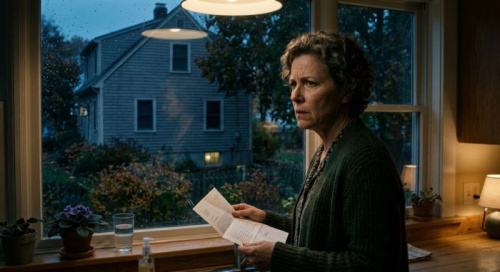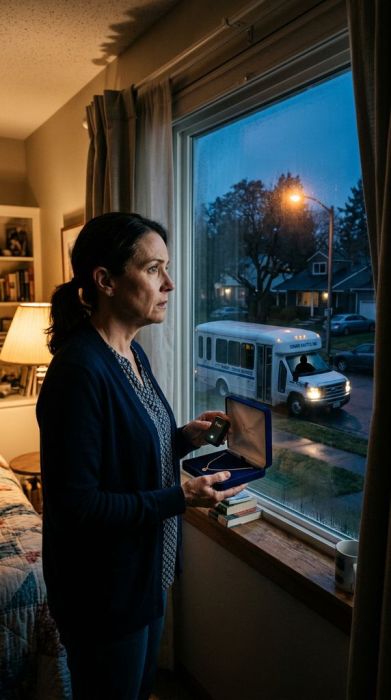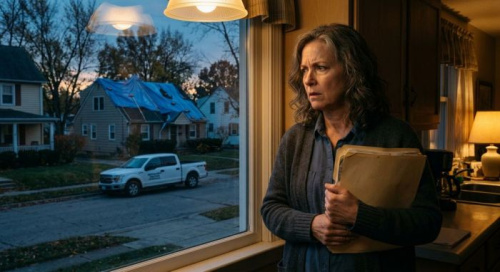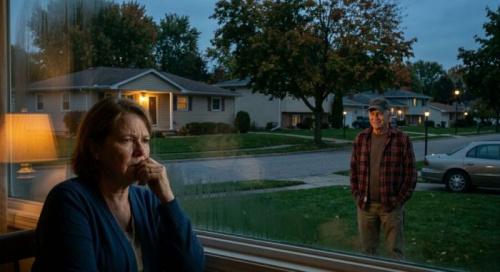
I saw the minivan first, but I didn't understand what I was seeing. It was late September, and I had been home from my daughter Suzanne's house for exactly four hours, my knee still heavy inside the brace, when a man about my age walked up my front steps with a suitcase in each hand and a woman at his side holding a bouquet of grocery-store carnations, like they were arriving at a friend's house. He saw me through the screen door and waved, cheerful as the mailman. "Morning!" he called. "You must be the property manager's wife. We're the new tenants. Lease says we're here through December."
I stood there in Carl's old cardigan and said, "I think you have the wrong house."
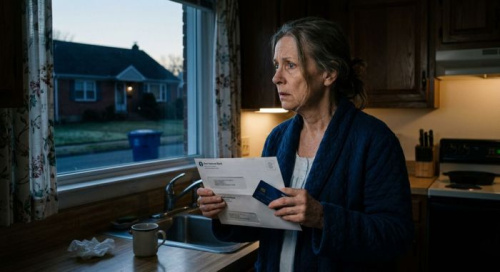
He pulled out his phone and turned the screen toward me. There it was, my own address, 14 Camellia Court, and under it a rental agreement signed a week earlier. Property manager: Mercer Property Services. Monthly rent: three thousand two hundred dollars, first month paid in advance. My hands started to shake. "That's my house," I said. "I didn't rent my house."
He looked at me the way you look at somebody who has wandered into the wrong doctor's office. "Ma'am, we paid a deposit and everything. The manager said the owner was sweet and elderly and wouldn't be around for a year." The woman tugged his sleeve, and I watched the smile leave both their faces as they looked past me and saw Carl's recliner and the wedding photograph on the mantel. "Wait," the man said slowly. "Are you...?"
"Yes," I said. "I'm the owner. And I've been gone six weeks, recovering from knee surgery at my daughter's."
That was the moment I first understood that Boyd Mercer had been renting out my house while I was in a hospital bed two hundred miles away. It was also the moment I stopped being the neighbor who trusted him.
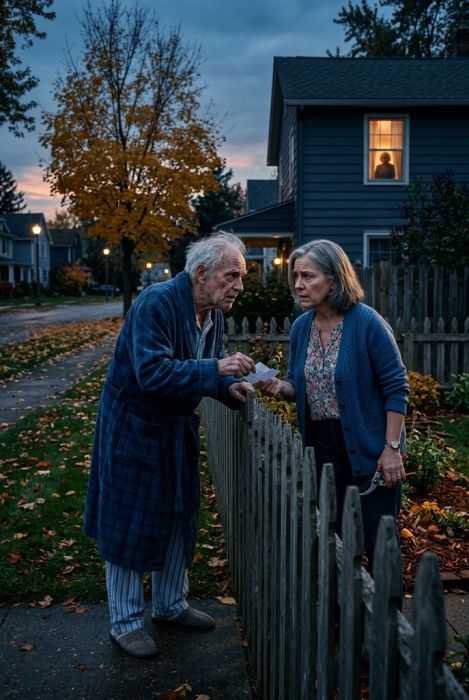
To explain Boyd, you have to understand our street. Camellia Court is the kind of cul-de-sac where the kids still ride bikes in the road and the adults leave their garage doors open on warm evenings. The houses went up in the mid-nineties, and we've watched each other's children graduate. I moved in with Carl in 1999. Carl was a high school history teacher, and I ran the library at the middle school until I retired. Then Carl got sick, and in the spring, four years ago, he was gone. The street wrapped around me like a family — meals appeared on the porch, someone mowed the lawn without a word, and Boyd Mercer was always at the front of that line.
Boyd had moved to Camellia Court eleven years ago with his wife, Trish, who left him three years later and moved back to Indianapolis. He told everyone she couldn't handle small-town cul-de-sac life, and nobody pushed. He carried the loss of her like a badge, and the street compensated. He ran a home services company out of his garage — Mercer Home Services, printed on his truck in friendly blue letters. He did lawns in the summer, shoveling in the winter, gutters in the fall. He was the first person you called when your water heater died, and he never overcharged, which made him the most popular man on the block. He also, as a kindness, held keys.
It started small. The Corbetts went to Florida every February and left Boyd their key to check the pipes. The Delucas followed. When I had my surgery, Suzanne wanted me to recover at her house in Cincinnati, and she worried about the house sitting empty with me laid up and nobody coming by. "What about Boyd?" she said, and honestly, I didn't have to think about it. He was the obvious choice. He came over the week before, in his work boots and his worn baseball cap, and took my key off the kitchen hook like it was the most natural thing in the world. "Don't you worry about a thing, Helen," he said. "Mail, plants, water heater, a light on at night. House'll be happy as a clam." I thanked him and told him I'd leave him a check. He laughed and said, "Neighbors don't charge neighbors."
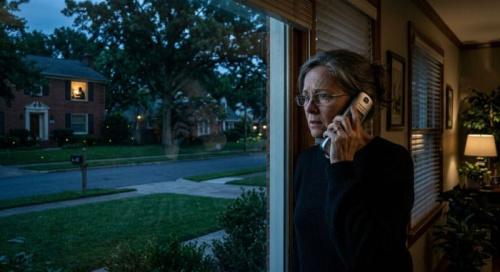
Six weeks is a long time when you can't put weight on a leg. I spent it on Suzanne's couch with my granddaughter Emmy reading me the funny parts of her library books. I called home twice a week, and Boyd always answered from whoever's yard he was standing in. "All quiet," he'd say. "Mail's fine. Lights are on a timer." Then one night Patti Deluca texted me a photo of a silver sedan parked in my driveway at nine o'clock: "Checking on things? Saw a car at your house." I forwarded it to Boyd. "Pest control guy," he wrote back, fast. "Rats in the crawl space, all handled." I felt silly for asking. Not until I got my water bill for seventy-eight dollars more than usual did Boyd say the air conditioner had been left running and he'd already fixed it.
That should have been the moment a normal person heard the wrong note. But you don't think that way about a man who held your porch light. You think he's doing you a favor, and that you're the one who's been gone.
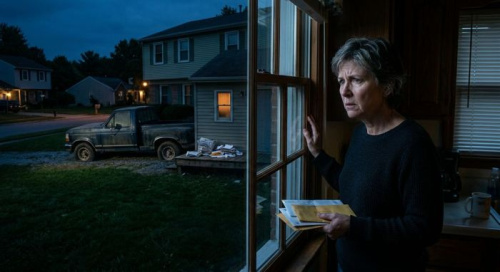
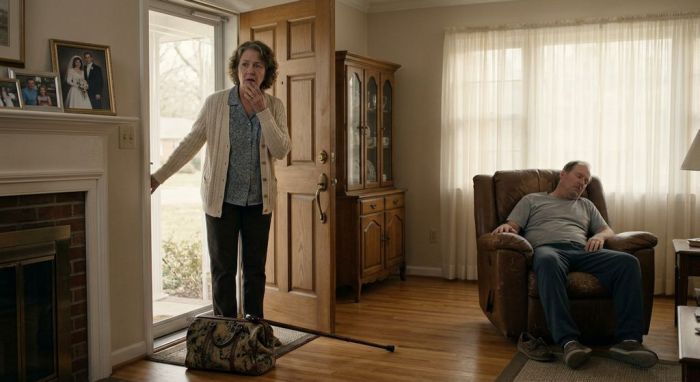
On the morning I came home, Suzanne dropped me at the curb and kissed me goodbye and drove off to work, and I stood on my own porch with my overnight bag and my cane and watched a stranger's minivan parked in my driveway like it had a right to be there. Inside, at the kitchen table, there was a half-eaten breakfast for two and a receipt from the Dahlia Diner for twenty-one dollars, paid in cash. In the guest room, the mattress was gone and the bed had been stripped to the frame. On the dresser sat a cheap floral bed-in-a-bag set and my grandmother's quilt, folded into a laundry basket. And in the living room, asleep in Carl's recliner with his shoes off and his mouth slightly open, was a man I'd never met.
I didn't scream. I stood at the kitchen counter with my hands flat on the laminate and let the anger rise, because waking him meant having to explain that his home was a lie. The man on the phone had been right — the owner was "elderly, out of the picture, gone a year." Except the owner was me, standing in my own kitchen at nine in the morning, no longer sure I owned anything.
His name was Randy Oakes. He was sixty-two, retired from the Ohio Highway Patrol after twenty-eight years, and he'd come to town with his wife, Carol, for a three-month contract job at the new hospital annex. Boyd had listed my house on a rental site with pictures he'd taken the day I left — my living room, my backyard, my screened porch, my drapes. He'd written the listing himself: "Quiet cul-de-sac, furnished, ideal for traveling professionals." Randy had paid him five thousand six hundred dollars: a deposit, first month's rent, and a twelve-hundred-dollar "pet damage fee" even though no pets were involved. He'd felt sorry for the old lady in the listing photo — me, watering petunias a week before surgery — and figured renting a grieving widow's house was helping her out.
When I showed Randy the wedding photograph and told him my husband's name was Carl and Carl had died four years ago and nobody had rented this house, he did a strange thing. He turned very calm very fast, the way I imagine a trooper learns to do at a bad wreck. "Ma'am," he said, "do you have Boyd's number, because I believe we should call him together."
Boyd came over in twenty minutes, carrying two coffees and wearing a caught-me smile. "Helen! Hello, sweetheart. Landed on your feet, I see." He made a show of looking at Randy and Carol like he'd never seen them. "There's been a mix-up. A paperwork mix-up. These folks were supposed to be over at number sixteen — the Harrisons are in Arizona, you know." He was so good I almost believed him, and something cold settled behind my ribs watching a man lie that smoothly. Then he lowered his voice and said, "Helen, you've been through surgery, and you've been confused since. Don't you remember you asked me to look into renting the place? You said the house was too big for you now." He pulled a folded paper from his pocket — a management agreement, dated before my surgery, with a signature that looked like mine the way a photocopy looks like a painting. My name was spelled wrong. Carl's name was spelled wrong. And Boyd knew my knee was the reason I might not trust my own memory.
I want to tell you I was brave in that moment, but I wasn't. I thanked him and said I needed to think, and he left the agreement on the counter like a receipt for a service I'd never ordered. After he was gone, Randy said four words that changed everything: "That man has done this before."
It took us a week to prove it. Randy had kept the texts, the listing screenshots, the money-transfer receipts, every scrap, because twenty-eight years on a highway teaches you to keep everything. We found a Facebook group called Ohio Rental Scam Watch, and buried under four years of posts, a woman from a suburb north of Akron describing the exact same shape of scam: her neighbor, a friendly handyman with a key, had listed her house while she was in a rehabilitation center for six weeks. Same blue truck. Same "don't you worry about a thing." Same folded paper with the wrong spelling. She'd filed a report, the county called it civil, and Boyd settled out of court for eighteen thousand dollars, admitting to nothing. That was how he'd learned that the worst case for him was a handshake and a check.
Meanwhile, my defenders were gathering. Suzanne's brother-in-law, Gary, is a real estate attorney, and the first thing he did was file a felony complaint that nobody could wave away: unlawful entry, theft by deception, and forgery of a signature. The county detective who took the file took one look at Randy's folder and one look at the woman from Akron's old report and said, "We've got a pattern." The second thing Gary did was hand Boyd a letter saying the management agreement was being examined by a document examiner and the matter had been referred to the prosecutor.
And the third thing we did was the trap. Randy had "a cousin in Dayton" — actually a retired deputy named Mike — who needed a furnished rental for exactly two months. Two days later, on a Thursday evening, Boyd walked Mike through my house, past my mother's china, past Carl's photograph, describing me as "an elderly owner, long-term care, won't be a problem." Mike paid Boyd nine hundred dollars in cash, and the whole exchange went onto the body camera of a man pretending to be a renter.
The bust happened at Boyd's annual end-of-summer barbecue. He was at the grill in his backyard, eleven years of our trust sitting in the smoke, when two marked cruisers came up the curb and a detective walked through his gate with a warrant. The whole street watched. Patti Deluca cried, because Boyd had walked her dog for a month after her mother's funeral. The Corbetts stood in their own driveway; Boyd had their lake-house key in his garage. The search turned up the pegboard. That was the detail that undid the street. On it hung eleven labeled keys — eleven neighbors' houses on our court and the two streets behind us — and beside it, a ring-bound datebook with columns: Property. Dates. Tenant. Deposit. Cleaned. Eleven houses.
Boyd was charged that night: breaking and entering, theft by deception, forgery, and a fraud pattern involving eleven properties. His attorney took a plea. Randy got his five thousand six hundred dollars back through restitution. So did the woman from Akron, and two other families the prosecutor found. Boyd served eighteen months in the county jail. His truck sat in his driveway with the blue lettering peeling before the bank came and took the house he'd rented out time after time.
I did not go to watch him be sentenced, but I heard he looked smaller, the way men do when a street finally sees them. He told a reporter he'd only ever wanted to "help neighbors out" and that the neighborhood had turned on him. A few neighbors never forgave me for making them look at the pegboard, and I won't pretend that didn't hurt.
But here is what I want you to know, and I think it's the whole point. When the detectives unpeeled that datebook, my phone rang for three weeks. The widow at number 9 had given Boyd her late husband's key and then spent four nights not sleeping, because she'd let a stranger in and the stranger was the man everyone trusted. A woman from two towns over found the group and drove an hour to sit on my porch and cry — her brother had passed her key to a friend, who listed her house while she recovered from a stroke. Awareness, I've learned, is just another word for the moment you stop being the trusting neighbor. I don't say that bitterly. I say it like a woman who sleeps with her windows open again.
A year later, I sold the house on Camellia Court and moved into a little place two blocks from Suzanne and Emmy, where the neighbor across the street, a retired nurse named Gloria, brings over her pecan bars and has never once asked for my key. On the day of the closing, I handed the new owners — a young couple with a shy dog — a single house key on a blue ribbon, and I told them: "One rule on this street: never give a spare key to a neighbor's service. Ever." They laughed politely, and I let them. You can't teach it. You can only live it, and hope that telling the story makes someone else listen sooner.
Carl would have laughed at me for ending up the warning story of the block. He'd have said I spent years teaching children to be careful with the world and then handed my own key to a man with a truck. He'd have been right. But he'd also have been proud, I think, that when the stranger in his chair woke up, I didn't run. I sat down across from him and said, "My name is Helen, this is my house, and we're going to find out who you paid." Randy Oakes still sends a card every Christmas. Inside, every year, he writes the same thing: "Thank you for not screaming." Someday I'll write back and tell him the truth — that I didn't scream because I was too angry, and that anger turned out to be the best house-sitter I ever hired.