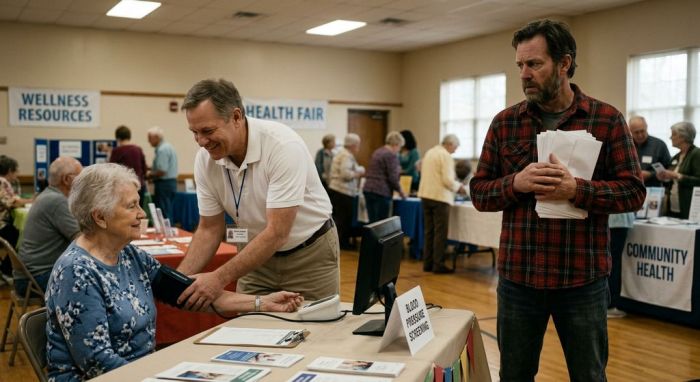
The first time I noticed Greg Harmon, he was holding my father's elbow. It was a Tuesday afternoon in September, and Dad was standing at the edge of the community center parking lot, looking the way he always looked after my mother died — a little lost. Greg had the old man laughing by the time I pulled into the lot. "You have to watch this one, Danny," Dad said. "Guy's a saint."
Greg was fifty-two, maybe, with the kind of friendly face that made strangers tell him their troubles. He'd moved onto Juniper Lane three years earlier with his wife, Pam, and a golden retriever named Winston. He'd retired early, he said — twenty-five years in medical supply logistics — and now he "gave back." On Sundays he handed out bulletins at St. Anne's. On Saturdays he trimmed Mrs. Kowalski's hedges for free. And every first Thursday, he set up folding tables in the community center and ran "Oakmont Senior Wellness Screenings." Blood pressure, glucose checks, a little chitchat. No charge. No strings. People from three blocks away told me it was the best thing that ever happened to this neighborhood.
I should have found it charming. Instead, I found it too good to be true — and I hate that phrase, because it sounds like something a paranoid man says. I'm a high school biology teacher. I've spent thirty years around people who mistake their gut feelings for facts. So I told myself to be rational. Greg Harmon was a good neighbor. The evidence said so. The evidence was wrong.
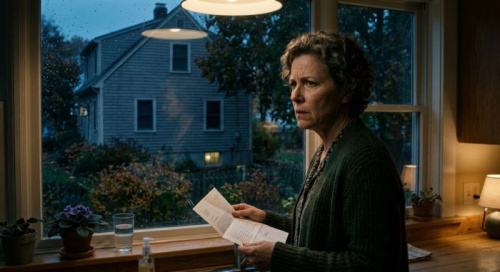
The first real crack came in November, in the mail. Dad's Medicare Summary Notice arrived in a window envelope, and Dad, at eighty-one, has a habit of dropping his mail on my kitchen table unopened. "That's for you," he said. "You understand it better than I do."
I didn't understand it at all. Under "Laboratory Services" there was a line I had never seen in twenty years of reading those statements: a $3,412 charge from something called Biolab of Sarasota, Florida. The test was listed as "Molecular Pathology, Level III." My stomach dropped. Dad had never had a genetic test. He'd barely had a blood test. When I called the clinic, the billing woman went quiet for a long moment. "There's no doctor's order for that," she said, finally. "Not from anyone in our office."
I tried to reach Greg that night. I kept my voice light, neighbor-to-neighbor. "Hey, our Medicare statement has some lab charge on it — that screening clinic you ran in October, was that you?" And that's when I saw the first tiny slip in that perfect, patient smile. He laughed. "Oh, sure. That's a billing mix-up. There's another Frank Whitfield in the system. I'll get it straightened out for you, Dan. You know I hate seeing folks worried." He shook my hand with both of his. His hands were cool and dry. He looked me dead in the eye. Everything about him was calm, and that was what scared me most — because I hadn't told him which screening, or when Dad had gone, or anything else.
Dad swore up and down he'd never set foot in Greg's booth. "I don't need that stuff, Danny, I eat my vegetables." But the charges kept coming. A second notice, six hundred dollars. A third, for a cardiac panel Dad couldn't have gotten without a doctor in the room. And then, on the same afternoon, Mrs. Kowalski's daughter called me in tears. Her mother's Medicare statement for the same month was more than six thousand dollars. "Mom says she never had any of it done," she said. "The clinic says it's from a Sarasota lab. What is going on?"
That's when I started to really look. I walked the block and knocked on doors I hadn't knocked on since the last block party. Eighteen seniors on Juniper Lane, and thirteen of them had statements from Biolab of Sarasota. None of them remembered signing a form that promised anything but a blood pressure reading. Two of them remembered Greg asking for their Medicare card numbers, just to "make sure the free screening was free." The pattern was so clean it made my teeth ache. Somebody had built a machine, and the machine was sitting right across the street in a two-car garage with Venetian blinds that never moved.
I did what any sensible man would do. I called the number on the back of Dad's Medicare card and let a patient advocate at the federal line take down everything: dates, amounts, lab names, addresses. The woman said the words "healthcare fraud" and my hand went cold. She said they'd get back to me, and I believed her, and I also knew better than to wait. I called Marge Deluca instead.
Marge is seventy-one, a retired ER nurse who lives two doors down and has forgotten more about medicine than most doctors will ever learn. She read the codes on my kitchen table the way other people read headlines. "This isn't a mix-up, Dan. This is a crime with a signature." She pointed to a line of six identical codes, one for each statement. "Whoever billed these knew exactly what Medicare pays and what it never questions. Whoever did this didn't stumble. They built a pipeline." Then she went quiet and said the thing I had been too afraid to say: "You need to get your father's card out of the system before something bigger flies through."
The next morning Greg's wife Pam knocked on my door with a basket of apple muffins. "Greg said you've been asking questions about the lab billing," she said, cheerful as a church bell. "He's sick about it, honest. He spent all week on the phone with that lab in Florida trying to get it fixed." I smiled and thanked her and took the muffins, and after she left I opened them up and checked every single one. Rational? Maybe not. But I had reached the point where I didn't trust a free muffin. And I was right not to trust it — because inside the basket, tucked under the muffins, was a hand-addressed note in Greg's careful cursive: "Dan: Be careful who you talk to about this. Some things get 'fixed' faster when they're not stirred up. — G."
That note flipped something in me. It wasn't a threat you could call the police about. It was a handshake with a glove inside it. But it was also a confession — because an innocent man with a billing error does not hand-write warnings to the person who reported it. I put the note in a ziplock baggie with the date written on it. Then I did the one thing Greg never expected. I went to his basement.
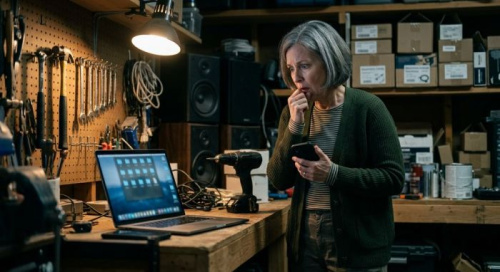
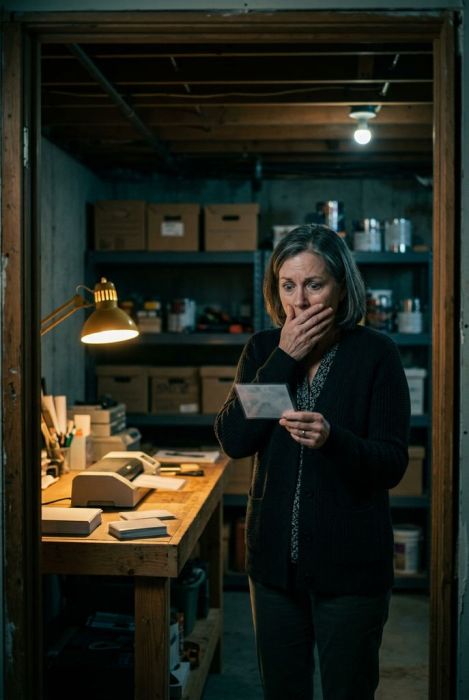
Let me be honest about that part, because I'm not proud of the illegal part of this story. The door to his garage was unlocked — a neighborly oversight — and the door from the garage into the basement was ajar, propped open with a cinder block. What I saw stopped me cold. It wasn't a workshop full of tools and old skis. It was a staging room. Cardboard boxes stacked to the ceiling, each one stamped with a Sarasota return address. Racks of small plastic specimen kits. A laminating machine on a folding table, sitting right next to a gold-framed certificate that made him "Dr." in a field he'd never studied. And on the wall, pinned like a butterfly collection, a board with thirty-one index cards — one for every senior on our street — each with a Medicare number written in the same neat hand I'd seen on my muffins.
That was the moment I should have walked straight out and called the federal line again. Instead I stood there like a man at a crime scene, memorizing every box, every label, every card. And that's where Greg found me, standing in his own light, holding the proof I'd come for. His face went through three expressions in four seconds: surprise, anger, then a horrible smoothness. He closed the door behind him and smiled the way you smile at a child who's wandered where he shouldn't. "Dan," he said. "We need to talk."
I won't pretend I was brave. I was sixty years old and cornered in a neighbor's basement, and for the first five seconds I genuinely thought about whether I could make it up the stairs before he did. But in that same five seconds, I remembered that my phone was already recording, that Marge knew where I was, and that the federal line had my case open and my name on it. I looked at him and I heard myself say something I didn't know I had in me: "Greg, I've already mailed it. All of it. Every card in this room has a copy that isn't in this room."
It was a bluff. God forgive me, it was mostly a bluff. But Greg couldn't know that. For one long, beautiful second, the machine stopped humming. The smile twitched. He said, "You'd destroy your own street for this." And I said, "No. You destroyed your own street. I'm just the one who read the mail."
I got out of there. Marge picked me up at the end of the block in her Buick, and I sat in her passenger seat shaking hard enough to rattle the cup in the holder. But I was also, for the first time in weeks, thinking clearly. Because on the way back I realized Greg hadn't asked me what I'd seen. He'd asked me how much I'd sent. A man innocent of a crime asks you what you're talking about. A man guilty of a crime asks you what you copied.
The federal agents showed up nine days later, on the morning of the biggest event Greg had ever organized: the "Holiday Senior Health Fair," in the same community center where he'd built his little empire. I'd told the patient advocate about it, the way you tell the pitcher which batter is coming. I'd also told Dad to stay home, which earned me the longest silence of my adult life. "You think I'm that old?" he said, and I hugged him and said, "I think you're that loved."
They came at ten in the morning, in unmarked cars, two of them in plain clothes and one in a green windbreaker that said Health and Human Services across the back. They walked through the side door of the community center while Greg was tying a blood pressure cuff on Mrs. Kowalski's arm, telling her she was his "best patient." He saw the windbreaker in the glass reflection behind him and the blood pressure cuff dropped out of his fingers. He tried to make it look like a joke — "I'll grab my wallet, fellas, am I on the list for the golf outing?" — but the agents were already reading him his rights, and the seniors at the next table were looking at him the way we'd all started to look at him: as if they'd never seen him before.
The raid on the house on Juniper Lane happened the same hour. Three agents in gloves carried out the boxes, the racks, the laminator, the gold-framed certificate, and the board with thirty-one index cards, sealed now in evidence bags. The neighbors stood on their porches and watched the whole thing, and I watched with them, and nobody said a word, because what is there to say when the free muffins turn out to have a price after all?
The trial came the following spring. The federal prosecutor laid it out plainly: Greg Harmon had used a legitimate-sounding mobile lab company and a licensed lab in Sarasota as a money pipeline. Seniors who came for a free blood pressure check left with their Medicare numbers in his file. The lab processed the tests it got and the tests it never got, billed Medicare for thousands of dollars each, and split the payout with the charming man in the polo shirt who had never once complained about serving seniors. By the time they froze his accounts, he'd collected more than $480,000 from a system meant to keep old people alive.
He pleaded guilty to eleven counts of healthcare fraud. He got six years in federal prison, plus restitution, plus the house on Juniper Lane, the boat he'd bought in cash, and the cabin up by the lake — all seized to pay it back. Pam left town in April with her sister and Winston, and I heard she'd cried at the hearing, and I believe it, because the worst part of all of this is that Greg wasn't a monster. He was a salesman who found a product he knew how to sell, and the product was trust. He didn't even hate us. He just needed the money, the way a gambler always needs just one more hand.
The after part is quieter, the way real endings always are. Dad got his account scrubbed and a new card, and he carries it in a worn leather sleeve now. Mrs. Kowalski's daughter finally stopped crying when the resolution office called. The community center put up a little laminated notice by the door — the Medicare fraud hotline number, printed in the same blue ink they used for the bingo schedule. And every first Thursday, when the folding tables would have gone up, the hall stays dark, and it feels like the street holding its breath.
Marge and I still talk over the fence. Sometimes I catch myself telling the story too fast, and she'll say, "Slow down, Dan, you act like they're still watching us," and I'll laugh, because they're not. Greg Harmon is locked in a federal facility in Kentucky, and the machine he built has been dismantled piece by piece. But there's one image I can't shake. It's my father, standing on the porch the day the agents finished the search, looking across the street at the house he'd trusted like a neighbor and guarded like a friend. He said, "Danny, I think I'm going to start reading my own mail again."
I hugged him, and I thought about all the years I'd spent believing the good man in the nice house was just the good man in the nice house. And I thought about that note under the muffins, and the thirty-one index cards, and the way a kind voice can be the loudest lie there is. Then I went inside my own house, the one I paid for with a schoolteacher's salary and a schoolteacher's patience, and I locked the door because it was mine to lock. The screen door still creaks when the wind blows. That's fine. It's our creak now, and it was bought with our truth.