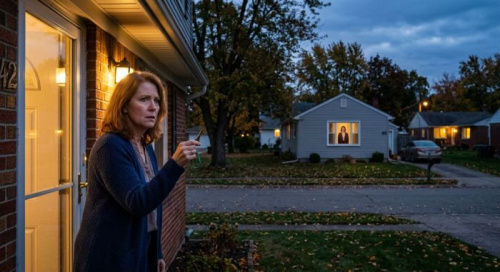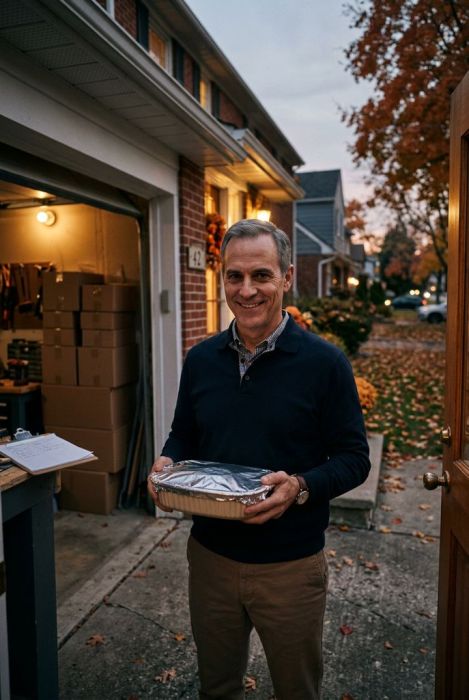
The first time I saw Danny, he was kneeling in Warren Whitfield's front yard with one hand on old Duke's head, letting the dog lick his face like they'd been waiting for each other for years. I watched from my kitchen window, a dish towel in my hands, and I remember thinking how sweet it was. How lucky Warren was, at eighty-seven, to have his grandson come home. I did not know, on that warm September afternoon, that I was watching a stranger wrap my neighbor's life in a pretty bow so he could carry it away like a gift.
Danny introduced himself to the whole street within a week. He said he was Tyler Whitfield, Warren's grandson, and that he'd driven all the way from San Diego the moment he heard Grandpa's memory had started slipping. That part was true, in a way. Warren's memory had been slipping since the minor stroke the winter before, and yes, his grandson had left for the Navy at eighteen and hadn't been home in twelve years. What nobody on Magnolia Court knew — because nobody thought to ask — was that the real Tyler was somewhere on the far side of the world, writing letters his grandfather would never read.
You have to understand the house on the corner of our street. Warren and Eleanor Whitfield had lived there for fifty years, and Eleanor had been gone for nine. Their daughter, Tyler's mother, had died when the boy was small, and they'd raised him themselves, with the same stubborn pride Warren brought to his tomato vines. Every summer he'd press foil-wrapped tomatoes into the hands of anyone walking past, bragging about his soil like it was a third grandchild. The whole street loved that old man. The whole street wanted to believe his family had finally come back to him.
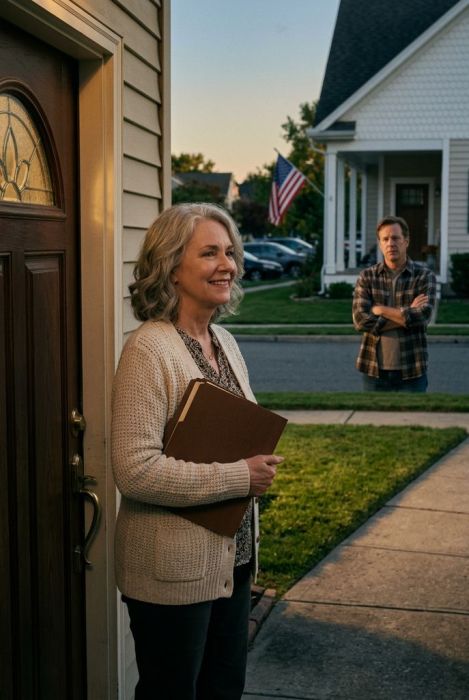
And Danny made it so easy to believe. He fixed Mrs. Kowalski's loose porch step before she even asked. He volunteered at the church pancake breakfast and called everyone "ma'am" and "sir." He brought Warren's mail in before the carrier had even turned the corner — "Grandpa gets confused by all the bills," he'd say, with a sweetness that made you want to pat his arm. Within a month he had the house running like a clock: the mail, the phone, the checkbook. "I'm just helping him," he told me once, holding a stack of envelopes against his chest. "That's what family does."
By October, Warren's famous garden was a graveyard of dead vines, and Danny had an answer ready. "Grandpa's eighty-seven, ma'am. He shouldn't be out here in the heat. Doctor's orders." I couldn't argue with a doctor, even one I'd never met.
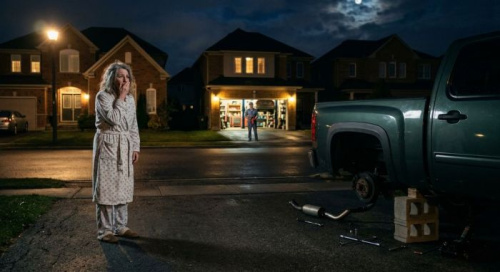
Duke started sleeping outside that month, pressed against the shed like a shadow, with a water bowl that was more mud than water. I mentioned it once, gently, and Danny laughed. "That old dog's spoiled rotten. He comes and goes as he pleases." But I'd known Duke since he was a puppy, and I knew he had never once in nine years spent a night away from Warren's foot of the bed.
Warren himself seemed to shrink. He stopped coming to the Saturday coffee at the VFW, where he'd held court for forty years. The last time I saw him at the diner, he stared into his coffee like it held a question he was afraid to ask. I told myself it was the stroke. I told myself old men shrink. I had a dozen reasons not to look closer, and I used every one of them.
Then came the cookout. Mrs. Kowalski's daughter was home from college, and the whole street gathered in folding chairs with paper plates piled high. Danny steered Warren around like a gentleman, refilling his lemonade, and Warren — mid-sentence about the flood of 1967 — looked at the young man beside him and said, quite clearly: "Danny, pass the salt. I mean Tyler. Tyler. My mind plays tricks on me since the stroke."
Danny laughed it off with a joke about Grandpa's old ticker, and everyone laughed with him. Only I noticed the flash in the young man's eyes before he dropped his gaze — a flicker of something that wasn't embarrassment. It was the first time I truly looked at him, instead of at the good son I wanted him to be.
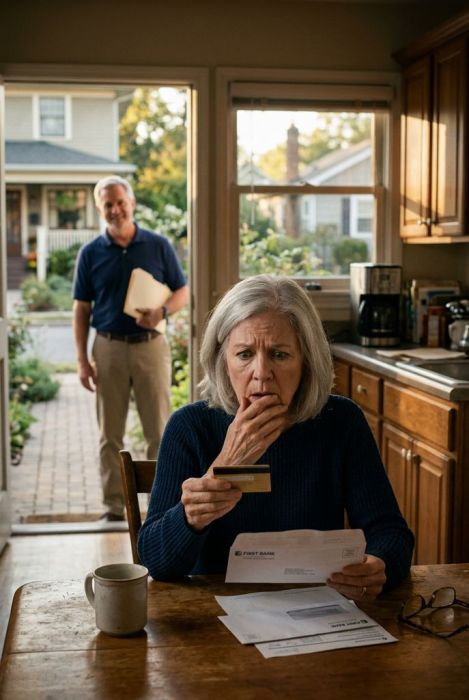
The pharmacy bottles were the second thing. Danny worked during the days — "remote logistics," he said — so when Warren's prescriptions were ready, I'd pick them up on my way home from the grocery. The first time, I noticed the labels: CVS Pharmacy, Escondido, California. Two thousand miles away. "Oh, we had everything transferred," Danny said when I mentioned it. "Grandpa swears by the pharmacists out west. Legacy of my San Diego years." I nodded because it was easier than asking the question sitting at the back of my throat: since when did an eighty-seven-year-old man with a stroke have a favorite pharmacy in a state he'd never visited?
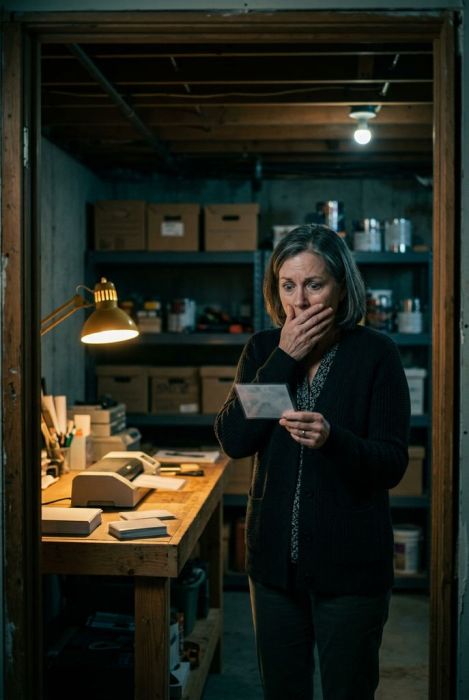
The night of the fall, I stopped making excuses. Warren had gotten tangled in the rose bushes at the side of his house — he said later he'd been looking for Duke — and I helped him inside while Danny was at the store. The living room felt wrong before I could say why. The wall above the fireplace, where a gallery of family photographs had hung for as long as I'd known the house, was bare. "We're painting," Danny said when I asked about it, but there was no paint, no drop cloths, no blue tape. On the desk by the window sat a stack of papers, and on top of them a document with Warren's signature — loopless, shakier than the bold Warren Whitfield I'd seen on a hundred birthday cards. His reading glasses lay beside it, one lens cracked.
And the walls in that little house were thin. That night I heard Danny on the phone, his voice low and jittery. "Because the power of attorney is signed, that's why. The house is essentially mine. I just need the deed and we're done."
I didn't sleep that night. I lay awake counting the reasons I could be wrong, and I came up with a dozen, and none of them felt like enough.
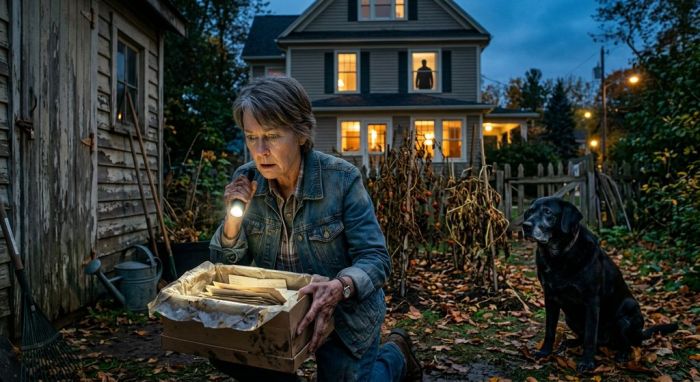
It was Duke who showed me the truth. A week later he'd gotten under my fence — that dog had never once come into my yard uninvited — and he was digging frantically at the corner of Warren's shed, whining low in his throat like a hurt animal. I went out with a flashlight and a bag of cold cuts, and the moment I crouched down I saw the loose board, and under the board, a shoebox wrapped in wax paper and tape.
I shouldn't have opened it. I tell myself that even now, and I know I'd do it again tomorrow.
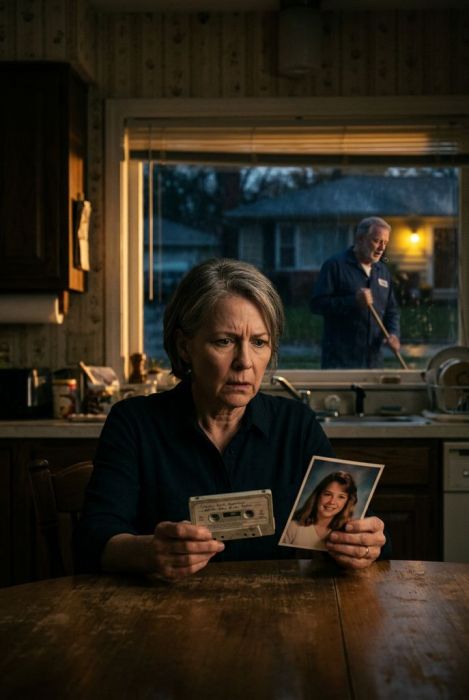
Inside were letters. Dozens and dozens of letters, fastened into neat bundles, every single one unopened, addressed to Warren Whitfield in a cramped, earnest handwriting. The return addresses were postmarks from Norfolk, from San Diego, from a ship's name I couldn't pronounce. The top letter was postmarked three weeks before. The bundle beneath it went back two years, three — fifteen months at least, maybe more — and every one of them was sealed, never read, hidden under a shed where an old man's dog had been digging for days.
My blood ran cold. I knew in that instant — the way you know a thing before your mind catches up — that somewhere, on a ship or in a port, there was a real Tyler Whitfield writing letters to a grandfather who never received a single word. And the man sleeping in Warren's house, wearing his name like a borrowed coat, had been stealing them one by one.
I took only the top letter and put everything back exactly as I'd found it. Inside the envelope, along with three pages of a young man's careful handwriting, was a phone number. I called it at four in the morning Ohio time, which was four in the morning somewhere in the Pacific, and a voice thick with sleep and a Texas drawl answered: "This is Tyler."
I told him who I was. I told him about his grandfather. There was a long silence, the kind that travels across oceans, and then he said, very quietly: "Ma'am, I've written my grandpa every two weeks for three years. He's the only family I've got left. If somebody's been sitting in that house telling people he's me..." He stopped. "I'm on leave in eleven days. I'll be on the first plane I can get."
We planned it like a small, quiet war. Tyler flew into Columbus and stayed at my house, out of sight. I told Danny the church was throwing a luncheon to honor Warren as the street's oldest veteran, which was true enough to be beautiful. Danny loved the idea — bless his greedy heart, he saw an audience, another room full of people to charm. We printed the flyers. We baked the cakes. We invited every soul on Magnolia Court.
The day of the luncheon was bright and cold, the sky that hard October blue. Danny stood at the front of the church hall in a pressed shirt, one hand on Warren's shoulder, telling a story about "Grandpa's" heroics in Korea that I'd never once heard Warren tell. People were smiling. Plates were being passed. And then the door opened.
Tyler Whitfield walked in wearing his dress blues, and the room went quiet the way rooms do when the truth arrives.
For a long second, nobody moved. Then Warren — the old man who'd seemed so lost, who'd been shrinking for months — looked up, and his whole face changed. "Ty-Ty?" he said, in a voice I hadn't heard in years. The name only one person in the world called him.
Danny's smile froze. I saw the calculation happening behind his eyes, the quick math of escape. "Hey, pal," he said, loud and jovial, "I don't know who you are or what you're selling, but this is my grandfather's party—"
Tyler pulled out his military ID and held it up like a mirror. Then he pulled out the letters — all thirty-one of them, the ones we'd dug up the night before with a sheriff's deputy watching — and laid them on the table in front of Warren. "Grandpa," he said, and his voice cracked, "I wrote you thirty-one times. Every two weeks for three years. You never answered. I figured you were done with me."
Warren's hands shook as he picked up the top envelope. He turned it over. He looked at Danny — at the man who had been his grandson for three months — and I saw understanding arrive in his eyes like a slow, terrible dawn. "I never saw these," he said. "I never saw a single one."
That was when the deputies came through the side door. Danny — Danny Crowe, as his license turned out to read — bolted toward the kitchen and made it two steps before Mrs. Kowalski's son-in-law, who'd played defensive end in college, put him on the floor. They found the forged deed in his truck, and a notebook in his duffel bag with the names and addresses of three more elderly marks in two other towns, each one annotated in his tidy hand: "POA signed." "House almost mine." "Needs one more signature."
He'd been doing this for years, moving from one quiet street to the next, wearing the names of sons and grandsons who were too far away to answer.
The bank clawed back most of the fifty-two thousand dollars he'd drained from Warren's accounts. The fraud division at Social Security caught the redirected pension in time. Danny got federal time — identity theft, financial exploitation of an elderly person, mail theft, forgery — and the judge made an example of him. The county prosecutor used our story in a training video for adult protective services, walking through the signs we'd all missed: the dying garden, the thin dog, the bare wall of photographs, the pharmacy labels from two thousand miles away.
Tyler took a stateside posting and moved into the old gray house. He planted tomatoes with his grandfather the following April, Warren in his lawn chair bossing him around, memory razor-sharp on the days that mattered. Duke got fat. The garden bloomed. The street threw a block party to welcome the real Whitfield family home, and somebody hung a banner that said "Welcome Home, Tyler," and I cried into my potato salad like a fool.
I still think about that September afternoon — the stranger kneeling in the grass, letting a dog he'd never met lick his face. Duke had known the truth from the first sniff. He'd spent his whole life loving one family, and he knew, the way dogs know, that this man was not his boy. He just couldn't tell us in words, so he showed us in the only language he had: he dug, and he waited, and he led us to the letters.
Sometimes the ones who love us most are the quietest. And sometimes, it's an old black dog who finds the box that brings the real family home.