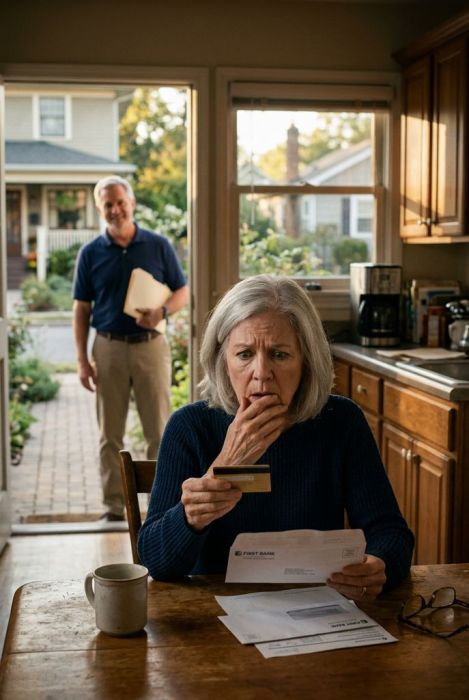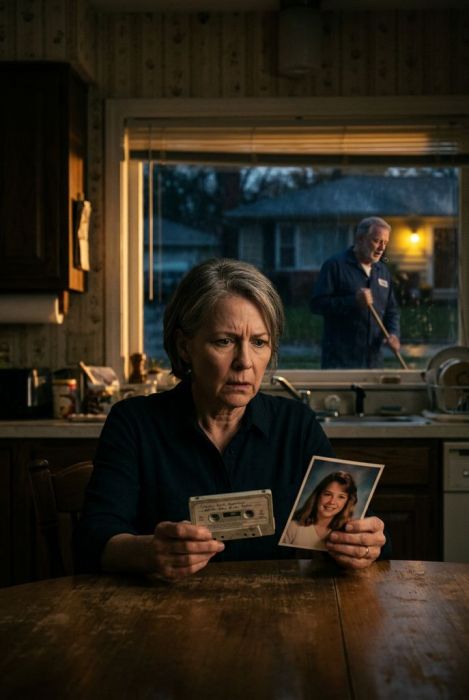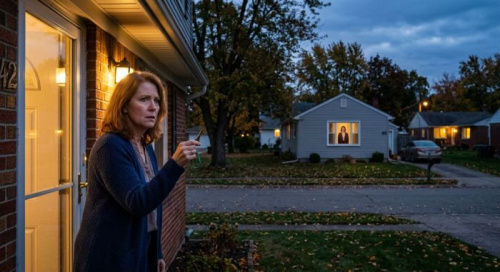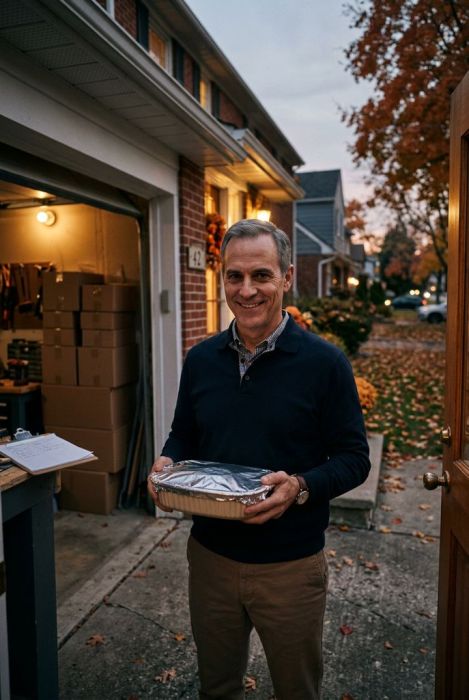
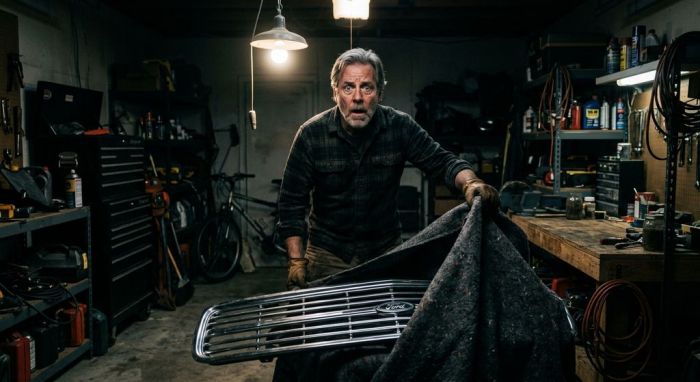
The grille sat on a wooden workbench at the back of Ray Kessler's garage, wrapped in a gray moving blanket like something precious. I didn't need the blanket pulled back to know what it was. That dent on the passenger side, just above the headlight — the one my brother Frank put there back in 1998 when he backed Dad's truck into the corner post at the old grain elevator — was as familiar to me as my own reflection. I stood there with Ray's shop rag still in my hand, my ears ringing like a struck bell, while footsteps crunched across the gravel outside.
"Bill?" Ray's voice drifted in from the driveway. "You still back there?"
I had maybe twelve seconds to decide what kind of man I was going to be from that moment forward. Twelve seconds, a moving blanket, and my father's truck grille staring at me out of the gloom of a neighbor's garage.
Most people on Juniper Lane would tell you Ray Kessler was the best neighbor we ever had. He moved into the house at the end of the cul-de-sac four years ago, a trim, friendly man in his forties who ran a mobile detailing business out of his driveway. He called it Ray's Shine. He was always polishing someone's car in the evenings, always whistling, always the first to volunteer when someone needed a hand. When Mrs. Delgado's hedges needed trimming, Ray was there with his trimmer before she could ask twice. When the Millers flew to Florida for two weeks, Ray collected their mail and watered their ferns, and he refused to take a dime.
He flipped cars, he told us. Bought them cheap at auction, detailed them, sold them for a few thousand more. That explained the parade of vehicles in his driveway — a red Camaro one week, a white Silverado the next, sometimes two at a time. "Auction finds," he'd say with that easy grin, rubbing his hands with a rag that always smelled faintly of solvent.
Crestwood, Ohio, is the kind of town where that sort of neighbor makes you feel blessed. Forty miles south of Columbus, two stoplights, one diner everyone calls The Rail. We used to leave our doors unlocked, used to wave at every passing car, used to believe the worst thing that could happen on our street was a raccoon getting into someone's trash. That was before Frank's truck disappeared, and before I learned what was really under that tarp.
The truck was our father's 1986 F-150, candy-apple red, three-on-the-tree, with a bench seat worn smooth by forty years of calloused hands. Dad bought it new the year I turned ten. He drove it until his knees gave out in 2009, and when he died that December, Frank and I restored it in the shed behind our mother's house. Frank was always closer to that truck than I was. He kept it in his garage on Honeysuckle Road, drove it to car shows every summer, and told anyone within earshot that Big Red would go to his son, Tommy, the day he couldn't climb into the cab anymore.
On a Tuesday in late August, Frank called me at 6:10 in the morning, his voice doing something I'd never heard it do before.
"Bill. The truck's gone."
I drove over in my bathrobe. The garage door was standing open, and the empty bay where Big Red had been parked looked like a missing tooth in a photograph. Frank stood on the sidewalk in his work boots, staring at the tire marks on the concrete like they might rearrange themselves into an explanation. The police came, and a detective with a clipboard took notes, and Frank told him about the dent and the bench seat and how the odometer had rolled over twice. The detective said what detectives say. Vehicle theft task force. Chop shop. Insurance. Frank's policy covered maybe half of what Big Red was worth, and Frank told me he didn't care about the money. "That truck's got Dad's fingerprints on the wheel," he said. "I want it back."
I wanted it back too. What I didn't know yet was that I'd already seen it — pieces of it — a thousand times, from my own front porch.
Because that's the thing about being a retired diesel mechanic. You notice things other people don't. I noticed that Ray's "auction finds" never had auction stickers in the windows or dealer plates on the bumpers. I noticed that the black van from Apex Auto Parts pulled into his driveway at three in the morning on the third Tuesday of every month, and that Ray always waved when he saw me watching, like the timing was perfectly innocent. I noticed that his garage, which he claimed was full of nothing but detailing supplies, had a heavy exhaust fan mounted in the back wall — the kind body shops use, not waxers.
And I noticed the smell. Cutting fluid, ozone, hot metal. The smell of a torch and an angle grinder. The smell of things being taken apart.
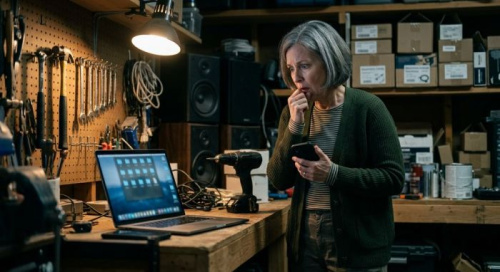
He asked me to look at his truck on a Thursday night. "Just a chirping belt, Bill. Ten minutes of your time. I'd do it myself, but you're the artist." Flattery, I know now. The belt was fine, but I didn't say so right away. I leaned over the engine, and Ray got a call on his phone that made him step into the house — something about a delivery issue, his hand cupped over the speaker. Alone in his garage for the first time in four years, I did what any old mechanic would do. I looked around.
And that's when I saw the tarp.
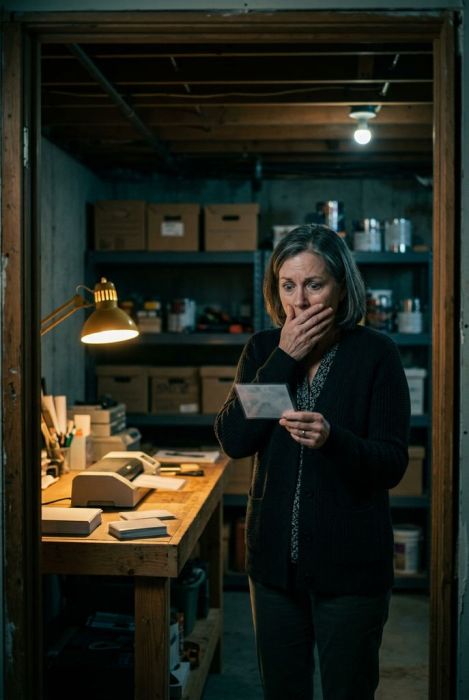
It was draped over something long and flat on his workbench, and my boot caught the edge of it as I turned toward the sink. The blanket slipped six inches, and there it was. A chrome grille with a FORD emblem at the center and a dent above the passenger-side headlight that I could have picked out of a lineup of a thousand grilles.
I stood there with my heart in my throat. Then I heard the gravel crunch under his boots, and I tucked the blanket back the way it had been, and I was washing my hands at the sink when he came through the door.
"All fixed?" he asked.
"Belt was just glazed," I said. My voice came out steadier than I felt. "Give it a week and it'll quiet down."
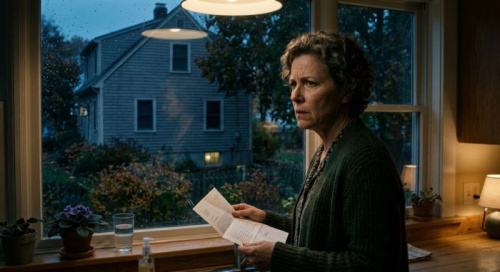
He smiled at me — the same easy smile he gave the whole street — and I walked home on legs that didn't feel like my own. Nancy knew something was wrong the second I came through the door. I told her everything. She said call the police. I called the police, and the detective listened politely, and then he told me what I already knew: that a grille under a tarp in a neighbor's garage wasn't probable cause, and that Ray Kessler had never been arrested for anything in his life.
"You bring me something I can walk a warrant in with," the detective said, "and I'll walk it in with you."
Two nights later, someone broke into my garage. Nothing was taken. My toolbox was open, and my father's old work gloves — the cracked leather ones I kept on a peg — were laid out neatly on the bench, side by side, like an offering. I called the police again. They took a report, and a patrol car circled the block for forty-five minutes, and then the street went quiet.
The next morning, Ray was waiting for me at the mailbox.
"I saw the tarp move, Bill," he said. He didn't smile. He stood close, and he spoke softly, like he was telling me a secret. "I know what you think you saw. I'm going to tell you the same thing I'd tell my own brother. Some things aren't worth being a good Samaritan about. You and Nancy have a nice life. Nice house. Nice garden. Nancy walks at 6:15. Real regular." He patted my shoulder once, and walked back to his garage, whistling.
I stood there shaking for a long time. That was the moment I understood two things. Frank's truck wasn't coming back through the front door of any system, and Ray Kessler had just shown me exactly who he was.
The person who finally believed me was Ed Kowalski, two houses down. Ed was in his seventies, a retired Columbus PD detective who had spent twenty-two years in auto theft. He had been watching Ray longer than I had. "Title washing," he said the night he knocked on my door. "That's what he's doing, Bill. They buy stolen vehicles, grind the VINs, cut them into parts, and move the parts through a network of shops. The auction story is how he explains the cars. The detailing is how he explains the cash." Ed had already made a call to the regional auto theft task force, and Detective Calderon — a woman with more undercover years behind her than most squads put together — came to our kitchen and listened without interrupting once.
"Give me a vehicle worth stealing," she said, "and I'll give you your warrant."
Ed had a 2019 Silverado he had been meaning to sell. Between the three of us — Ed, Calderon, and a task force with more cameras than a movie set — we built the trap. They buried a tracker in the frame, hid a camera in the cab, and bolted a clean, factory-fresh VIN plate onto the door. Ed parked it in his driveway with a FOR SALE sign, and he mentioned to Ray, offhand, that the dealership had lowballed him and he was done haggling.
My part was small, and it made me sick to do it. I did it anyway.
"Ed's finally selling that Silverado," I told Ray over the fence a week later. "He's getting old. Doesn't want the hassle."
Ray's eyes did something I didn't like. Interest, then greed, then smoothness. "Huh," he said. "Good truck. I might take a look."
The Silverado disappeared from Ed's driveway on a Wednesday night. Ed had "forgotten" the keys in the cup holder, which is a detail that still makes me smile. The tracker showed it moving at two in the morning, and it went exactly where we all knew it would go: into Ray's garage, where the door came down like a curtain.
The task force hit the house at 4:47 the next morning. I watched from my bedroom window, my hand flat on Nancy's shoulder. Floodlights. Blue and red swirling over the cold grass of a September dawn. Ray Kessler came out in his bathrobe with his hands behind his head, and the look on his face wasn't the easy grin we all knew. It was something smaller.
They found the Silverado on jack stands in the back bay, doors off, mirrors off, the grille already loosened. They found Big Red's chassis under a pile of tarps — frame, engine block, numbers intact, waiting to be cut like everything else. They found a VIN grinder and a box of counterfeit registration plates and a ledger disguised as a detailing appointment book, with columns that matched stolen-vehicle reports from Ohio, Indiana, and Pennsylvania. They found a burner phone with a list of buyers.
It took a year and a half, but Frank and I rebuilt Big Red from the engine block up, using the parts the task force recovered. Tommy, Frank's boy, helped with the wiring. We fired her up on the first turn of the key, and Frank cried, and I pretended not to see it, and we drove her down Juniper Lane with the windows down and the radio playing something old.
Ray Kessler pled guilty to charges across three states. He was sentenced to nine years in federal prison and ordered to pay restitution that stripped the equity from his house, which sold at auction and sat empty through two winters. Mrs. Delgado still shakes her head when she passes it. "He shoveled my walk, Bill," she says. "He shoveled my walk."
I know. That's the part that still gets me. He could have just been the nice man at the end of the cul-de-sac. Instead, he was the man who stole my father's truck and thought a friendly smile would make me forget.
The garage sits empty now, and the street has a neighborhood watch, and Nancy walks at 6:15 every morning, the same as always. Sometimes I sit on my porch with my coffee and look down the cul-de-sac and think about how close we came. How one dent in a chrome grille, made by my brother's fender in 1998, was the detail that brought the whole thing down.
The lesson I carry with me is simple, and it isn't grim. Be friendly to your neighbors. Trust is a good thing. But when a man tells you some things aren't worth being a good Samaritan about — believe him when he shows you exactly who he is. Then do something about it.