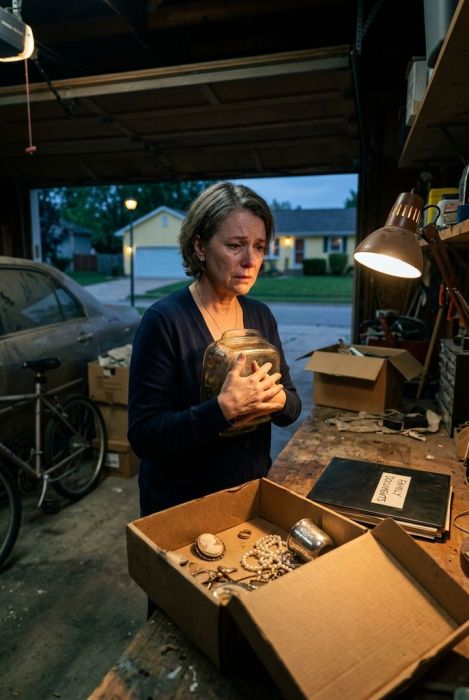
I saw my mother's cameo first. It caught the pale light from the garage window and turned, and for one second I thought my eyes were playing the same trick they'd played a hundred times since she died — the glimpse of her in a crowd, the echo of her voice in a quiet room.
But this was not a trick. The cameo sat on top of a cardboard box marked CHRISTMAS DECOR, and beneath it, tangled like fishing line, lay a silver baby cup, a man's gold wedding band, and a string of pearls I recognized from Diane Albright's neck.
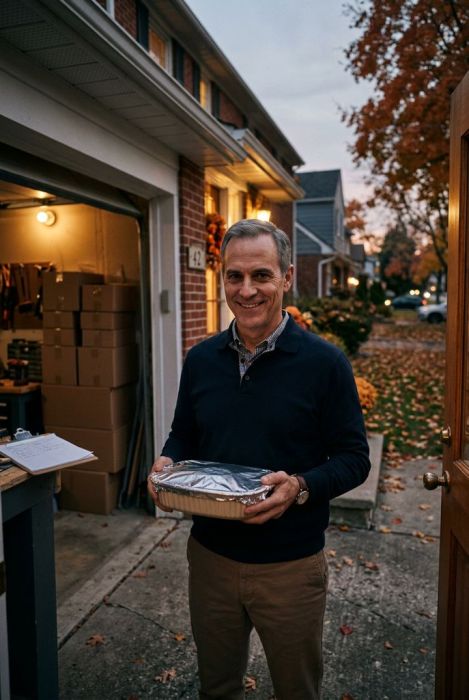
I was holding Phyllis Harmon's casserole dish. That was the only reason I was in her garage at all.
The door had been cracked, three inches, just enough for a cat or a gust of wind. I'd meant to set the dish on her porch and leave a note, the way everyone on Juniper Court had learned to return Phyllis's dishes — because she never asked for them back, because she always said the same thing with that soft, mournful smile: "Oh, honey, you keep it. You've got enough to carry right now."
That was Phyllis. The street's guardian angel.
She brought warm meals to every doorstep within an hour of sorrow arriving. She always knew which family was sitting vigil at the hospital, who'd gotten bad news, who needed a freezer full of lasagna. For nine years, since she and her husband Walt moved into the yellow house at the end of the block, Phyllis Harmon had been the first person every grieving family called.
And now, standing in her garage, I understood why she never attended the funerals.
She always had a reason, delivered in that same gentle voice. "I can't bear it, Claire. I'd rather serve the family here at home. Let me watch the house while you're gone. Let me water the plants and take in the mail. You shouldn't come home to a cold, dark house."
Nobody ever thought it was strange. Nobody ever thought anything was strange about Phyllis. That was the whole point.
My mother, Ruth Bennett, died on a Tuesday in March, three weeks shy of her eighty-fifth birthday. She'd been living with me for two years after a small stroke, and the end came fast — a fall, a hospital, a quiet room. I was alone in the world except for my daughter Sarah, who flew in from Phoenix for the service. My husband Dan had been gone five years, and in the weeks after Mom died, I moved through the house like a ghost, not seeing anything, not wanting to see anything.
Phyllis arrived with ziti within the hour. She always did.
"Oh, Claire," she said, and her eyes filled with tears that looked absolutely real, and I suppose they were, in their way. "I'll take care of everything. You just grieve."
She took over. That was what she did. She made the calls to the church. She organized the reception. She told me what to wear, and she asked, very gently, if I wanted a few pieces of Mom's jewelry to hold during the service.
"The cameo," I said. "She wore it to my father's funeral. It meant the world to her."
"I'll find it for you," Phyllis said.
She didn't find it. Nobody found it. When I finally looked through Mom's jewelry box myself, two days after the burial, the cameo was gone. So was a gold bracelet Dan had given me for our twentieth anniversary, the one I kept on Mom's dresser because she loved to look at it.
I convinced myself I'd misplaced them in the fog of grief. That was what everyone on Juniper Court did.
Because that was the genius of Phyllis Harmon. She robbed us, and we blamed ourselves.
Diane Albright lost her diamond studs three weeks after her sister's funeral. Phyllis had watched their house that afternoon. "I'm so sorry, Diane," she'd said, "but are you sure you didn't leave them at the church?" And Diane, exhausted, tearful, had apologized for wasting Phyllis's time.
Angela Perez lost her grandmother's wedding band after her grandmother's service. "It just slipped off, honey," Phyllis told her, comforting. "These things happen during grief."
Old Mr. Peregrine's war medal vanished the week of his wife's memorial. Phyllis had offered to tidy the sideboard.
I'm not sure when I started to notice. Maybe it was the question Phyllis asked after my mother's service, while the last guests were leaving: "Did the hospital do an inventory of her things, Claire? Sometimes they lose track of jewelry, you know."
It was kind. It was helpful. And it was the same question she'd asked every grieving family on the street for nine years, because it told her whether anyone would be looking.
The night I found the cameo, I almost didn't go to her house at all. The casserole dish had sat in my sink for ten days, and I knew if I didn't return it, Phyllis would "just happen to stop by" to collect it — walking through my house with her soft eyes and her sweet voice, taking in the rooms, remembering where I kept things.
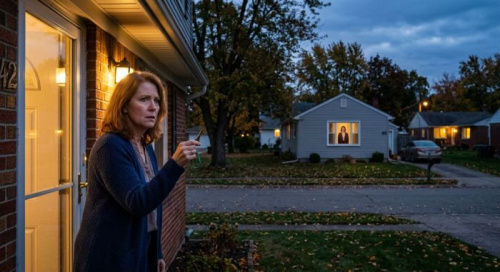
I set the dish on the passenger seat at eight o'clock that evening. Her garage door was cracked open, leaking a wedge of yellow light onto the driveway. I meant to leave the dish on the porch. I swear I did.
But as I got closer, I heard something — a small, dry, humming sound. A radio, maybe. And I saw, through the crack in the door, that the workbench light was on, and on the workbench sat a thin black binder. And I saw, because the garage door opened toward the house and the angle was exactly wrong for her to see me, that the binder was open to a page with my mother's name written at the top in Phyllis's careful schoolteacher handwriting.
Ruth Bennett — cameo brooch. Gold bracelet, 20th anniv. Check upstairs dresser, middle drawer. No safe. House key under blue pot.
The garage door was heavy, but it moved when I pushed it. I told myself I was going to confront her. I told myself I was going to ask her what any of this meant. But when I stepped inside, the garage was empty — just the radio on the workbench, humming, and the binder, open, and the cardboard box marked CHRISTMAS DECOR.
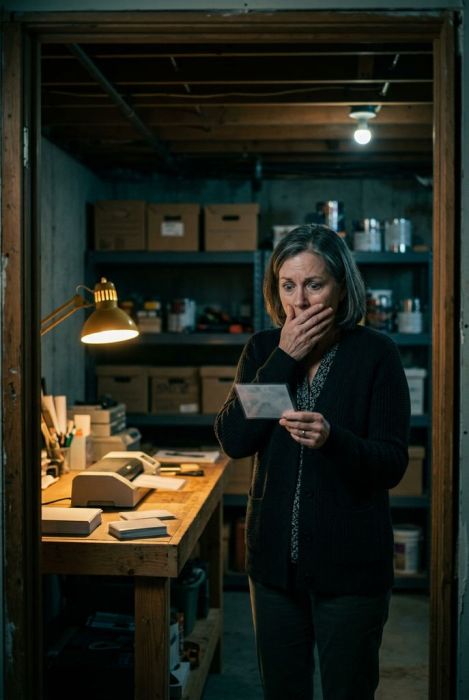
I knew I shouldn't touch it. I knew what I would find. And I opened it anyway, because my mother's cameo was in there, and I would have walked through fire to hold it one more time.
The box was full of other people's grief.
Two brooches, a man's watch, the Albright studs in a tissue, the pearls, the wedding band, a silver rattle, a medal on a ribbon, a locket with a child's photo, a stack of sympathy cards. She kept the sympathy cards, too — the ones people wrote her, thanking her for her kindness. She kept them like trophies.
Under the jewelry, in a manila folder, were the notes. Nine years of notes. Every funeral, every memorial, every hospital bed on Juniper Court, and two streets over, and four blocks down. Names, dates, valuables, and — in the margins, in that same kind handwriting — little reminders: "Watched house during service. No one came home early." "Told family I'd check the mail."
I took only two things that night. The cameo, because it was my mother's. And the binder, because it was everything.
I didn't confront her. I went home, locked every door for the first time in forty years, and called Frank Doyle.
Frank had been a state trooper for thirty-one years. He lived at the other end of Juniper Court, and he'd loved my mother — not the way Dan loved me, but the way old friends love each other: faithfully, without needing to say it. He was the first person I called after Mom died, and he was the one who'd told me, gently, that hospitals are very good about keeping track of personal effects.
That night, after I read him the notes from the binder, Frank went very quiet.
"Funeral burglaries," he said finally. "You hear about them. Someone inserts themselves into a grieving household. The family trusts them, lets them in, hands them the spare key. And the whole time, they're writing down what the dead person left behind." He paused. "I've seen it once in thirty-one years, Claire. It takes a special kind of cold to do it to someone you bring lasagna to."
I told him about the trap I wanted to set. I told him I wasn't going to let her do this to another family. And Frank — who had known me my whole adult life, who had watched me bury a husband and a mother in the same five years — said the only thing I needed to hear.
"Then we'll catch her together."
The plan was simple, and it worked because Phyllis Harmon could not resist a funeral.
The following week, at the church coffee hour, I let it slip — quietly, so the whole room heard — that I was driving to Phoenix to stay with Sarah for a while. That I needed to get away. That I'd asked Phyllis to keep an eye on the house while I was gone, of course, because she was the only person I trusted.
Phyllis's smile never flickered. "Oh, honey, of course. I'll take such good care of it."
The night before I left, I did something that would have horrified the women of Juniper Court. I taped my father's gold watch to the inside of Mom's jewelry box — a real watch, one I genuinely treasured — and I slipped an AirTag beneath the velvet lining. Then I put the box in the drawer where Phyllis's notes said I kept it.
"Are you sure you want to do this?" Frank asked me at the door. It was the last time he asked.
"She took my mother's cameo the day of her visitation," I said. "I'm sure."
I drove to the airport the next morning. I really did fly to Phoenix. Sarah thought I'd come to stay, and I let her think it, because I couldn't tell her the truth: that her mother had just baited a trap with her father's watch.
It happened on the third night.
Frank called me at nine. "She's at your house, Claire. The tracker's moving — she's in the bedroom."
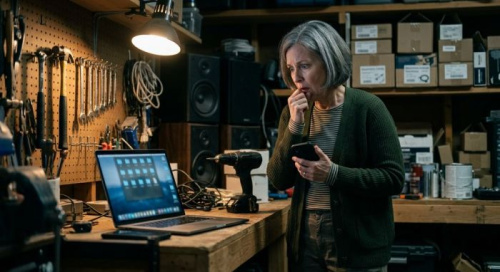
The tracker was an AirTag, and the camera was a cheap motion camera Frank had mounted in my kitchen, aimed at the back door. I'd never asked how he knew how to wire it. I'd never needed to.
"Call the police," I said.
They caught her with the jewelry box in her hands, coming out my back door at nine-fifteen, wearing the same blue coat she wore to every funeral. She had my father's watch in her pocket and my mother's cameo in her purse — because she'd kept it, Frank told me later, she'd kept it to look at, the way she kept all of it.
The search warrant found the rest. The Christmas-decor box. The binder with nine years of names. The pearls, the studs, the baby cup, the medals, the locket, the wedding bands — forty-one items from twenty-six families in four neighborhoods. In a shoebox upstairs, still wrapped in tissue, were the sympathy cards people had written her. Our thanks. Our love. Our grief. She'd saved every one.
Phyllis Harmon cried when they arrested her. That was the detail everyone remembered. She stood in her apron — she'd made herself a cup of tea before stepping into my yard, the police said, as if she'd been about to sit down and enjoy it — and she cried, and she said to the officer, so softly, "I was keeping them safe. The families were so upset. I was keeping them safe until they were ready."
Nobody on Juniper Court believed her. After nine years, after all those casseroles, all those kind words, all that performed love, the street turned on her in a single evening. And I understood, standing in my kitchen watching the blue lights through the window, that it wasn't the theft they couldn't forgive. It was the notes. It was the binder. It was knowing that every time she'd held a hand and said "I'm so sorry for your loss," she had been, in that same moment, deciding what to take.
Walt Harmon moved out of the yellow house a month later. He left the casserole dishes behind, and the street held a yard sale for charity with them, and someone — I never learned who, but I smiled for a week — stuck a sign on the table that said "Guardian Angel Bakeware."
The trial took eight months. Phyllis pleaded guilty to ten counts of burglary and two of larceny from a person in a care facility — she'd taken an old woman's rings at the hospital once, the notes revealed, and no one had ever suspected. The judge gave her eleven years. The courtroom was full of my neighbors.
Most of the jewelry came home. The Albright studs went back to Diane Albright, who cried in her own kitchen. Angela got her grandmother's band. The baby cup found its way to a woman in the next town who'd given up hope years ago. And my mother's cameo — the one she wore to my father's funeral, the one I'd searched a hospital for — sits on my dresser now, where the morning light hits it the way it used to hit it in her room.
I still find it hard to trust new people. I don't apologize for that. When a stranger brings me food, I thank them, and I put the dish in the sink, and I watch the house while they're gone. But it's not fear that follows me now. It's the strangest thing: it's gratitude.
Because the woman who robbed my mother's house taught me something the kind people of Juniper Court could never have taught me. She taught me that grief makes us blind — and that the people who move fastest toward our worst moments are not always the ones who love us most. She taught me to hold my daughter a little tighter, to tell her where the good jewelry is, to write down what matters.
And she taught me that when someone offers to "keep things safe until you're ready," you should ask yourself one question, the question I should have asked nine years ago.
Ready for what, exactly?
The cameo is home. The neighbors are, too. And the yellow house at the end of the street has a new family now — a young couple with a golden retriever, who brought us cookies the week they moved in. I thanked them. I put the plate in the sink. And when I saw them watching the house the following weekend while I was at the store, I laughed at myself for a full minute.
Old habits, I guess. But maybe that's the point of the whole thing. Some of us learn to see, finally, after a lifetime of trust. And some of us — like the woman everyone called a saint — spend nine years carefully, patiently, writing down the names of the people she planned to hurt.
I don't think about her often anymore. But on anniversary mornings, when the light hits my mother's cameo, I think about the night I pushed open a garage door and found my grief, neatly labeled, in someone else's box. And I think about Frank, who kept watch with me, and about all the families who got their memories back.
The last thing I did, before the trial, was plant a rose bush at the corner of my yard, where the yellow house and mine share a fence. My mother loved roses. And it felt right, somehow, to be growing something beautiful on the exact spot where I'd buried nine years of lies.
It blooms every June. The neighbors say it's the prettiest thing on the street.
They're right.