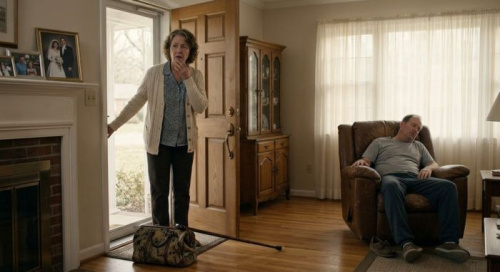
I saw the color of Frank's face before I understood any of it. It was a quarter past eleven on a Tuesday, and he was standing in the light of our open refrigerator with a glass of water in his hand, swaying the way a man does when his body has stopped listening to him. I caught him by the elbow and pulled him down to the sofa, and by the time I got a cold cloth on his forehead he was already saying he was fine, already telling me not to make a fuss.
That was Frank. After thirty years as a firefighter he could talk you out of worrying even while his collar was wet. But I had seen stress knock men down enough to know better. I called for help anyway, and I will never be proud of it the way other men are, and I will never be ashamed of it either. Two paramedics climbed our front steps in the dark, and I have never been more grateful for a siren in my life.
In the emergency room they did not tell me he was going to be fine. They told me his blood pressure had climbed to a number I had only ever heard attached to a man being moved out on a stretcher. The doctor, a tired man with a tired name tag, kept turning to the bottle Frank was still holding in his jacket pocket. It was a squat amber thing with a handwritten label, the kind that makes you want to trust it and gives a pharmacist the urge to throw it away.
"Where did this come from?" he asked me, and I told him the truth, the whole truth, without understanding why his eyebrows were working their way toward his hairline.
It came from the cellar of the lady across the street. Ginny Holloway, the retired nurse who had filled the later days of her life by mixing what she called "heart support" capsules in her basement and selling them to anyone on Pine Street with a low, steady complaint. Frank had been taking them for nearly a year. He said they made him feel lighter in the mornings. I believed him, because I was a fool about Ginny Holloway, just like everybody else.
Ginny was not our closest neighbor in distance. She was the closest neighbor in spirit. When my mother lived out her final months with us, it was Ginny who brought the soups we were too tired to make. When the blizzard buried the road one January, hers was the first walkway cleared. She had a face that looked as though it had spent a whole life smiling at somebody else, and a voice that could settle a skittish dog. Nobody on the street doubted she was the kindest woman we knew.
What she had been doing for years was running a small supplement line, nothing official, nothing registered. Pale capsules resold beneath a name she had written on a label with a steady hand. We called them Ginny's vitamins. We told ourselves a retired nurse would never hand a neighbor anything that could hurt her.
It is a strange thing, the way we hand our own safety over to the shape of a familiar smile. I started to understand that in a curtained hospital bay, where a doctor explained the slow, dull work of hypertension and stress. The odd part, he said, was that Frank's numbers did not fit. His diet was clean. His habits were clean. He had no history. Somewhere, he told me, there is a variable you have not thought of.
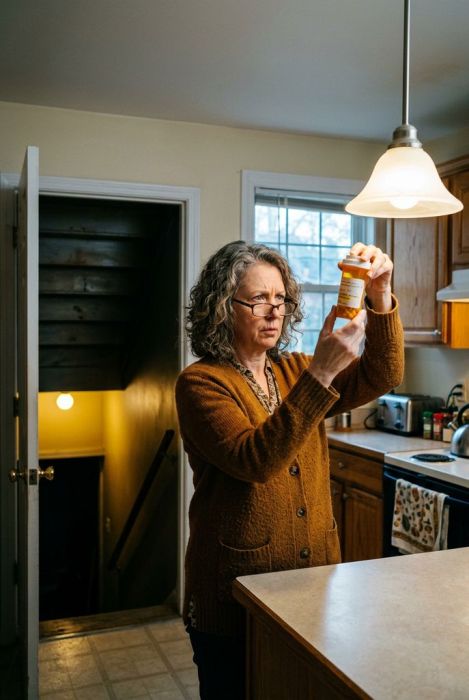
I thought of the amber bottle in Frank's fist all the way home. And I will be honest with you. I did not want to think it meant anything about the lady across the street. I wanted it all to be nothing, to write it off as one rough night and the ordinary weight of living. So I did what I do when I do not want to know the truth. I waited until Frank slept, pulled the bottle from his jacket, took a photograph of it, and began to look.
What I found, piece by piece, did not feel like unearthing a crime. It felt like a puzzle where you move one tile and suddenly half the board is wrong. I weighed the capsules. I searched the lot number written in a sloped hand on the tape and found it did not belong to any supplier I could find. I called the supplement store she swore she used, and the woman on the phone told me to read her a stock list that contained nothing that belonged to Ginny.
Then I did the thing that kept making me blush to say it. I asked the retired pharmacist two doors down, a quiet, exacting man named Eli Barlow, who had been waiting, I think, for somebody to finally ask. He took a single capsule between his long fingers and held it up to the window. And with a certainty I did not want him to have, he told me the powder inside was not the herb it claimed to be.
The compounds he named he read in the way I would read a stranger's address. He said the capsule had been weighed down with a cheap filler and carried traces of something a person would have to explain to a licensing board. He said, very carefully, that a blend like this could be fine for one person and dangerous to another, depending on dose and ordinary luck. And then he gave me the word I had been dodging in my heart: counterfeit. Not a mistake. Not an accident. A counterfeit, line by line, built in the cellar of the woman everyone on the street trusted.
I did not sleep that night, but it was not anger that kept me up. It was something closer to tenderness, because every accusation I turned over sounded like an accusation against myself. For a year I had fed my own husband anything that came with a handwritten heart on the label. I had believed her because she had been kind to my mother. And kindness, I was learning, is a lock that opens the same way for everyone.
So you will understand why I did not march across the street holding a complaint. I did the slower thing. I watched. For two weeks I paid attention to Ginny Holloway the way you watch a dog that has barked once at your child. I noticed the deliveries that came to her door in plain yellow boxes, no brand, nothing outward. I noticed how the little window above her cellar glowed most evenings, even when nobody else kept a basement light on. I noticed that she sold her remedy to the oldest people on the street, and that she always said she was sorry, dearly, while she asked for cash.
And then one afternoon I saw more than I wanted to. I was returning a dish around the hedges at the back of her yard when I caught her at her basement door, handing a cardboard box to a man from a delivery van. Printed plainly on the side of that box was the very supplier she had sworn she used, the one she claimed had gone out of business years ago. She was buying the merchandise she sold us as her own hand mixed cure.
I stood in the hedge with my heart climbing. It took everything in me not to do what Frank would have done, which is to be hot and then to force the whole thing through a door. But I am not Frank. I am the one who stays, the one who, when the light goes out, walks to the fuse box and opens it. So I waited, and I decided, and I made the quiet choice that could not be unmade.
It took me a week to find a way in. It was her dog, in the end, that gave me the door. He had a habit of slipping through the gate whenever the wind turned, and one afternoon I caught him and carried him to her front step, and while she was distracted into her house to calm him, I let the cellar door take on a second latch of open air. It was the only dishonest thing I ever did to that woman, and I would do it again, a hundred times, for every hour Frank lost to a bed in the hospital.
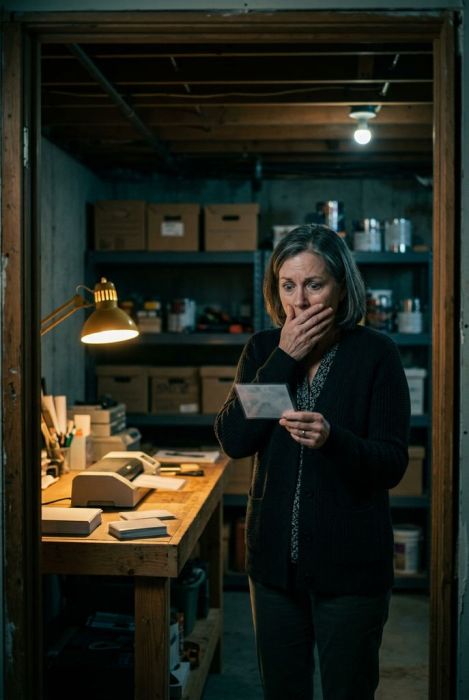
I went down those stone stairs with a penlight and a telephone, and I stayed only long enough to know what had to be known. There was no trace of herbs at all. There was a workbench with a heat sealer, a tray of empty capsules, a printer, a stack of clean labels, and a ledger that told me, in neat columns, exactly which neighbor on Pine Street had taken the pills, and for how many dollars. She had stock. She had been refilling the same white bottles for years, charging a high shelf price, keeping the brand hidden, keeping the real source somewhere no one requested to inspect.
I took one photograph with it. Then I came back up the stairs, closed the cellar as I had found it, and took myself over to the county office without telling a neighbor, because a person who thinks they are acting alone tends to protect the evidence better. There I showed the photograph to a woman nameless Ter herself, who ran the drug unit. She looked down at it a long time, and then she said Ginny Holloway's name as though the office had heard it from someone before.
She pulled open a file thick as my forearm, built out of complaints and inspection letters that wandered across state lines. The quiet, gentle nurse at number nine had done this same tidy, almost motherly fraud many years and many miles away, and had lost her license under circumstances no one liked to say out loud. She had simply moved to a new town, and become the friendly neighbor, and found an entire street happy to hand her the keys to their loyal, expensive pill bottles without ever once asking what was genuinely in them.
On a gray morning, a county van parked at the curb on Pine Street. They went to her door, and they went down those steps. I watched from my own pantry window while a pair of inspectors carried her jars in bins and boxes, and I saw Ginny in her clean apron stand just inside her own door and start to turn her attention instead to the two men, unable to look at the street that was at last looking at her. I did not wave. I did not gloat. I only closed my own door, quietly, and went to be sure Frank did not want to hear the way it went strange.
They arrested her the following week, counterfeiting, along with the misbranding and delivering of an unapproved substance to a list of older neighbors she had personally cared for. She found a way to bond and weeks later, she did not come back to the house. And the thing that made the whole block sit down, that first quiet evening, was not that all believed her lights had gone out front. It was the county notice that went into every mailbox on the street, telling each family which bottle of Ginny's vitamins they had bought, and how to have it tested, and with whom to speak about their heart if they had already swallowed one.
Frank never touched a single pill of hers again, and the part of me that had trusted her did not come fully home, either. He came out of the hospital different, softer. One evening on the porch, he said to the kettle filling up, mostly the way a man says a thing to himself so he can hear it, that a person thinks he knows the street he lives on. He watches the same doors, the same lights, the same faces. And the street that looked and nodded neighborly for all those years had a seam stitching it shut, the one thing nobody had noticed.
I tell this story not to frighten you with the cellar, but to tell you what a neighborhood is made of. A neighborhood is a web of trust that you build one kindness at a time, and the trust you give without looking is the one you may be paying for with the well-being of the people you love. None of the mailboxes on Pine Street will take a jar or a bottle from a friendly hand the same way again. It is not a bitter thing to say. It is the tired, useful understanding that cuts a few quiet dollars out of your peace and hands you a much sharper pair of eyes.
Some evenings, when Frank opens the plain glass bottle his real pharmacist made for him, I feel the genuine, entirely earned relief of a safe ending. The woman who had fooled us did not cost me very much, in the ugly end, except a lesson I wish I had paid any less for. She gave me an understanding I never asked to have, that a warm smile is not a receipt, and that the thing that shows you all its teeth is usually the thing you repared to see.
I did not get to keep the quiet, trusting street I believed I lived on. But I got to keep my husband sitting peacefully on this one, awake, with both eyes open. And after everything we looked out the window for, that was the only trophy I was ever really fighting to carry home.