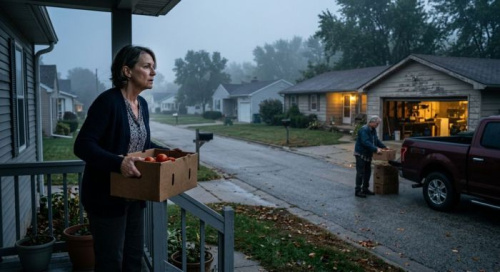
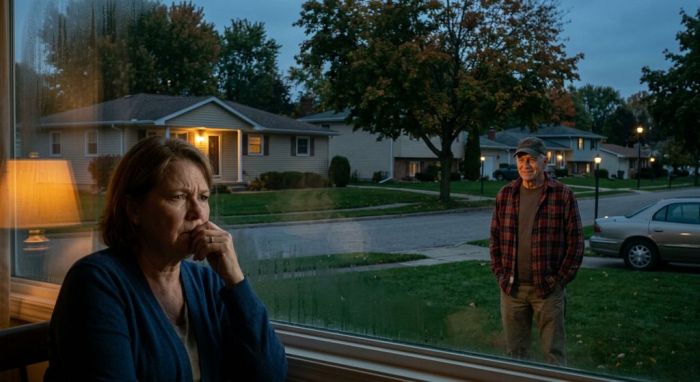
The night everything changed, I was sitting on my porch with a glass of sweet tea, watching Frank Delgado mow his lawn across the street. He waved, the way he always did, that easy smile wide under the brim of his old Cardinals cap. I waved back. I had no idea that within a week that same smile would make my blood run cold, or that the kindest man on Juniper Street would turn out to be a ghost wearing a borrowed name.
Frank had lived across from me for nearly thirty years. He was the first person to bring me a casserole after my husband Arthur passed, and the only one who remembered to check on me during the bad winters. He fixed Mrs. Kowalski's porch swing. He taught the Rileys' boy how to change a tire. Every July he fired up the big grill for the block party, and every December he hung lights on the streetlamps the town had officially forgotten. Nobody on Juniper Street locked their doors around Frank. He was our uncle, our handyman, our hero. Everyone said so.
It was Emma who started it. My granddaughter, fifteen years old, came over one Saturday with her laptop and a school assignment that asked her to trace her family history. "Grandma," she said, "I need to interview you about Grandpa Arthur." So we sat at the kitchen table, and I told her about her grandfather, about my parents, about the old farm my great-grandparents had worked. She typed and nodded, and then she asked, almost as an afterthought, "Who's the old man across the street?"
"Frank Delgado," I said. "He's lived there since before you were born. Everyone loves Frank."
She typed his name into a genealogy website and frowned. "There's no Frank Delgado in Ohio," she said. "Not one born before 1992, anyway."
I laughed. "Maybe he's not on the internet, honey. Some people aren't."
But Emma was thorough, the way teenagers are when a puzzle grabs them. By the next afternoon she had a folder full of dead ends. No birth record. No marriage license. No deed in his name before 1995. No driver's license history. No high school. No military record. It was as if Frank Delgado had simply appeared on Juniper Street one day in the early nineties, fully grown, fully loved, and completely unrecorded.
I told myself it was nothing. Plenty of people weren't online. But that night, lying awake, I remembered the way Frank always dodged questions about his past. "Oh, I'm just a boring old man," he'd say with a chuckle, and change the subject. He never mentioned a hometown. He never mentioned a family. When someone asked about his accent — a faint, flat drawl that didn't quite fit Ohio — he'd say he'd moved around a lot as a kid.
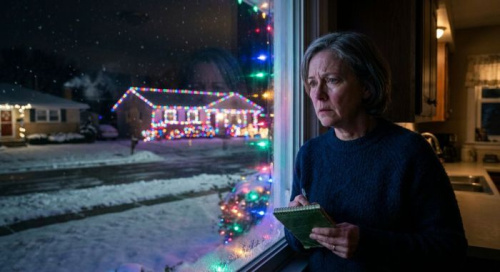
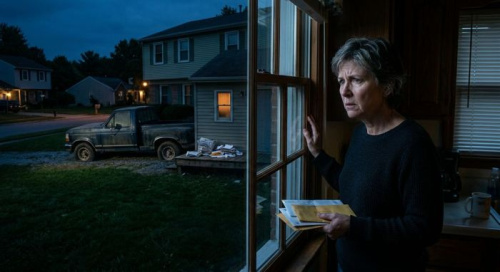
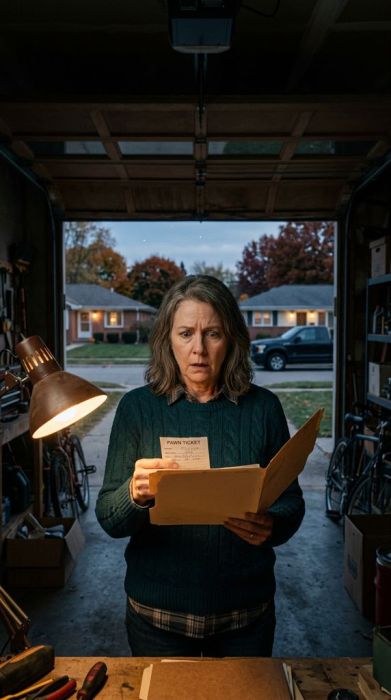
I started watching him differently after that. Not like a spy. Just noticing. The way he never let anyone inside his garage. The way he paid for everything in cash. The way he flinched, just slightly, whenever a police cruiser rolled down the street.
I tried to let it go. I really did. But a week later, Emma called me, breathless. "Grandma, I found something." She had gone back further, searching old newspaper archives in other states, looking for any Delgado who might match. And she found one. A front-page story from February 1992, out of a county in Tennessee. An armored car had been robbed outside a bank, and the lone guard, a young man named Tommy Vasquez, had been shot and left paralyzed. The suspect, a man named Raymond Mercer, had vanished with over six hundred thousand dollars. The paper printed his photograph.
Emma sent it to my phone. I opened it in the kitchen, and my hand went to my mouth.
The man in the photograph was younger, thinner, with darker hair. But the jaw was the same. The build was the same. And above his left eyebrow, barely visible in the grainy print, was the same thin white scar that Frank had. The scar he'd always said came from a fall off a roof when he was a kid.
I stared at that photograph for a long time. Part of me wanted to delete it, to pretend I'd never seen it. Because if it was true, then the man who'd brought me casseroles and checked on me in the winters had been living a lie for thirty years. And the money that bought his house, his tools, his easy life — some of it had paid for a young man's ruined spine.
I didn't know what to do. So I did the only thing that felt safe. I told no one, and I watched.
For two weeks I watched Frank. I saw him help old Mr. Hendricks carry groceries. I saw him wave to the mailman. I saw him laugh at the Rileys' dog. And I saw the way his eyes went flat and careful whenever anyone mentioned the news, or the police, or the past. He was a good neighbor. He was also, I was becoming certain, a very good liar.
The night I decided to confront him, I told myself I just wanted to hear him deny it. I wanted to be wrong. I walked across the street with a plate of brownies, the way I'd done a hundred times, and I knocked. He opened the door with that easy smile, and for a moment I almost turned around.
"Carol," he said. "Come in, come in."
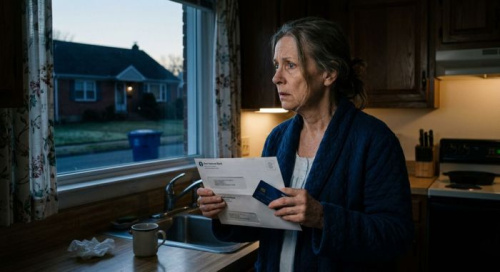
I set the plate on his kitchen counter. Then I took out my phone and showed him the photograph. "Frank," I said quietly, "who is Raymond Mercer?"
The smile didn't leave his face. That was the worst part. It just settled. His eyes went flat, and the warmth drained out of them like water out of a sink. For a long moment he said nothing. Then he leaned close, and his voice dropped to something I'd never heard from him before.
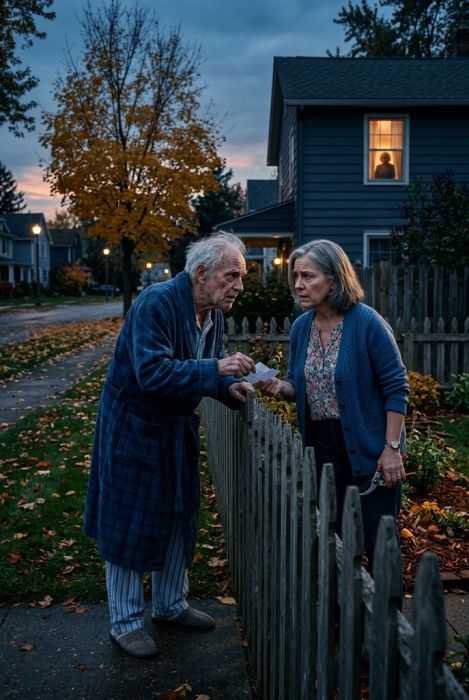
"That's an old name," he said. "A dead name. And I'd thank you to let it stay dead, Carol. You're a smart woman. You know what happens to people who dig up graves."
I walked out of his house with my heart hammering. I didn't run. I made myself walk, slow and steady, all the way across the street. But I felt his eyes on my back the whole way, and I knew, with a cold certainty, that I had just become a problem in Frank Delgado's tidy new life.
I didn't sleep that night. I kept the porch light on and the doors locked. And in the morning, I did the hardest thing I've ever done. I knocked on the door of the one neighbor I'd always dismissed as a gossip: Ed Pemberton, three houses down, a retired detective who'd spent thirty years with the state police.
I expected him to laugh at me. Instead, he listened. He listened with his coffee going cold in his hand, and when I finished, he set the cup down and said, "Show me the photograph."
He studied it for a long time. Then he looked at me with something I hadn't expected: respect. "You're not the first person to wonder about Frank," he said. "I've wondered for years. But I never had a thread to pull. You just gave me one."
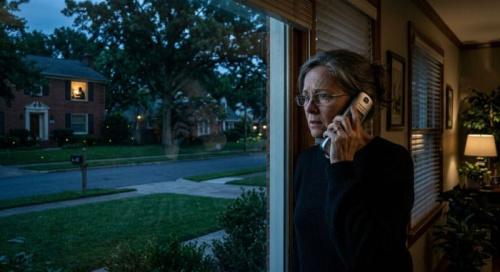
What happened next happened fast, but it felt like slow motion. Ed made some calls. He had an old friend still on the force in Tennessee who remembered the Mercer case like it was yesterday. They pulled the old fingerprints from the armored car. Ed, being clever, found a way to get Frank's prints off a glass he'd left at the block party barbecue. Two days later, Ed called me, and his voice was shaking.
"It's him," he said. "Raymond Mercer. The prints match. He's been hiding in plain sight for thirty years."
The arrest happened on a Saturday, at the July block party, of all places. Frank was standing at his grill, flipping burgers, laughing with the neighbors, the picture of a beloved old man. Two unmarked cars pulled up, and three detectives in suits walked across the lawn. The whole street went quiet. I watched from my porch as Frank's smile finally, finally cracked. He didn't run. He just stood there, spatula in hand, as they read him his rights and told him he was being charged with the 1992 robbery of an armored car and the shooting of Tommy Vasquez.
The neighbors didn't believe it at first. Some of them turned and looked at me with accusation in their eyes, as if I'd somehow done this to their beloved Frank. But then the detectives explained, and the story spread, and the disbelief curdled into something else. The man who'd fixed their porches and taught their kids to change tires had been living on the proceeds of a crime that had put a young man in a wheelchair for life.
Tommy Vasquez, I learned, was still alive, still in his wheelchair, still in Tennessee. When the news reached him that the man who'd shot him had finally been found, he told a reporter he'd waited thirty years for this day. "I never gave up," he said. "I always knew he was out there somewhere."
Frank Delgado — Raymond Mercer — was convicted. He'll be in prison for a long, long time. The house across the street sits empty now, and the neighbors who once brought him casseroles have learned to look at it with a different kind of feeling.
As for me, I got a lot of apologies in the weeks that followed. People who'd doubted me, people who'd called me paranoid and cruel for suspecting a saint, came by to say they were sorry. I accepted every apology, because I understood. It's the hardest thing in the world to believe that the kindest person you know is hiding something. We want to believe the best. That's what lets men like Raymond Mercer hide for thirty years.
Emma came over the day after the verdict. She hugged me and said, "You were right, Grandma. You were right the whole time." And I held her, and I thought about Tommy Vasquez, and about all the years that man stole from him, and about how easily it could have gone the other way.
I still live on Juniper Street. I still drink sweet tea on my porch in the summer. But now I lock my doors at night, and I look at my neighbors a little differently. Not with suspicion, exactly. Just with the knowledge that none of us is ever quite what we seem. And that sometimes, the kindest smile in the neighborhood is the one hiding the darkest secret of all.