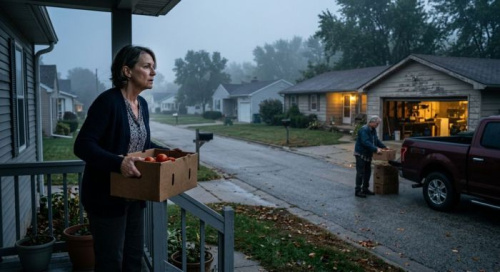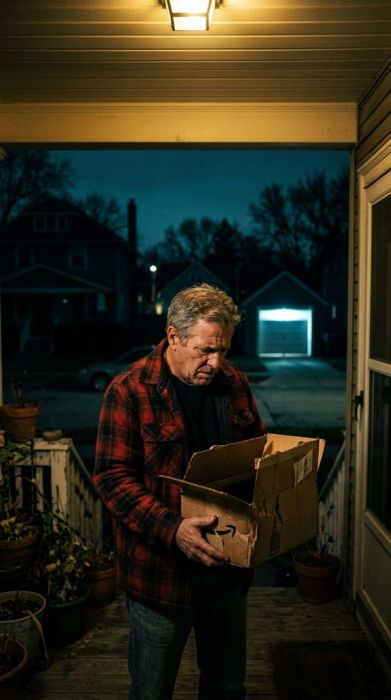
Eight months after Walter Hale had his stroke, his daughter Rita moved back to Hanover Falls, and every neighbor on Acorn Court said the same two words: what a saint. Rita came up from Columbus with two suitcases and a story about leaving her hospital billing job to be with her father in his final years. She cooked him warm meals. She drove him to physical therapy every Tuesday and Thursday. She stood on his porch each evening with a glass of lemonade, waving at the walkers who passed by, telling anyone who lingered what a blessing it was to be home.
I wanted to believe it. I really did.
Walter and I had been fence-line friends since my husband Bill died, four summers back. I'd bring him my leftover squash. He'd hand me tomatoes over the picket line, always wrapped in newspaper, always with a wink. He was a retired millwright who'd spent thirty-five years at the brass plant, a quiet man who repaired antique clocks in his garage and hummed Frank Sinatra while he worked. When the stroke took half his smile and most of his words, I grieved for him the way you grieve for a tree that loses a limb in a storm. Still standing. Still Walter. Just slower.
Rita arrived with her father's medicine bottles organized in a little plastic caddy, and I admit, I was grateful. I didn't have the training to know if he was taking his pills right. She seemed to. She had the kind of clipped, confident voice you hear on hospital shows, and she used words like "rehabilitation" and "care plan" like they were nothing. For the first month, I slept better at night knowing someone was in that house with him.
Then the little things started.
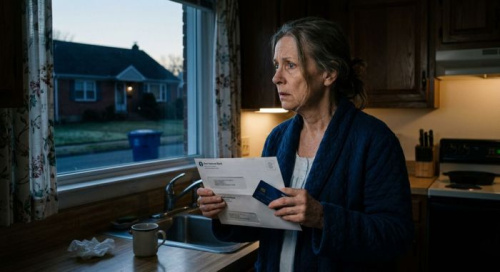
Robert, the mailman, mentioned that Rita had put Walter's pension on direct deposit. "Smart lady," he said. Except Walter had made that walk to the bank every first-of-the-month for forty years. He liked the young teller, Marcus, who kept a photo of Walter's old clock collection taped to the counter.
Three weeks later, the clock he'd been restoring — a 1928 walnut mantle clock with a chime like a cathedral — disappeared from the garage. Rita told Mrs. Alvarez next door that Walter had sold it because he "didn't need the clutter." Walter never sold things for clutter. He loved that clock the way other men love their dogs.
And then the fence. Walter's side of our shared fence had always been a little crooked, held together by his own stubbornness and baling wire. I came outside one morning to find Rita standing on a ladder in her driveway with a storm of papers in her hands. "Landscapers," she said before I could ask. "I'm having the iron fence and the hedge taken out next week." Taken out. Just like that. She was reshaping Walter's yard into something for herself.
The old man had stopped coming to the fence. That was the part that scared me.
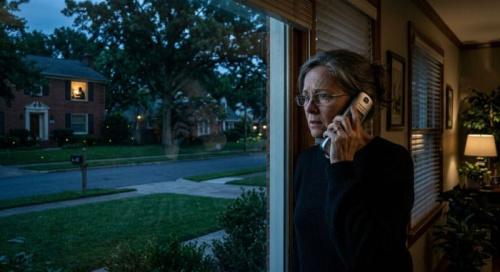
I used to see him at dawn, shuffling out in his bathrobe to check the roses his wife Edith had planted in 1974. Now the robe hung on a hook by his back door, and the roses grew wild. Rita said he was tired, that therapy wore him out, that he needed bed rest. But when I waved at his kitchen window, I often caught the curtain move too fast — as if someone had pulled it shut.
My daughter Jenna, who works at the county clerk's office, heard through the grapevine that Rita had applied to be Walter's legal guardian. Not conservator. Guardian. The word sat wrong in my stomach. Guardians take over everything, I remembered from a documentary I'd once watched. Bank accounts. Property. Decisions. Freedom.
I told myself I was being an old busybody, the voice in my head that sounds like my mother. Mind your own yard, Peggy. You don't know their business. I told Frank Delaney the same thing when I found myself standing at his back door two houses down, twisting my hands.
Frank is a retired county detective who lives with his wife Marie and a basset hound named Phil. We've been supper-club friends for years. He listened without interrupting, nodding the way he used to nod at witnesses, patient and unreadable. Then he said, "You're not a busybody, Peg. You're a good neighbor. Trust your gut, but verify everything. That's the first thing they teach you."
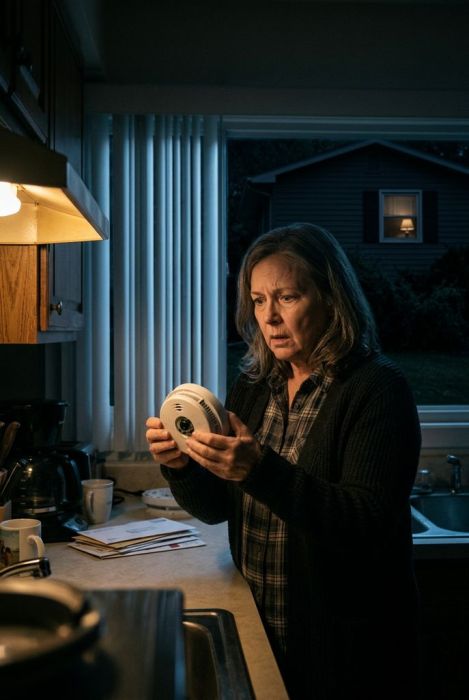
He lent me something that afternoon. A little digital voice recorder, old but reliable, the kind that fits in a breast pocket. "If you're going to have conversations with that woman, have them with proof running. People like Rita Hale don't get caught by feelings."
I didn't need the recorder for what happened next, because I'll never forget it. But I was glad I had it.
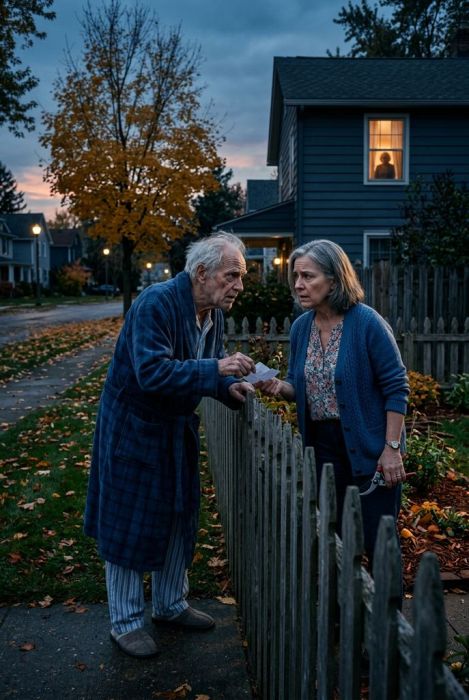
It happened at the fence, of all places. Late afternoon, the first cool day of autumn, when you can smell woodsmoke and leaves burning somewhere down the street. I was out with the pruning shears, and there was Walter, shuffling along his side of the fence in his shabby blue bathrobe — the one Rita said he never wore anymore. He looked thinner than I'd ever seen him. His good hand shook as it gripped the rail. And then he slid a small, crumpled ball of paper through the boards, right into my flowerbed.
I picked it up like it was a live coal. I unfolded it carefully.
She took my ring.
Written in pencil. Shaky, careful handwriting, the letters pressed hard, like they'd taken him an hour.
My heart turned over in my chest. Walter's ring — I knew the ring. It was his wedding band, a plain gold band with a tiny inscription inside: E.H. 1963. He'd worn it for sixty years. Edith had been gone since 2011, but Walter wore that ring every single day of his life.
I crushed the note in my pocket and went inside and locked the door, and I didn't sleep that night. The audacity of what crept through my mind kept me awake. Not just the ring. The clocks. The pension. The garden. The guardianship papers. Saint Rita, up on that ladder, reshaping a dying man's world one piece at a time.
The next morning, I called my son Mark, who's a sheriff's deputy over in the next county. He's my baby, thirty-eight, and he has his father's way of going quiet when he's doing the math. I read him the note over the phone. He was quiet a long moment. Then he said, "Mom, can you find paper with her name on it? Utility bills? Bank statements?"
"I don't know," I said. "Why?"
"Because if you can find paper with her name on it, anything, we can tie her to the accounts. That's how they get them, Mom. Paper. Paper is how you catch paper people."
So I did what any retired librarian worth her salt would do. I watched. I waited. And I waited for my chance.
It came the following Thursday, trash day. Rita drove off at 9:15 in a new silver SUV I'd never seen before. I knew she'd be gone at least an hour, because on Thursdays she liked to get her nails done in the next town. I put on my garden gloves, walked to the back of Walter's property where the low hedge meets the alley, and found the old wooden gate we'd used for years, padlocked from her side since she moved in.
The padlock sat open. Sitting right there, not clicked shut.
I know it sounds like something from a bad mystery novel, the neighbor creeping into the yard. But the note was in my pocket, and the man who wrote it was losing everything. Sometimes being a good neighbor means being brave enough to be nosy. I lifted the latch and went in.
Walter's house smelled like lemons. That was the first wrong thing. Walter's house had always smelled like pipe tobacco, coffee, and old clocks — a warm, dusty, honest smell. Not lemons. Rita had scrubbed his life out of the air.
I found what she used as an office in what used to be the dining room. I only cracked the door, and I saw enough to feel sick. A foldout table covered in neat piles: bank statements, power-of-attorney forms, a photocopy of Walter's birth certificate, a calendar with circles around benefit deposit dates. And on the chair, a shoebox.
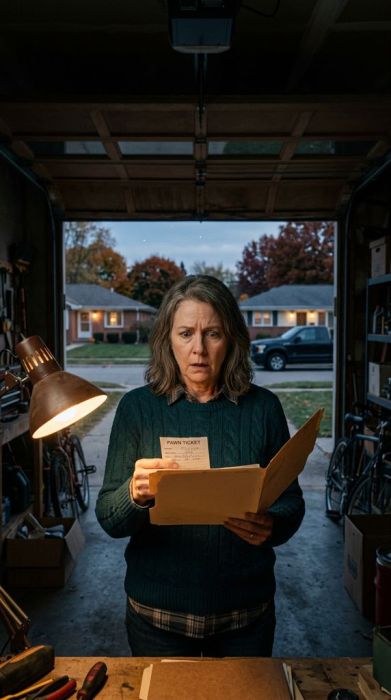
I opened the shoebox. I know this confession makes me sound like a terrible person, but I had to know what my neighbor was losing. Inside was a waterfall of pawn slips. I counted forty-one. Forty-one, all in Rita's name, all from the same pawn shop in the next town over. Wedding band, gold. Wedding band, gold, engraved. Mantel clock, walnut, 1928. Ring, diamond, small. Ring, gold, class of 1963. Class of 1963. That was Walter's high school ring. She'd pawned her father's high school ring. She'd pawned the ring he'd asked his wife to marry him with.
I took out my phone and took pictures of every single receipt. Then I drove straight to Frank's house.
Frank listened to the whole terrible story — the note, the shoebox, the forty-one slips — and for the first time in the thirty years I've known him, I watched him get angry. Not loud angry. The quiet kind, the kind that tightens a jaw and makes a grown man stare at his shoes for a minute before he speaks. "That's elder financial exploitation, Peg," he said finally. "It's a felony in this state. She's looking at every item as a separate charge. Forty-one items. Forty-one felonies."
He made three phone calls that afternoon: to Adult Protective Services, to a detective he'd trained named Sergeant Ines Morales, and then, catching me by surprise, to Marcus at First National. Through him we learned the final ugly piece. Rita had moved Walter's pension into a new account with only her own name on it.
The last thing she wanted was what she called a "transition meeting." She wanted Walter out of the house by the end of the month — into a state-run facility three counties away, where visiting would be hard and paperwork even harder. She'd told him about the move the way you tell a child it's time for the dentist, bright and cheerful and final.
But here's the thing about being underestimated by the good neighbors of Acorn Court. We're a neighborhood of retired teachers and nurses and one very patient ex-detective, and we know how to make a plan.
Frank arranged for Walter to stay at my house for a weekend. Just a weekend. "It's legal if he's there voluntarily, and nobody can stop a grown man from visiting a neighbor." Rita was out of town at a "conference" — though Marcus told us there was no conference, just a bank appointment across state lines. Frank parked his truck across the street and settled in with a thermos of Marie's coffee.
We rehearsed it like a church pageant. Friday afternoon, I brought Walter a pie. I told Rita I was dropping groceries off for the church food drive. I watched her SUV pull out. I knocked on Walter's door, and behind me, Frank's truck flashed its headlights three times — the all-clear. Walter opened his own front door for the first time in three weeks.
He packed a small bag, and he held it against his chest like a shield. Then he looked me dead in the eye and reached into his bathrobe pocket and pulled out a pawn slip he'd found in his own coat — the one Rita missed. The clock. The 1928 clock.
"Someone knows where he is," he said, and his shaking hand held the paper steady enough to read. He meant the pawn shop. The shop where she'd sold the thing he'd built his life around.
We brought the slip to Frank, and Frank brought it to Sergeant Morales, and Sergeant Morales said the two words that lifted years off Walter's shoulders. "We'll handle it." Elder abuse cases are built on paper, Frank told me, and we had a mountain of it.
The end came on a Saturday, at the Hanover Falls Community Center, of all places. Rita had the nerve to organize a "celebration of life" event for her father — a fundraiser, she called it, to help "cover Dad's care." She'd rented the hall and ordered a sheet cake with gold lettering that read "To a Wonderful Father." The whole neighborhood RSVP'd, because Frank told them to.
She stood at the podium in a new dress, tears in her eyes, telling everyone what a burden she'd carried, what a loving daughter had sacrificed. And behind her, at the back of the hall, two county deputies and Sergeant Morales walked in through the double doors with paperwork that folded Rita's speech in half.
I didn't see the arrest itself. I heard it — the gasp, the scrape of a chair, the quiet, professional voice reading her rights. By the time the hall emptied, the cake still sat uncut on its table, and Rita was in the back of a cruiser with her forty-one pawn slips in an evidence bag beside her.
The charges came down the following Monday: seven counts of financial exploitation of an elderly person, forgery, identity theft, and obstruction. The "conference" that weekend, it turned out, had been a trip to another state to open a second account and a lockbox. All traced. All in the folder Sergeant Morales would later describe as the cleanest elder-abuse case she'd ever worked.
Walter moved into a memory-care facility with a garden and a porch full of rocking chairs, paid for by his own restored pension and the restitution that came out of the criminal case. He has a volunteer who drives him to the pawn shop once a month now, tugging his cap down low and grinning like a boy, and the shop owner shakes his hand and hands back the clock he's been buying back piece by piece, on layaway.
He wears the wedding ring again. He wears it on his good hand, and he tells anyone who'll listen that a neighbor brought it home. "Peggy brought it home," he says, like I'm some kind of hero. I'm not. I'm just the woman who unfolded a note.
The silver SUV sat in his driveway for three months, gathering leaves, until a tow truck came and took it away, and the sign went up: For Sale By Owner. Lovingly restored. Come see the garden.
Emily, Rita's daughter, came down from Oregon the week after the sentencing. She was twenty-six and had barely spoken to her mother in eight years — she'd cut Rita off the way people cut off storms. She sat with her grandfather on the porch of the memory-care home while a cardinal sang in the hedge, and I watched her hold his hand exactly the way Edith used to.
"Do you want to keep the ring in the family?" I asked her, when she walked me to my car.
She looked at me, and her eyes were red. "I think it belongs on his hand," she said. "For as long as it fits."
That's the thing about karma, I've decided. It doesn't wave a wand. It moves through people — through a retired librarian with a pocketful of pawn slips, a retired detective with a thermos of coffee, a bank teller who remembered a man's clock collection. It moves one careful, brave step at a time, until the day the hall doors open and the paper catches up.
I still see Walter most Sundays. I bring him tomatoes, wrapped in newspaper, with a wink. He brings me the latest clock from his bench — a little one, always ticking, always on time. And when I walk home past the corner house with the new family's truck in the driveway, I stop and look at the fence — the honest, crooked, beautifully imperfect fence that needed no one's permission to pass a note.
Some things you can't pawn. That's the only lecture I'll ever give.