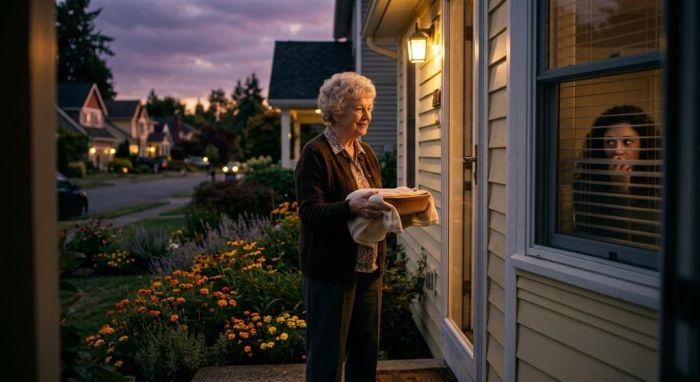
The first time I saw Helen Kowalski, she was kneeling in her front garden, bare-handed in the dirt, pulling weeds with a tenderness most people reserve for petting a sleeping cat. She looked up and smiled when she noticed me standing on my front porch, gave a little wave, and went back to her marigolds. I remember thinking how lucky we were to have someone like her on the street. She was exactly the kind of neighbor my mother always said you pray for when you buy a new home.
Helen moved onto Sycamore Drive about three years before we did, into the pale yellow colonial at number 27. She was seventy-three at the time, a retired schoolteacher who had taught second grade for forty-one years in the same school district where her own children had once studied. Her husband, Frank, had passed away a decade earlier from a sudden heart attack. She spoke about him often, always with the same wistful smile, always with the same phrase: "He was the love of my life."
Everyone on Sycamore Drive adored her. That's not an exaggeration. Mrs. Kowalski — though she insisted everyone call her Helen, or better yet, Grandma Helen — was the kind of person who showed up at your door with a warm casserole the day you moved in, who remembered your birthday when you'd forgotten it yourself, who knitted blankets for every new baby born within a five-mile radius. She organized the annual block party, coordinated the neighborhood watch, and volunteered three days a week at Saint Mark's food pantry. She was, by every measurable standard, the heart of the community.
The first death was Doris Mayhew, a seventy-eight-year-old widow who lived five houses down at number 19. Doris had been struggling with congestive heart failure for years, so when she passed away quietly in her sleep, no one raised an eyebrow. Helen was the one who found her. She had a key to Doris's house, as she did to most homes on the street, because she checked on the elderly neighbors every morning. She made the phone calls, coordinated with the funeral home, and personally delivered a lasagna to Doris's daughter who flew in from Phoenix.
"Doris is in a better place now," Helen told me at the funeral, dabbing her eyes with a handkerchief. "She suffered so much. At least she went peacefully."
I hugged her and told her she was a blessing to this street.
The second death came seven months later. Arthur Pendleton, number 33, a sixty-nine-year-old retired postal worker with a history of high blood pressure. He collapsed in his garage while carrying groceries. Helen found him too. She had been bringing him his weekly meal, something she did for all the single men on the street. The coroner ruled it a massive stroke. No autopsy was requested. Why would it be? Arthur had been on medication for hypertension for fifteen years.
"He was such a good man," Helen said at the potluck dinner she organized in Arthur's memory. "Always so grateful for the little things."
She served her famous shepherd's pie that night. Everyone raved about it. I had three helpings myself.
The third death was the one that should have made me stop and think. But it didn't, because Helen was Helen, and the thought that she could be anything other than kind was incomprehensible. Margaret Hollister, number 41, was eighty-two years old, a retired librarian who lived alone with her cat, Mister Darcy. Margaret had been in excellent health for her age. She walked two miles every morning, ate a Mediterranean diet, and had recently been cleared by her cardiologist. She died suddenly one Tuesday afternoon.
Helen found her, of course. She had brought Margaret a thermos of homemade tomato soup. The coroner listed cause of death as cardiac arrhythmia. Margaret's doctor signed off without question. She was eighty-two, after all. These things happen.
But here's what no one on Sycamore Drive knew at the time. Margaret Hollister had no history of heart problems. None whatsoever. And the night before she died, she had called her sister in Oregon and mentioned, almost as an afterthought, that she had been feeling unusually tired and lightheaded since having dinner at Helen's house two days earlier.
"I think I might have eaten something that didn't agree with me," Margaret had said. "Grandma Helen's cooking is delicious, but it's sitting heavy in my stomach tonight."
Those were the last words Margaret ever spoke to her sister.
Over the next three years, seven people on Sycamore Drive died unexpectedly. Seven. In a street with only twenty-three houses, that was statistically improbable. But nobody connected the dots, because the deaths all seemed natural. Heart attacks, strokes, aneurysms. Each one had a plausible explanation. Each victim was elderly. Each had some pre-existing condition that could have reasonably caused their death.
And each of them had eaten a meal prepared by Helen Kowalski within forty-eight hours of dying.
I didn't figure it out. I wish I could say I did, that my instincts caught something the rest of the neighborhood missed, but the truth is that the revelation came from somewhere else entirely. It came from a young woman named Clara Benson, Margaret Hollister's great-niece, who had inherited Margaret's house at number 41. Clara was twenty-eight, a graduate student in forensic chemistry at the state university. She had spent the summer cleaning out her great-aunt's belongings and had grown increasingly troubled by the pattern she was noticing.
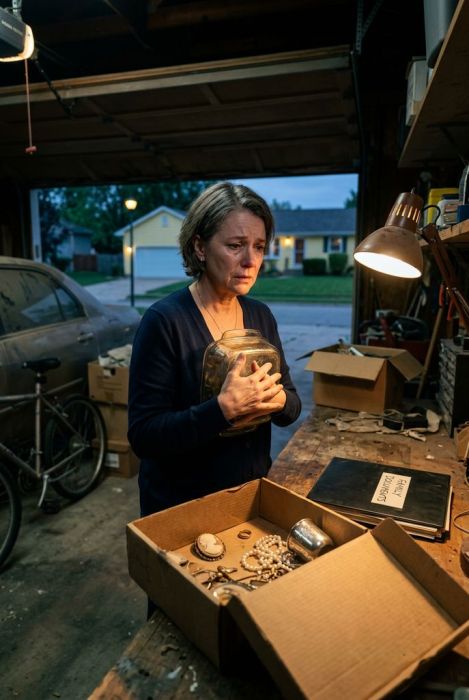
Clara came to my door on a humid August evening, clutching a manila folder. She looked like she hadn't slept in days.
"Can I show you something?" she asked, her voice barely above a whisper.
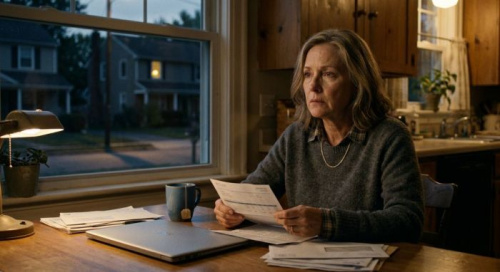
I invited her inside, made coffee, and listened as she laid out her findings on my kitchen table. She had created a timeline. Every death on Sycamore Drive, cross-referenced with date, time, cause, and — most importantly — the last person to visit the victim before they died. The pattern was unmistakable. Helen had been the last visitor in every single case.
"That doesn't mean anything," I said, though I could feel a cold knot forming in my stomach. "She checks on everyone. She brings meals to all the old folks."
"I know," Clara said. "That's what I thought too. So I did something else."
She pulled out a second sheet of paper. It was a list of chemicals. Digitalis, she explained, was a heart medication made from foxglove. In small doses, it treated heart failure. In larger doses, it caused fatal cardiac arrhythmia that looked exactly like a heart attack during an autopsy — if an autopsy was even performed. And none of the seven victims had received autopsies.
"Helen worked in the school district's administrative office for two years before she retired," Clara said. "She had access to the district's old science supply inventory. Foxglove extract was listed as missing from the high school biology lab in 2019. No one was ever held accountable because the amount was small and the lab teacher assumed it was miscounted."
I stared at the paper. "Clara, this is... this is circumstantial at best."
"I'm not finished."
She pulled out a third document. It was a bank statement she had obtained from a private investigator she'd hired with her savings. Helen Kowalski had opened a new savings account eighteen months ago. In that account were deposits totaling almost two hundred thousand dollars. The deposits had been made in irregular amounts over the past three years. Each deposit correlated, within days, to the death of a neighbor.
"She was named in Doris Mayhew's will. Fifty thousand dollars. Arthur Pendleton left her his car and ten thousand dollars. Margaret didn't leave her anything directly, but Helen became the executor of Margaret's estate, and she paid herself a forty-thousand-dollar executor fee. The others — small amounts, insurance policies, sentimental items sold on eBay. She's been doing this for years."
I felt the room spin. "But she's Grandma Helen. She brings us cookies. She waters our plants when we're on vacation."
"That's exactly why nobody noticed," Clara said. "She's the last person anyone would suspect."
We sat in silence for a long moment. Outside, through my kitchen window, I could see Helen's yellow colonial. The porch light was on. A silhouette moved past the living room curtain.
"What do we do?" I whispered.
"I already called the police," Clara said. "They're sending a detective tomorrow. But I have to warn you — if she suspects anything, she might destroy the evidence. She has a greenhouse in her backyard. She grows her own foxglove. I've seen it."
The next morning, a detective from the county sheriff's office arrived on Sycamore Drive. His name was Detective Marcus Webb, a heavyset man in his fifties with tired eyes and a gentle voice. He interviewed every neighbor individually, asking the same questions each time: Did you know the deceased? Did they have any enemies? Did you ever see anyone acting suspicious around their homes?
No one mentioned Helen. Not once. Because even with all the evidence Clara had gathered, none of us could make our brains accept that the woman who knit our children's Christmas sweaters could be a killer.
Detective Webb was more thorough than we were. He obtained a search warrant for Helen's property based on Clara's documentation and the pattern of deaths. The warrant was served at 6 AM on a Saturday morning. I watched from my bedroom window as three police cruisers pulled up to the yellow colonial. I watched as Detective Webb knocked on the door. I watched as Helen answered in her bathrobe, looking confused and slightly offended.
I watched as they led her out in handcuffs two hours later.
The search of Helen's property revealed everything Clara had predicted. The greenhouse contained carefully cultivated foxglove plants, along with several other toxic species. A locked drawer in her home office contained a ledger — a handwritten record of every death she had caused, the amount she had received from each, and notes on her methods. She had been refining her technique for nearly a decade.
What the investigation eventually uncovered was far more extensive than anyone imagined. Helen Kowalski had been poisoning neighbors for at least twelve years, dating back to before she even moved to Sycamore Drive. She had lived in three different homes in three different counties over the course of her retirement, and in each location, elderly neighbors had died under similar circumstances. She had inherited over four hundred thousand dollars in total, none of it enough to trigger suspicion on its own, all of it carefully laundered through small transactions and estate sales.
Helen never confessed. She maintained her innocence through the trial, sitting in court with the same gentle expression she had worn while serving casserole at block parties. Her defense attorney argued that the evidence was circumstantial, that the deaths were natural, that Clara Benson was a troubled young woman with a vendetta against a sweet old lady. But the ledger was damning, and the jury deliberated for only four hours before returning a guilty verdict on seven counts of first-degree murder.
She was sentenced to life in prison without the possibility of parole.
I still live on Sycamore Drive. The yellow colonial has been sold twice since Helen's arrest. No one stays there very long. There's something about that house that people can't shake. Or maybe it's the street itself. Because what happened here didn't just change the address — it changed the way we see each other.
I find myself paying attention now. When a neighbor offers to bring me dinner while I'm recovering from the flu, I thank them politely and find an excuse to decline. When someone knocks on my door with a plate of fresh-baked cookies, I accept with a smile and throw them away the moment the door closes. I know how paranoid that sounds. There are days I hate myself for it. But then I remember Helen's shepherd's pie, and I think about Doris Mayhew's last meal, and I tell myself that a little caution is not such a bad thing.
Grandma Helen was convicted of seven murders. But I don't believe she stopped at seven. I think she started long before Sycamore Drive, and I think there are families all over the state who buried their elderly relatives never knowing that the sweet lady with the casserole dish had killed them.
We are all so desperate to believe in goodness, especially in the people who remind us of our own grandmothers. We smile at the neighbor with the warm eyes and the kind voice. We thank them for the meals, the homemade gifts, the acts of kindness. And we never stop to ask the question that could save our lives: What if this kindness is a mask?
I asked Detective Webb, after the trial, how someone like Helen could exist. He thought about it for a long time before answering.
"She wasn't a monster," he said slowly. "She was a woman who figured out a system that worked. She found a way to get what she wanted — money, but also admiration and love — and she got so good at playing the role that even she probably believed it was real. That's the scariest part. These people don't see themselves as evil. They see themselves as survivors doing what they have to do."
Helen Kowalski is serving life at a women's correctional facility three hours from here. She has no visitors. She writes letters to the neighbors sometimes, apologetic, rambling things that the prison staff never send. She still signs them, "With love, Grandma Helen."
The yellow colonial sits empty most days. At night, if you walk past it, you might notice the garden she planted is still blooming. The marigolds she loved so much have seeded themselves year after year, as if refusing to acknowledge that the hands that planted them were capable of such darkness.
I walk past that house every morning on my way to work. I don't cross the street. I don't avoid it. I look at the marigolds and remind myself of something my mother used to say: everyone is capable of cruelty. The only question is what it takes to bring it out.
And I wonder, every single day, how many Grandma Helens are still out there, living on quiet streets, bringing casseroles to unsuspecting neighbors, waiting for their next opportunity to strike.