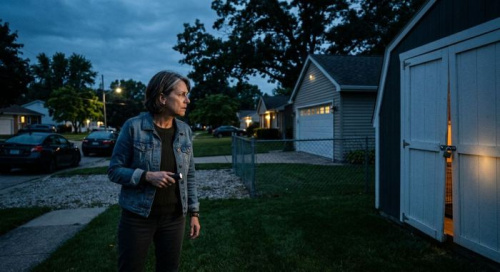
The first time Ella Moreno noticed something strange about the house at 7 Oak Lane, she was hanging laundry in her backyard. It was a humid Tuesday afternoon in late June, and the cicadas were so loud she almost missed it — a low, rhythmic thumping sound coming from somewhere beneath the ground. She paused, a wet bedsheet half-draped over the line, and listened. The sound stopped.
Ella told herself it was probably just the old water heater in her own basement. She was a practical woman, fifty-eight years old, a retired school nurse who had lived in Lakewood, Ohio for twenty-two years. She wasn't the type to jump at shadows. But that thumping stayed at the back of her mind like a splinter she couldn't quite dig out.
The house at 7 Oak Lane belonged to a man named Walter Cross. He was seventy-three, a retired postal worker with thinning white hair and a gentle, almost apologetic way of speaking. He wore cardigans even in summer and kept a meticulously manicured lawn. Whenever Ella saw him, he was either watering his petunias or sitting on his porch with a cup of tea, waving politely at anyone who passed.
"Lovely day, isn't it?" he would call out in his soft, raspy voice.
Everyone in the neighborhood liked Walter. When the Morrisons' cat got stuck in a tree, Walter was the one who brought a ladder. When the teenage boys across the street held loud parties, Walter never complained. He brought homemade banana bread to newcomers and remembered everyone's birthday. He was, by all accounts, the ideal neighbor.
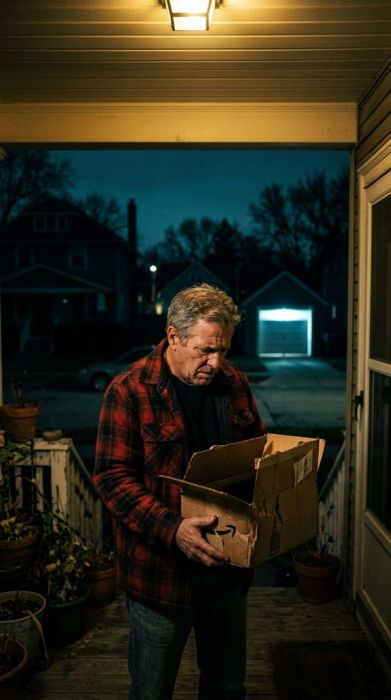
But there were things about Walter that didn't quite add up. Ella first noticed the packages. Truck deliveries would arrive at odd hours — two in the morning, sometimes three. She had insomnia, and on those restless nights, she would watch from her darkened bedroom window as a white van pulled into Walter's driveway. The drivers never used the front door. They always went around the back, carrying heavy boxes that clinked and rattled.
She mentioned it to her husband one morning over coffee. "Maybe he's just a night owl," Frank said, not looking up from his newspaper. "Some people get their groceries delivered." "At three in the morning?" Frank shrugged. "He's old, honey. Maybe he can't sleep." Ella let it go. But she started paying closer attention.
She noticed that Walter never invited anyone inside his house. Not once, in all the years she had lived across the street, had she seen a single visitor walk through his front door. When the mailman handed him packages, Walter would step outside, take the box, and close the door behind him with a polite smile. He never let anyone cross the threshold. The windows on the ground floor were always covered with thick, dark curtains. Even on the hottest days, they remained drawn. The only light visible at night came from a single window on the second floor, which glowed faintly until dawn.
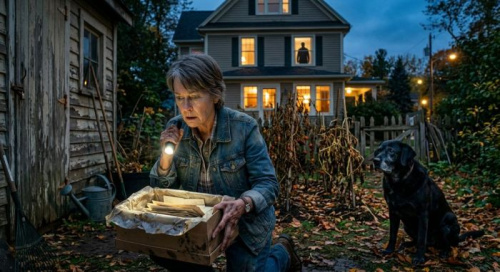
Ella's suspicion grew when she noticed the locks. Walter had three deadbolts on his front door and a heavy-duty padlock on the gate leading to his backyard. The shed behind his house was similarly fortified — a thick chain wrapped around its handle, secured with a combination lock. "It's a storage shed," Frank said when she pointed it out. "Probably keeps tools in there. You're reading too many mystery novels."
But Ella couldn't shake the feeling. She had spent thirty years as a school nurse, and she had learned to trust her instincts. Children couldn't always tell you what was wrong, but their bodies did. And something about Walter Cross's house felt like a child who was too quiet, too well-behaved — a sign that something was being hidden.
The first real clue came in September. Ella was walking her dog, a lazy golden retriever named Gus, past Walter's house when she noticed the garage door was slightly open. Just a crack, maybe six inches off the ground. She slowed down, pretending to let Gus sniff a bush, and peered inside. The garage was empty. Completely empty. No car, no lawn equipment, no boxes. Just a bare concrete floor and a single door leading into the house. But what caught her attention was the floor. The concrete was stained with long, dark streaks that fanned out in irregular patterns, as if something heavy and wet had been dragged across it.
Ella felt a chill that had nothing to do with the autumn air. She told herself it was oil. Or paint. Or maybe Walter had just cleaned the garage and the stains were from bleach. There were a dozen innocent explanations. But she couldn't stop thinking about the way those streaks seemed to lead toward the interior door, like a trail that had been hastily scrubbed but never fully erased.
That night, she couldn't sleep. She sat in her living room with the lights off, watching Walter's house from across the street. At 2:47 AM, a white van pulled up. The driver got out, a heavyset man in a dark jacket, and walked around to the back of the house. He was carrying something — a small duffel bag. He was inside for less than ten minutes. When he came out, his hands were empty. The van drove away. The light in Walter's upstairs window turned off.
The next morning, she noticed something else. Walter's flower bed, which he had always tended with obsessive care, was freshly dug up along the right side. The soil was dark and loose, and there was a smell in the air — faint but unmistakable. It was the smell of decay, the kind you got when something dead was buried just beneath the surface. That was the day Ella decided to call the police.
The officer who responded was a young woman named Detective Rachel Torres from the Lakewood Police Department. She listened patiently as Ella explained her concerns, her face neutral and professional. "Has Mr. Cross ever threatened you or anyone in the neighborhood?" she asked. "No, nothing like that. He's always been polite." "Has anyone reported missing persons in the area?" "No, but — " "Ma'am, I understand you're concerned, but we can't get a warrant based on a retired man's flower bed and a few late-night deliveries."
Ella felt her face flush with embarrassment. "I'm not crazy. I know what I saw." Detective Torres softened. "I'm not saying you're crazy. But if you see anything more concrete, call us. In the meantime, try not to get too close to his property." Ella agreed, but she couldn't leave it alone.
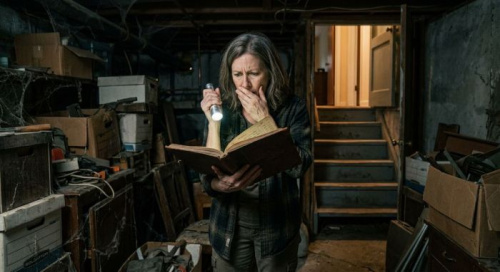
Over the next few weeks, she started keeping a journal. She logged every delivery, every strange noise, every time the light in Walter's upstairs window turned on or off. The patterns became clear. Deliveries came every Tuesday and Friday, always between 2:00 and 3:00 AM. The light in the upstairs window stayed on until dawn, then turned off precisely at 6:00 AM. On Sundays, Walter went to church at St. Mary's, returning at exactly 11:15 with a bulletin in his hand and a smile on his face.
The breakthrough came on a Thursday evening in October. Ella was in her kitchen, washing dishes, when she heard a woman's voice. It was faint, barely audible over the running water, but it was unmistakably human. The voice was coming from across the street — from Walter's house. Ella turned off the faucet and pressed her ear to the window. The voice was pleading. "Please... I just want to see the sun. Just once. I'll do whatever you want."
Ella's blood ran cold. She grabbed her phone and called Detective Torres. "I heard a woman's voice," she said, her voice shaking. "Coming from inside his house. She was begging to see the sun." There was a long pause on the other end. "Stay where you are," Torres said. "Do not approach the house. I'm on my way."
It took twenty minutes for Torres to arrive, along with a patrol car. Ella watched from her living room window as the officers approached Walter's front door. The doorbell rang. Nothing. They knocked. Still nothing. Then Walter's voice, muffled through the heavy wood. "Who is it?" "Police, Mr. Cross. We'd like to have a word with you." A long silence. Then the sound of locks clicking open, one by one, three deadbolts sliding back.
The door cracked open, and Walter's face appeared in the gap. He looked tired, his eyes sunken, but he managed a polite smile. "Is everything all right, officers?" Detective Torres explained that they had received a noise complaint. Walter's smile didn't waver. "I'm sorry about that. I was watching television a bit too loud. I'll keep it down." "Would you mind if we took a quick look around, sir?" Walter's smile faltered, just for a fraction of a second. "I'd rather you didn't. I have a lot of... medical equipment in here. It's very sensitive. And I'm a private man."
"I understand," Torres said. "But we have a report of a woman's voice. We need to make sure everyone in the house is safe." "I live alone," Walter said. "Then you won't mind if we check." The tension in the air was thick enough to taste. Ella watched from her window, her hands pressed against the glass. Walter's face had gone pale. He stood there, frozen, as if calculating his options. Then, slowly, he stepped aside.
The police entered. Ella held her breath. Twenty minutes passed. Then thirty. She was about to step outside when the front door opened again, and Detective Torres emerged, her face unreadable. "Everything's fine," she called to Ella from across the street. "No one else in the house. Mr. Cross was very cooperative."
Ella felt her world tilt. "But I heard a voice. I swear I heard a voice." Torres walked over to her. "I believe you heard something," she said quietly. "But the house is empty. We checked every room. The basement is finished, but there's nothing down there except a washer and dryer. No signs of anyone else." Ella was stunned. "The shed," she said suddenly. "Did you check the shed?" Torres frowned. "He said it's just gardening tools. We can't search a locked shed without a warrant." "Get a warrant." "On what grounds? A voice you heard that might have been a television? I'm sorry, Mrs. Moreno. There's nothing more I can do right now."
The police left. Ella stood in her doorway, watching Walter's house. She saw him through the front window, standing perfectly still, staring directly at her. He didn't wave. He didn't smile. He just watched.
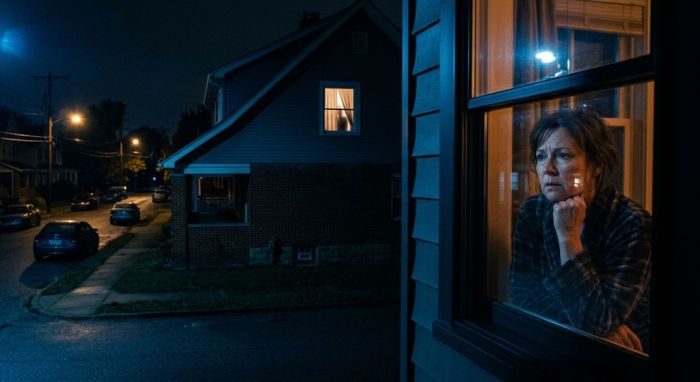
That night, Ella couldn't sleep. She sat in the dark, watching Walter's house, the journal open on her lap. At 2:00 AM, the white van arrived. This time, there were two men. They carried boxes into the back of the house and came out empty-handed. The van drove away. The light in Walter's upstairs window stayed on. Ella was about to close her curtains when she saw something that made her freeze. The light in the upstairs window flickered. Not a bulb going out — a pattern. Long, short, short, long. It was Morse code.
She grabbed her phone and started recording. The light flickered again. S...O...S.
Ella called Detective Torres. "I have proof," she said. "Someone in Walter's house is sending an SOS signal from the upstairs window. Please. You have to come." This time, Torres didn't hesitate.
A search warrant was obtained within hours. At 5:00 AM, with the first light of dawn breaking over Oak Lane, a tactical team arrived. Ella watched from her living room, her hands shaking, as officers surrounded Walter's house. There was a loud crash as the door was breached. Shouts. The sound of heavy footsteps. And then, from deep within the house, a sound that Ella would never forget. A woman's scream. Not of terror, but of relief.
Walter Cross was arrested without incident. He sat in the back of a patrol car, his cardigan still buttoned, his face blank, as his neighbors gathered on their porches to watch.
The truth came out in the days that followed. Beneath Walter's pristine living room, hidden behind a false wall in the basement, was a six-by-eight-foot concrete room. It had no windows. A single bare bulb hung from the ceiling. A mattress lay on the floor, stained and thin. In that room, police found two women. One of them had been there for three years. The other, for eleven months.
Walter had been kidnapping women from bus stations and shelters — women no one would report missing, women who had slipped through the cracks of society. He would bring them to his home, keep them in the hidden room, and use them for his own purposes. The white van deliveries were supplies — food, water, restraints. The combination lock on the shed was a decoy, meant to draw attention away from the real secret hidden inside the house.
The woman who had sent the SOS signal had been a nursing student from Cleveland. She had memorized Morse code as a Girl Scout. For three weeks, she had waited for the right moment, signaling into the darkness, hoping someone would see. Ella Moreno had seen.
Walter Cross was sentenced to life in prison without parole. The two women were reunited with their families. And the house at 7 Oak Lane was eventually torn down, the land left fallow, nothing but a patch of wild grass where a quiet old man had once watered his petunias.
Ella never walked past that empty lot without feeling a chill. She thought about the clues she had almost ignored — the thumping, the stains, the smell of decay, the polite man who never let anyone inside. They were all there, scattered like puzzle pieces, waiting for someone to put them together. She learned that the most dangerous predators are often the ones who smile at you from across the street, who bring you banana bread, who seem so harmless that you almost convince yourself the thumping in the night is just your imagination. But it's never just your imagination. It never is.