The first time I noticed something wrong was the smell.
It wasn't the kind of smell you'd call the police about. It was faint, electronic, like the ozone that lingers after a lightning storm. It drifted from the house next door at odd hours — three in the morning, four, sometimes just before dawn. I'd wake up to let my dog out, and there it was, that strange metallic scent hanging in the air like a question nobody asked.
My neighbor was Daniel Cross. He was thirty-seven years old, with a crew-cut haircut and wire-rimmed glasses. He always wore polo shirts tucked neatly into khakis and pressed the crease in his slacks every morning. He worked from home as an IT consultant — or so he told everyone on the day he moved into the cul-de-sac at 318 Sycamore Drive. He was polite, quiet, the kind of man who waved when you pulled into your driveway but never lingered for conversation. The perfect neighbor, really.
Too perfect, as it turned out.
The first real red flag came three weeks after he moved in. I was working in my garden, pulling weeds along the fence line that separated our properties, when I noticed the cables. There were at least six of them, thick black coaxial lines running from a utility box near the street directly into a basement window that had been permanently sealed with black foam insulation. They weren't standard cable TV lines. They were thicker, heavier, the kind I'd seen in data centers during my years as a network administrator before retirement.
I mentioned it to my wife that evening over dinner. "The new neighbor has some serious internet setup," I said.
She shrugged. "He works in computers, honey. Isn't that normal?"
It was normal. That's what made it so hard to pin down. Everything Daniel Cross did was just barely normal enough to dismiss. His behavior existed in a gray area where suspicion felt paranoid and trust felt naive.
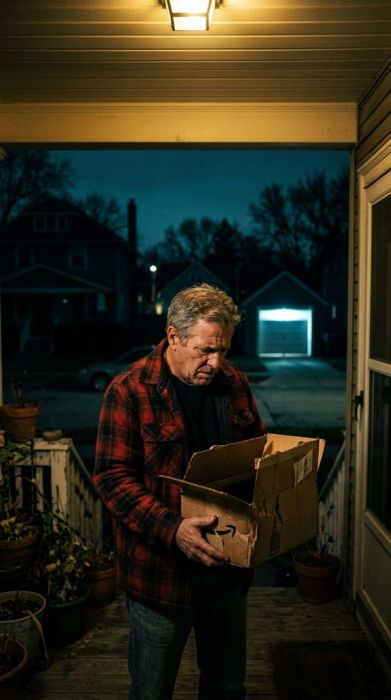
The packages started arriving about a month later. Not Amazon boxes or UPS deliveries — these were unmarked brown cardboard boxes, delivered by men in unmarked white vans who never rang the doorbell. They'd pull into his driveway at odd hours, usually between midnight and two in the morning, and Daniel would meet them at his garage door. The exchange took less than thirty seconds. No receipts. No signatures. Just a handoff and a handshake, and then the van would disappear into the night.
I told myself it was computer parts. IT consultants need hardware. Maybe he was building servers for clients. Maybe he ran a small data-hosting business on the side. It made sense. It was reasonable. It was the kind of explanation a rational person would accept.
But I couldn't shake the feeling that something was off. The feeling grew in my chest like a slow infection, spreading until I couldn't ignore it anymore.
By the third month, I started paying closer attention. I'd watch his house from my living room window while pretending to read the newspaper. I noticed patterns. His lights turned off at exactly 11:47 PM every night, then turned back on at exactly 2:14 AM. The basement light — a faint blue glow from a window well covered by a metal grate — would stay on until dawn.
The electricity bill became a topic of conversation at the neighborhood block party. Margaret from 322 Sycamore mentioned that her bill had gone up substantially since summer. "I think the AC unit is getting old," she said.
Daniel Cross smiled politely. "Mine's been through the roof too. These old houses, you know."
He didn't mention that his house was only six years old. He didn't mention that he kept the thermostat at seventy-two degrees. He didn't mention that his basement — the one with the blue glow and the sealed windows — consumed more electricity than a small factory.
I started researching him. It wasn't hard — I had time, and I had a growing unease that wouldn't let me sleep. I searched for "Daniel Cross IT consultant" and found nothing. No LinkedIn profile. No company website. No business registration with the state. No professional certifications. No conference appearances. No articles. No blog posts. Nothing. A man who claimed to work in technology had absolutely no digital footprint.
That's when I called my daughter, Sarah, who works in cybersecurity for a bank in Chicago.
"Dad, that's not nothing," she said when I told her. "That's a ghost. Someone who doesn't want to be found."
"You think he's hiding something?"
"Everyone has some kind of footprint. Everyone. Even criminals. But someone who's completely invisible? That takes effort. That takes money. And that takes a reason. A very good reason."
The next week, I bought a small security camera and pointed it at my driveway. I told my wife it was for package theft prevention. The truth was, I wanted to see what happened at 318 Sycamore when no one was watching.
What I captured over the next ten days made my blood run cold.
There were the van deliveries, of course. Two of them in the first week alone. But there was also something else. People. Young men and women, usually in pairs, arriving at Daniel's house late at night. They'd stay for exactly forty-five minutes, never longer. They'd leave with envelopes. Sometimes boxes. I counted fourteen different visitors in ten days, all of them arriving between 11 PM and 3 AM. None of them ever made eye contact with the street. None of them ever looked back.
I took the footage to the police. Officer Martinez listened patiently, nodded at the right moments, and then told me what I already knew — there was no law against having late-night visitors. No law against unmarked packages. No law against smelling ozone at three in the morning.
"Let us know if you see anything more concrete," he said.
Two weeks later, I didn't need to show them anything. They came to me.
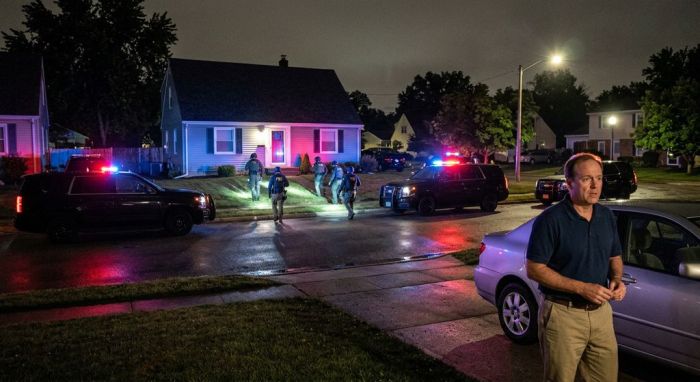
It was a Tuesday morning. I was drinking coffee and reading the paper when the entire street filled with vehicles. Not police cruisers. Black SUVs. Unmarked. Federal license plates. FBI, I later learned. At least thirty agents, some in tactical gear, fanning out across the cul-de-sac. Two of them knocked on my door.
"Sir, we need to evacuate this residence immediately."
"What's happening?"
"Sir, please gather your family and step outside. Now."
They wouldn't tell me anything. Not then. Not until the computers were already being carried out of Daniel Cross's house in evidence bags. Racks and racks of servers, hard drives, routers, modems, and devices I couldn't identify. Twenty-three boxes of electronic equipment in total. They worked for six hours, filling that truck with evidence.
The agent who finally spoke to me was a woman named Special Agent Chen. She stood in my driveway, watching the operation unfold, and told me the truth.
"It's been going on for four years," she said. "Since before he moved here. He had a smaller operation in an apartment in Cleveland, but he upgraded. Needed more space. More power. More bandwidth."
"For what?"
"Identity theft. Large-scale. He wasn't just stealing credit cards, Mr. Patterson. He was running a full-service identity factory. Stolen identities from data breaches, phishing campaigns, hacked databases. He'd buy raw data on the dark web, process it here, and sell complete identity packages — Social Security numbers, birth certificates, driver's license templates, medical records. He had clients in seventeen countries."
I stared at the house. The quiet house with the potted plants on the porch and the American flag by the door. The house where a man waved hello every morning and never caused any trouble. The house where children trick-or-treated on Halloween and received full-sized candy bars.
"How many people did he hurt?"
Agent Chen was quiet for a moment. "We've identified over three thousand victims so far. But that number is going to grow. We're still mapping his network. Some of those victims lost everything. Homes, retirement savings, their ability to get loans or mortgages. One woman in Florida had her identity stolen to buy a house in another state. It took her three years to clear her name."
Three thousand. More than the entire population of our town.
They arrested Daniel Cross in his basement. He didn't resist. He didn't run. He was sitting at his desk, calm as a Sunday morning, when they came through the door. I watched them lead him out in handcuffs. He was wearing the same polo shirt and khakis he always wore. He looked like a man being taken to a traffic court, not a federal prison.
He looked at me as they walked him past my driveway. His eyes were calm. Almost apologetic.
"I'm sorry about the smell," he said. "The cooling system was never adequate for the server load."
That was the only real conversation we ever had. In six months of living next to each other, those eleven words were the only thing he ever said to me that wasn't a wave and a hello.
The trial was covered by national news. Three thousand seven hundred and twenty-two confirmed victims. Over forty million dollars in fraudulent transactions traced back to his operation. The prosecution called him a "ghost factory" — a man who manufactured invisible crimes that destroyed lives one stolen identity at a time.
What struck me most was the interview with his mother. She came to the trial from Ohio, a small woman in her sixties who looked confused and heartbroken.
"He was always so good with computers," she told a reporter. "He helped elderly people with their email. He was a good boy."
I thought about that a lot afterward. How many times had I told myself the same thing? He's polite. He waves hello. He keeps his lawn neat. He's a good neighbor. He must be a good person.
The trial ended with a twenty-three-year federal sentence. The house at 318 Sycamore Drive was seized by the government. A new family moved in six months later. They're nice people. They wave hello. They keep their lawn neat. They invited us over for a barbecue last summer. I went, but I found myself staring at their basement windows, wondering if there were cables running through the walls.
I still check my credit report every week. So does my wife. So does my daughter, and she wasn't even living on this street. The habit has become a ritual, a small act of vigilance that I perform every Monday morning without fail.
The thing about identity theft is that you don't always know when it happens to you. It could be months before you find out. Years. Some people never find out. They just lose their homes, their savings, their credit, and they never know why. They never connect the dots. They never see the quiet neighbor with the strange smell and the late-night visitors.
That's what I think about when I look at the house at 318 Sycamore Drive. Not the servers. Not the cables. Not the strange smell at three in the morning. I think about the three thousand seven hundred and twenty-two people whose lives were taken apart, piece by piece, by a man who seemed too quiet to cause any trouble at all.
I think about how easily it could have been me. How easily it could be you.
And I wonder how many other quiet neighbors are doing the same thing right now, in houses just like his, on streets just like mine. I wonder if the next Daniel Cross has already moved in somewhere, smiling and waving, while the blue glow of a thousand stolen identities burns in his basement until dawn.