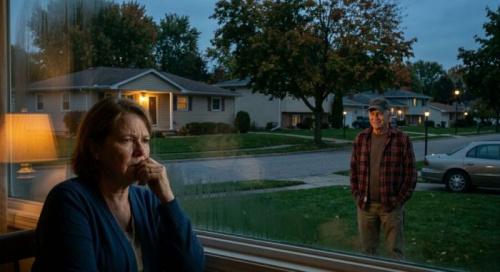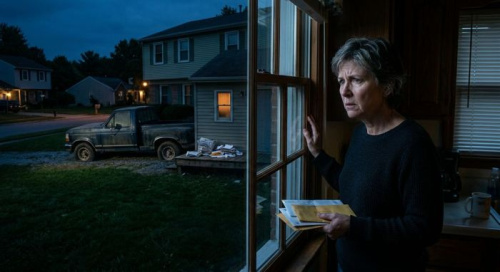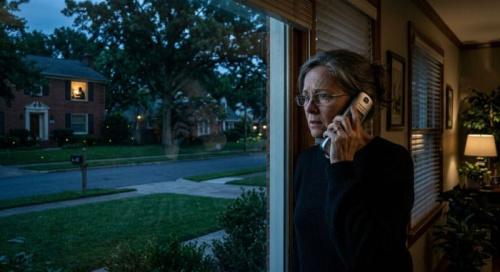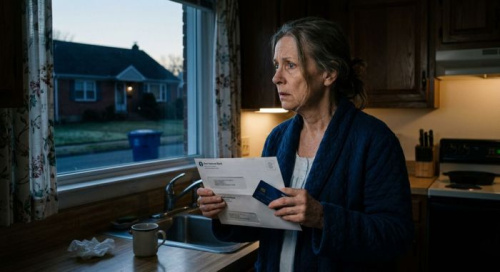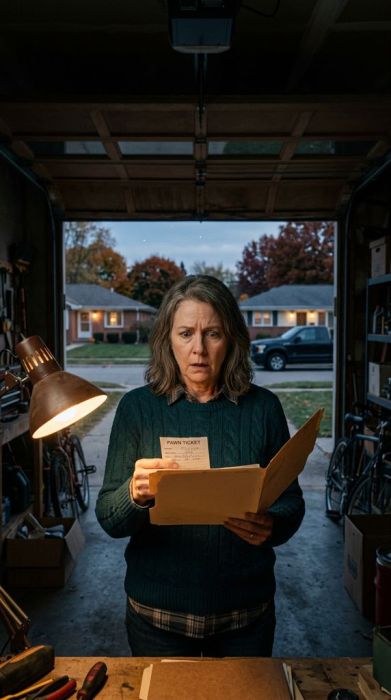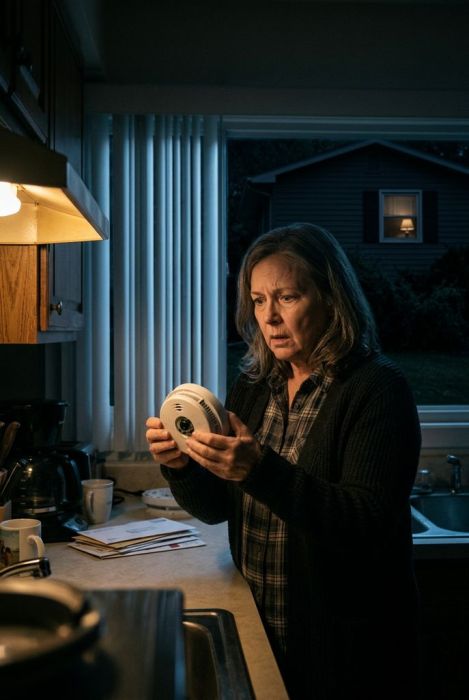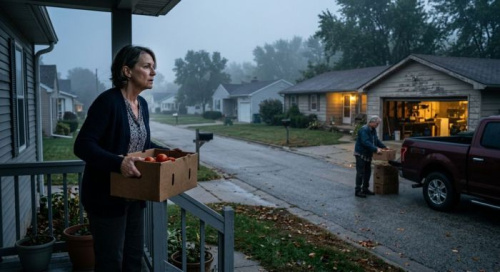
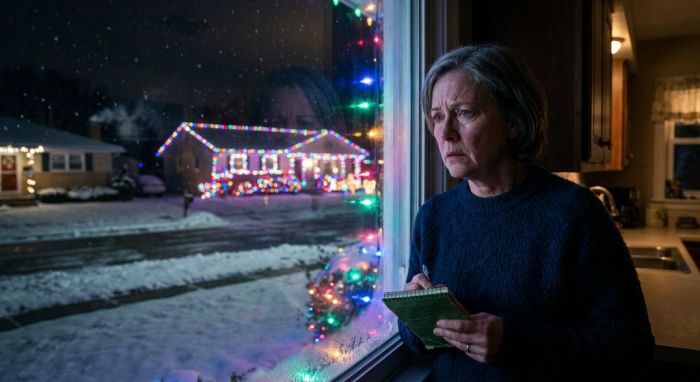
The whole block thought I was watching the show. They stood on the frost-hard grass with mugs of cocoa and phones raised to the sky, letting out little oohs when the Karlson house rolled into its famous finale — forty thousand lights sweeping in waves down the roofline, red and green and gold, the same spectacle that had won the Pinecrest Drive lighting contest ten Decembers in a row. I stood at my own kitchen window in the dark and counted. One, two, three. Pause. One, two. Pause. Long. I'd been counting blinks for eleven nights, ever since my grandson Ethan slid a green spiral notebook across my kitchen table and pressed his small hand flat over the cover.
"Grandma, look," he'd said. "The lights are talking."
He was twelve and had a mind that caught patterns the way other kids caught pop flies. His teachers called it a gift. His mother, my daughter Taryn, said it was just Ethan being Ethan, and she was right. That Saturday in late November, the day Vince Karlson hung the first strings of his display, Ethan sat on our porch with his chin on his knees and watched each strand warm up like it was an old friend. I remember smiling at that. I remember thinking how lucky we were to live next door to the man who made our whole street beautiful. I had no idea I was watching the man mark my own house.
My husband Tom had been gone six years come March. Army man, thirty-one years, died the way he'd always said he wanted to — in his sleep, in his own bed, with his girls down the hall. Taryn moved in with Ethan two years later, after her divorce, and the three of us made a good, loud, crowded home out of the one Tom and I had built. That's probably why the burglary stung so bad. Whoever came through our back slider the night of October twenty-fourth walked past the family photos, past the box of Tom's medals, and took my jewelry box clean off the dresser. Taryn was on her shift at the hospital. I was at choir practice — Wednesdays, six to eight, everyone knew it. Ethan was at a sleepover at his best friend's house. The prints were glove-prints. The detective, a young fellow named Purcell, said it plainly: "Whoever did this knew the house. Knew the schedule. This wasn't a kid kicking in a door."
Those words stayed with me. For weeks I replayed them like a scratched record while I argued with the insurance company over my mother's pearl necklace and the gold band Tom slipped on my finger when I was twenty-two. The premiums kept coming due. The lady on the phone kept saying the word "review." And every night I lay awake listening to the house settle, no matter how many times I checked the locks, sure that whoever knew the schedule might be out there learning a new one.
Vince Karlson and his wife Connie had lived at 22 Pinecrest since before I moved here as a bride. He was a retired master electrician, a wiry, big-handed man who could fix anything with a length of tape and a promise. Over thirty years he'd rewired half the street, replaced a breaker panel here, hung ceiling fans there, installed the outlet that ran my grandfather clock. "Mr. Sparky," the kids called him. Connie brought casseroles to every funeral and knew everyone's birthday by heart. When the community center needed its stage lights repaired free of charge, it was Vince's pickup in the parking lot every Saturday. When I needed a ladder after Tom died, Vince's was already leaning against my gutter before I could ask.
There was no reason on earth to think a bad thought about Vince Karlson, and that's what made the green notebook feel like a betrayal of my own mind.
It started with the countdown. Every year Vince "tuned" the display for the first week of December, testing and re-testing, running the lights in short patterns while he stood in the yard with his phone pressed to his ear, talking to the same number. Ethan noticed the patterns followed a kind of grammar. Long stretches. Short stretches. Gaps like spaces between words. He started writing them down, not because he suspected anything, but because that was what his brain did with order. He filled pages. He drew little calendars in the margins, tiny boxes with x's in them. When a ranch house four blocks over got hit on the second of December, Ethan tapped my arm at breakfast. "Grandma. The lights said two. They said the number two the night before the robbery, too."
I told him it was a coincidence. I told him patterns are everywhere if you look for them, and that a boy who hears music in numbers sees all kinds of things the rest of us miss. I made him pancakes and poured the little maple bottle too generously, the way I did when I wanted to change a subject. Then I put the notebook on the top shelf of the hall closet, behind the good candles, and I did not sleep that night — because part of me had already started counting.
Then came the Tuesday after Thanksgiving. I was at the sink, wrists deep in suds, when Ethan came down the stairs with the notebook open to a page he'd dog-eared with a strip of receipt. "Grandma, I found ten twenty-four," he said. "That's the night we got robbed." I turned off the water. "What do you mean, you found it?" He flipped the notebook around and ran a small finger along a row of marks. "The lights made this pattern the night before we got robbed. And they made it again last night."
I didn't sleep that night either. I sat in the dark living room with the porch light off — the porch light Vince had insisted needed a new fixture, the porch light that had burned out "mysteriously" in September and stayed out until the first week of October because the hardware store back-ordered the part — and I watched the Karlson house, the only house on the block bright enough to read by, and I tried to talk myself out of everything. There are only so many patterns a string of lights can make in a week of testing. It was chance. It was my grief making monsters out of neighbors. It was the same voice that hadn't trusted the mailman since October, or the gas meter reader, or anyone else who knew my Wednesday choir schedule. But the detective's words kept coming back to me. Who knew the house? Who knew the schedule? Who had been inside every single house on Pinecrest Drive, including mine, with a toolbox and a smile and a perfectly good reason to know where the breaker panel sat behind the master bedroom wall?
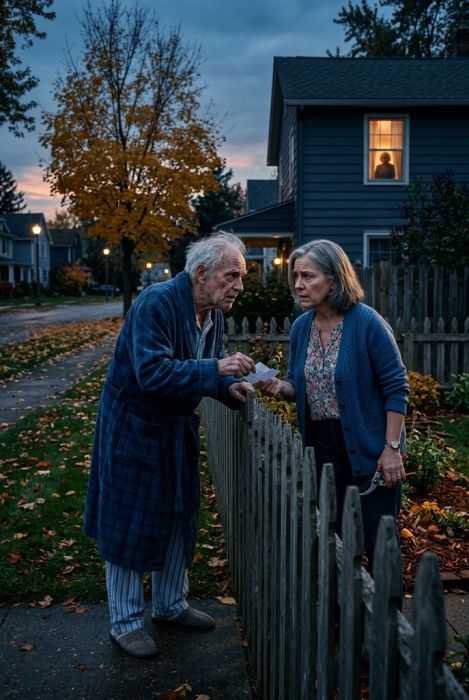
Two weeks later I was standing at Lou Hendricks's front gate in the cold, feeling like the world's biggest fool. Lou was eighty-one, widowed twice, and for thirty-four years he'd worn a badge for the county sheriff's office before retiring to a recliner and a porch full of wind chimes. Everyone on the street called him the Mayor. He listened to the whole story — the notebook, the blinks, the October date, my sleepless nights — and he did not laugh. He put on his reading glasses and studied Ethan's pages for a long, quiet while. "Diane," he said at last, "the boy's got something. I can't tell you what. But I spent enough years in a cruiser to know that the best lies are the ones built on a truth nobody wants to look at."
Lou drove me to the county building himself, in his old Buick with the passenger seat warmer that only worked when the engine idled. Detective Sheila Barnes was a compact woman in a gray blazer who had taken the burglary reports from our side of town. She had a nominee list from three towns over, and when I told her about the white panel van with no lettering that I'd seen twice near the end of the street, she pulled down a binder thick enough to choke a horse. There it was. No plates. No logo. Witnesses at four separate scenes. "You're the first person to put that van on a date we can use," she said.
The trap, when Barnes laid it out, was almost embarrassingly old-fashioned. Every year since my cousin Rita moved to Arizona, she left her house at the quiet end of Pinecrest empty from mid-November to New Year's — and she'd left me a key and told me to use it however I liked, which made saying yes on her behalf feel a little less like forgery. Barnes asked permission to turn it into a drop. A cardboard box of "Christmas gifts" — three decoy necklaces and a ring, each with a GPS transmitter sewn into the velvet — sitting on Rita's dining room table, visible from the back slider, bait no burglar on a timeline could resist. Lou said yes to the plan, but he added one condition. "We tell the boy," he said. "You're not using a twelve-year-old's gift against a man without telling him what you're using it for. He'll keep the log either way. He'll keep it better if he knows it matters."
So we told Ethan. I sat him down at the same kitchen table where he'd first shown me the notebook, and I told him that his grandmother believed him, and that investigators believed him, and that the lights he loved might be hiding something unkind behind their beauty. He didn't cry. He didn't look scared. He nodded like a soldier receiving orders, went to his room, and came back with the notebook and a red pen. "I'll know when they're going to move," he said. "The lights always say first."
The lighting contest fell on the second Saturday of December, and for ten years that had been the night Vince Karlson became a king. The judges gathered at the cul-de-sac with clipboards. The carolers came with flashlights and frost on their scarves. Connie stood in the doorway in her red coat handing out cookies, telling everyone how shy her husband got when people made a fuss. Taryn was working nights again, which meant I watched the end of the street alone. And at exactly 6:58 the lights went dark for three full seconds — the crowd always gasped at that part — before forty thousand bulbs detonated into light like a firework that wouldn't quit. "It's on," Ethan whispered from the window. "Two longs. One short. That's the code for the empty house."
Detective Barnes had two unmarked cars parked behind the old church on Willow, with a clear line on both ends of Pinecrest. Her people had been in place since the carolers arrived. And at 7:12 a white panel van with no lettering rolled slowly down the block, past the glowing Karlson house, past the judges and the cocoa and the laughter, and turned into the empty drive at the quiet end of the street. I watched it from my kitchen with my hands flat on the counter, my dish towel still around my neck. I had never in my life wanted so badly to be wrong.
It was over by 7:40. The two men who came out of Rita's house carrying the decoy box met three deputies at the bottom of the steps. The driver found Barnes's flashlight in his window before he could find his keys. Lou and I stood on the sidewalk and watched, and I remember thinking the strangest thought of my life — that the arrest went exactly the way Vince's lights always went. Quiet. Then sudden. Then all at once. The two men belonged to a crew working out of a town a hundred and ten miles away, and they gave up Vince's name before they reached the car. Detective Barnes came up my driveway at 9:30 with Ethan's notebook in a plastic evidence bag and told me they'd searched the Karlson garage. Under the reindeer, bolted to the slab — the one patch of ground in the whole display that sat in shadow — they'd found a magnetic box, and inside it a list of houses with nights written beside them in a code that matched the lights. Houses he'd known the insides of for thirty years. Houses like mine.
They arrested Vince at his kitchen table while the last of the crowd was still walking home with cookies. I didn't see it, and I'm glad. Connie came to my door the next morning hollow-eyed, and I expected her to throw my own porch light at me. Instead she hugged me hard and said, "I never knew. You have to believe me, I never, ever knew," and then she cried into my shoulder, and I cried too, because there is a particular grief in losing thirty years of a marriage to the discovery that you never really met the man. The grand jury said gambling debts. Forty-one thousand dollars, hidden for years, the kind of number a proud man hides until it owns him. The crew paid him to know the houses. The lights were his payphone. The beauty was the cover, and the cover had a price, and the price was us.
Vince Karlson pleaded guilty to six counts of burglary and one count of conspiracy, and the judge gave him eleven years. Restitution was ordered, and when the insurance company tried to keep stalling on my claim, Detective Barnes's report — and the notebook, entered into the record — became the one document they couldn't wave away. My mother's pearls came home in April in an evidence box, still in their little case, like they'd just been out for cleaning. Tom's wedding band never did. I let myself miss it for a week. Then I went to the jeweler and bought a plain gold band with a good guarantee, put it on the chain beside my watch, and stopped waiting for a man who was six years gone to come back. Taryn was angry with me for exactly one day. Then she read the notebook cover to cover, and I watched her call Detective Barnes to ask if Ethan could see the task force's building someday.
The first December without Mr. Sparky's lights, Pinecrest Drive almost went dark out of mourning. But Connie surprised us. She held a meeting in her living room — I went, and I won't pretend I wasn't nervous — and she said the tradition shouldn't die just because the man had. So now the block pools its money, and every December we light up together, one house at a time, until the whole street glows instead of one shining monument to a lie. Connie does the organizing. Ethan is the pattern-keeper, the boy who taught a county task force how to listen to light, and there's a photo of him with Detective Barnes on my mantel that I'd rather have than any trophy.
On the first Saturday of December, I stand at my window the way I always have, and I watch our street wear its light the way an honest neighborhood should — a little imperfect, a little patchwork, fully known. Nobody on Pinecrest locks their doors against each other anymore. We lock them against the dark outside the street, and we keep them that way. When Ethan's school asked what he wanted to be, he didn't hesitate. "I'm going to decode things," he said. "I'm going to find what the patterns are hiding." And I thought, child, that's exactly what you already did. You found the truth hiding in the brightest house on the block — and you carried it into the light where it belonged.