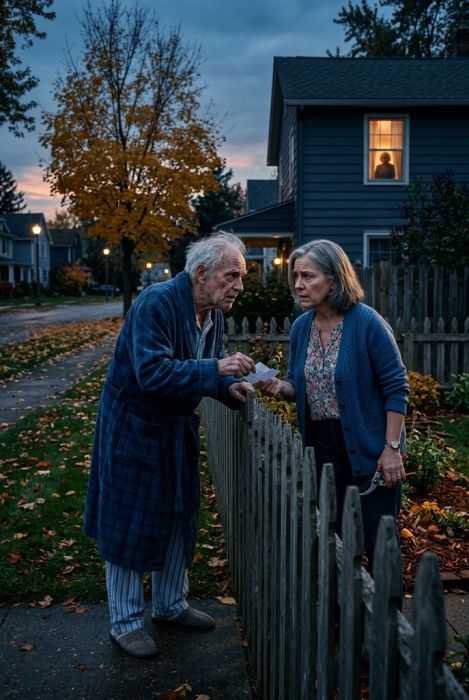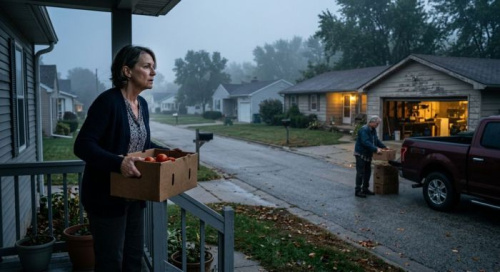
The morning after the second hail storm, I found Ernest Ellison standing at the end of his driveway in his bathrobe, staring up at his roof with the same look my students used to get when a test came back lower than they'd hoped. He was eighty-one years old, a retired railroad engineer who had spent forty years keeping freight trains on their rails, and he was the kindest soul on Primrose Court by a long mile. He was also holding a coffee mug with a brown stain spreading across his bedroom ceiling, because the roof he believed was fixed had just leaked on him for the third time in six months.
"Roof's fixed, Carol," he told me, and I didn't have the heart to argue with him, not yet. He said it the way he said everything that summer, with the quiet confidence of a man who had signed his name to a promise he never actually read. That was the whole problem, in the end. Ernest Ellison trusted people. And the person he trusted most, after my husband Pete and me, was the man who had bought the Hendersons' house at the corner two summers back: Royce McAllister.
Royce had a way about him that I still struggle to describe without making him sound better than he deserved. He was in his early fifties, with a sun-browned face, a strong handshake, and an easy laugh that made you feel like the two of you had grown up on the same street. He said he sold replacement parts to the oil-field companies up the turnpike, which sounded right, because the older part of our town was full of men who had spent their lives around machinery and could talk about a distributor cap the way other people talk about the weather. Pete liked him immediately, and that was saying something, because Pete didn't like anybody immediately.
When the first big storm rolled through that April and hail the size of golf balls tore the shingles off half the neighborhood, Royce did what nobody else on the block had the energy to do. He backed a pickup into his driveway with a magnetic sign that read McAllister Storm Restoration, hired two high school kids who had been out of work all spring, and went up and down ladders from sunup to sundown. He shoveled hail out of gutters, threw tarps over holes, and told every retiree on the street the exact same thing. "I'll handle the insurance company for you, ma'am. You just sign here so they can write the check to my crew, and I'll make sure the work gets done right."
I didn't pay attention to that sentence at the time. Nobody did. It was the kind of thing contractors say; you nod along, you sign, you forget. My own house only needed a small patch — a dented gutter and a few loose shingles — and Royce fixed it for two hundred dollars cash, no paperwork, and he did a fine job. That was the genius of the operation, I realize now. He did honest work for the people who asked questions, so the whole street would swear by him when he went after the ones who didn't.
Ernest's roof took the worst hit of anybody's. A branch from the old cottonwood in his backyard punched clean through three feet of shingles, and the rain found his spare bedroom before the storm even finished moving east. Royce was up there the very next morning, and by lunch he had a tarp over the hole and a sad story about everything he'd found underneath. "Carol, this roof's done," he told me over the fence that evening, shaking his head like a surgeon who had just seen a bad X-ray. "Mr. Ellison's had that same roof since 1982. The decking's soft, the shingles are shot. He needs a full tear-off, all of it." He quoted Ernest a price I still remember because I wrote it down out of pure reflex: fourteen thousand, six hundred dollars. New decking. New architectural shingles. New ridge vents. And because Ernest's daughter had been after him for years to fix that roof before it caved in, Ernest said yes.
That was when Royce pulled out the piece of paper that changed everything, although it took me six more months to understand it. "Now, Mr. Ellison," he said, "your insurance will cover most of this, but I don't want you dealing with adjusters and paperwork. You just sign this claim assignment, and they'll send the money straight to my company. I'll take care of the rest." Ernest, who was too proud to admit he couldn't read the fine print without a magnifying glass, signed his name in his careful round handwriting and handed the paper back. The insurance company mailed a check for fourteen thousand, six hundred dollars to McAllister Storm Restoration, LLC, and it was cashed within the week.
For about a month, it all looked like it had worked out fine. Royce's crew spent three days on Ernest's roof, and when they finished, it didn't look repaired so much as brand new, in a strange gleaming way that I now know was just silver roof coating spread over plywood and tar. Ernest was delighted. He insisted on paying for pizza for the whole crew, and Royce stood in his yard with his arm around the old man's shoulder while I snapped a photo for Ernest's daughter in Dallas. We all stood on our porches that night and toasted the street's newest favorite neighbor. Nobody saw what I would later see, stamping the claim folder on a cold October afternoon: McAllister Storm Restoration, LLC, had not pulled a single permit for any of the nine homes it had signed.
The second storm came in October, the way autumn storms always do in our part of Oklahoma, fast and mean and loud. It raged through the night, and by morning the tarp Royce had promised would last the winter was hanging off Ernest's roof like a wet flag. The leak came back worse than before, straight into the bedroom Ernest had shared with his late wife, and that's when his son Scott drove up from Kansas City. Scott was a big quiet man who worked in a warehouse and asked questions for a living, which meant he didn't stay quiet long. He climbed the ladder himself, pulled back the edge of the tarp, and found what I'd been dreading: painted-over plywood, busted decking, and not one inch of the fourteen-thousand-dollar repair Royce's invoice described.
"You paid him for a new roof," I heard Scott say into his phone that afternoon. He was standing in Ernest's kitchen with the claim number in his hand, and his voice had that flat, dangerous calm that only a grown son gets when somebody's hurt his father. "Dad's insurance says the claim was settled and paid in full two months ago. Paid to McAllister Storm Restoration. And there's no new roof up there." He hung up, stared at the ceiling stain for a long moment, and then he went next door to have a word with Royce.
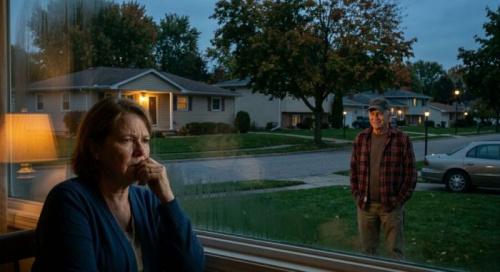
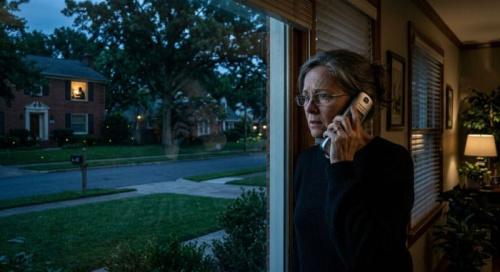
I watched the whole thing from my kitchen window, and I will never forget Royce's performance. He came out onto his porch with his hands in his pockets and that easy smile already in place, and he told Scott the exact same story he'd told everyone for six months. The crew had been swamped. The shingles were on backorder. Supply chains, you know how it is. He'd be up there first thing Monday to make it right, he promised, and he even shook Scott's hand, which I could tell Scott didn't want to do. Scott drove back to Kansas City with the ceiling still leaking, and Primrose Court went quiet, and I lay awake for three nights straight, doing the math Royce had never wanted anybody to do.
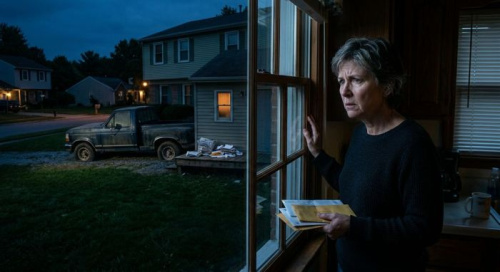
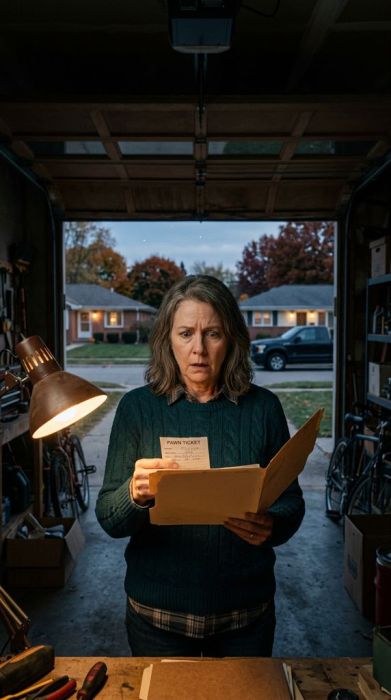
The trailer is what finally broke it open. A week after Scott left, Royce's crew parked the company trailer in his driveway with the back door hanging open, and there was a milk crate of manila folders stacked right inside, half covered by a bundle of shingles. I told myself not to look. I told myself it was his truck, his driveway, his business, and that I was a sixty-one-year-old retired biology teacher, not some television detective. Then I saw the top folder, and the name on it was Ernest J. Ellison, and I understood that it had stopped being Royce's business the moment he took an old man's fourteen thousand dollars and left him a tarp.
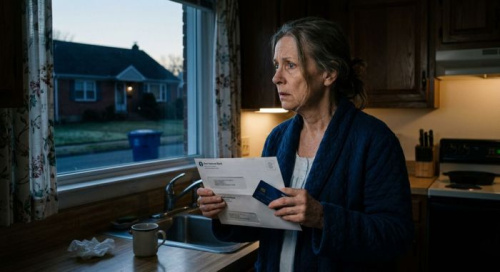
I took pictures of every page with my phone. Claim assignment forms, all in the same handwriting, all signed in the careful round script of elderly people who had never been asked to read what they were signing. Paid-in-full statements from an insurance company, nine of them, for nine addresses on my street, adding up to two hundred and fourteen thousand dollars. Mrs. Kowalski's name was in there, and Mr. Portillo's, and the two unmarried sisters at the end of the lane who still drove to church every Sunday. Every one of them had trusted Royce McAllister the way Ernest had. And every one of them had gotten tarps.
I didn't go to Royce with it. I went to Hank Caldwell, retired claims adjuster, two houses down, who had spent thirty years watching insurance fraud eat through neighborhoods like ours. Hank read through my phone with his reading glasses perched on his nose, and when he was done he just nodded, slow and grim. "You've got a textbook claim-assignment scheme here," he said. "They don't do the work, they sell the paper. The insurance pays, the homeowner gets nothing, and by the time anyone checks, the company's dissolved and the man's two states over doing it again." Then he made a call to a friend of his at the Oklahoma insurance fraud task force in Oklahoma City, and I learned that Royce McAllister had been on their radar for months.
The state database told the rest of the story. McAllister Storm Restoration, LLC, had been formed three months before the April storm, registered to a post office box. Royce had no contractor's license in Oklahoma, no general liability coverage, and two complaints from counties to the west that had been settled quietly out of court. A little more digging, through Texas county records Hank had saved over the years, turned up something even worse: a roofing company called Lone Star Roofing, owned by the same man, shut down in 2019 with a string of defrauded homeowners and one dismissed indictment for insurance fraud. He hadn't changed his methods when he came to our street. He had just found a neighborhood where nobody knew his name.
The task force wanted one clean, documented sting to take to the prosecutor, and they asked if I would help. I said yes before my mouth caught up with my brain. Two days later, I called Royce and told him my sister had a place outside Owasso that had taken a beating in the October storm, and that after seeing how well he'd taken care of Mr. Ellison, I wanted him to take care of her too. He came to my door that evening carrying a note pad and a folder of his own, and he gave me the exact same speech he'd given Ernest, word for word. "I'll handle the insurance company for you, Carol. You just sign here, and I'll make sure the work gets done right."
The men in the unmarked van across the street recorded every word. I let him write up the estimate, ten thousand eight hundred, and I handed him a certified check for the down payment, which the task force had provisioned with state funds so there was no question of fraud on my end. He took it, folded it into his shirt pocket with a grin, and climbed into his truck. He made it exactly to the corner of Primrose Court before the lane filled with blue lights.
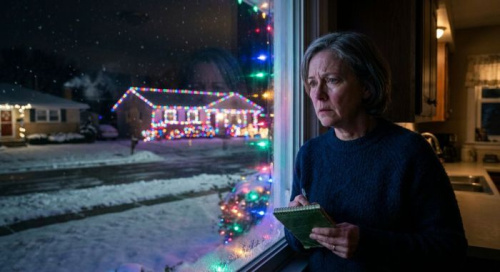
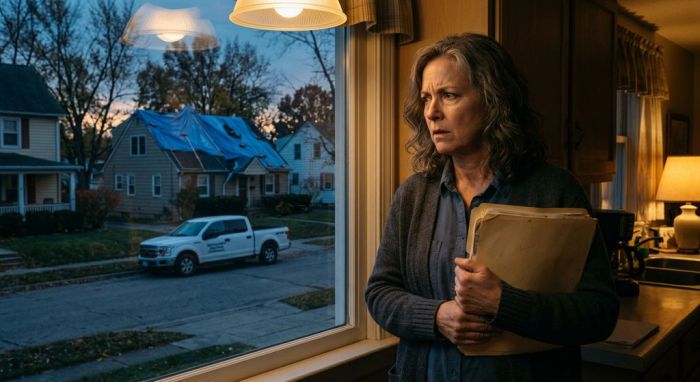
I stood at my window like I had stood a hundred times that year, and I watched them cuff him on the curb in front of his own truck. The whole street came out, because on Primrose Court a commotion was news, and the silence that settled over us was unlike any silence I'd ever heard. Nobody said a word. We just stood in a loose circle in the middle of the road, the way neighbors do at a funeral, and watched the man who had brought us pizza and tarps get read his rights by two agents who looked about the age of his crew. The only sounds were the click of the handcuffs and the slam of a van door, and somewhere far off, a chain-link gate swinging in the wind.
The search warrant found everything. The milk crate of folders was still in the trailer, and so were the fake invoices, the backorder excuses, and a handwritten list of nine names with notes beside them. "Kowalski — son in Phoenix, won't visit." "Portillo — forgets his keys, easy." "Ellison — can't see fine print." The prosecutor stacked the evidence eighteen inches high, and I sat in the second row of the courtroom with my hands folded in my lap while Royce McAllister, who had looked so at home on our street, pleaded guilty to insurance fraud and theft by deception. He got seven years, and the judge ordered every dollar of the two hundred and fourteen thousand returned. The insurance companies and the state's Contractor Recovery Fund made the nine families whole before Christmas.
Ernest's roof was finished the week before Thanksgiving by a licensed crew from a real company, with actual permits, and Ernest stood in his yard in his good jacket and wrote the foreman a thank-you card with his careful round handwriting. Scott wanted to move him to Kansas City, and for a few weeks I thought he might. But Ernest told him the same thing he told everybody who asked: "Fifty years on this street. I'm not leaving on account of a bad handshake." So he stayed, and Scott started driving down the third weekend of every month, and Ernest got a smart doorbell and a magnifying glass on a chain that he hung right beside his back door.
The neighborhood changed after that, in small ways that matter. The association held a coffee morning with a fraud-prevention officer, who taught us how to check a contractor's license and why you should never sign over your insurance claim to anyone, ever. Mrs. Kowalski got her money back and bought new drapes and told everyone they were from "the nice man at the courthouse." Mr. Portillo donated part of his refund to the volunteer fire department, and they put his name on the back of the new truck. And every contractor who comes to Primrose Court now gets asked for a license number before he's offered a glass of water.
Last week a thunderstorm rolled through at three in the morning, the kind that used to wake me up with my heart pounding, waiting for the phone to ring. I lay there in the dark and listened to the rain hammer the roof, and I thought about Ernest's coffee mug and the stain that used to grow across his ceiling. In the morning I walked over to check on him, and he came to the door in his bathrobe, dry as a bone, laughing at a joke he'd heard on the radio. His roof held. His mug was clean. And when I walked back home, past the corner where Royce McAllister's truck used to sit, I noticed a kid from the high school riding a bike with a roll of tarps strapped across the handlebars, and I thought: that's who we became. A street that pays attention. And that's the whole guard, as my Pete would say — it only takes one pair of eyes to keep a whole block honest.