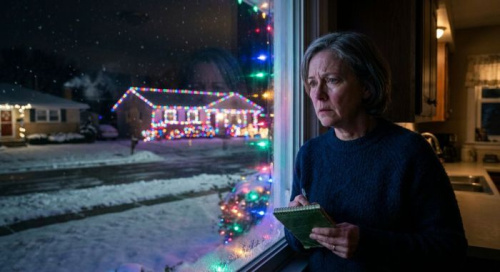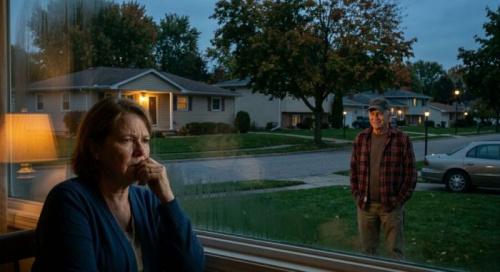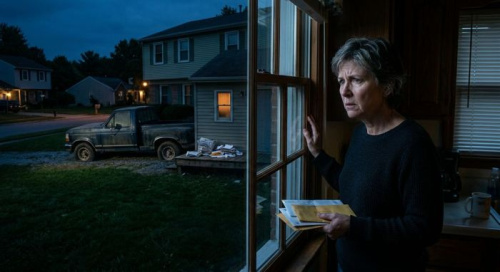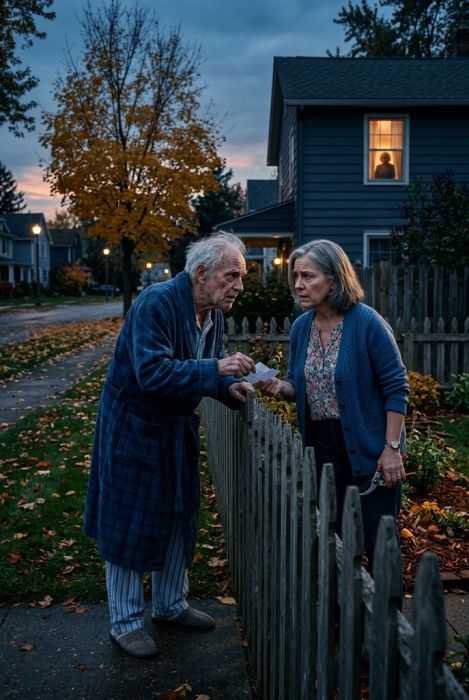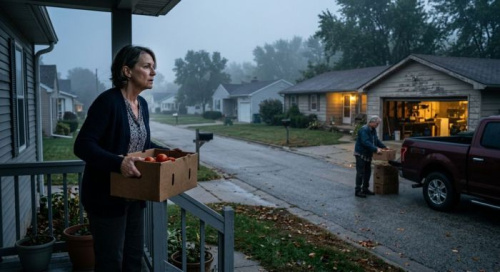
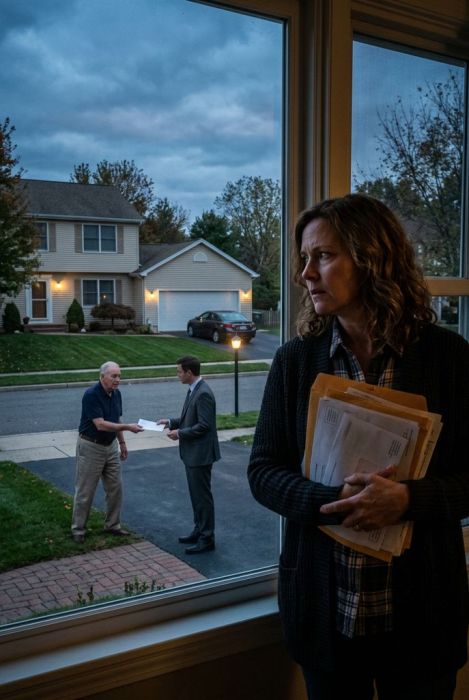
The first letter arrived three days after the funeral, and I remember thinking how weird it was that the envelope was typed so perfectly.
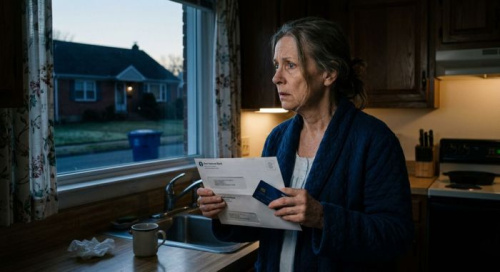
To: Dana Whitmore, 14 Bluebird Court. Re: Violation of Section 4.2, Exterior Maintained Appearance. Fine: one hundred fifty dollars.
I sat at Mom's kitchen table, her coffee mug still in the cabinet, and read it twice. The grass needed cutting. I knew that. I'd just buried my mother and hadn't mowed the lawn in two weeks because I'd been at the hospital every night for a month before that. I figured a polite call could fix it.
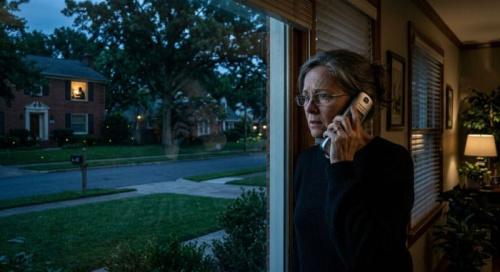
The man who answered was Gerald Whitfield, the HOA president, and his voice was as smooth as butter left out too long.
"Oh, Dana — can I call you Dana? Listen, I understand you've had a hard couple of months. Truly, I do. But rules are rules, and the board takes the curb appeal of our little community very seriously. Your mother kept this property immaculate for thirty years. It'd be a shame to let it go now."
He made it sound like he was doing me a favor by letting me pay the fine.
I mowed the lawn that same afternoon, borrowed my neighbor's mower since I didn't own one, and sent in the check. I thought that was the end of it. It was not the end of it.
The next violation came a week later — a crack in the front walkway that had been there since I was a kid, one Mom had tripped on every winter and never once been fined for. Then the garage door, which rattled. Then the fence at the side of the yard, warped from a storm two summers ago. Each one came with the same typed letter, the same stiff fine, and the same polite signature at the bottom: Gerald Whitfield, President.
Within two months, I owed four thousand dollars in fines on a house I wasn't even living in full-time yet.
I had a daughter, Emma, who was nine. She'd started calling Mom's place "Grandma's house" even though Grandma was gone, and she loved the big backyard and the neighbor's golden retriever. I'd been planning to fix the place up and move us in — my apartment lease was up, and the mortgage on Mom's house was already paid off. It should have been the easiest decision of my life. Instead, I was drowning in paper.
"It's like he's trying to push me out," I told my best friend, Rachel, over a glass of wine one night. "Every time I fix one thing, he finds something else."
"Maybe he is," she said quietly. "Who owns the houses around you?"
I thought about that all the way home.
The woman two doors down, Mrs. Alvarez, had sold her bungalow in May and moved to Arizona to be near her daughter. The house at the end of the cul-de-sac, the big ranch with the columns, had gone on the market in June and sold within a month. And just last week, I'd seen a "For Sale" sign sprout in front of the house across from mine — the one belonging to the elderly Mr. Kowalski, who'd been in the same spot since the eighties.
Bluebird Court was changing. And Gerald Whitfield, the man who'd been on the board since before I was born, was the one collecting everyone's fines along the way.
I started paying closer attention.
Gerald lived in the biggest house on the block, a two-story colonial at the top of the hill. He was retired, but everyone knew he'd made a fortune in real estate back in the day. He drove a new SUV every few years and took long vacations to places with palm trees. He had a way of greeting every neighbor by name, of knowing exactly which of their kids was in which school, of remembering birthdays. People loved him. People trusted him. He was the kind of man who made you feel like this neighborhood was the safest, friendliest place on Earth.
That made what happened next all the harder to believe.
It started with the hearing. Gerald called me to a "compliance review" at the clubhouse — a little room with folding chairs and a scratched laminate table where the board met. Just him and two other women I didn't know, their faces polite and blank.
"We're going to need to put a lien on the property, Dana," Gerald said, sliding a stack of paperwork across the table. "The fines are accumulating, and the board can't let them go unresolved forever. It's nothing personal."
"A lien?" My voice came out too high. "On my mother's house? I've paid every single fine. I have the receipts."
He smiled the same butter smile. "Yes, and we've credited those. But the clock keeps running, and new violations keep being documented. I wish there was something I could do — I really do — but the homeowners' association is a legal entity. We answer to the community."
A young woman in a business suit I hadn't noticed before leaned forward. "If I might — we're seeing some interest from a buyer who'd love to take this property off your hands at a fair price. Take the stress out of it entirely. You'd walk away clean."
The words hit me like cold water. A buyer. Someone who wanted my mother's house specifically.
"Who?" I asked.
"Oh, we're not at liberty to say," she said sweetly. "But the offer would resolve everything. The fines, the lien, all of it. You'd be free."
I took the papers and left. My hands were shaking so hard I could barely hold the steering wheel.
That night I couldn't sleep. I lay in Mom's old bedroom — I'd moved in by then, my apartment given up, Emma's room full of boxes — and stared at the ceiling, turning it all over in my mind. The fines for things that had never been an issue when Mom lived there. The comments about how a young single mother couldn't possibly keep up with a property this size. The mysterious buyer who kept appearing whenever the fines piled up.
It was a squeeze. I was sure of it. Gerald Whitfield was using the HOA to drive me out so someone could buy the house cheap, and he was getting something out of it on the back end.
But proving it was another thing entirely.
I called a real estate lawyer I found online, a tired-sounding man named Howard Dozier who'd been practicing for forty years. He listened to my whole story without interrupting, and when I was done, he let out a long sigh.
"Section 4.2," he said. "Let me guess — that's the one they always use."
"It's the exterior appearance one. The grass."
"Every HOA has a grass rule. But let me ask you something, Dana. Has anyone else on your street gotten fined recently? Anyone who's refused to sell?"
I hadn't thought to check.
Howard told me to do something that felt almost too simple: start asking questions. Not accusations — just friendly, curious questions. Comparing notes with the neighbors. Meanwhile, he'd pull the county records and see who actually owned the development company that kept making offers.
I started with Mrs. Patel, whose house sat right between mine and the bungalow Mrs. Alvarez had sold. She was lovely, a retired school librarian, and she'd known my mother for years.
"Fine?" she said, startled, when I brought it up over a cup of tea. "Oh, honey, Gerald fines everyone eventually. It's his whole game. He fined me last spring over a bird bath that was — I quote — 'too tall for the property line.' I told him the bird bath had been there since 1994 and he said the rule had changed."
"Did you pay?"
"I fought it. Took it to the state mediation board. It got tossed out. He hates that." She smiled a little wickedly. "He doesn't like it when people push back. That's why he goes after the ones who won't."
The ones who won't. The ones who don't know their rights. New widows, young families, old folks whose kids lived far away.
I went home with my head buzzing, and then I started going through Mom's things.
That's when I found it — tucked in the back of a dresser drawer under a pile of old tax returns, in a shoebox Mom had labeled "Important Papers, Do Not Throw." A stack of letters, all from the HOA, all addressed to my mother over the past two years, all signed by Gerald Whitfield.
And every single one of them was a fine.
She'd never told me. She'd never said a word. She'd been paying Gerald Whitfield for the last two years of her life — over six thousand dollars in fines for violations I'd never even seen. The warped fence. The same crack in the walkway. The garage door that rattled. He'd been bleeding my dying mother dry, and she'd been too proud, too private, to tell anyone.
I sat on the floor of her closet and cried until I couldn't cry anymore.
When I finally looked up, I noticed something else in the shoebox. A small plastic box, the kind that holds a child's toy. I popped it open, and inside was a tiny digital camera — one of those cheap ones for kids, hot pink, covered in scratches and stickers.
Emma's old toy camera. She must have left it at Grandma's years ago, and Mom had saved it with her important papers, the way grandmothers save everything.
It still turned on.
I don't know what made me flip through the old photos. Nostalgia, maybe. But as I scrolled past blurry pictures of my mother's garden and Emma's feet and the golden retriever next door, I found a series of shots that made my breath catch.
They were taken from Mom's kitchen window — the one that faced the cul-de-sac, where the big ranch house stood. And they showed Gerald Whitfield, in his polo shirt, standing in the ranch's driveway at dusk, shaking hands with a man in a business suit. In two of the photos, I could see an envelope changing hands.
It was dated six months ago, right around when the ranch sold.
I couldn't see the other man's face clearly, but I recognized the cut of his suit, the way he carried himself. It was the same man who'd been at my compliance hearing. The same man from "the buyer's side."
Howard Dozier called me that afternoon, and his voice had shed its tiredness entirely.
"Dana, you're not going to believe what I found. The development company making offers on your block — Whitfield Holdings, LLC. It's owned by one person. A man named Gerald Whitfield."
My hand tightened on the phone. "The president of the HOA."
"One and the same. He's been running a squeeze on your entire street for years. Finning people into submission, then buying their properties through his own shell company at below-market prices, flipping them for a fortune. He's not just your enemy — he's been picking the pockets of every vulnerable homeowner within reach of his clipboard."
I looked down at the pink toy camera in my hands, at the photo of Gerald handing an envelope to a stranger in a suit.
"I think I have proof," I said.
The climax came at the neighborhood meeting, a month later, in the same clubhouse where Gerald had threatened me with a lien.
I wasn't alone. Howard was there with a stack of notarized documents. Mrs. Patel had brought a friend from the state mediation board, a sharp-eyed woman who'd handled HOA complaints for twenty years. And I'd had the photos from Emma's camera professionally enhanced and printed — clear as day, Gerald Whitfield's face and the other man's, the envelope between them, the date stamp in the corner.
The other man, it turned out, was the buyer of the ranch. He'd been Gerald's partner in the scheme — a contractor Gerald hired, who'd been taking a cut to pretend to be an outside developer.
When I stood up and laid the photos on the table, the room went silent.
At first Gerald tried to laugh it off. "That's ridiculous," he said, too loudly. "Those are doctored. Anyone could see —"
But then Mrs. Patel produced the state board's ruling on his bird bath fine, a public record that already questioned his conduct. And Howard laid out the ownership chain of Whitfield Holdings in black and white. And the county assessor, who'd come because Howard had vouched for him, confirmed that Gerald had quietly bought four properties on our street in the last three years, all from people he'd been fining.
The other woman on the board, the one whose face I'd thought was blank, stood up and slowly pulled her glasses off.
"We need to vote him out," she said. "Tonight. And then we call the county attorney."
Gerald's butter smile finally cracked. For the first time since I'd met him, he looked like a cornered animal. He tried to leave, but two men from the county had already come through the door, one of them holding a folded document. They read him his rights right there at the laminate table, in front of everyone he'd ever sweet-talked.
The investigation took eight months. When it was done, Gerald Whitfield was charged with fraud and elder exploitation — because prosecutors traced his fines all the way back to my mother and several other elderly residents who'd paid him without a word. He lost the HOA, he lost his shell company, and he lost his home at the top of the hill. He was found guilty and sentenced; the last I heard, he was still in state custody, writing letters to news outlets insisting he was set up.
The victims got their money back. My mother's six thousand dollars, returned to her estate. Mrs. Alvarez's. Mr. Kowalski's. Every single fine he'd collected under that false authority, disgorged.
And I still live at 14 Bluebird Court, in the house my mother loved for thirty years.
Emma runs in the big backyard with the golden retriever, and I've fixed the fence and the walkway and the garage door — not because anyone fined me, but because it's ours now, free and clear. The new HOA president is Mrs. Patel, and her first act was to abolish every rule Gerald had weaponized. "We're a neighborhood," she announced at her first meeting, "not a dictatorship."
Some of the neighbors who'd quietly paid him for years finally told their own stories. They'd been afraid, they said — afraid of the fines, afraid of being stared out of their homes, afraid that pushing back meant losing everything. They'd needed someone to stand up first.
Now I know the truth about the man at the top of the hill. And I know this: the finish line for people like Gerald Whitfield is never the house they steal. It's the record they leave behind — the paperwork, the shell companies, the one small detail they never expect to surface.
For my mother, that detail was a granddaughter's forgotten toy camera, saved in a shoebox labeled "Important Papers, Do Not Throw."
Somehow, it seems like she knew all along exactly what it would one day prove.