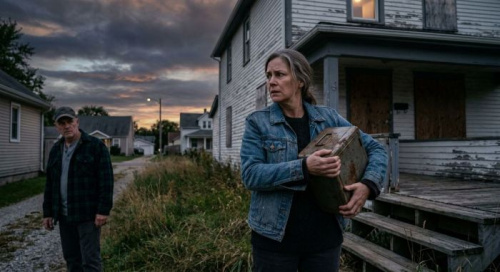

I knew something was wrong the second my fingers touched the leather.
The handbag sat on my kitchen table, wrapped in tissue paper and tied with the little bit of twine Danny Doyle always used. On the surface it was perfect. Same deep cognac color as my grandmother's bag. Same brass clasp. Same graceful arch of the handle. But the leather felt wrong in my hands. Too stiff. Too new. Like a stranger wearing my grandmother's face.
Grandma Pearl carried that bag the day she married my grandfather in 1958, and she carried it at every wedding after that — my mother's, mine, my daughter Sarah's, and finally my granddaughter Lily's. Over sixty years the leather had softened into something almost alive, creased by a thousand happy occasions. The bag Danny had returned to me after "restoring" it felt like a history book with all the pages ripped out.
I turned it over and ran my thumb along the seam, and that's when my whole world tilted. The stitch.
Grandma Pearl's bag had a tiny crooked stitch at the base of the handle, a factory mistake from 1958 that she loved. "Nothing in this world is perfect, Maggie," she used to say, pointing at it. "That little flaw is why I never wanted a new one." The bag sitting in front of me had a perfect row of stitches. Neat, even, and new.
Somewhere between my front porch and Danny's workshop, my grandmother's handbag had been replaced.
I want to tell you first that Danny Doyle was the most trusted man on our street. That's not an exaggeration. He was sixty-three, a widower, and he ran a small leather repair shop out of his garage — Doyle's Custom Repairs — where he fixed shoes, handbags, zippers, and belts for practically nothing. If a kid's backpack strap broke, Danny fixed it and refused to take a dollar. If an old man's wallet split, Danny stitched it up and sent him home with a cup of coffee. When my husband Tom passed away five years ago, Danny was the first neighbor on my doorstep with a casserole and a quiet offer to fix the loose shutter that Tom never got around to.
He was the kind of neighbor you counted on. The kind whose truck you'd spot in the driveway and feel safer for it. That's why, when I decided to have Grandma Pearl's bag restored for Lily's wedding, Danny was the only person I considered. I'd even told him the story of the crooked stitch. He'd smiled and said he'd be honored to touch something with that much history.
And then he handed me back a lie.
For the next three days I tried to convince myself I was being foolish. Maybe the leather felt different because Danny had cleaned it. Maybe he'd evened out the stitching as a thoughtful gesture, not realizing how much that little flaw meant to me. I'm a retired schoolteacher, and I know all about overthinking. I told myself to let it go.
But I couldn't. Because the bag had no memory. Grandma Pearl's bag smelled faintly of her lavender sachet, even after all these years. This one smelled like a chemical cleaner you'd buy at a hardware store. And when I held it up to the window light, I could see the leather was a shade too bright, like it had been dyed yesterday.
So on the fourth day, I walked across the street to talk to Danny about it. I was hoping, truly hoping, that he'd laugh and say he must have mixed up my bag with another customer's. I even rehearsed the conversation in my head so it wouldn't come out like an accusation.
But Danny's garage door was up, and there was a stranger's sedan in his driveway. I heard voices inside. I'd lived on this street long enough to know better than to eavesdrop, but I stopped anyway when I heard Danny's voice, low and sharp in a way I'd never heard before.
"No. Absolutely not. I told you, we don't touch the ones with authentication cards. That's how people get caught."
I pulled back behind the hedge before anyone saw me. My heart was pounding. Danny Doyle, the man who refused to take money from a widow, was standing in his own garage talking about people getting caught.
I didn't sleep well that night.
The next morning I did something I'd never done in thirty-five years on Ashgrove Court. I checked Danny's trash. Not the cans — those were harmless. I walked my dog Bruno past his house and noticed a flattened cardboard box in his recycling bin with a shipping label on it. It was addressed to an online consignment store called "Pearl Street Vintage." The return address was a P.O. box in our town, and the declared contents said: "Vintage leather handbag, auth. cert. included."
My grandmother's bag had no authentication certificate. It had a crooked stitch and a lavender sachet.
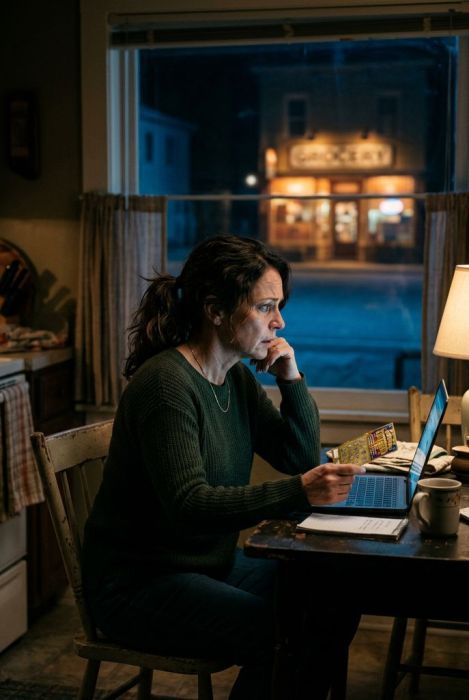
I went home, sat down at my computer, and searched "Pearl Street Vintage" online. It was a slick little website selling "authentic pre-owned designer handbags" at suspiciously low prices — Chanel, Louis Vuitton, Gucci, all of them "certified" and "mint condition." The photos looked right, but something about the way the light hit the leather bothered me. Then I clicked on a listing for a 1960s cognac-colored bag with a brass clasp, described as "the perfect heirloom piece."
It was my grandmother's bag. I'd know that bag anywhere. It was listed at four hundred dollars.
That's when the shaking started. Not because of the money. Because Danny had taken something that belonged to my family and turned it into merchandise. And if he'd done it to me, he'd done it to other people on this street. People who trusted him with their wedding rings when the band needed soldering, with their grandmothers' lockets, with the wallets their dead husbands had carried.
I made a decision right then. I wasn't going to confront him. Not yet. A sixty-two-year-old schoolteacher against a man who clearly had a whole operation going wasn't a fair fight, and I knew it. So I called the only person on the street who could help me think straight: Frank Bellamy, the retired county detective who lived two doors down and kept a beagle named after a famous case.
Frank came over that evening with a six-pack and a notepad. He listened to the whole story without interrupting, which I appreciated. Then he asked me the question I'd been avoiding: "Maggie, do you still have the bag he gave you?"
I did. I'd locked it in my bedroom closet.
Frank took a long look at it under the kitchen light, turning it over in his hands exactly the way I had. Then he set it down and said something that chilled me. "This isn't a repair job, Maggie. This is a swap operation. He takes the real item, puts a convincing fake in your hands, and sells the real one online. The question is how many people on this street are walking around with fakes in their closets and don't know it."
Over the next two weeks, Frank and I did quiet detective work. I went back to Danny's with small jobs — a loose belt, a broken zipper — and each time I took a photograph of the item before I handed it over. Frank used his old contacts to pull sales records from Pearl Street Vintage, which took a bit of finagling and a very old friendship. What we found made my blood run cold.
In the past year alone, Danny had sold eighty-one "authentic vintage" items online. The patterns matched our neighborhood — the same types of items neighbors had mentioned in passing, the same brands, the same decades. A woman three houses down had casually mentioned her mother's fur stole going missing. A man across the street had complained that his grandfather's engraved watch "didn't feel right" after Danny serviced it. The pieces were all there, hiding in plain sight.
The really disturbing part came on a Tuesday night when Frank called me with a trembling voice — Frank Bellamy, who'd seen things in thirty years of police work that would keep most people up at night.
"There's more to this, Maggie. That website of his? The account that runs it is registered to a shell company. And that shell company is connected to a bigger operation in Cleveland that the Bureau's been watching for counterfeit luxury goods. Danny isn't just swapping heirlooms. He's a small cog in a much bigger counterfeit machine."
For the first time, I was genuinely scared. Not of a dishonest neighbor. Of a network.
And that's when Danny got scared of me.
It started small, the way these things always do. A scratch on my car that I couldn't explain. My garden gnome — a silly thing Tom had bought me — appearing in my flowerbed one morning, its head cracked. Then the note. I found it tucked under my windshield wiper on a Thursday morning, written in block letters on a piece of paper torn from a spiral notebook.
"STOP ASKING QUESTIONS. SOME THINGS ARE BETTER LEFT BROKEN."
I should have been terrified. Instead, I felt a strange calm settle over me. Because that note proved Danny knew I was onto him. And a man who's cornered makes mistakes.
Frank and I put our plan together in my living room, and I want you to know that no part of it involved heroics on my part. We simply used Danny's greed against him. Frank called in a favor with a task force detective who'd been watching that Cleveland network for months. They were more than happy to help a retired colleague. The plan was simple: I would tell Danny that I'd found another "vintage piece" to sell — a pearl necklace from my mother that I'd suddenly decided to part with. The necklace was real, but the "authentication paperwork" I'd show him would be printed on my home computer, complete with a barcode that I'd never let him scan.
If he took the bait, he'd bring the necklace to his workshop, and he'd be photographed moving it — and everything else — by a camera the task force had already installed across the street.
Danny took the bait in two days.
I still remember the last time I saw him smile, standing on my porch in his canvas work apron, holding my mother's pearl necklace up to the light. "This is a beautiful piece, Maggie. I can get you a fair price." He didn't know I could see Frank's beagle across the street, sitting unusually still on the porch — Frank's signal that the camera was rolling.
Three days later, the police came at dawn.
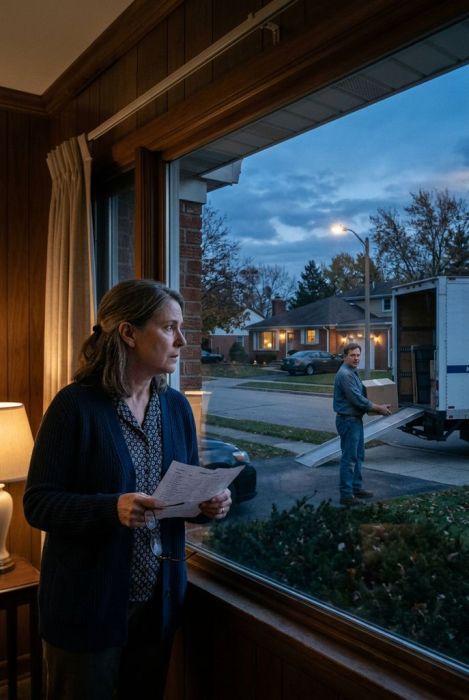
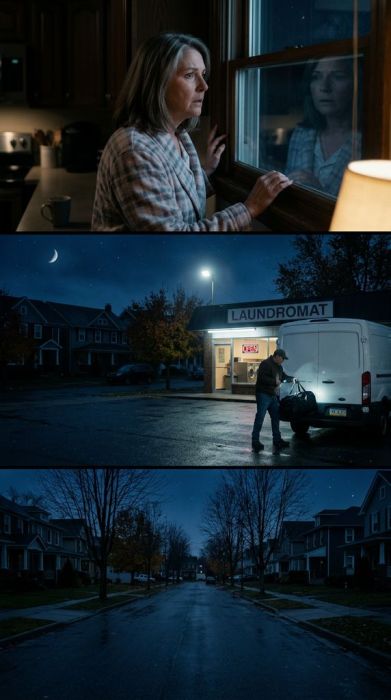
I watched from my kitchen window as four unmarked cars pulled silently onto Ashgrove Court and officers surrounded Danny's house. There was no dramatic chase, no yelling, no gunfire. Danny Doyle came out in his bathrobe with his hands on his head, looking smaller than I'd ever seen him. Behind him, officers carried out evidence in clear plastic bags — designer handbags, boxes of forged certificates, a laptop, my mother's necklace, and a ledger with more than two hundred names in it.
My grandmother's handbag was returned to me a week later by a federal agent who apologized for the inconvenience of the investigation. It smelled faintly of lavender, and when I turned it over, there at the base of the handle was the tiny crooked stitch. I sat on my porch and cried into that bag for a long time, the way you cry when something precious that you thought was lost comes back to you.
The full story came out over the next few weeks. Danny had been part of a counterfeit luxury goods ring that stretched across three states. The swap operation — taking genuine heirlooms and replacing them with fakes — had been his specialty for years. He'd picked Ashgrove Court precisely because it was full of older people, people with attics full of inherited treasures and no way to verify authenticity. People who trusted their neighbors.
Eighty-three families on my street alone had been victims, though most didn't realize it until the police returned their real belongings. The man across the street got back his grandfather's watch. The woman three houses down got back her mother's fur stole. And the neighborhood that had loved Danny Doyle learned, together, that trust is a beautiful thing — but it should never be a substitute for asking questions.
Danny was convicted on federal counterfeiting and fraud charges. I won't pretend to know the details of his sentence, and I don't take any satisfaction in his punishment. What I take satisfaction in is simpler. The next time someone tells me they got a "steal" on an authentic designer bag from a friend of a friend, I tell them the story of the crooked stitch. And the next time my granddaughter Lily wears that cognac-colored bag at her wedding, I'll see the tiny flaw at the base of the handle, and I'll smile.
Because nothing in this world is perfect. But now I know exactly what belongs to me — and what never really was mine at all.