I never thought I'd see the Ferris house come back to life. For twenty years it had sat at the end of Cedar Court like a rotting tooth nobody wanted to pull, its porch sagging, its windows so layered with grime they looked black from the street. Kids dared each other to ring its doorbell. New buyers on the block would ask when it would finally be bulldozed. My late husband used to say that house held more ghosts than people, and I believed him.
Then, on a humid Thursday in late spring, Marcus Ferris showed up.
He was barely old enough to buy a beer, a quiet boy with his grandfather's tired eyes, who introduced himself at my fence with a shy wave and a cardboard box of old keys. "You were neighbors with my great-uncle," he said. "I'm his heir. I've come to finally see the place."
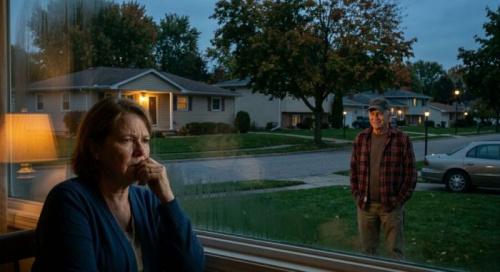
I didn't know, standing there at my gate, that our polite, church-going neighbor Ted Packer had already spotted him from across the street. Ted was the kind of man everyone trusted on sight — a big, beaming, helpful fellow who ran a little "restoration" business out of his garage and was always first to lend a ladder or bring casseroles when someone got sick. He'd lived on Cedar Court longer than almost anyone, and the whole street counted on him for everything he did.
I just wished I knew why he seemed so excited to see that boy walk up the Ferris walkway.
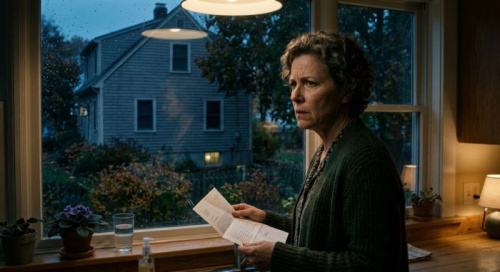
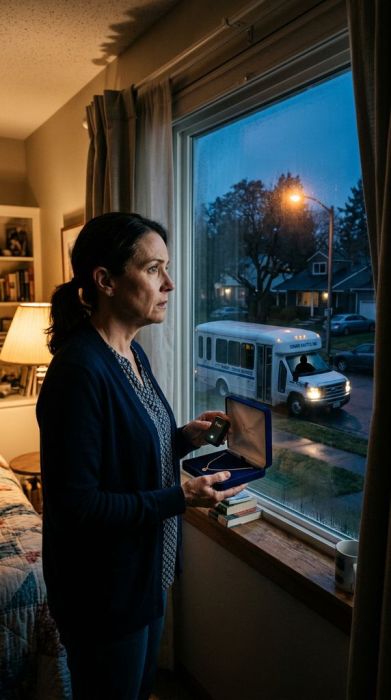
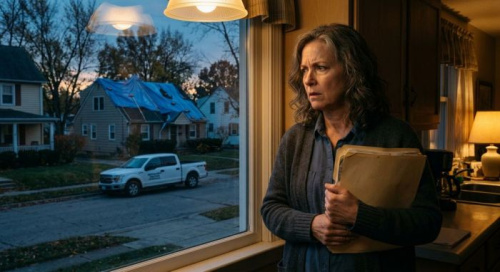
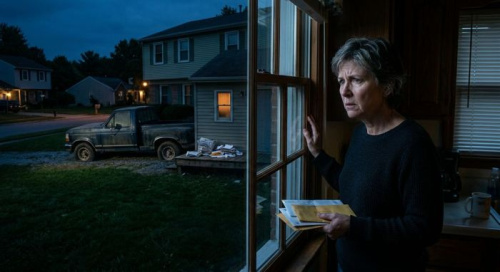
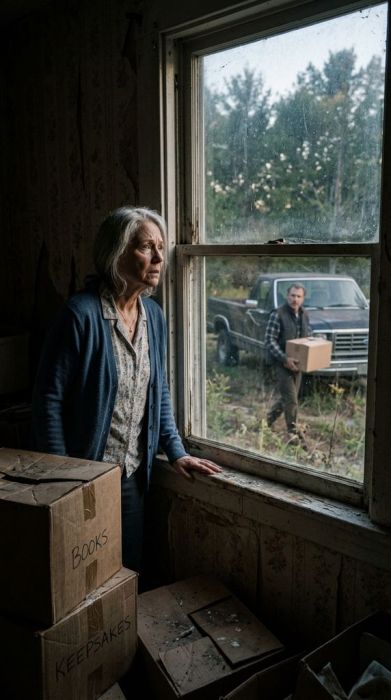
Over the next few weeks, Ted and Marcus became inseparable. I'd see them from my kitchen window, Ted in his paint-stained overalls carrying furniture out of the house while Marcus trailed behind him, nodding, looking overwhelmed by the sheer weight of his inheritance. My grandson Tommy, who visited every weekend, would watch them too, bored until he wasn't.
"Why does that man keep taking so much stuff out of the house, Grandma?" he asked one Sunday, leaning his chin on the windowsill.
"Ted's helping him clean it out, sweetheart. That's a big job for one young man."
"He doesn't look like he's cleaning," Tommy said. "He looks like he's moving out."
I laughed and ruffled his hair and told him not to be silly, that our neighbor Ted was the most helpful man on the street. And he was. Everyone said so. Ted organized the block parties. Ted repainted the mailboxes. Ted was the first one to shovel anyone's driveway in a snowstorm, always waving off the thanks. "Just being a good neighbor," he'd say, with that warm, booming laugh of his.
So when I noticed his truck parked at the Ferris house at two in the morning, I told myself he must have left a tool there. When I saw him carrying a cardboard box to his van one night, I assumed it was trash, like he'd told Marcus. When Marcus stopped eating lunch on his porch and started looking thin and nervous, I figured the boy was just overwhelmed by all the work.
I should have trusted the cold feeling that kept settling in my chest instead.
It was my grandson who finally broke it open.
Tommy had a little cheap drone my daughter bought him for his birthday, and like every eleven-year-old with money to burn on batteries, he flew it everywhere. One afternoon I heard him whoop from the backyard and came out to find him staring at his tablet screen, a picture of the Ferris house from above.
"Look, Grandma," he said, zooming in. "There's a room in that house that doesn't have any windows, and the roof's rotten right over it. You can see inside. There's a big metal box in there."
I squinted at the grainy image. He was right. Through a gap in the sagging roofline, I could see a shadowy attic space, and sitting in the middle of it, a large dark-green chest that looked old enough to be from my grandparents' generation.
"Probably just old trunks of junk," I said.
"Then why is the lock still on it?" Tommy asked.
The question burrowed into me and wouldn't leave. That weekend, when Marcus came by the fence looking more tired than ever, I asked, as casually as I could manage, whether Ted had taken him up into the attic yet.
Marcus blinked. "What attic?"
"There's a pulled-down ladder in the hallway ceiling," I said, because I remembered the old Ferris place from when I was a girl, before it fell into ruin. "There's always been a loft up there."
Marcus's face went pale, then red. "He said the house was a single story, ma'am," he said quietly. "He said there wasn't any upstairs."
I should have gone to the police right then. I should have marched over to Ted's house and demanded to know what he'd been hauling away in the dark. But I was afraid — afraid of being wrong about a man the whole street adored, afraid of the cold humiliation of making a fuss over nothing. So instead, I waited until dark, took my heavy-duty flashlight, and let myself into the Ferris house through the back door that was always unlocked on account of the rotting latch.
The place smelled of dust and old cedar and a lifetime of neglect. I found the attic ladder right where I remembered it, pulled it down with a groan, and climbed.
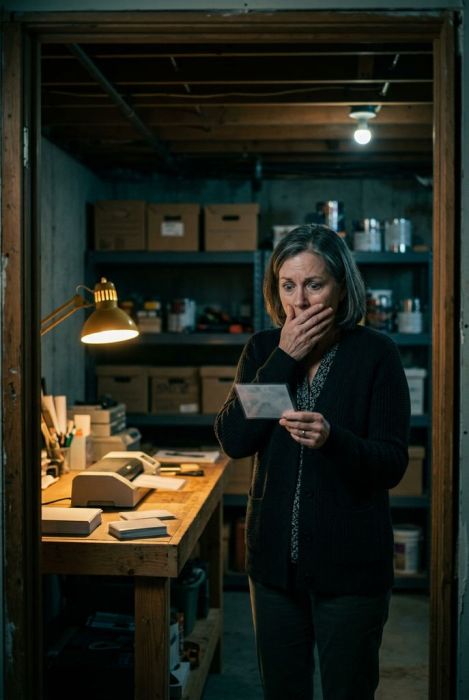
The metal chest sat exactly where Tommy's drone had shown. The lock was a cheap padlock, and it took me three tries with my grandson's bolt cutters to snap it. When I lifted the lid, my breath caught.
Inside weren't junk or old clothes. Inside were bank statements, deed copies, and a thick old leather folder with a name embossed on it: FERRIS HOLDINGS. I opened it, and my hands shook, because inside was a paper that changed everything.
It was a signed agreement — dated the same week Marcus arrived — in which "Marcus T. Ferris" agreed to sell the entire Ferris property to one Ted Packer for the sum of forty thousand dollars cash. Only the signature wasn't Marcus's. I knew because I'd seen the boy write his name on a thank-you card he'd taped to my fence. The boy wrote a careful, shaky "M" that slanted left. The signature on this paper was a bold, practiced swirl that belonged to a grown man who'd signed a thousand things.
I also found, tucked at the bottom of the chest, the original deed to the property — and an old unsigned will from Marcus's great-uncle, in which he'd expressed his wish that the house be kept in the family. And beneath that, a stack of identical forged contracts, each ready-signed, each with a different young heir's name.
Ted Packer wasn't helping anyone. Ted Packer was running a quiet, terrible little scheme, waiting for distant relatives to inherit abandoned properties and then talking them into "quick sales" he'd forged the signatures on.
My heart hammered as I climbed back down, clutching the deed and the forged contract. I nearly ran into him in the dark hallway.
Ted stood in the shadows of the living room, his big frame blocking the front door, the flashlight in his hand pointed straight at my face. For a long, awful moment neither of us moved.
"Ruth." His voice was flat in a way I'd never heard. "You shouldn't be in here."
"I was checking on the boy," I said, my voice steadier than I felt. "He seems upset lately."
"He's fine." Ted took a step toward me. "This place is dangerous, Ruth. Rotting floors. You could break a hip and I'd be the one calling the ambulance. Why don't you head home and let me handle things?"
I knew then, with a certainty that froze my blood, that the friendly, helpful, casserole-bringing man I'd known for fifteen years would not hesitate to bury the truth to protect what he'd built. And I knew, too, that I was alone in the dark with him and the proof I'd found.
"You'd like that, wouldn't you?" I said, and I was surprised at the anger in my own voice. "You'd like me to go home and pretend I didn't see that chest, or this." I held up the leather folder. "Forty thousand dollars, signed by a boy who can't even write straight. How many grandchildren have you done this to, Ted?"
His face went through a series of changes I'll never forget — surprise, then fear, then something cold and calculating. "You don't understand the real-estate business, Ruth," he said softly. "That house is worthless. The family walked away from it. I'm doing that kid a favor."
I backed toward the kitchen door, the folder pressed against my chest. "Then you won't mind if he does it properly, with a real lawyer," I said. And then I turned and ran, expecting to feel his hand close on my shoulder at any second.
It never did. But he stood on that sagging porch, watching me, as I crossed my own lawn, and I could feel his eyes on my back like cold fingers.
The next morning I did three things. I called the sheriff's office and made an appointment. I called a lawyer I trusted at the county bar association. And I called the one person on Cedar Court I knew Ted couldn't charm — a retired deputy named Frank Alvarez, who'd lived next door to Ted for years and had quietly, steadfastly refused to like him.
Frank listened to my whole story without interrupting. Then he said, in his slow, careful way, "I've got a file on that man, Ruth. Been building it for years. Nobody believed me. Do you still have those papers?"
"I have them," I said.
"You're braver than half the department," Frank said. And for the first time in days, I felt a thread of hope.
Frank came over that night, and together we went through the chest. He took careful photos of every document. He called an old colleague at the county recorder's office, who confirmed what I'd already suspected — Ted Packer had quietly acquired seven properties in town over the past decade, every one of them from a "grieving heir" who'd signed a quick-sale contract. Every one of them, Frank said, was probably forged.
We built the case quietly over ten days. Marcus, when I finally showed him the forged contract, turned white and then shook with fury. "He told me I was doing my great-uncle's memory a favor," he whispered. "He said the house was full of nothing but rot."
"He lied to you, Marcus," Frank said gently. "And he stole from you."
The trap closed on a bright Tuesday morning. Frank's old partner brought a warrant, and they found Ted Packer at his garage, unloading boxes marked "ESTATE SALVAGE" from his van. On his workbench, in plain view, sat a stack of blank contracts and a rubber stamp with the words "SIGNED, HEIR OF RECORD" — the kind of thing no honest restorer would ever own. In his filing cabinet, they found copies of every forged sale he'd pushed through the county since the year Frank's own father died.
Ted tried to charm his way out of it, of course. He waved his hands and laughed and told the deputies it was all a misunderstanding. But the county prosecutor didn't think it was funny. He was arrested that afternoon on multiple counts of forgery, theft by deception, and fraud. By the time the story ran in the local paper, four more families had come forward with the same story — the same helpful restorer, the same forged signature, the same stolen inheritance.
The neighborhood gathered on the street in stunned silence as they led him out in handcuffs, and I watched the disbelief on our neighbors' faces turn, slowly, to shame as the truth sank in. The man who'd brought every one of us a casserole had been quietly picking the bones of our community for years.
The Ferris house is not a rotting tooth anymore.
Marcus stayed. With the forty-thousand-dollar forged sale thrown out and his great-uncle's wishes honored, he put the deed in his own name and began, slowly, carefully, to repair the old place, board by board, using a real contractor who itemized every bill. The first thing he did with a bit of his savings was buy me a proper glass of lemonade and sit with me on my porch, and thank me, in that quiet, tired voice of his, for not looking away.
"Everyone else saw what they wanted to see," he said. "You saw what was true."
Ted Packer pleaded guilty rather than face a trial with seven victims' families in the gallery. He lost his restorer's license, his garage, and the house he'd lived in for twenty years, which was sold to pay back the people he'd cheated. I heard he now lives with a sister three states away, and that when neighbors there asked what he used to do, he couldn't bring himself to answer.
Tommy flew his drone over the Ferris house the day the new roof went on. He didn't find any secrets this time. Just a boy my age, up there hammering, building something honest with his own hands.
I sat on my porch and watched the sunset paint that old house gold, and I thought about all the years I'd trusted a man's smile because the whole street did. It's a strange thing to learn, at my age, that the most dangerous person you'll ever meet can look exactly like the kindest man on the block. But I learned it.
And I sleep better knowing the truth is safe in a file with the county now — and that the boy next door is finally home.