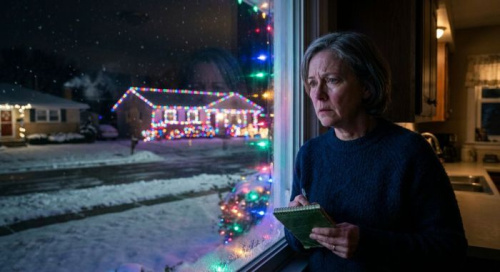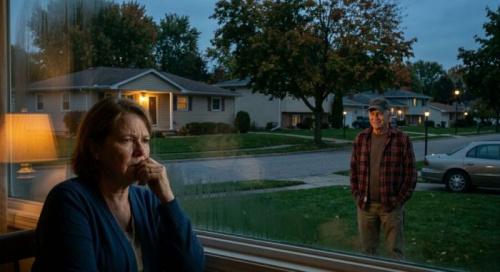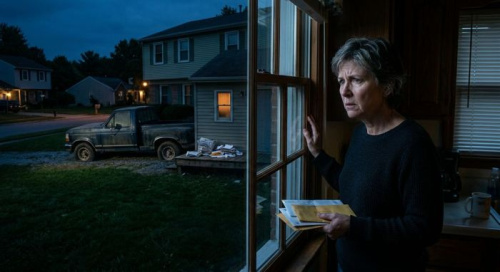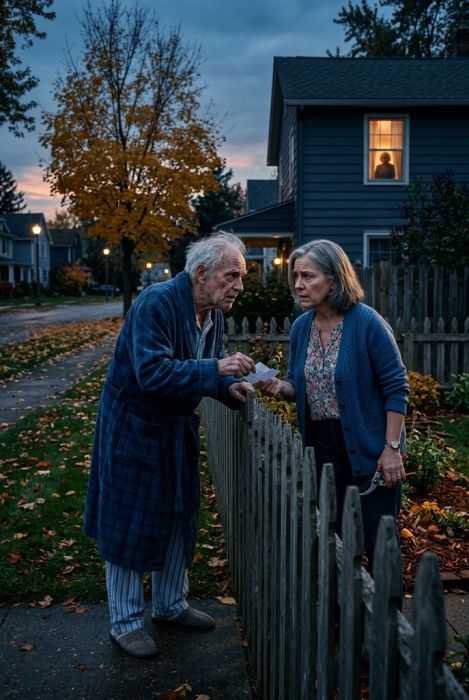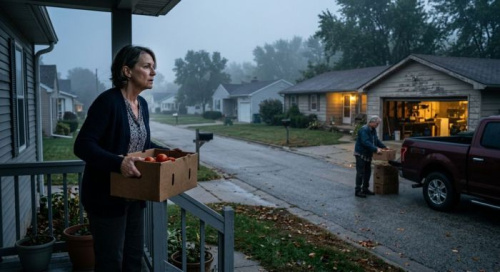
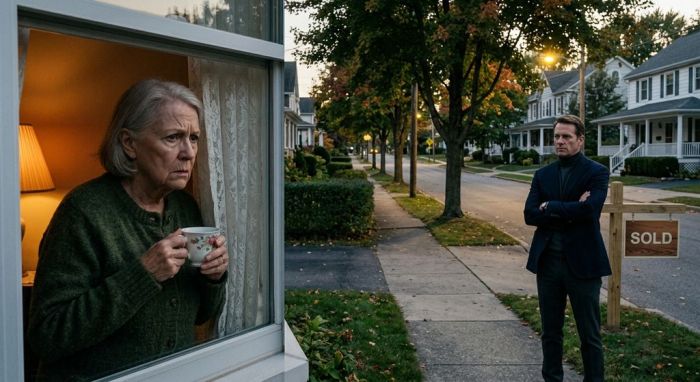
My name is Margaret, and for thirty-one years I've lived in the same yellow clapboard house at the end of Millbrook Lane. It was the home I raised my two boys in, the home where my husband Richard and I celebrated our fortieth anniversary, and, after he passed in the spring, the home where I learned to make coffee for one.
So when Dale Whitaker moved in next door last August, I told myself he was just another neighbor. He was a developer with a company called Whitaker Estates, and he'd bought the old Perkins place that had sat empty for two years. He seemed friendly enough at first. He waved from his porch. He brought me a casserole the week of the move, the same one his wife Carol made for everyone on the street, I assumed.
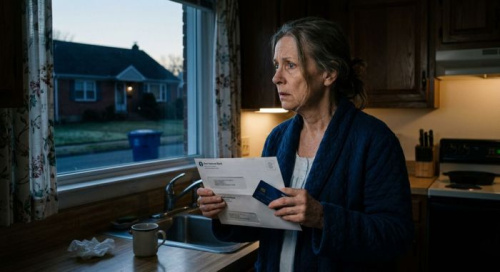
The first offer came on a Tuesday in September. He knocked, smiling, a manila folder tucked under his arm. He said he'd heard I was thinking of selling, which I wasn't. He said his company wanted to expand its new subdivision off Millbrook, and that my little corner lot, with its half-acre of mature oaks, would be perfect. He slid a check across my kitchen table for nearly double what the tax assessor said the place was worth.
I pushed it back. "This house isn't for sale, Mr. Whitaker."
His smile didn't waver. "Call me Dale. And Margaret, I hope you'll at least think about it. These old houses, they cost more to keep up than people realize."
He wasn't wrong about the upkeep. The porch needed painting, the furnace was finicky, and the roof had a patch of shingles that flapped in a good wind. But Richard had put his whole life into this place, and I wasn't going to hand it to a stranger with a checkbook.
What happened next is hard to describe without sounding like a paranoid old woman. Because it started small, and it started in ways that could have been accidents.
The first thing was the fence. The cedar slats along the back boundary had been fine for years, but in late October I found a whole section knocked flat, as if something heavy had been driven through it. The boards were splintered, fresh, and there were tire tracks in the mud that led straight to Dale's driveway.
When I called him about it, he was all concern. "Oh, that's terrible, Margaret. My contractor must have clipped it with the truck. I'll have my guys fix it first thing Monday."
They did fix it. New boards, even better than before. But there was a manila envelope waiting on my porch the morning they finished, with a fresh offer and a note in Dale's neat handwriting. I hope you'll reconsider. Prices only go one direction around here.
I didn't. And that's when the true trouble began.
It started with the zoning complaints. A county inspector showed up in November asking about an unpermitted shed that, as far as I knew, had always been there, built by the previous owner in the seventies. He was polite, but he said someone had filed a complaint. I fought it, provided the old permits Richard had kept in a shoebox, and the matter was dropped with an apology.
Then the noise. Dale's crews started showing up at dawn, running heavy equipment and wood chippers in the lot between my house and the new subdivision, even though his permit clearly stated work hours. I called the town. They fined him. He paid it and kept going.
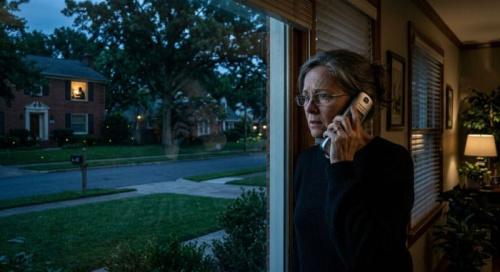
Then came the night I heard a car idling outside my bedroom window at two in the morning, engine running, headlights off. I stood at the curtain, heart pounding, and watched a silhouette sit in the dark for nearly twenty minutes before the car crept away. I never saw the driver's face, but the car was a black luxury SUV, the same kind Dale drove.
I started leaving every light in the house on. I told myself I was being silly. But my locks, which I'd had installed new, started sticking. Twice I found the back door slightly ajar when I knew I'd locked it. My neighbor to the left, a retired school nurse named Esther who'd known me for decades, started looking at me with worry in her eyes. "Maggie, you look exhausted," she said one morning at her mailbox. "Are you sure you're all right?"
I wasn't, and I knew it. But I didn't want to be the lonely widow who cried wolf about the friendly developer who'd brought her a casserole.
The turning point came in January, in the snow.
There was a bad storm, and my driveway got buried. I hired a local plow company, but they were backed up, so I went out myself with a shovel, the way I'd done all my life. And that's when I noticed the mailbox was gone. Not knocked over — gone. The post had been pulled clean out of the frozen ground, and when I dug in the snow, I found fresh boot prints leading toward the tree line behind Dale's property.
Something in me snapped. Not into anger, but into a cold, clear calm. This man was trying to break me, one small assault at a time, and he expected a tired old woman to either cave or look foolish. He didn't know my husband had taught me to never back down from a bully, and he didn't know that Richard's old friend George worked in the county clerk's office.
George was eighty-one and had been certifying property documents for forty years. He knew more about every parcel on Millbrook than the people who owned them. When I called him in tears — not about the mailbox, but about how scared I was — he didn't try to soothe me. He said, "Maggie, bring me your deed. All of it. And let me do a record search."
It took him three days. When he called me back, his voice was different. Darker. "Maggie, sit down."
He told me that a quitclaim deed had been filed against my property the previous month, transferring a fifteen-foot strip of my land along the back boundary — the section where Dale's men had "fixed" my fence — to an LLC registered to Whitaker Estates. The signature on it was a scrawled version of my maiden name, a name I hadn't used in over fifty years. It wasn't my handwriting. It wasn't even close.
My hands were shaking as I held the phone. "How is that legal, George? I never signed anything."
"That's just it," he said. "It's not. It's forgery. But these scams work because people don't check their own records. Whoever filed it is betting you won't, either. And the backdating lines up exactly with when your fence came down."
I stood in my quiet kitchen, surrounded by everything Richard and I had built, and I understood at last. The fence wasn't damaged by accident. Dale's men had torn it out, and in the chaos of the repair, they'd surveyed my land, planted his claim, and filed a document that would quietly steal a piece of what was mine. And if I ever sold, or if I ever died and my sons inherited, that strip would belong to him.
The fear I'd been carrying for months turned into something else. Something I'd almost forgotten I had. Fury.
I didn't confront him. That was the old me. Instead, I did exactly what George told me to do. I hired a real attorney, a sharp young woman from the next county named Danielle Reyes who'd handled property fraud cases before. I gave her the deed, the tire tracks, the boot prints, the zoning complaints, the noise violations. I gave her the records of his LLC.
And then I set a trap.
I had Esther call Dale's company, pretending to be a curious neighbor, to ask about a "big sale" she'd heard was happening. Sure enough, before the week was out, Dale was at my door, folder in hand, a triumphant little smile on his face. He thought I'd finally cracked. He'd come to close the deal.
"Margaret," he said, stepping inside without waiting to be invited, "I knew you'd come around. I'll make this easy. Sign here, and I'll have the movers here by the weekend." He laid a stack of papers on my kitchen table and produced a pen, sliding it toward me like I was a child who needed help learning to write.
I didn't touch the pen. I looked at him, this man who had tried to frighten an old woman into giving up her home, and I said, very quietly, "Dale, did you really think I wouldn't check my own deed?"
The smile didn't vanish so much as it died. For one long second, he didn't blink. Then he laughed, a thin, forced sound. "I don't know what you're talking about, Margaret."
"You filed a quitclaim on a fifteen-foot strip of my back lot. You signed my maiden name. A name I haven't used since 1972." I pulled the folded copy out of my apron pocket and laid it flat on the table. "I have witnesses. I have a lawyer. And I have a very clear recording of this conversation."
That last part was a bluff — the young lawyer had suggested I remember state law allowed one-party consent, and I'd kept my phone recording on the counter, screen down. But Dale didn't know that. He looked at the paper, then at me, then at the phone, and for the first time, I saw real fear cross a face that had never once shown it.
He didn't threaten me again. He didn't beg. He just grabbed his folder, turned on his heel, and walked out of my house without another word.
The authorities did the rest. Danielle filed the forgery report, and the county detective who took my statement spent three weeks pulling Dale's records. What they found was worse than I'd imagined. The quitclaim against my property wasn't the first. Across three counties, they uncovered eleven similar forged documents, quiet little thefts of land from other aging homeowners, all funneled into Whitaker Estates. He hadn't just been coming after me. He'd been doing it for years, patient and methodical, preying on people he assumed were too old or too tired to fight back.
The police came down Millbrook Lane on a bright morning in March. The neighborhood that had watched me shovel my own drive in the snow gathered on porches as officers walked Dale out of his own house in handcuffs. Carol stood in the doorway, pale, shaking her head like she'd just learned the man she married was a stranger. I watched from my window, and I'll admit — I felt a little shamed by how much relief washed over me.
Dale Whitaker was charged with forgery, attempted fraud, and filing false documents. His real estate license was revoked. The LLC that had tried to swallow up my corner of Millbrook was dissolved, and all eleven stolen strips of land were quietly returned to their rightful owners. He pled guilty in exchange for a reduced sentence; the paper in our town ran the story on the front page, and for weeks, everyone I met wanted to shake my hand.
But the part that mattered most to me happened the following autumn, when my boys came home for Thanksgiving. My son Michael wrapped his arm around my shoulder in the kitchen where I'd made coffee for one for too many months, and he said, "Mom, you were the bravest person on this street. You know that?"
I didn't feel brave. I felt relieved, and grateful, and — for the first time since the snowstorm — safe.
I still live in my yellow house at the end of Millbrook Lane. The fence Dale's men tore down has new cedar boards, and I planted rose bushes along the boundary, the way I'd always wanted. The county returned my plow money and apologized for the runaround, and George comes over every third Sunday for coffee, and we laugh about the day I outfoxed a man who thought he had an old woman cornered.
I'm not a hero. I'm just a woman who knew what her house was worth — not in dollars, but in the life that was lived inside its walls. And I learned something that winter that I want every person in a similar position to remember: if someone is pressuring you to sell, to sign, to agree to something that doesn't feel right, check everything. Check your deed. Check your records. Check the fine print and the friendly smiles. Because sometimes the people who seem most generous are the ones counting every dollar you own.
And sometimes, all it takes to stop them is one person willing to look at their own paperwork — and refuse to be moved.