When my wife Claire and I moved into the old colonial at 11 Birch Street, the first person to welcome us was the man next door.
He appeared on our porch carrying a basket of store-bought cookies and wearing a smile so warm it felt like we had known him for years.
"Name's Gerald," he said, extending a hand. "Retired high school history teacher. Lived here twenty-three years."
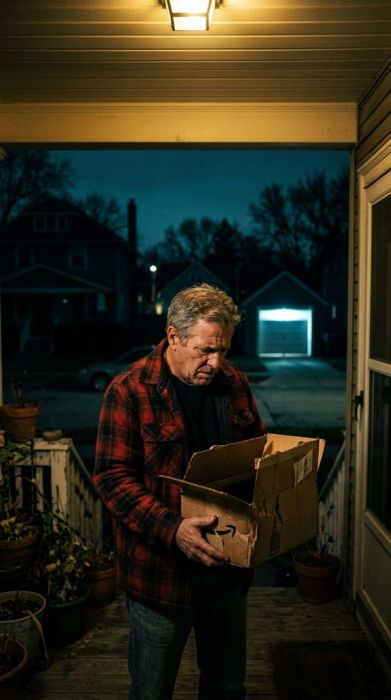
Gerald was in his late sixties, slightly stooped, with gray hair combed neatly to one side. He wore a flannel shirt tucked into pressed jeans. The kind of man who probably mowed his lawn every Saturday at exactly 10 AM.
I learned quickly that Birch Street was that kind of neighborhood. Kids played basketball in driveways. Retired couples walked their dogs at dusk. The biggest controversy in recent memory was whether Mrs. Patterson's oak tree violated the HOA height restriction.
Gerald fit perfectly into this landscape. He helped Mrs. Patterson carry her groceries. He let the neighborhood kids cut through his yard to reach the creek. He never raised his voice and never complained. He seemed to have no flaws at all.
Except for one thing. His wife.
"She left me," he told me one afternoon when I asked. He was watering his petunias, and his face did not change when he said it. "Twelve years ago now. Came home one day and she was just gone. Took some clothes. Left a note saying she was not happy."
"Did you ever try to find her?"
He shrugged. "What would be the point? If someone wants to leave, you let them."
It seemed reasonable. Almost noble, the way he said it.
But that evening, my wife Claire said something that stuck with me.
"Did you notice," she said, brushing her teeth, "he said she left twelve years ago. But his house looks exactly like a woman still lives there."
"What do you mean?"
"Those flower boxes on the porch. She would have planted those. The floral curtains in the front window. The mailbox still has both their names on it. If my wife left me after twenty-three years, I think I would at least scrape her name off the mailbox."
I dismissed it. "Maybe he is sentimental."
"Maybe."
But she was right. Over the next few weeks, I started noticing things I had missed before.
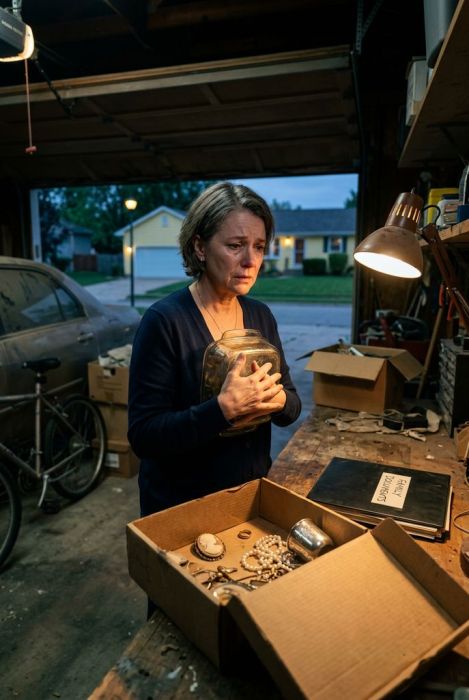
Gerald never invited anyone inside. Not once. When I offered to help him carry a new air conditioning unit into his garage, he practically blocked the door with his body.
"Oh, I have got it," he said with a forced smile. "Place is a mess anyway. You know how it is when you live alone."
I did not think much of it until the night of the storm.
It was mid-March, and a thunderstorm had rolled through around midnight, knocking out power across the entire neighborhood. I was in the basement with a flashlight, checking the circuit breaker, when I heard it.
A thumping sound.
It came from somewhere below me. Or behind me. It was hard to tell with the rain hammering the foundation. I pressed my ear to the cinderblock wall and held my breath.
There it was again. Three muffled thumps. Then silence. Then three more.
It seemed to be coming from the direction of Gerald's house.
I told myself it was the storm. Pipes expanding. The house settling. But I could not sleep that night.
The next morning, I inspected the basement wall more carefully. The foundation was original to the 1928 build. But along the far wall, where it backed up against Gerald's property, I noticed something odd.
A section of the cinderblock looked newer. The mortar was a slightly different color, and the blocks did not have the same weathering as the rest. I ran my fingers along the seam and felt a faint vibration. A draft was coming through a hairline crack.
Air was moving between my basement and whatever was on the other side.
Over the next week, I became obsessed. I started watching Gerald's house the way a detective watches a suspect.
His routines were textbook normal. He left every morning at 7:45 AM, drove to the local diner, had breakfast, visited the library, and returned by 11:30. He spent afternoons in his garden. He was in bed by 9 PM.
But there were anomalies.
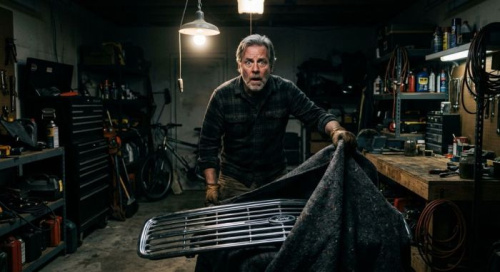
Every Tuesday evening, Gerald left the house at exactly 6 PM with a large duffel bag and returned at 9 PM without it. He never went anywhere specific but simply drove around for three hours. And every Saturday morning, he spent exactly two hours in his garage with the door closed. I could hear him moving things but never saw what he was doing.
I mentioned this to Claire.
"Honey, you are reading too many crime novels," she said. "The man is just peculiar. That does not make him a murderer."
"Then why will he not let anyone inside his house?"
"Some people are just private."
But the thumping had started again. Every few nights now. Always around midnight. Always exactly three thumps in a row.
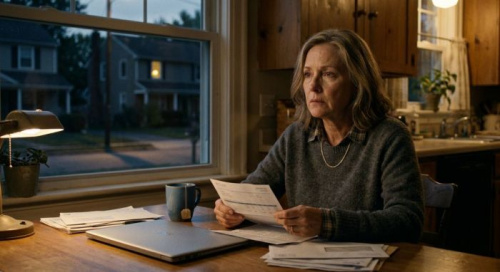
I started keeping a log. Tuesday, March 18th: three thumps at 12:14 AM. Thursday, March 20th: three thumps at 11:57 PM. Saturday, March 22nd: silence.
I bought a stethoscope from the pharmacy and pressed it against the basement wall. I could not hear words clearly. But I heard something unmistakable.
A voice. Female. Speaking in a rhythm that sounded like pleading.
I called the police.
Two officers arrived at my door the next morning. I explained everything. The basement wall. The sounds. Gerald's strange behavior. They listened patiently, nodded, and exchanged a glance.
Then one of them said something that chilled me to the bone.
"Mr. Gerald Harrison? We know him. He has actually helped us on a couple of cold cases over the years."
"Helped you?"
"He is a retired history teacher. Volunteers at the county historical society. He has given us tips on missing persons cases, old property records. Solid citizen."
I felt my face go red. "But the sounds —"
"Probably just your foundation settling. Old houses do that."
They left without even speaking to Gerald.
But I knew what I had heard. A woman's voice, coming from behind a sealed wall, in the middle of the night. And everyone around me was telling me I was imagining it.
That night, I made a decision. I waited until 1 AM, when I knew Gerald would be asleep. Then I went down to the basement carrying a crowbar, a hammer, and a flashlight.
I started chipping away at the newer mortar along the cinderblock wall.
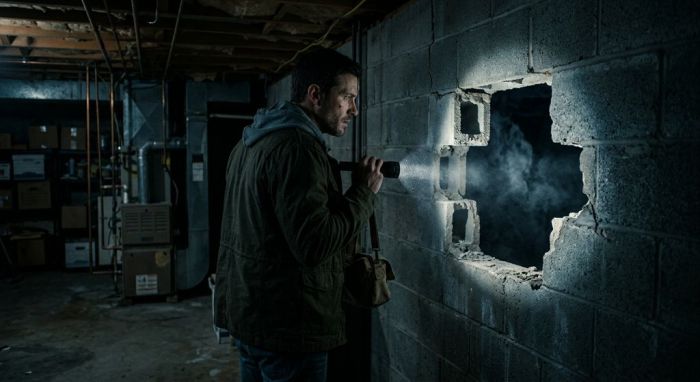
It took forty-five minutes. The mortar was softer than the original, a rushed job. When the first block came loose, cold air rushed through the gap. And with it came a smell. Damp. Musty. And something metallic that I did not want to identify.
I pulled out three more blocks, creating an opening just wide enough to crawl through.
I aimed my flashlight into the darkness.
I was looking into a room that did not exist on any floor plan. A concrete room with a single bare bulb hanging from the ceiling. A metal cot bolted to the floor.
On the cot sat a woman.
She was thin and frail, her hair matted and gray. She wore a faded blue dress that might have been nice twelve years ago. She squinted against the flashlight beam and raised a hand to shield her eyes.
"Please," she whispered. "Please, is someone there?"
I could not speak. I just stared.
"My name is Eleanor Harrison," she said. "My husband told everyone I left him. But he never let me leave the basement."
I crawled through the opening and helped her to her feet. She weighed almost nothing. Her legs were weak and her muscles had atrophied from years of confinement in that tiny concrete box.
"He told me he would kill me if I ever tried to leave," she said, tears streaming down her face. "He said no one would believe me. He said everyone thought I was gone."
She stopped suddenly and looked toward the stairs.
There was a creak above us.
Then a voice. Calm. Familiar.
"Eleanor? Who are you talking to?"
I turned and looked up the narrow staircase. A door at the top was opening. Gerald's silhouette appeared in the doorway, backlit by the hallway light. He was holding a hammer in his right hand.
"I am sorry you had to find out this way," he said. His voice was calm, almost gentle. The same voice he had used when he offered me cookies on my front porch. "I really am."
I pushed Eleanor behind me and grabbed the crowbar.
"Run," I told her. "Get outside. Call 911."
She stumbled up the stairs toward the door to the kitchen, toward the front yard, toward freedom.
Gerald started down the basement stairs.
I swung the crowbar.
The rest happened fast. Eleanor made it to the front door and screamed into the night. A neighbor two houses down heard her and called the police. They arrived within minutes.
They found Gerald sitting on the bottom step with his head buried in his hands, the hammer on the floor beside him. He did not resist. He did not speak. He just sat there, finally defeated.
In the weeks that followed, the full story emerged.
Gerald Harrison had been a respected teacher for thirty-one years. Beloved by students. Admired by colleagues. But at home, he had been something else entirely.
Eleanor had tried to leave him twelve years earlier. She had packed a bag and called a taxi. He stopped her by dragging her to the basement and sealing off a small section he had secretly reinforced over the previous year. The room was soundproofed. The walls were thick. No one could hear her screams.
He told the neighborhood, told the police, told everyone that his wife had simply left him. And everyone believed him. Because why would they not? He was Gerald. The friendly man at 9 Birch Street. The retired teacher who waved hello and helped carry groceries.
The basement room was a masterpiece of cruelty. He had vented it into my crawl space to provide air. He had installed a small toilet and sink. He kept Eleanor alive on canned food and tap water for twelve years.
Twelve years. Just forty feet from where I ate breakfast every morning.
I still think about that night. I think about how close I came to believing everyone who told me I was imagining things. The police. My wife. My own relentless doubt.
I think about how evil does not always look evil. Sometimes it looks like a man with a basket of cookies and a warm smile.
Eleanor is alive now, recovering with her sister in Oregon. She is learning to walk again, to trust again, to feel sunlight on her skin.
And every time I walk past Gerald's house now, it sits empty with a For Sale sign on the lawn. I feel that cold draft from the basement wall. I feel unseen eyes watching me from behind the curtains.
And I remember that sometimes, the most dangerous person on your street is the one who waves the friendliest.