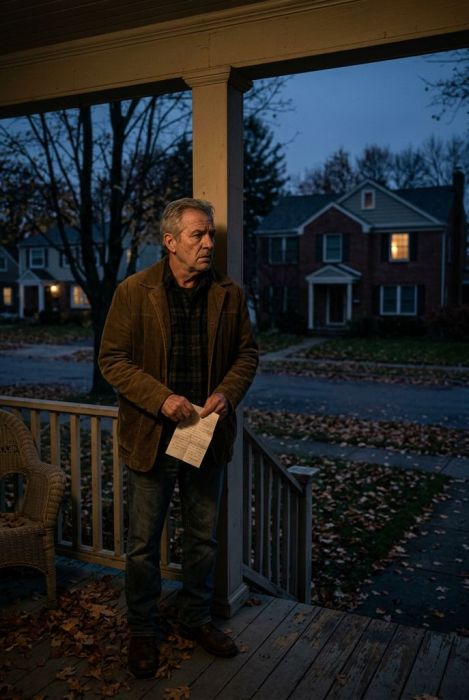
The note was waiting on the front porch when I came home from the grocery run, folded into a neat little triangle and tucked under the doormat the way Lily's friends did when they wanted to pass her something without knocking. I almost stepped on it. I bent down, picked it up, and unfolded it with the tired patience of a man who'd spent the afternoon arguing with the price of milk.
The handwriting was careful, almost painfully neat, the kind of penmanship you don't see much anymore. Loops and flourishes on the capital letters, a little dot floating above the i that looked more like a tiny heart. It was addressed to Lily. My granddaughter. She'd been living with us since February, while her parents worked a year-long contract overseas, and in all that time nothing about raising a fourteen-year-old again had been easy. But nothing had ever made my stomach turn quite like reading that note.
It said she was beautiful. It said he'd been watching her from his window for months. It said he knew the song she hummed when she thought no one was listening, and that he'd love her forever if she'd only come over to his house for lemonade one afternoon.
It wasn't signed. Below the last line, instead of a name, there was a little drawing of a heart with an arrow through it.
I stood there on the porch with the note shaking in my hand and the porch light buzzing overhead, and I told myself it was probably some boy from her school. Kids did things like that, I reasoned. Awkward, sweet, harmless. I told myself that until I noticed something that made my blood go cold. The doormat hadn't been lifted. The note was tucked underneath, in the one spot where the mat met the concrete, and whoever put it there had to have crouched down on my porch, right at my door, and slid it in without a sound.
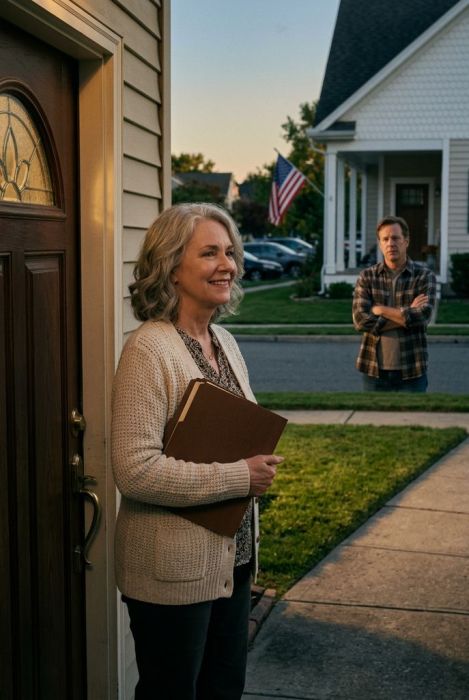
No boy from her school had any reason to come all the way across town to Maplewood Court. Maplewood is one of those cul-de-sac streets that real estate listings call "family friendly" and "quiet," which is just another way of saying everyone knows everyone's business and nothing much ever happens. My wife Margaret and I raised our own two kids in that house, watched them learn to ride bikes on that cracked sidewalk, and waved good morning to the same neighbors for over thirty years. It was the kind of street where you left your front door unlocked and your porch light on, and thanked your lucky stars for it every single night.
I didn't tell Lily about the note. I didn't tell Margaret, either. I folded it back into its triangle, slid it into my shirt pocket, and spent the rest of the evening pretending everything was normal while she did her homework at the kitchen table and Margaret hummed along to the radio. But I couldn't stop thinking about that handwriting. That heart. That careful, deliberate neatness.
I was a history teacher for thirty-one years. I've read thousands of handwritten papers, exams, and letters. Handwriting is a fingerprint, and I'd seen that one before. I just couldn't place it.
The next morning, Ed Parsons waved to me from across the street like he always did. Ed was our retired crossing guard, seventy-three years old, with a round, kind face and a Santa Claus belly that made the neighborhood kids adore him. He'd been at the corner of Maplewood and Birch since before most of the parents on our street were born, shepherding generation after generation of children safely across the road. He knew every kid by name. He brought them candy on Halloween and water on hot days and always had a story about one of their parents back when they were little.
Everyone on Maplewood Court loved Ed Parsons. That was the thing about him. He was the last person in the world you'd ever suspect of anything.
"Frank!" he called out, shuffling across his driveway with a thermos in his hand. "Beautiful morning, isn't it? You get those storm gutters looked at yet? I told you that east side's gonna sag before winter."
I waved back and said something noncommittal. He smiled, all warmth and goodwill, and I felt a little guilty for the suspicious turn my thoughts had taken. Ed was harmless. Everybody said so.
But that night, there was another note.
This one was tucked into the mailbox, folded the same way, the same careful handwriting, the same little heart. It said he'd watched Lily ride her bike to the library, and that the way the wind moved through her hair was the most beautiful thing he'd ever seen. It said he'd left a small gift for her under the big rock in the garden, and would she please find it and think of him.
I found the gift. A little silver locket, cheap and pretty, the kind a middle school boy might buy at a flea market. And that's when I stopped trying to convince myself it was a schoolkid, because no boy her age would know about the rock in our garden. You could only see that rock from the street if you were standing on our side, looking in. And the only person who ever lingered on our side of the street, day after day, watching, was Ed.
I still didn't want to believe it. So I did what any sensible man would do. I started watching back.
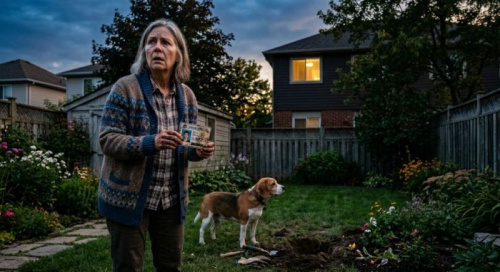
For two weeks I kept my eyes on Ed Parsons' house from my study window, pretending to read the newspaper. I watched him water his roses, walk his old beagle, chat with the mailman. He was so ordinary, so gentle, that I nearly convinced myself I'd lost my mind. There were nights I lay awake asking myself if I was just a paranoid old man, inventing monsters in a neighborhood where the hardest thing anyone ever did was complain about someone's leaves. Then I would take the note out of my shirt pocket and read it again, and the paranoia felt like the only sane response in the world.
One afternoon, while I was digging through the attic for some old tax documents, I found a cardboard box my grandfather had left behind when he passed. Inside was an old guestbook from his funeral, and a stack of sympathy cards from the whole neighborhood.
And there, among them, was a card from Ed Parsons.
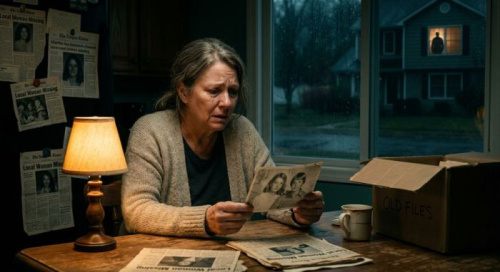
I didn't need to compare them side by side for more than a second. The loops, the flourishes, the little dot floating above the i like a heart. It was the same hand. The same careful, deliberate handwriting that had been writing love letters to my fourteen-year-old granddaughter.
I locked every door in the house that night. And then I did something that probably saved us all.
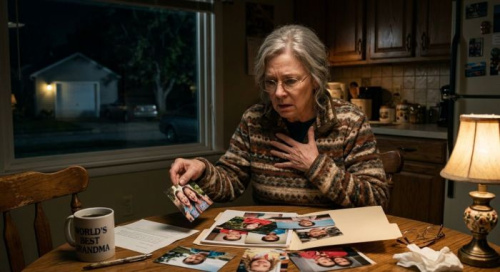
The hardest part was telling Lily. She looked at me like I'd grown a second head, then laughed nervously, then went pale when she saw the notes and the locket and the sympathy card laid out on the kitchen table. She told me Ed had been walking her to the bus stop every morning, that he always asked about her day, that he'd told her she reminded him of a girl he'd loved when he was young. She thought he was just a sweet old man being nice.
"He gave me this, Grandpa," she whispered, holding up the locket. "He said it was his mother's."
I took her to her aunt's house in the next town that very night. I didn't tell anyone on Maplewood Court why. And then I went to see Walt Bergman, the retired detective who lived three houses down.
Walt had been a detective for twenty-five years. He listened to the whole story without interrupting, his face going stonier and stonier, and when I finished he took the notes and the card and studied them for a long, silent minute.
"Frank," he said quietly, setting them down, "this is grooming. This is how it starts. And if he's been doing this to one kid, he's been doing it to others."
We set up a camera in the bushes facing my porch, the kind you can run off your phone, and we let the word spread through the neighborhood that my granddaughter had gone to visit family for a month and that Margaret and I would be away at my brother's place for the weekend. We made it look real. We left the porch light off and the curtains drawn, and I parked my truck in the garage so the driveway looked empty.
On the second night, the camera caught him.
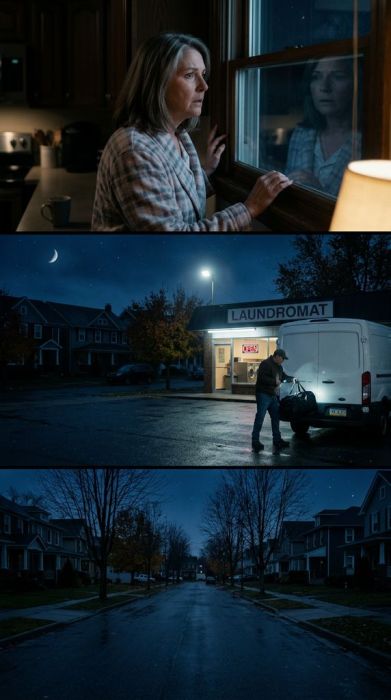
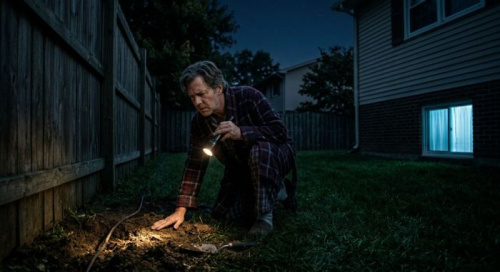
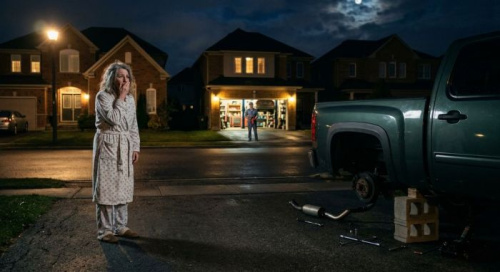
At 1:47 in the morning, Ed Parsons crossed the street in his bathrobe and slippers, moving with a smoothness that didn't belong to a seventy-three-year-old man. He knelt on my porch, reached under the doormat, and left another note. Then he stood up, looked around once, and walked back to his house with his hands in his pockets, whistling softly.
Walt was the one who called the police. He had contacts from his years on the force, and they took it seriously the moment they heard a minor was involved. When they searched Ed's house, they found more than they expected. A shoebox full of notes addressed to other girls on the street, girls who were now grown women with daughters of their own. A scrapbook with photographs he'd taken over the years — of children at the bus stop, at the park, on bicycles. And in the back of his closet, a stack of letters he'd written but never sent, to Lily, describing things only someone watching our house every single day could have known.
The neighbors were in shock. The parents of the other girls were sick. And Ed Parsons, the gentle crossing guard who'd watched over our street for fifty years, was arrested for stalking and for the attempted grooming of a minor. He lost everything. His reputation, his friendships, his freedom. The man everyone trusted was gone, and the street was left to reckon with the fact that the danger had been living right next door the whole time.
Lily came home two weeks later. She was quiet for a while, but kids are resilient, and so is she. We talked a lot about what happened, about how predators hide in plain sight, about how kindness and trust are the very things they exploit. She still rides her bike, but she doesn't go to the bus stop alone, and she knows now that some smiles aren't what they seem.
As for me, I sleep better these days than I did during those two weeks of watching. Not because I trust the neighborhood more — I trust it less, and that's a good thing. But because I know we caught him, and because Lily is safe, and because sometimes the quietest people on the street are the ones hiding the most. That's the lesson I carry now, the one I'd want every parent and grandparent to know. Keep your eyes open. Trust your instincts. And if you ever find a note with handwriting that makes your blood run cold, you lock every door — and then you look closer.