Maggie Foster had lived on Chestnut Drive for eleven years, and in all that time, she had never once seen Vince Parson mow a single lawn.
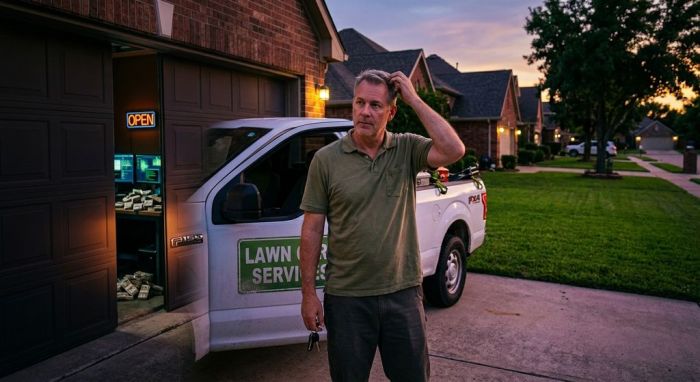
It was a small observation at first. The kind of thing you notice but don't think twice about. Vince was the neighborhood handyman type — crew cut, work boots, polite smile, always driving that white pickup truck with "Parson's Property Maintenance" stenciled on the side in faded blue lettering. He waved at everyone. He asked about your kids. He brought his trash cans in before noon on collection day.
But nobody on Chestnut Drive had ever hired him.
"Has he ever done your yard?" Maggie asked her husband Tom one evening as they watched Vince back his truck out of the driveway at 7 p.m. — a strange time to be starting work.
Tom shrugged from the couch. "Maybe he works commercial. Office parks, strip malls. Something like that."
It made sense. It was a perfectly reasonable explanation. And for two years, Maggie accepted it.
Until she started paying closer attention.
It began with the hours. Vince left his house at odd times — sometimes early morning, sometimes late evening, rarely at consistent intervals. His truck would come and go at all hours, but Maggie never saw any equipment in the back. No mowers. No trimmers. No leaf blowers. Just a covered truck bed with a black tonneau cover, always locked.
Then there were the visitors. Around nine most evenings, cars would pull into Vince's driveway. Nice cars. BMWs. Mercedes. A black Escalade that showed up every Thursday like clockwork. The visitors never stayed long — fifteen, twenty minutes tops. They'd walk to the front door, Vince would let them in, and they'd leave with envelopes or briefcases that seemed noticeably thinner than when they arrived.
"Maybe he runs a poker game," Tom said when Maggie mentioned it.
"Does a poker game need an Escalade every Thursday?"
"Rich people play poker too, honey."
Maggie let it go. But she didn't stop watching.
The real trouble began on a cool October night when Maggie's golden retriever, Buddy, got out through a gap in the fence. She chased him down the block, calling his name in a hushed voice so she wouldn't wake the neighbors. Buddy had made it all the way to the corner of Chestnut and Sycamore, and by the time Maggie caught up with him, she was standing directly behind Vince Parson's house.
That's when she heard it.
A voice. Muffled. Coming from somewhere beneath the ground.
Maggie froze, her hand gripping Buddy's collar. She listened so hard her ears ached. At first there was nothing but the hum of the neighborhood — a distant TV, the wind through the trees. But then she heard it again, clearer this time. A man's voice, speaking rapidly in a language she didn't recognize. And then another voice answering him.
They were speaking from below the grass. From under the backyard.
Maggie's first instinct was to assume it was a basement window. Lots of houses had basement egress windows at ground level. But Vince's house was a single-story ranch built on a concrete slab. There was no basement. She knew because she'd been in the model home when the development was built fifteen years ago.
She walked home in a daze, telling herself it was ventilation ducts, or maybe a storm drain, or the way sound carried in the cul-de-sac. By the time she reached her front door, she had three perfectly logical explanations ready.
But she didn't sleep that night.
Over the next week, Maggie began keeping a mental log. Vince's visitors increased. The Escalade came twice instead of once. A silver Lexus showed up at 11 p.m. on a Tuesday. And every single time, the visitors carried something — a duffel bag, a briefcase, a gym bag that clinked when it moved.
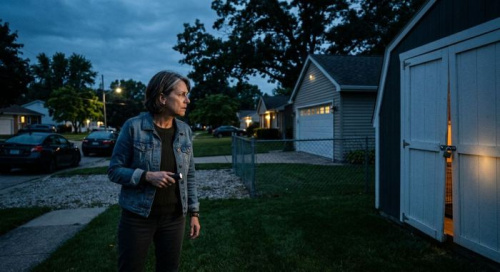
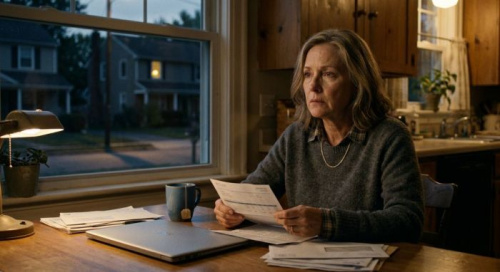
Maggie started taking walks at night. She told Tom she was trying to get more steps in. In reality, she was timing Vince's visitors. She noted license plates. She counted how long each person stayed inside. She wrote everything down in a notebook she kept hidden in her coat closet.
What she found was a pattern. Every visitor stayed between twelve and eighteen minutes. Every visitor arrived exactly on time — not five minutes early, not five minutes late. And every single visitor left carrying something smaller than what they brought.
Maggie's sister Karen was the first person she told. Karen worked as a paralegal at the county courthouse.
"He's running a business out of his house," Karen said dismissively. "Probably sells insurance or financial services. That's why people bring paperwork."
"Financial services at 11 p.m.?"
"Some people work late."
But Maggie saw the hesitation in Karen's eyes. She knew her sister well enough to recognize when she was being humored.
The breaking point came on a Thursday night in late November. Maggie was sitting in her dark living room at 11:30 p.m., watching Vince's house through the gap in her curtains, when she saw something that made her blood run cold.
A woman got out of a sedan parked behind Vince's truck. She was young — maybe early twenties — and she was crying. Maggie could see it even from across the street, the way her shoulders shook, the way she wiped at her face with the back of her hand. Vince met her at the door. He put a hand on her shoulder, pulled her into a hug that looked almost fatherly. Then he guided her inside and closed the door.
She didn't come out.
Maggie stayed awake until 3 a.m. watching that door. The woman never reappeared. Vince's lights went off at midnight. And the next morning, Vince waved at Maggie like nothing had happened, like there wasn't a young woman asleep somewhere in his house who had arrived in tears.
Maggie called the police the next day.
Officer Diane Russo was the one who took the call. She was a twenty-year veteran with kind eyes and a skeptical poker face. She listened to Maggie's concerns with professional patience, jotting notes in a small spiral pad.
"So your neighbor has visitors at odd hours, and you saw a woman crying?"
"She went inside and never came out."
"How do you know she didn't leave while you were asleep?"
"I didn't sleep."
Officer Russo's pen paused. "Ma'am, do you have any evidence that a crime has been committed? Any actual proof?"
Maggie hesitated. "No. But something is wrong. I can feel it."
"Feeling it isn't probable cause."
The officer left with a promise to "drive by more often" and a business card that Maggie knew was a formality. She wasn't being taken seriously. She was the neighborhood busybody, the middle-aged woman who watched too much true crime television and saw monsters in every shadow.
But she wasn't wrong.
Four days later, Vince Parson's life began to unravel in ways Maggie couldn't have predicted. It started with a traffic stop. A routine pullover on the interstate — Vince's truck had a taillight out. The state trooper ran his plates and found nothing unusual. But Vince was nervous. Too nervous. His hands shook when he handed over his license. His answers came in fragments.
The trooper asked to search the vehicle.
Vince said no.
That alone wasn't enough. But the trooper noticed something — a faint chemical smell coming from the truck bed. Not gasoline. Not fertilizer. Something sharp and synthetic. He called for a K-9 unit.
The dog sat down immediately at the tailgate.
Inside the covered truck bed, beneath a tarp and two stacked toolboxes, the troopers found four duffel bags containing a total of one point eight million dollars in cash. The bills were wrapped in vacuum-sealed plastic, organized by denomination, each bundle stamped with a number that matched a ledger found in Vince's glove compartment.
The arrest was swift. But the real discovery came when law enforcement executed a search warrant at 23 Chestnut Drive.
Maggie watched from her living room window as a convoy of unmarked SUVs and county sheriff's vehicles descended on Vince's house at 6 a.m. She watched officers in bulletproof vests stream through the front door. She watched them emerge hours later carrying boxes, filing cabinets, laptop computers, and dozens of banker's boxes filled with documents.
But what she remembered most was the sound.
Around 8:30 that morning, one of the officers opened Vince's garage door from the inside. Maggie had a clear view of the garage for the first time in years. It wasn't a garage at all. It had been converted into a fully equipped office space — desks, computers, monitors, a cryptocurrency mining rig that took up an entire wall, and a massive safe embedded in the concrete floor.
And in the corner, curled up on a cot with a blanket wrapped around her shoulders, sat the young woman Maggie had seen a week earlier. She was crying again. But this time, she was smiling.
The investigation that followed painted a picture far darker than money laundering. Vince Parson had been running what federal prosecutors called "a comprehensive criminal financial enterprise" — laundering money for three separate drug cartels, running an offshore gambling operation, and facilitating illegal cryptocurrency transactions for organized crime networks across four states.
The young woman in the garage was Elena Vasquez, a 22-year-old informant who had been placed inside Vince's operation by the FBI six months earlier. The crying act had been real — she was terrified — but she had been wearing a wire the entire time. Every conversation, every transaction, every midnight visit from the black Escalade had been recorded.
Vince Parson, the friendly neighbor who waved at everyone and never mowed a single lawn, had been one of the most prolific money launderers in the Midwest.
The trial lasted three weeks. Vince was convicted on seventeen counts of money laundering, racketeering, and conspiracy. He was sentenced to twenty-two years in federal prison.
Maggie testified at the sentencing hearing. She sat in the witness box and told the court about the late-night visitors, the crying woman, the voices beneath the ground — which turned out to be a reinforced underground vault Vince had built beneath his backyard shed, accessible through a hidden trapdoor.
"I almost didn't call," Maggie said, her voice steady but quiet. "I almost convinced myself I was imagining things. That I was being paranoid. That he was just a nice man running a business."
She paused, looking at Vince's family sitting in the gallery — his elderly mother, his sister, his niece. They looked as shocked as everyone else.
"But I learned something," Maggie continued. "Nice people can hide terrible things. And if something feels wrong, it's worth paying attention to."
After the trial, the FBI held a press conference. The lead agent, a weathered man named Donald Pryor, took questions from reporters. One reporter asked how Vince had managed to operate undetected for so long.
"He was boring," Agent Pryor said simply. "He was the most unremarkable man on the street. He waved at his neighbors. He brought cookies to block parties. He never gave anyone a reason to look closer. And that's exactly what criminals like him count on."
Maggie still lives on Chestnut Drive. She still takes walks at night, but now she does it without hiding. Sometimes she stops in front of 23 Chestnut Drive. The house sat empty for eight months before a young couple bought it at auction. They're nice people. They wave when they see her. They invited her to their housewarming party.
She went. She ate their store-bought cookies and complimented their paint colors. But she couldn't help noticing the way her eyes kept drifting to the garage door, checking if it was fully closed, straining to hear if there were any voices coming from beneath the ground.
There weren't, of course. But she checks every time anyway.
Because that's what living on Chestnut Drive taught her. The quietest house on the street is sometimes the one hiding the most. And the man who waves at you every morning might be the most dangerous person you'll ever meet.
Maggie still glances at everyone who pulls into a driveway with an envelope in their hand. She still pays attention when a truck leaves at odd hours. She still writes down license plates when something feels off.
She doesn't apologize for it anymore. Not since the FBI thanked her for her vigilance.
Not since Elena Vasquez called her from a safe location six months later and thanked her for not looking away.