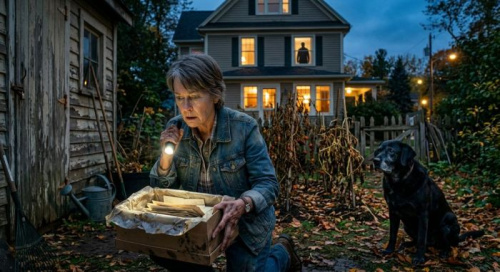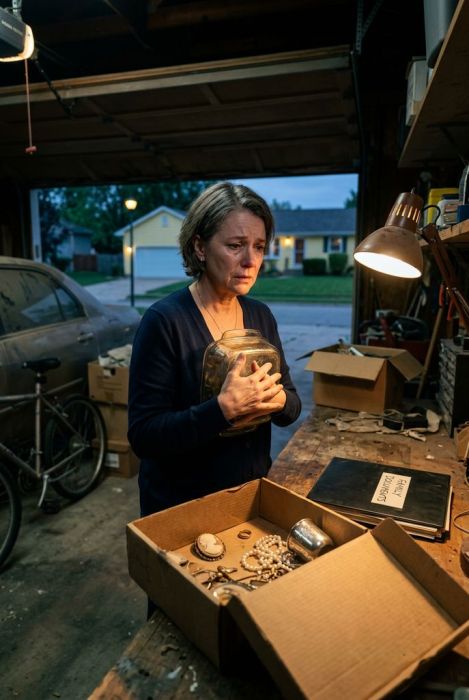
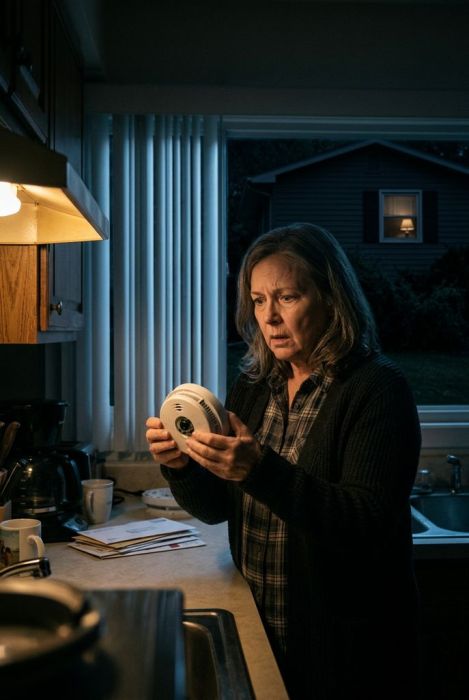
The smoke detector above my stove started chirping that Tuesday at 6:40 in the morning, the same flat beep it had made every few minutes since the weekend. I finally dragged a kitchen chair over and popped the cover off, expecting a dead battery and a lecture from my daughter about climbing on furniture at fifty-eight. What I found instead was a camera lens, small as a peppercorn, and behind it a micro SD card so new it still had that slick plastic shine.
There was one folder on that card, and it wasn't labeled "kitchen." It was labeled MAGGIE.
I have thought about that morning a thousand times since then. I remember how my hands shook when I clicked the first file open. I remember how the image on my laptop screen was my own stove, my own blue dish towel, my own granddaughter's high chair pushed against the counter. And I remember that the earliest clip was dated January 14th — the exact afternoon our neighbor Ray Calloway had "updated" the smoke detectors in my mother's house and mine.
This is the story of how I learned that the kindest man on Larkspur Lane had been watching my family for eight months, and how we made sure he never watched anyone again.
To understand how any of this happened, you have to understand Ray Calloway. He was sixty-one, a retired security-system installer who'd spent twenty-six years putting alarms and cameras into banks and pharmacies before his back gave out. He moved into number twenty-two on Larkspur Lane two years after my husband died, and inside of a month he had fixed Mrs. Kestler's garage door opener, jump-started half the street's cars, and shoveled driveways without ever being asked. He was the man you called when you couldn't reach your own son. Everyone said the same thing: Larkspur Lane got lucky the day Ray Calloway moved in.
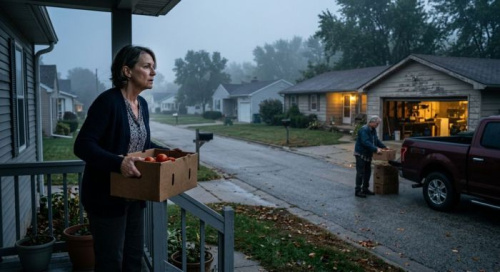
It was my mother he attached himself to first. Dot — Dorothy Bancroft, eighty-four — lives at number twenty-six, right next door to me at number twenty-four, in the house where I grew up. After Dad died she kept the place immaculate, but the winter she turned eighty-three she started forgetting the stove, forgetting the mail, forgetting that she'd already called me four times before breakfast. In January she took a bad fall on the ice and spent three nights in the hospital. I came home from that week carrying a weight I didn't know how to put down.
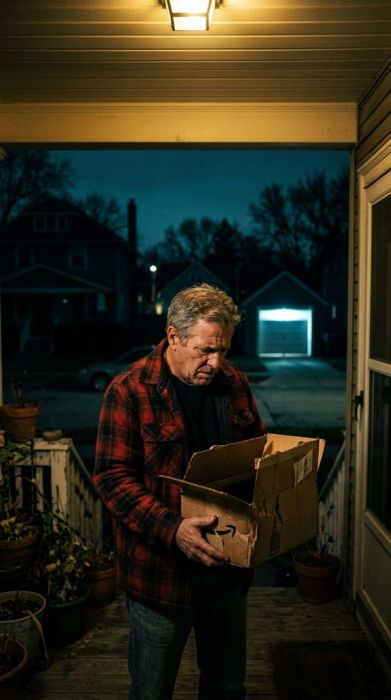
Ray met us in the driveway the afternoon she came home. "I've been thinking," he said, holding a cardboard box with a camera on top. "You can't be over here every minute, Maggie. Let me set up a system so you can check on her from your phone."
I told him I'd pay him. He waved me off like I'd insulted his mother. "Your mom reminds me of mine. Let me do this for her."
He worked all afternoon. Cameras in Dot's living room, her kitchen, and her front porch — honest angles, he explained, nothing in the bathroom or bedroom. "I'm not a monster," he said, and I laughed. He set up the app on my phone and showed me how to look in on her from anywhere. Then he drove to the hardware store and came back with new smoke detectors, replacing three in my mother's house and one over my stove because, he said, squinting at the date stamp, "that one's from 2009."
I hugged him. I baked him a pie. I told every neighbor on the street what a godsend he was.
The first time I felt the prickle, I told myself I was being ridiculous. It was March, and Ray asked me, "How's Claire's new schedule treating her?" Claire is my daughter, a pharmacist, and she had told me about switching to night shifts exactly one day earlier. Ray had no way to know that. I told myself the walls were thin.
Then Evie said the thing that should have stopped me cold. Evie is my granddaughter, two and a half, and she spends her afternoons with Dot while Claire works. She said it at dinner one night, plain as anything: "Mr. Ray says hi." I asked her when she'd seen him. She shrugged and pointed at the ceiling. I thought she was being two years old.
In May I lost my house keys, tore the place apart, and eventually found them on the porch swing. Ray mentioned them two days later: "Saw them on your porch the other day, meant to bring them over." I had never told him they were missing.
And my mother, whose memory was going soft, said the line I would replay for the rest of my life. "That nice man from next door watches TV with me," she told me once, "but he never sits down." She smiled when she said it. I smiled back. I assumed it was the confusion talking.
The cold thread finally pulled tight the weekend Ben came to visit. Ben is Claire's husband — he does cybersecurity for a regional bank — and he offered, over cold lemonade, to update the router in my kitchen because I'd been complaining about the buffering. He did it in about twenty minutes. Then, when Claire was in the yard with Evie, he came inside and closed the kitchen door behind him.
"There's a device on your network I don't recognize," he said. "It's labeled RB-CAM-02, and it's been streaming video out of this house, around the clock, for months. I looked up the hardware. It matches a covert camera module that gets sold online to private investigators and to people who don't necessarily have your best interests in mind."
He showed me the log. I felt the floor tilt. Because the only person with the initials RB who had ever touched the inside of my house was Ray Calloway.
Nobody slept well that weekend. We didn't confront anyone, partly because I couldn't stop shaking, and partly because Ben is the cautious kind. He pulled the specs on my camera app and found a second login I had never created, an administrator account named "RB Security — master." He copied every timestamp on the network before we did anything else. Then he asked me the question I'd been afraid to hear: "Maggie, does he have a key?"
I told him yes. The month my mother came home from the hospital, Ray had asked for a spare "in case you ever lock yourself out again," and I had handed one off my key ring like it was nothing. I watched him put a green tag on it. "Spare — Hollis," he said, and smiled.
We kept the discovery to ourselves for exactly one night. The next morning I put the little card in my purse and drove to the police station, and I asked to speak to a detective. I got Detective Ann Mulligan, a woman my age with gray hair and a voice like gravel. She listened to the whole story without interrupting once. Then she looked at the folder on my laptop — the one labeled MAGGIE, with eight months of mornings inside it — and she asked the question that tautened every muscle in my body: "Has he ever been inside the house when you weren't there?"
I said yes, he watered the plants when we went to Columbus for a weekend in April. Mulligan nodded and pushed a notepad across the desk. "Write down everything," she said. "Every time he showed up at the wrong moment. Every odd thing your mother said. Every 'just happened to be walking by.'" When I finished, she read it twice, then looked up. "Okay. Go home. Act normal. And don't tell Ray Calloway a single thing."
I'll tell you the hardest part of those two weeks: it was succeeding.
We turned my little house on Larkspur Lane into a quiet trap, and we did it in plain sight. Claire and Ben drove up from Columbus with a trunk full of Ben's own cameras — clean ones, purchased under a business account, pointed at my back door from inside the birdhouse and at the driveway from the mailbox. Detective Mulligan's team confirmed the second account went live every night between nine and midnight like a man checking his watch. They also found it had access to footage from five other homes within a half mile of mine — including a house in the next town over that had been burglarized three months earlier. They didn't tell the press. They told me to keep the vacation story going.
So we played our part. We told the mailman we were going to Michigan for ten days to see Ben's parents. We told Mrs. Kestler, which was the same as telling the whole street. And we made sure Ray heard it twice — once at the church picnic, where I said it across the folding table and watched his eyes brighten over his potato salad, and once when I knocked on his door to ask if he'd "keep an eye on things" while we were away.
He was delighted. That's the part I remember clearest. He stood on his porch with Carol — his wife of thirty years, who had no idea what her husband did with the hours between nine and midnight — and he said, "Don't worry about a thing, Maggie. I'll watch it all for you."
The decoy was simple. Ben took my grandmother's jewelry box off the dresser, emptied it, and put glass paste replicas inside where the real pieces had been. The real pieces went into a safety deposit box — Detective Mulligan watched me put them there myself. We left the velvet box exactly where the kitchen camera could see it, on the dresser at the end of the hallway. Then we packed the van, turned off the lights, and drove to Claire's apartment thirty minutes away, where we ate pizza and watched three screens and waited.
He came on the second night, at 11:41.
I saw him on Ben's feed first: a gray jacket rounding the side of the house, moving slow, like a man who knew exactly which boards of my back porch creaked. Then the door opened, and the green tag on his key caught the light. On the feed, he moved like a man who owned the place. He went to the dresser, emptied the velvet box into his jacket, and paused at the mantel to pocket the silver frame — Dot's, one of the cheap doubles Ben had put out, with a picture of Evie smiling.
He started down the hallway toward the bedroom. That was when the porch lights came on, and the front door swung open, and Detective Mulligan's voice came through my own speakers, calm and loud: "Ray Calloway. Dayton Police. Put the box down and your hands where I can see them."
He ran for the back door, and he made it as far as the back step before two officers who had been waiting in the dark between the houses stepped into the light. There was no struggle to describe, thank God for that. Just the sound of my grandmother's glass "diamonds" scattering across the porch, and the click of handcuffs, and Ray Calloway's voice asking, over and over, "How did you know?"
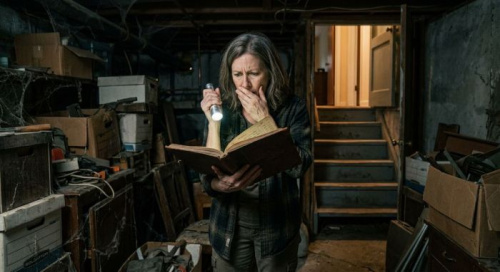
The search of his house found the answer. In a closet under the stairs, behind a false wall he'd paneled himself, was a server with years of footage on it. Folders labeled with family names and street numbers. Twelve families' worth of kitchens and living rooms and backyards — every house where Ray Calloway had ever "helped" with the cameras, going back long before Larkspur Lane. He had watched people for years. He had used what he learned to time the burglaries in the next town over, hitting the houses he'd watched go dark. He was the neighborhood watchman, and the burglar, and the eye behind the walls, all in one.
The charges stacked up like plates at a church supper: burglary, unlawful surveillance, illegal interception, possession of stolen property. Carol Calloway moved out that same week. By the following Monday there was a realtor's sign on the lawn at number twenty-two, and the news van from Dayton was parked in front of my mother's house.
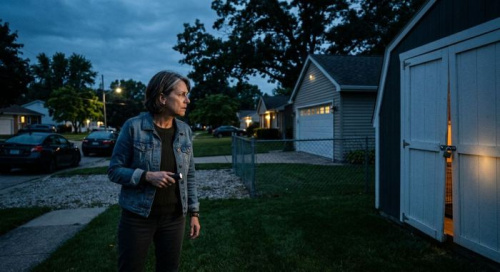
The neighborhood meeting was held on Mrs. Kestler's lawn two nights later. People cried. People apologized to me, which I didn't want, because I had missed it too — I had baked the man a pie. I sat on my porch swing and listened to the woman across the street explain that she'd given Ray her keys as well, and the man three doors down who'd hired him to watch his mother. Nobody had seen it. That was the part that kept us all up at night.
Ray Calloway took a plea deal. He'll be past seventy when he walks out of prison. And what I remember now isn't the fear, and it isn't the satisfaction of watching him led away on television. It's what came after.
I paid a real security company to redo every lock in both houses. A young woman named Priya walked the entire property with me, asked me questions no one had ever asked before, and changed every code on every device. The street started a Neighborhood Watch with actual training, actual badges, and no single person in charge of the neighborhood keys. And something else happened — slower, quieter: we started actually knowing each other. Not the wave-and-smile kind of knowing. The kind where you notice when someone's back door is open at midnight.
Dot still asks, some mornings, whether that nice man from next door is still there. She forgets before I have to answer. And last September, in that cool gold light of early autumn, the movers carried the last box out of number twenty-two, and a young couple with a yellow dog came back to paint the shutters. Claire called the same afternoon. Evie, on her third birthday, stood on my porch and said the sentence I'd been waiting for since August: "Grandma, can we leave the door open now?"
I said yes. And I sat in the old swing and watched her play, and I thought about folders and lenses and all the quiet ways a person can be watched without ever knowing. The best security camera I ever had was the one Ray Calloway never saw: a neighborhood that finally started looking each other in the eye.