
The chain snapped first. Then the leather peeled away like wet paper, and the little gold clasp hit the ballroom floor and rolled between the feet of a girl who'd been whispering about my Emily all night. I heard it happen from across the room — that tiny, terrible clatter — and I knew before I even turned around that our whole year had just crumbled.
Emily had been saving for that bag since her sophomore year. Babysitting. Tutoring. Double shifts at the diner every single summer. Three thousand dollars, folded into a sock drawer, counted and recounted, all for the one thing she wanted more than anything in the world: a vintage Chanel to carry at her senior prom. And Diana Pemberton, our neighbor at 8 Rosewood Court, had sold it to her for a "steal" — "because of the condition," she'd said sweetly.
Diana was the darling of Rosewood Court. She'd moved in four years ago with her husband Tom and their two little girls, and within a month she was president of the block's book club, captain of the bake sale, the first one with a casserole on your porch when you had a bad day. Her side business — Pemberton Vintage & Designer Resale — was the envy of the whole county. Every woman on the street owned something from Diana: a silk scarf, a brooch, a handbag that had once belonged, supposedly, to someone famous. She authenticated everything herself, she said, in her little studio in the garage. She had a certificate for everything, printed on heavy cream paper with a gold seal.
I should have seen it. I should have listened to that small voice that told me three thousand dollars was too good to be true for a bag that usually cost three times that. But Emily's face, the way her hands shook when she unboxed it on the kitchen counter — I couldn't take that moment away from her. Diana stood right there and watched her open it, watched her cry happy tears, and hugged her and called her "my little fashionista."
Now, at the prom, with the bag coming apart like a cheap Halloween prop, that memory made me sick.
The DJ was playing something thumping. Teenagers in rented tuxes and borrowed gowns were laughing under a canopy of white lights. And my granddaughter stood frozen by the dessert table, holding the ruined bag with both hands, her face the color of the tablecloth. The strap had detached from the body. The leather had split along the stitching. And where the serial number should have been, deep inside, there was only a tiny sticker that read "Made in China."
I took Emily by the arm and led her out to the parking lot before she could cry in front of everyone. In the car, she finally let go. "It was the real thing, Grandma," she kept saying, over and over, like she could will it back into being. "She showed me the certificate. She showed me the receipt from 1998. She hugged me, Grandma. She hugged me."
I drove home with my jaw so tight I thought my teeth would crack, and I called Diana Pemberton's number before we even pulled into the driveway.
She answered on the second ring, all warmth and concern, like she'd been waiting for us. "Oh, honey, no," she said when I told her. "That can't be right. That bag came from an estate in Palm Beach. It was authenticated by a certified specialist. I have the paperwork right here."
"The bag fell apart, Diana. At the prom. In front of everyone."
"Well," she said, and the warmth cooled about ten degrees, "these vintage pieces are delicate. Maybe she got something on it. Some punch, maybe, or lotion. It's really not my responsibility once it leaves my hands. I sold it in good faith."
"Three thousand dollars, Diana. You sold my granddaughter a three-thousand-dollar bag."
"Margaret, I know you're upset." Her voice was honey again, but I could hear the steel underneath. "Let's not say things we'll regret. I'll tell you what — bring it by tomorrow and I'll see if I can have my specialist repair it. But I can't do a refund. That's just not how consignment works."
Consignment. The word stuck in my head all night. Emily cried herself to sleep in the guest room, and I sat at the kitchen table until two in the morning, turning that ruined bag over and over in my hands, looking at the peeling leather, the flaking gold, the little sticker that said "Made in China."
The next morning I did something I hadn't planned on doing. I drove into town and I talked to a woman I knew from church — Carol Whitfield, who'd worked forty years at a big department store downtown before it closed, the kind of woman who could tell a real silk scarf from a rayon one with her eyes closed. I showed her the bag.
She went quiet for a long moment. Then she turned it inside out and studied the lining with a jeweler's loupe she pulled from her purse like a magician. "Honey," she said, setting it down gently, "I've seen better fakes at the flea market. The stitching on this label is machine-made and crooked. The hardware isn't even brass. And look here —" she pointed at the serial sticker — "they didn't even bother to change the country of origin. This is a dupe. A good dupe, from a distance. But a dupe all the same."
I asked her, carefully, what someone would do with a box of bags like this, and certificates, and receipts from 1998. Carol looked at me for a long beat. "You're talking about a counterfeit operation," she said. "A serious one. Do you know where that bag came from?"
"I think," I said, "I know exactly where it came from."
I went home and started paying attention, really paying attention, the way you do when someone's hurt your family. Diana Pemberton's garage studio had a small side door, and I started noticing things I'd never noticed before. The delivery truck that came down Rosewood Court every Thursday at four in the afternoon, always stopping at her house, never anywhere else. The way Tom Pemberton would wave and smile but never quite meet your eyes. The way Diana's two little girls were never, ever allowed to open the mail.
And then, one Thursday, I saw the truck driver hand Diana a large box, and Diana — thinking she was alone, thinking the whole street was at the high school for the spring concert — carried it around back. I happened to be pruning my roses by the fence. I happened to see her struggle with the garage's side door, and I happened to notice that the cardboard box had a label on it.
The label said, in neat black marker: "DUPES — DO NOT OPEN."
I stood there with the pruning shears in my hand and my heart hammering so loud I was sure she could hear it. For a moment I thought about marching over there and demanding answers. But something stopped me — the memory of that honeyed voice on the phone, that steel underneath, and the thought of what a woman like Diana would do to a nosy grandmother who'd started asking questions.
So instead, I went back inside, and I called the one person I trusted more than anyone in the world besides my own children: my brother-in-law Walt, a retired state trooper who'd spent his last five years on the force working property crimes.
Walt listened to the whole story without interrupting. When I finished, he was quiet for a moment. "Maggie," he said — he's the only one who calls me that — "you just described an organized counterfeit ring. Designer handbags, shoes, watches. They're not small-time. These people buy wholesale from overseas, put them in boxes that look authentic, fabricate certificates and receipts, and sell them as 'estate finds' and 'vintage resale.' A good operation can clear a couple hundred thousand a year, tax-free, out of a garage."
"My granddaughter," I said, "gave that woman three thousand dollars of her own hard-earned money."
"And she won't be the last," Walt said. "But you need to be careful. If she's part of a network, there are people behind her who don't care about grandmothers or granddaughters. Don't go poking around that garage alone. Don't confront her. Give me a couple of days, and let me make a few calls."
The waiting was the hardest part. For two days, I pretended everything was fine. I waved at Diana over the fence. I brought a Bundt cake to the Pembertons' block barbecue and watched her cut it and smile and talk about her "estate sourcing trips," and I felt something cold settle in my stomach the whole time. Emily stayed quiet. She'd stopped crying, but she'd stopped talking about the prom too, and that was somehow worse.
Then Walt called me on a Saturday morning with a name and an address. "The boxes go to a warehouse over in the next county," he said. "Industrial unit, rented under a shell company. And Maggie — your neighbor isn't the top of this. She's a foot soldier. But she's a foot soldier with a paper trail, and that paper trail is going to make a very satisfying case."
He gave me a number for a detective in the county's economic crimes unit and told me to call it, and to tell them I'd found the label. So I did. I called, and I explained, and I sent photographs of the bag, the sticker, the certificate Diana had given Emily, and the "DUPES — DO NOT OPEN" box I'd photographed from behind my roses on my phone — a little shaky, a little blurry, but good enough.
And then I waited again.
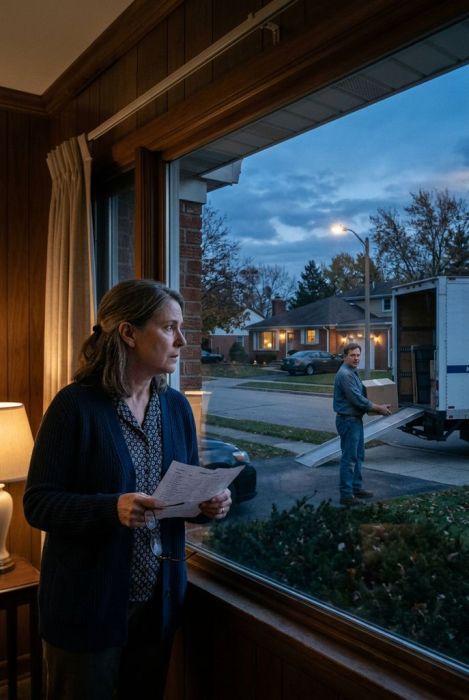
The raid came on a Thursday — a different Thursday, three weeks later. I was pulling weeds in my front garden when the first unmarked car rolled down Rosewood Court, quiet and purposeful, followed by three more. Detective Amaral from the economic crimes unit had told me to stay inside, but I couldn't help myself. I stood at my living room window and watched them file around the side of the Pemberton house, watched Diana come to the door in her gardening gloves with that smile on her face, watched the smile die when they showed her their badges.
I watched them carry boxes out of that garage studio for hours. Designer bags in clear plastic evidence bags. Shoe boxes. Jewelry cases. Little plastic pouches of serial-number stickers and "authenticity cards." A whole industry of lies, carried out of a neighbor's house in broad daylight, while the whole street gathered on porches and driveways and watched in stunned silence.
Tom Pemberton was arrested that afternoon at his job site. Diana was arrested at the house, right there in her own front yard, and I'll never forget the way she looked at me through the window of the patrol car — not angry, not scared, but calculating, like she was already trying to figure out who'd turned her in and what it would cost them.
But here's the thing about karma, and about this street: Diana Pemberton had been the darling of Rosewood Court, but she'd never been one of us. Not really. When the news got around — when the county prosecutor announced that Diana had been running a counterfeit operation that sold thousands of fake designer goods through her "vintage resale" boutique, with a warehouse full of stock and a bank account that proved she'd made nearly half a million dollars off it in three years — the casseroles stopped coming. The book club found a new host. And one by one, the women on this street went through their closets and found their own "vintage" treasures — the scarves, the brooches, the handbags they'd bragged about at parties — and started quietly checking them, and quietly, one by one, started calling the number Detective Amaral had given me.
They got Diana on trademark counterfeiting, wire fraud, and a laundry list of state charges. She pled down to avoid trial, and the judge wasn't kind: prison time, restitution to every victim who came forward, and forfeiture of the house on Rosewood Court, which is currently up for sale.
Emily's restitution check arrived six weeks later — the full three thousand dollars, with a letter from the court explaining that her claim had been verified and prioritized. She opened it at the kitchen table, and she didn't cry this time. She just sat there holding it, very quiet, and then she looked up at me and said, "Grandma, can we go to the real store? The one downtown? With the doors that lock behind you?"
So that's what we did. We drove downtown to the only authorized luxury boutique in a hundred miles, and we stood at the glass counter while a very serious woman in a very serious suit showed us a bag — a new one, a real one, with a receipt that had the store's name on it and a serial number that matched the box. Emily held it in her hands like it was made of glass, and I watched her turn it over, check the stitching, check the hardware, check everything — and then she smiled, a real smile, the first one I'd seen since the prom.
"That's the one," she said. "This is the real one."
It cost more than three thousand dollars. I made up the difference. I'd have paid double, triple, anything, to see her smile like that again.
A month later, the court finalized Diana's sentence, and the local paper ran a story about the "Rosewood Counterfeit Ring," with a picture of the house we'd all loved. I read it at my kitchen table with a cup of coffee, and I thought about all the ways trust gets sold for a bargain, and all the little labels we ignore because we want so badly to believe.
Emily's prom bag sits on my dresser now. I kept it, in the end — a reminder, a warning, a strange little trophy. Every time I look at it, I remember the sound of that clasp hitting the ballroom floor, and I remember the look on Diana Pemberton's face as they led her away.
We have a new neighbor at 8 Rosewood Court now — a retired couple from Ohio who wave hello and keep to themselves and brought us a pie on their first week. I brought them a Bundt cake back, because that's what you do on this street, and I smiled, and I thought: I'll give you a chance. I'll always give people a chance.
But I'll also read every label. I'll check every receipt. And I'll keep my eyes open, always, for a box marked "Do Not Open."