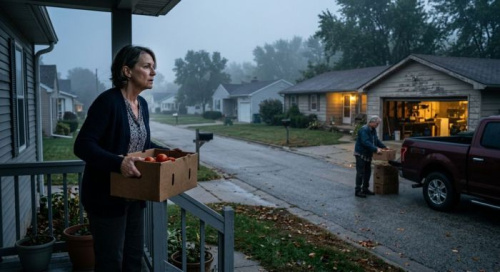
The first time I really noticed Dale Whitmore was the week I broke my wrist. I'd been trying to haul a bag of birdseed out of the trunk of my old Honda, and the thing slipped, scattering seed all across the driveway. I stood there swearing under my breath, clutching my cast, when I heard footsteps behind me.
"Let me get that, Rita," a warm voice said.
It was Dale from next door, wearing his usual faded flannel and a smile that crinkled the corners of his eyes. He'd lived at the end of the maple-lined street for years before I even bought my little house, but somehow he'd always seemed like a background figure, somebody you waved to from a distance. That afternoon changed all of that.
He swept up every last seed, carried the bag into my garage, and refused the twenty dollars I tried to press into his palm. "Neighbors help neighbors," he said, patting my good shoulder. "That's what this street is for."
I remember thinking what a kind soul he was. I was sixty-one, just a few years into widowhood, and the kindness felt like a warm blanket after a long, cold stretch of being alone.
It started small, the way these things always do. The following week, my lawn got mowed before I even woke up. I looked out the window at seven in the morning and there was Dale, pushing his mower across my patchy grass in the grey light. He waved when he saw me at the window, and I waved back, a little embarrassed.
He wouldn't take money for that either. "I've got the time," he explained over the fence. "Wife's been gone five years now. Keeps me busy, keeps me sane."
I found out he was a retired high school history teacher whose two grown kids lived clear across the country. His lawn was always immaculate, his shutters freshly painted, his porch swept clean. People on the street called him the perfect neighbor, and honestly, he was.
He brought me a casserole the night my daughter called to say she'd be late visiting. He fixed the loose step on my front porch that I'd been tripping over for months. He checked my mailbox when I was out of town and watered my dying rosebushes so they came back to life that spring.
My daughter, Dana, liked him at first. "Mom, you've got a guardian angel next door," she'd say, laughing, bouncing my granddaughter Emma on her hip. Emma was nine, all pigtails and scraped knees, and she adored Dale because he always had a peppermint in his pocket for her.
That's the thing that still makes my stomach turn when I think about it now. My granddaughter adored him.
The first real crack in the picture came on a Sunday in late September. Dana and Emma were over for our usual dinner, and we were sitting on the back porch when Emma came running in holding something up.
"Grandma! Look what Mr. Dale gave me!"
It was a little carved wooden bird, whittled so carefully you could see each feather. It sat in her palm like something precious, and when I looked across the fence, Dale was standing there in his yard, smiling and leaning on his rake.
"He whittled it himself," Emma said, beaming.
"That's very kind," I said, forcing a smile. "But honey, you know we ask before we accept things from—"
"Oh, he's just being nice, Mom," Dana interrupted, ruffling Emma's hair. "He's like a grandpa to her. You worry too much."
I didn't argue. But something about the way he'd been standing there, watching, waiting for her reaction, made a small knot form in my chest. I tried to tell myself I was being paranoid, the way old widows in small towns always are in the scary stories.
Still, I started to pay attention.
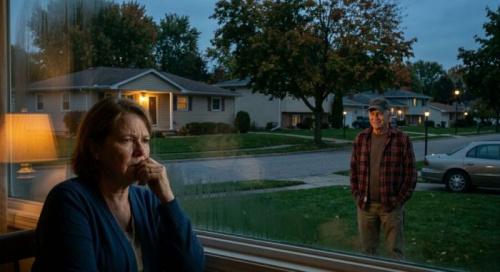
I noticed he knew our routines better than I did. If we left for church at nine on Sunday, he'd be out sweeping his porch precisely at eight forty-five, always with a cheerful wave. If I mentioned in passing that Emma had a soccer game, he'd somehow be in the park that day, watching from the bleachers, always a few rows back.
"He's so supportive," Dana said once, when we spotted him at the field.
"He's everywhere," I muttered, but only to myself.
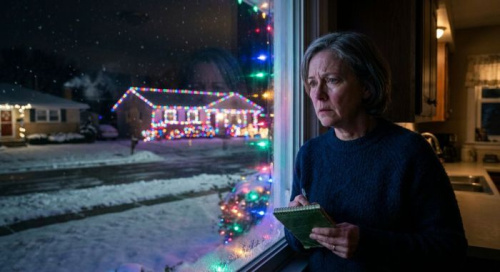
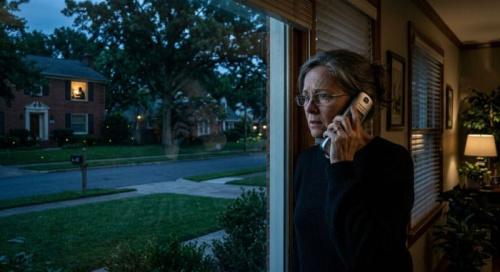
The real shift happened the night I couldn't sleep. It must have been two in the morning, and I was up getting a glass of water when I glanced out the kitchen window. Across the fence, a single light was on in Dale's basement. It was a small, steady glow, and through the window I could just make out his silhouette pacing back and forth, back and forth, like a caged animal.
I remember feeling a chill run up my spine. I told myself he was probably just an insomniac like me, restlessly wandering his own house. But something about the way he paced, the way he kept glancing toward my house, stayed with me.
The next day I did something I'm not proud of. I called my old friend Mary, who had lived on this street her whole life, and I asked her, in the most casual voice I could manage, what she knew about Dale.
Mary's voice got low, the way it does when someone is about to share a secret. "Oh, Rita, everyone knows about Dale's trouble," she said. "His wife Marianne didn't just die. She left him. Took out a restraining order and everything, about six months before she passed."
I gripped the phone. "A restraining order?"
"She said he wouldn't leave her alone," Mary said carefully. "That he got... possessive. That he'd gone through her things, followed her to work. The whole street knew, but nobody talked about it. He was so good at being charming, you know? Nobody wanted to believe it."
I hung up feeling cold all over. The mental picture I'd built of the sweet old widower next door had cracked right down the middle, and behind it was something I didn't want to look at.
But I didn't want to look. I buried it. I told myself that was a different man, a different time, that Dale had been nothing but wonderful to us.
Then came the night everything changed.
Dana and Emma were staying over for the weekend. We'd had a lovely dinner, and Emma had fallen asleep early in the guest room with her carved wooden bird clutched in her hand. Around midnight, I realized I'd left my reading glasses at the back of the yard, on the little table by the birdbath where I'd been sitting earlier.
I slipped out the back door in my housecoat, the porch light off so as not to wake Emma. The yard was dark and quiet, lit only by the moon and the soft glow from Dale's basement window.
That's when I heard it. A low scraping sound, coming from behind his garage.
I froze. The scraping continued, rhythmic, like something heavy being dragged across concrete. Curious and uneasy all at once, I crept to the fence and peered through the slats.
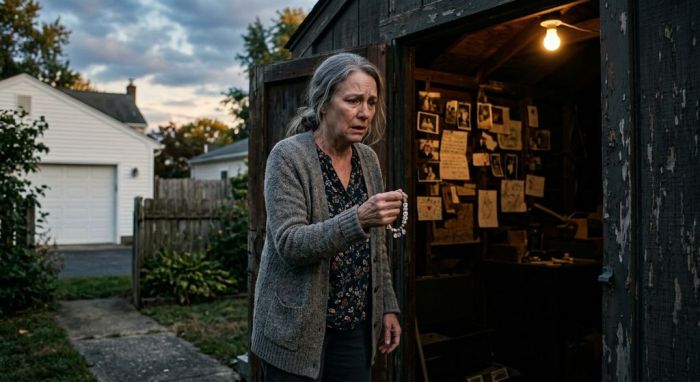
Dale was there, in the dark beside his garage, bent over the padlock on a small, squat shed I'd never really noticed before. It had always just been part of the scenery, an old tool shed. But now I saw him unlock it, push open the door, and step inside. The light he switched on was dim, but it was enough.
My breath caught in my throat.
On the walls of that little shed, tacked up in neat rows, were photographs. Photographs of my house. Photographs of my front porch. Photographs of Emma riding her bike down the street. Photographs of Dana getting out of her car. There were dozens of them, maybe hundreds, pinned up like a shrine, with little notes and dates written in the margins.
And there, on a small table in the center, was a collection of things I recognized. A red scrunchie Emma had lost at the park. A button that had come off Dana's coat. A page of the Sunday crossword I'd thrown away.
And a photograph of me, asleep in my chair by the window, taken through the glass at night.
I don't remember walking back to the house. I only remember that my legs were shaking and my heart was pounding so hard I could barely breathe. I locked every door, dead-bolted every lock, and stood for a long time with my back against the kitchen wall, staring at nothing.
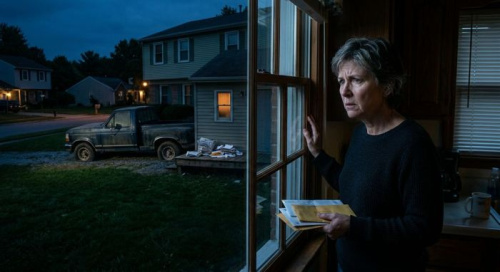
I didn't sleep that night. I crouched by the window of the guest room, watching Dale's house, and I was still there when dawn broke.
I knew I couldn't go to the police with just a creepy shed and a feeling. I needed proof, something concrete, something that would make them listen. But I also knew I couldn't let that man near my granddaughter for another single day.
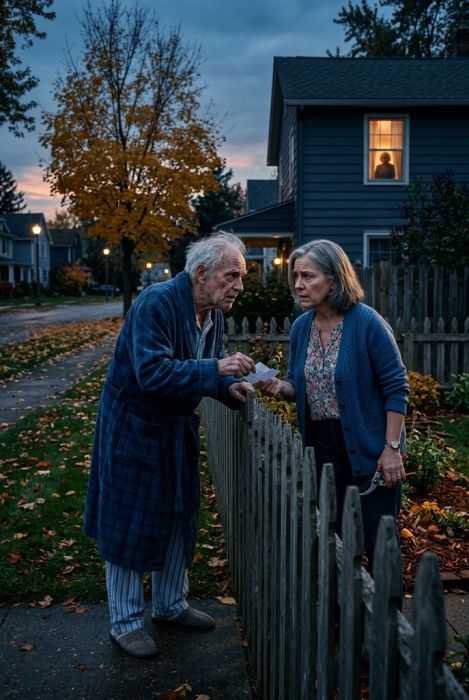
That's when I remembered Arthur, the retired detective who lived three houses down. He was a gruff, private man with a bad knee and a shaggy dog, and he kept to himself. But when I knocked on his door the next morning, my hands still shaking, he took one look at my face and ushered me inside without a word.
I told him everything. By the time I finished, Arthur had a pained, knowing look in his eyes.
"Marianne," he said softly. "I suspected something when she got that order. The way that man watched her, like she was his possession. I told myself it was grief, that it was her being dramatic. I've regretted my silence ever since."
He reached into his worn jacket and pulled out a small digital recorder. "I've kept an eye on him off and on over the years," he said. "And I've got a feeling you're not the first family he's fixated on."
Over the next week, Arthur helped me quietly gather everything. He knew people at the county courthouse, people who pulled old records without asking too many questions. And what he found made my blood run cold.
There had been two other families on this street in the past twenty years who'd had "unfortunate falling-outs" with Dale. Two other families who'd moved away suddenly, refusing to say why. In both cases, Dale had been the friendly, helpful neighbor who'd been the last to see them go.
And in both cases, there'd been reports of a prowler on the night they left.
We'd just finished putting the pieces together when Emma's bracelet disappeared. She'd come to me crying that morning, saying her favorite bracelet, the one with the little blue beads her daddy had given her, was gone from her nightstand.
I knew where it was. I'd seen the shrine.
That's when I made a decision. I couldn't wait another day. I called Detective Harper, the officer Arthur vouched for, and I told him everything. He listened, and this time, because of Arthur's standing and the records we'd found, he believed me.
On the night of the next full moon, Dale left for his weekly card game at the VFW. The moment his car turned the corner, Arthur and I crossed the fence. Arthur had gotten a copy of Dale's key from a friend at the hardware store who'd made a duplicate years ago, "just in case," and he used it on the shed's padlock.
Inside, it was worse than I'd imagined. The photos covered every wall. The keepsakes filled the shelves. And in the center, in a lockbox that Arthur cracked open with a crowbar, were the journals.
Dozens of them, spanning decades. Page after page of obsessive notes about Marianne, about the families who'd left, about the routines of every woman and child who'd ever lived near him. And there, in the most recent pages, written in his neat, careful handwriting, was a plan.
A plan involving my house. My daughter. My granddaughter.
I stood there in the cold light of that little bulb, reading his words about my family, and I felt a nausea rise so strong I thought I might be sick. Arthur had to steady me.
"This is enough," he said firmly, closing the journal. "This is more than enough."
We called Detective Harper. He arrived with two squad cars, and the evidence we'd found filled several boxes.
When Dale came home that night, the street was lit up with patrol cars. He got out of his car and stood there, looking at the lights, at his open shed, at me standing in my doorway with my daughter and granddaughter safely behind me.
For a moment his face did something I'd never seen it do before. The charm, the warmth, that mask he'd worn for years, it all just collapsed. Underneath was something hollow and bitter, and for one brief, terrible second, his eyes locked on mine.
"After everything I did for you," he said.
Detective Harper read him his rights as they cuffed him. The neighbors came out onto their porches, their faces pale, talking in hushed voices. Nobody offered to help him. Nobody defended him. They'd all seen the shed by then, had peered inside at the shrine and understood, all at once, the truth they'd been too comfortable to see.
The trial, when it came, was swift. The journals, the photographs, the keepsakes, the prowler reports, the testimony of the families who'd finally come forward, it was all there, laid out in black and white. Dale was convicted on multiple counts of stalking and harassment, and given a sentence that meant he wouldn't be stepping foot on this street again for a very long time.
The house next door sold a few months later to a young couple with a golden retriever. They're lovely. They bake bread and wave hello and mind their own business.
And me? I sleep with my windows open again. Emma still wears her little blue bracelet, the one Detective Harper returned to her, though we had to get a new clasp for it. She's careful now, and so am I.
Arthur and I have coffee on my porch every Sunday morning. He says he learned a long time ago that the quiet ones are the ones you have to watch. And I've learned that a friendly smile can hide a lot — and that kindness, real kindness, never needs to be earned through fear.
I still think about that shed sometimes, about all those photographs on the wall, about how close I came to never knowing. Most of all, I think about how easily we trust the charming neighbor next door, how easily we wave and smile and never look too close.
That's the thing I want to leave you with. Watch the ones who give too much, who are always there, who know your routines better than you do. Because sometimes the sweetest neighbor on the street is hiding the darkest room, and it's better to open that door yourself — before someone opens it for you.