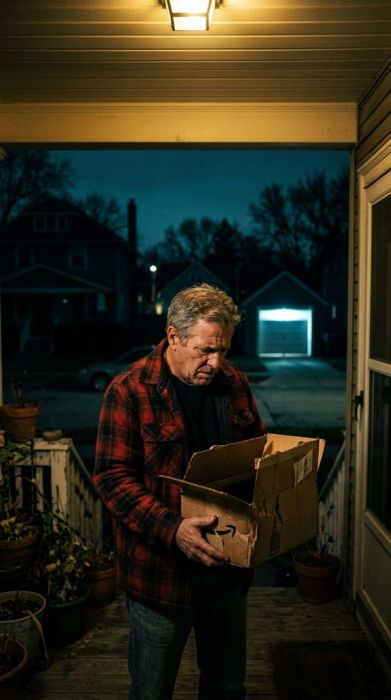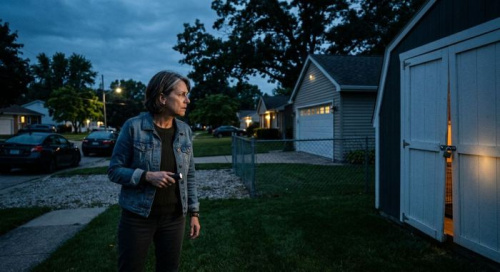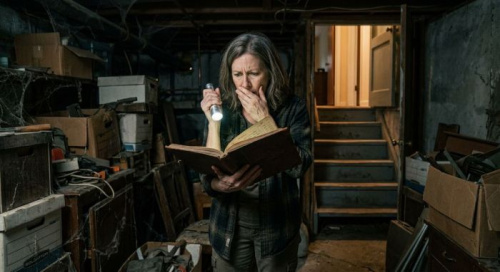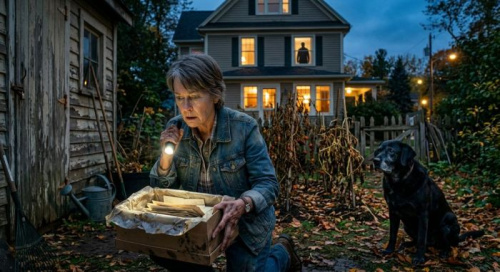
The first time I noticed something wrong, I didn't think much of it.
It was a Thursday night in late October, and the leaves had piled up against the curb like wet brown rubble. I was walking my dog, a fat golden retriever named Gus, past 14 Evergreen Court. The house belonged to a man named Paul Dornan.
Paul was the kind of neighbor everyone liked but no one really knew. He was in his late fifties, with silver hair and a soft voice that never rose above a polite murmur. He'd lived on Evergreen Court for about twelve years, according to the old-timers. He kept his lawn manicured, never played loud music, and always waved when you passed his driveway.
He worked from home — something in home security systems, he'd mentioned once at a block party. "I help people feel safe," he'd said with a modest shrug. Everyone nodded and smiled. It was a very American thing to say.
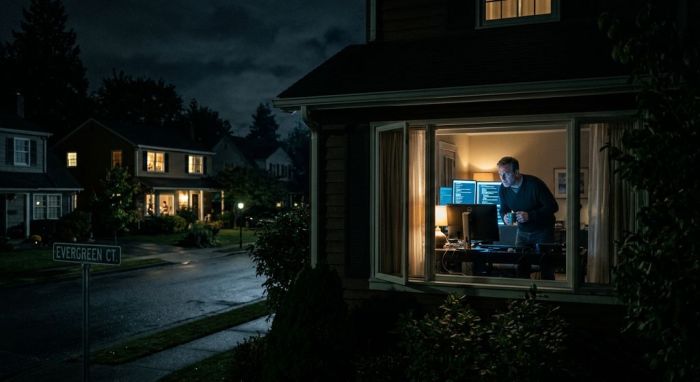
But that Thursday night, as Gus tugged me past his house, I noticed something that stopped me cold. All the lights in Paul's house were off — except for the basement. Through a narrow window at ground level, a faint blue glow flickered against the glass. It wasn't the steady light of a television. It was more like the restless pulse of multiple computer monitors.
And it was three o'clock in the morning.
I stood there for a moment, breath fogging in the cold air, and watched. Gus whined and pulled at the leash. I told myself it was nothing. Maybe Paul was a night owl. Maybe he was playing online chess. Maybe he had insomnia. There were a hundred innocent explanations.
But as I walked home, I couldn't shake the image of that blue light, flickering silently in the dark.
Over the next two weeks, I started noticing things I'd never noticed before. Small things. The kind of things you'd dismiss as coincidence if you weren't already paying attention.
Paul's company van — a white Ford Transit with "SafeGuard Home Security" printed on the side — was always parked in his driveway by 6 PM. But I'd see it leave again around 9, 10, sometimes 11 at night. He'd come back an hour later, always alone. I mentioned it to my wife, Diane, over dinner one night. She laughed. "Maybe he's got a girlfriend," she said. "Good for him."
But I wasn't convinced.
Then there was the mail. I work from home, so I'm often near the front window during the day. I noticed that Paul received an unusual number of packages — small, padded envelopes, the kind that could hold hard drives or memory cards. They came from different addresses, different states. No return labels. He always picked them up within minutes of delivery, as if he was waiting by the door.
I told myself to stop being ridiculous. Paul was a nice man. He'd helped Old Mrs. Kowalski install a Ring camera after her purse was snatched. He'd volunteered to teach a neighborhood watch seminar on home security. He was the guy who shoveled snow from the sidewalk of the elderly couple two doors down. He was a good neighbor.
But the more I watched, the more the small things added up.
One Saturday afternoon, I was in my backyard raking leaves when I heard voices from next door. Paul's backyard is separated from mine by a six-foot wooden fence, but the sound carried clearly in the crisp autumn air. He was talking to someone — a woman, by the sound of it. Her voice was strained, almost pleading.
"Please," she said. "I just want to know how you got those photos."
Paul's response was quiet, measured. I had to strain to hear it.
"I told you, Mrs. Delgado. Your home security system is my responsibility. I noticed some suspicious activity on your cameras and I wanted to make sure you were aware of it."
"That's not what I asked," the woman said, her voice rising. "I asked how you got photos of inside my bedroom."
There was a long pause. I held my breath, frozen mid-rake.
"Your cameras are very sensitive," Paul said finally. "Sometimes they pick up more than you'd expect. I'm just trying to help."
I heard the back gate open and close. Footsteps retreated. When I peered through a crack in the fence, I saw Paul standing alone in his yard, staring at his phone. He wasn't smiling.
That night, I couldn't sleep. I lay in bed staring at the ceiling, replaying the conversation in my head. Mrs. Delgado lived three houses down. She was a single mother with a teenage daughter. She'd had SafeGuard installed six months ago after a break-in on the next street over.
I got up and went to my home office. I opened my laptop and started searching for "SafeGuard Home Security reviews." Nothing unusual. A few complaints about customer service, but mostly positive ratings. Then I searched for "Paul Dornan Evergreen Court." Nothing came up except a property tax record. Clean. Normal.
I searched for "home security technician caught spying on customers." The results were alarming. Dozens of cases across the country — technicians who had installed hidden cameras, accessed customer feeds without permission, even stalked women using their own security systems. It was a dark corner of the industry that rarely made headlines.
I closed my laptop and told myself I was being paranoid. But the seed had been planted.
The next morning, as I watched Paul's van pull into his driveway at 7 AM, I noticed something I'd never seen before. The back doors were open for just a moment as he unloaded equipment. Inside, I saw a rack of electronics — modems, routers, a small server, and what looked like a radio frequency scanner. It was more equipment than any home security installer would ever need for routine service calls.
I started keeping a log. It sounds obsessive now, but at the time it felt necessary. I noted every visitor to Paul's house. I noted the times his van came and went. I noted the packages. I noted the complaints I overheard from other neighbors — people who had suddenly started receiving strange emails, who found their social media accounts compromised, who felt like someone was watching them through their own devices.
One neighbor, a retired schoolteacher named Helen, told me at the mailboxes that she'd found a tiny camera hidden inside a smoke detector in her hallway. She'd assumed it was left behind by the previous owner. But she'd had SafeGuard install her system two years ago. Paul himself had done the installation.
"She seemed shook up," Paul said when I casually mentioned it to him over the fence. "I told her it was probably nothing. Just a defective unit."
He smiled his easy smile. "Some people get paranoid in their old age."
I nodded and went inside. But I couldn't stop thinking about the cameras in Helen's smoke detector.
The night everything changed was November 6th. I remember the date because it was the day before my wedding anniversary. I was driving home from a late client meeting, and the neighborhood was dark and silent. As I passed 14 Evergreen Court, I noticed something different. The basement window was open just a crack. Not wide enough for anyone to notice unless they were looking.
I pulled over and killed my headlights.
Through that narrow opening, I heard a voice. A woman's voice. It was trembling, desperate. And it was coming from a speaker.
"Please, I'll do anything," the recording said. "Just don't send those pictures to my husband. He'll leave me. The kids will hate me."
My blood turned cold.
I sat in my car for a long moment, my hands gripping the steering wheel. Then I reached for my phone and called the police.
Two squad cars arrived within fifteen minutes. I watched from my car as officers knocked on Paul's door. He answered in his bathrobe, looking confused and concerned. The perfect image of a wrongfully accused man.
They talked for a few minutes. Then one of the officers turned and looked directly at my car.
I got out and walked over. I explained what I'd heard — the voice, the plea for mercy, the reference to photos. Paul smiled patiently, shaking his head.
"I think there's been a misunderstanding," he said. "I was watching a crime documentary. The volume was up high. I'm sorry if it disturbed anyone."
The officers seemed satisfied. "Call us if you have any more concerns," one said to me, his tone suggesting I should stop wasting their time.
As they drove away, Paul turned to me. His face was still friendly. But his eyes had gone flat. Empty. Like a doll's eyes.
"You should be careful," he said quietly. "You never know who's watching."
He went inside and closed the door.
I didn't sleep that night. I didn't tell my wife what happened. I just sat in the dark living room, replaying that recording in my head. The terror in that woman's voice. The complete calm in Paul's eyes.
The next morning, I called the FBI.
Three weeks later, I sat in a federal courthouse and listened to the indictment. The prosecutor laid out a case that made my stomach turn.
Paul Dornan had been running a massive surveillance and blackmail operation from his basement for over seven years. He'd installed hidden cameras and backdoor remote access in over four hundred home security systems across three states. Every system he'd personally installed came with a secret backdoor that he could access from his basement server.
He had collected intimate footage, financial records, personal conversations, private emails — everything. He had used the information to blackmail victims, to manipulate public officials, and to build a network of influence that extended into local goverment, law enforcement, and even the judiciary.
In his basement, agents found a server room that rivaled a small tech company's data center. There were hard drives containing over 200 terabytes of recorded footage. There were notebooks filled with personal information on hundreds of victims — their fears, their secrets, their vulnerabilities, their darkest moments.
There was a wall covered in photographs, connected by red string. A web of power, control, and manipulation that Paul had been building for nearly a decade.
Mrs. Delgado was one of his victims. Helen the schoolteacher was another. The woman whose voice I heard begging — they found her file. She was a city councilwoman in a neighboring county. Paul had been blackmailing her for three years to approve zoning changes for properties he owned through shell companies.
Paul Dornan never apologized. He never explained. He sat in his chair, expressionless, as the judge read the sentence. Twenty-seven years in federal prison. No possibility of parole.
The house at 14 Evergreen Court has been sold twice since then. The new owners filled in the basement with fresh concrete. They painted the walls white. They planted rose bushes in the front yard. It looks beautiful now.
But sometimes, late at night, when I walk Gus past that house, I still see that blue glow in my mind. I still hear that woman's voice begging for mercy. I still feel the chill of Paul's empty eyes in the dark.
And I think about how easy it is to trust someone who seems so perfectly ordinary.
Paul Dornan didn't look like a monster. He looked like a neighbor. A friendly, helpful, harmless neighbor who offered to install your security cameras and make you feel safe.
That's exactly what he was counting on.
The next time a security technician lingers a little too long in your hallway, the next time a neighbor seems a little too interested in your daily routine, the next time someone offers to make you feel safer than you already are — trust your instinct.
The quietest people are often hiding the loudest secrets.
And sometimes, the man who offers to keep you safe is the one you should fear the most.