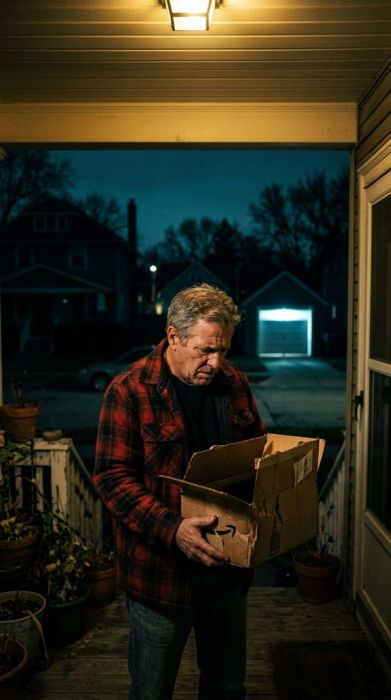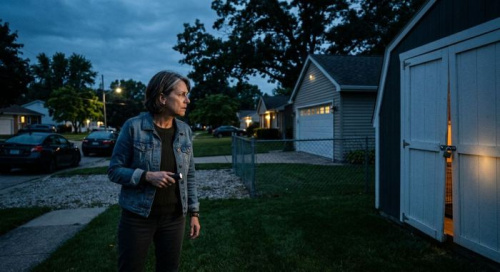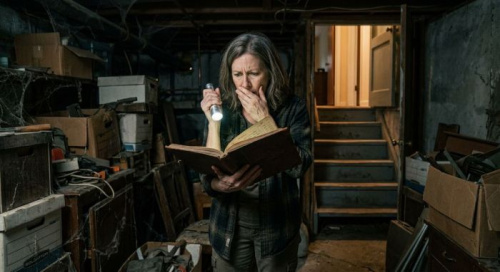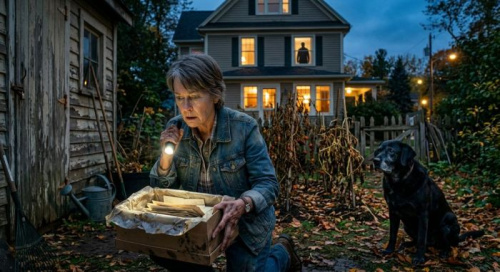
When my wife and I moved into the house at 9 Cedar Lane, we thought we'd finally made it. After twenty-three years of renting in the city, we'd scraped together enough for a down payment on a modest three-bedroom in a neighborhood where people still gave out Halloween candy and left their garage doors open on Saturday afternoons.
Cedar Lane was exactly the kind of street where nothing ever happened. Kids rode their bikes past manicured lawns. Retired couples walked their golden retrievers in the early evening. The mailman knew everyone by name. It was the American dream, shrink-wrapped and delivered.
Our next-door neighbor at number 11 was the first person to greet us. He came waddling across his lawn on a humid Tuesday afternoon, carrying a foil-covered plate in both hands. He was in his early seventies, wearing a cardigan despite the heat, with thin gray hair combed neatly across his scalp and a smile that seemed permanently stitched onto his face.
"Welcome to Cedar Lane," he said, his voice soft and warm. "I'm Harold. I've been here since 1983. These are my wife's chocolate chip cookies. Well, my recipe now. She left a long time ago."
I took the plate. The cookies were still warm.
"Thank you, Harold. That's incredibly kind."
"That's just how we do things here," he said, nodding toward the street. "We look out for each other. If you ever need anything — a tool, a ride, someone to watch your mail — you knock on my door. Day or night."
My wife Karen smiled and thanked him too. Later that night, we ate the cookies in bed and agreed that we'd somehow landed in the friendliest street in America.
That should have been the first warning.
Looking back, I think that's what made everything so difficult to accept. Harold wasn't just polite. He was aggressively helpful. He mowed Mrs. Patterson's lawn at number 15 when her arthritis flared up. He shoveled snow from everyone's driveways without being asked. He remembered birthdays, anniversaries, and the names of grandchildren he'd never met.
If you needed an egg, Harold had one. If your car wouldn't start, Harold would be there with jumper cables before you hung up the phone. He was the unofficial mayor of Cedar Lane, beloved by everyone.
And I genuinely liked him. That's the part that still keeps me up at night.
The First Sign
The first thing I noticed was the smell. It was July, about six weeks after we'd moved in. The heat that summer was brutal — the kind of heat that makes the asphalt shimmer and the air feel thick as soup. We had the windows open one night because our AC couldn't keep up, and around two in the morning, a wave of something foul drifted through the screen.
I sat up in bed. Karen was asleep beside me.
It smelled like death. Not garbage. Not sewage. Something deeper and more organic. The smell of something that had been dead for a long time.
I got up and walked to the window. The smell was coming from outside, drifting from the direction of Harold's house. I stared at number 11 for a long moment. All the lights were off. The house sat there like every other house on the street, quiet and unassuming.
I told myself it was probably a dead raccoon. Maybe a possum. It happens in the suburbs. I closed the window and went back to bed.
But the smell came back. Not every night, but often enough that I started to notice a pattern. It was always on hot nights. Always from Harold's direction. And it was always strongest around the back of his property, near the detached garage at the end of his driveway.
One Saturday morning in August, I was trimming the hedge that separated our yards when Harold came out to water his flowers. We chatted for a while, and then I decided to ask.
"Hey, Harold, have you noticed a weird smell around here at night? Kind of like something died?"
His face didn't change, but his eyes flickered. Just for a fraction of a second.
"Oh, that," he said, waving his hand. "It's the drainage ditch behind the property line. The city's had issues with it for years. When it gets hot, the water stagnates. Smells like rotten eggs sometimes."
It was a perfectly reasonable explanation. I nodded and went back to my hedge trimming.
But the smell wasn't stagnant water. I knew the difference. I'd grown up on a farm, and I knew exactly what rotting flesh smelled like.
The Routine
The second thing I noticed was Harold's schedule. He was retired, which meant he was home most of the time. But he had a peculiar routine. Every Tuesday and Thursday evening, without fail, he would back his old Buick out of the garage and drive away for exactly three hours. He'd return at 9:47 PM. I know because I checked.
And every time he came back, he would go straight to the garage. Not the house. The garage.
He would stay in there for about twenty minutes, and then he'd walk across the lawn and enter his house through the back door. I could see the kitchen light flick on, then off, about ten minutes later.
One Thursday night, curiosity got the better of me. I was taking out the trash, and I made sure to walk past the side of Harold's garage. The door was closed, but there was a small window near the top, covered in grime so thick I couldn't see through it.
But I could hear something. A humming sound. Like a motor running.
I pressed my ear against the cold concrete wall of the garage, and that's when I realized what the humming was. A freezer. A big one.
People have freezers in their garages all the time. Harold probably had a side of beef in there, or frozen vegetables from his garden. It was perfectly normal.
But why did he always go straight to the freezer when he came home? And why did he lock the garage door? I'd never seen him lock it during the day, but at night, the padlock was always on.
The Missing Woman
The missing person's flyer went up on the community board at the end of the street in early September. A woman named Diane. Thirty-seven years old. Last seen leaving her apartment complex about three miles from Cedar Lane two weeks ago. She was wearing a blue jacket. She had a birthmark on her left cheek. If you had any information, please call this number.
I didn't think much of it at first. People go missing in America every day. It's tragic, but it's not unusual.
But then I noticed Harold's reaction when I mentioned it. We were standing by our mailboxes, and I pointed to the flyer. "Terrible, isn't it? They still haven't found her."
Harold glanced at the flyer. Just a glance. And then he smiled his warm smile and said, "These things usually turn out fine. She probably just needed some time away."
It was such a normal, comforting thing to say. But there was something about the way he'd avoided looking at the picture. Something in the way his hand tightened just slightly on his mail.
That night, the smell was stronger than ever.
The Camera
The third thing happened in October. I'd bought a new security camera for our front door, one of those Ring-style cameras that sends alerts to your phone. I installed it on a Saturday morning and pointed it toward our driveway and front walk.
That night, around 11 PM, my phone buzzed with a motion alert.
I opened the app and watched the footage.
Harold was standing at the end of our driveway, staring at the camera.
He stood there for almost four minutes, completely still, his hands at his sides. The only light came from the streetlamp above him, casting his face in harsh shadows. He wasn't smiling.
Then he turned and walked back to his house.
The next morning, he waved at me as if nothing had happened. "Good morning, Dan! Beautiful day, isn't it?"
"Hey, Harold. I saw you on my camera last night. Everything okay?"
He blinked. "Oh, yes. I just thought I heard a noise. Probably a raccoon. Sorry if I set off your alarm."
Another perfectly reasonable explanation.
But I checked my camera again that night, and I noticed something I hadn't seen before. In the corner of the frame, barely visible in the darkness, the door to Harold's garage was open. Just a crack.
And there was a foot sticking out.
A bare foot, pale in the dim light, visible for just a moment before the door swung shut.
I rewatched the footage seven times. Each time, I told myself I was seeing things. The resolution wasn't great. It could have been a shadow, or a trick of the light.
But I knew what I saw.
The Police Visit
I called the police the next morning. Not with accusations. I wasn't that brave, or that certain. I told them I was concerned about my elderly neighbor, that I'd noticed some unusual activity, and that I'd smelled something foul coming from his property. I mentioned the missing woman from the flyer.
The officer on the phone was patient. He took down my information. He said they'd look into it.
Three days passed. Nothing happened.
Then, on the fourth day, I saw two police cruisers parked in front of Harold's house. I watched from my living room window as an officer knocked on his door. Harold answered, smiling as always. They spoke for about ten minutes. The officer wrote something in a notebook. Harold nodded along.
And then they left.
That was it. No search warrant. No investigation. Just a conversation with a friendly old man who charmed his way through it.
The officer came by my house afterward. He said they'd checked everything out. Harold was a respected member of the community. He'd explained that the smell was from the drainage ditch, just as he'd told me. He'd even offered to show them around his property.
"Mr. Patterson," the officer said, not unkindly, "I think you might be a little over-anxious. Moving to a new neighborhood can be stressful. But Harold's lived here for forty years without a single complaint."
I wanted to scream. I wanted to tell him about the foot I'd seen on the camera. But I knew how it would sound.
The Garage
That night, something snapped in me. I couldn't let it go. I couldn't sleep. I sat at my kitchen table, staring at Harold's house through the window, watching the dark shape of his garage in the moonlight.
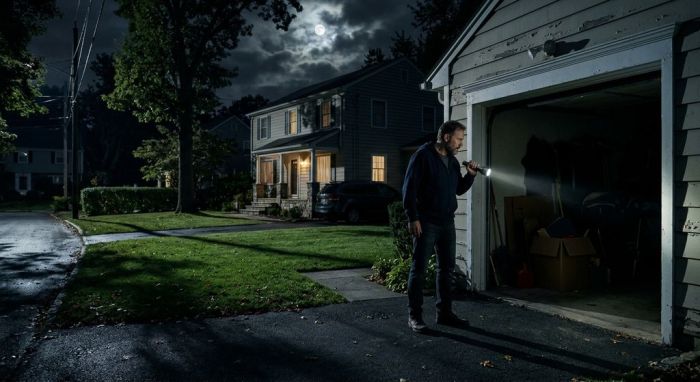
At 2 AM, I made a decision.
I put on dark clothes and a pair of boots. I left Karen a note saying I'd be back soon. And I walked across the lawn to Harold's property.
The padlock on the garage door was old. Cheap. It took me less than thirty seconds to break it with a crowbar from my own shed.
The door slid up with a groan.
The smell hit me like a physical force.
I gagged and stumbled backward, my eyes watering. It was the smell from those hot summer nights, concentrated and decades old. The smell of rot and decay, of death stored in a confined space.
I pulled my shirt over my nose and stepped inside.
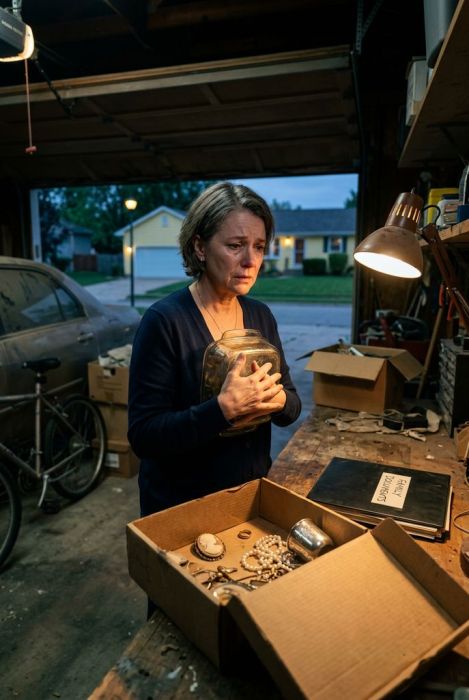
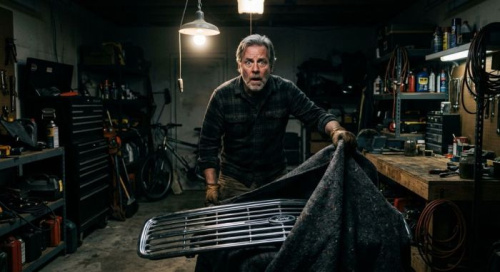
The garage was clean. Spotless, actually. Tools hung neatly on pegboards. The floor was swept. And in the corner, just as I'd suspected, stood an industrial-sized freezer. The kind they use in morgues.
I walked toward it, my heart pounding so hard I could feel it in my throat.
I opened the lid.
The light inside flickered on, illuminating the contents.
There were packages wrapped in white butcher paper, neatly stacked like frozen meat. I counted twelve of them. Each one was labeled with a woman's name and a date, written in careful block letters.
Diane. October 2024. That was the top package.
The woman from the flyer.
My legs gave out. I fell to my knees on the concrete floor, gasping for air that tasted like death.
And that's when I heard footsteps behind me.
"Dan?"
Harold's voice. Soft. Curious. The voice of a concerned neighbor.
"Dan, are you all right? I saw the garage door open."
I turned around. He was standing in the doorway, still wearing his cardigan, holding a flashlight that he pointed directly at my face.
And he was still smiling.
"You should have just asked for the cookies, Dan," he said. "I would have given you the cookies."
Aftermath
The police found remains belonging to seven women inside Harold's freezer. Three more sets of remains were buried beneath the concrete floor of his garage, wrapped in the same butcher paper, labeled with the same neat handwriting.
The earliest label was dated 1994.
Harold had been killing for thirty years.
He targeted women who reminded him of his mother, who had abandoned his family when he was eight years old. Every Tuesday and Thursday evening, he would drive to different parts of the city, find a woman who fit his twisted criteria, and charm his way into gaining her trust. And every time, he brought them back to Cedar Lane, walked them through his garage, and killed them.
The neighbors were interviewed. One by one, they came forward with the same story.
"He was so nice."
"He helped me with my lawn."
"He brought me cookies when I was sick."
Harold never confessed. He never showed remorse. At his trial, he sat in the courtroom with the same gentle smile he'd worn for forty years, nodding politely as the judge read the verdict.
Guilty on all counts. Life in prison without parole.
But I still live at 9 Cedar Lane. And every night, when I walk past number 11, I remember the cookies. I remember the warmth of his voice. I remember all the neighbors saying he was the kindest man on the street.
The house at 11 Cedar Lane is still empty. No one wants to buy it.
Some things you never unsee. Some smells you never forget.