The first time Karen Bishop noticed something wrong, she almost dismissed it as a trick of the light.
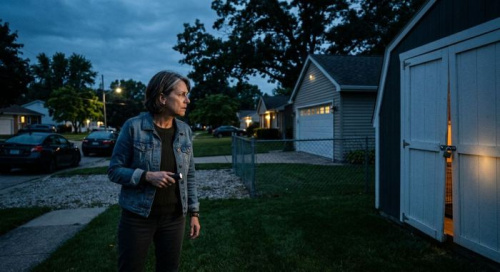
It was a Tuesday evening in late September, and she was sitting on her front porch with a glass of iced tea, watching Hemlock Street settle into its usual suburban quiet. The kind of quiet that real estate agents describe as "peaceful" and "family-friendly." Across the street, Edward Crane was walking a young woman to his car. She was maybe twenty-three, with dark curly hair and a nervous way of holding her arms wrapped around herself, like she was cold even though the evening was warm. Edward opened the passenger door for her, said something Karen couldn't hear, and the woman got in without looking back.
What bothered Karen wasn't the woman herself. It was that two months earlier, Edward had introduced a different young woman as his niece. That one had been blonde, athletic, with a confident stride. This one was not that one.
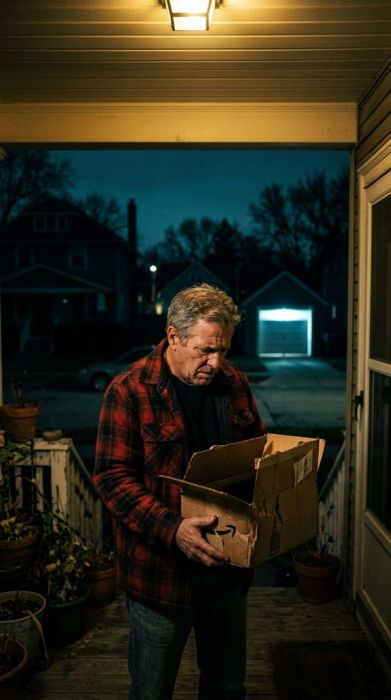
Karen told herself she was being ridiculous. Nieces visit. People have multiple nieces. Edward was a retired accountant, sixty-four years old, a man who kept his lawn immaculate and his opinions to himself. He'd lived on Hemlock Street for twenty-two years. He was the neighbor who brought over a casserole when Karen's husband died three years ago. He was the one who fed her cat when she visited her sister in Phoenix. Everyone on the block trusted Edward Crane.
Everyone on the block, Karen began to realize, had never really looked.
The next time was Christmas. Karen had invited a few neighbors over for mulled wine and cheese, a small gathering of the people she knew best on the street. Edward came alone, as always, carrying a bottle of wine and wearing a sweater his wife had knitted before she passed away six years earlier. He was gracious, as always, complimenting Karen's decorations and asking about her son in Seattle.
"So how's your niece?" Karen asked, keeping her voice casual. "The one who visited in September?"
Edward's face remained pleasant, but something flickered behind his eyes. A hesitation so brief that if Karen hadn't been watching for it, she would have missed it entirely. "She's fine. Back at school. You know how these kids are."
"Which school does she go to?"
"State college. Upstate."
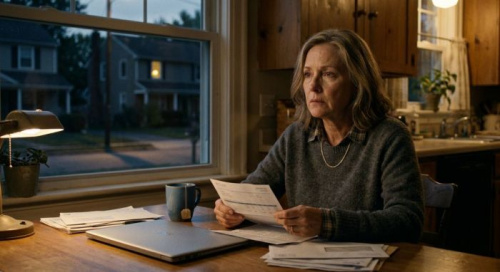
Karen nodded as if that answered everything. But she noticed he hadn't said which state college. And she noticed he changed the subject quickly, steering the conversation toward the new snow removal service the HOA was considering. Later that night, after the guests had gone, Karen stood at her kitchen window and looked across the street at Edward's house. The lights were on in the living room, but the curtains were drawn tight. She'd never seen inside that house. Not once in three years of living across the street. Edward always received visitors on the porch, walked them to their cars, never invited anyone past the front door.
She told herself it was just how some people were. Private. Old-fashioned. Her late husband had been the same way. But old-fashioned people didn't introduce different young women as the same niece.
Karen began to pay attention. Not stalking, she told herself. Just noticing.
She noticed that Edward's trash was always double-bagged, tied with a specific knot she'd never seen anyone else use. She noticed that he bought heavy-duty cleaning supplies from the industrial supply store on Route 9, not the supermarket like everyone else. She noticed that he had a basement window she'd never seen open, and that a faint, chemical smell sometimes drifted from his backyard vents late at night. She noticed that he never accepted dinner invitations. He never hosted. He never let anyone inside.
She mentioned it to her friend Linda, who lived three houses down. They were having coffee on Linda's patio, and Karen brought up Edward casually, as if she was just making conversation.
"Edward Crane?" Linda laughed. "He's harmless. He's the one who shovels Mrs. Patterson's driveway every winter. He's a saint."
"He has a lot of visitors," Karen said carefully. "Young women. He says they're his niece."
"Maybe he does. Some people have big families. What are you getting at, Karen?"
Karen didn't know what she was getting at. That was the problem. She had nothing but a vague unease, a sense that something was wrong, a feeling that Edward Crane's polite smile was a mask held carefully in place. "Nothing," she said. "I'm probably just bored."
But she wasn't bored. She was afraid, and she didn't know why.
April brought a warm spell, and Karen started sleeping with her windows open again. That was how she heard the crying.
It was a Thursday night, almost midnight. She was half-asleep, the room washed in pale moonlight, when she heard it: a muffled, desperate sound, like someone sobbing into a pillow. It was coming from across the street. She sat up in bed, her heart pounding. The sound faded, then came again, clearer this time. A woman's voice. Pleading. The words were indistinct, but the tone was unmistakable. It was the sound of someone begging for something they knew they wouldn't get.
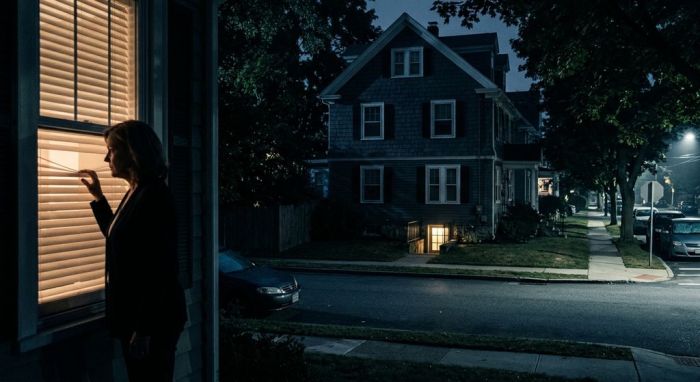
Karen got out of bed and walked to her window. Edward's house was dark except for a single light in the basement, visible through the narrow window well. The crying stopped. Then she heard a door slam. She stood there for a long time, her hands gripping the windowsill, her knuckles white. She thought about calling the police. But what would she say? My neighbor has a crying woman in his house? That wasn't a crime. She had no evidence. She had nothing but a feeling and a sound she couldn't prove.
The next morning, she saw Edward watering his petunias. He waved at her, his face cheerful and open, the picture of a contented retiree. She waved back. "Beautiful morning," he called. "Beautiful," she agreed. She looked at his basement windows. The chemical smell was there again, faint but unmistakable.
The breaking point came in May.
Karen was driving home from the grocery store when she saw a young woman standing on Edward's porch. She was maybe twenty-five, with reddish-brown hair pulled back in a ponytail. She was arguing with Edward, her voice low but urgent. Karen couldn't hear the words, but she could read the body language. The woman was afraid. Her shoulders were hunched, her hands were shaking, her feet were pointed toward the street. Edward was calm, controlled, his gestures placating, his posture relaxed. He looked like a man talking down a frightened animal.
Then the woman tried to run.
She made it three steps down the driveway before Edward caught her arm. His grip was firm, not violent, but there was something in the way he held her that made Karen's blood run cold. It wasn't anger. It was possession. The woman's face crumpled. She stopped resisting. She let Edward guide her back inside like a child being led to her room.
Karen sat in her car, her hands shaking on the steering wheel. She watched the front door close. She watched the curtains draw shut. She called the police.
Two officers arrived an hour later. Karen watched from her living room as they knocked on Edward's door. He answered with his usual polite smile, wearing a cardigan, looking every bit the harmless retiree. They talked for a few minutes. Edward nodded. He gestured inside. The officers went in. They came out twenty minutes later. One of them walked across the street to Karen's house.
"Ma'am, we spoke to Mr. Crane. His niece is visiting. She's a bit shy, that's all. She confirmed she's his niece."
"Did you see her?" Karen asked.
"Yes, ma'am. She seemed fine."
"Did you see her ID? Did you check if she had any bruises?"
The officer's expression hardened slightly. "Ma'am, we can't just search a man's house because his niece doesn't want to talk to him. Unless you have something more concrete..."
Karen didn't have anything more concrete. She thanked them and closed the door. That night, she didn't sleep. She sat in her darkened living room, watching Edward's house, waiting for something she couldn't name.
Three days later, a woman's body was found in a drainage ditch fourteen miles outside of town.
She was in her mid-twenties, with reddish-brown hair. She had been strangled. The police had no suspects. Karen saw the news report at 11 PM. She stared at the screen, her mind racing. The woman from the porch. The woman who tried to run. The woman Edward had pulled back inside. She called the police again. This time, she didn't take no for an answer.
The search warrant was executed at 6 AM on a Saturday morning. Karen watched from her window as a tactical unit swarmed Edward's house. She heard the door break open. She heard shouting. She heard Edward's voice, calm and controlled even then, asking what this was all about. The basement was the last place they searched. It was hidden behind a false wall in the laundry room, accessible only by a code-locked door. Inside, they found a room that had been soundproofed with industrial foam. There was a bed, a bathroom, a computer station, and a locked cabinet containing multiple sets of identification documents.
There were also two women. One was the woman Karen had seen on the porch, alive but terrified. The other had been dead for approximately three days.
Edward Crane had been running a human trafficking operation from his quiet suburban home for over a decade. The "nieces" were women he had recruited online with promises of legitimate work, then held captive in his basement until they could be transported to buyers across state lines. He had been methodical, careful, and so utterly ordinary that no one in the neighborhood had ever suspected a thing. In his computer, investigators found records of over forty women who had passed through his basement. Some had been transported. Some had been killed.
Edward Crane was convicted on thirty-seven counts, including kidnapping, human trafficking, and first-degree murder. He is currently serving life without parole at a federal penitentiary in Pennsylvania. The two women found in his basement were rescued and placed in a witness protection program. Their names have not been released.
Karen still lives on Hemlock Street. She still watches the houses around her. She still notices things. She still trusts her gut. The case changed her in ways she didn't expect. She became a volunteer with a local organization that trains civilians to recognize the signs of human trafficking. She speaks at community events about the importance of paying attention to the quiet details that don't add up. She no longer believes that the quietest house on the street is always the safest. Sometimes, she says, the quietest houses are the ones hiding the loudest screams. And the most dangerous predator is the one who looks exactly like everyone else.