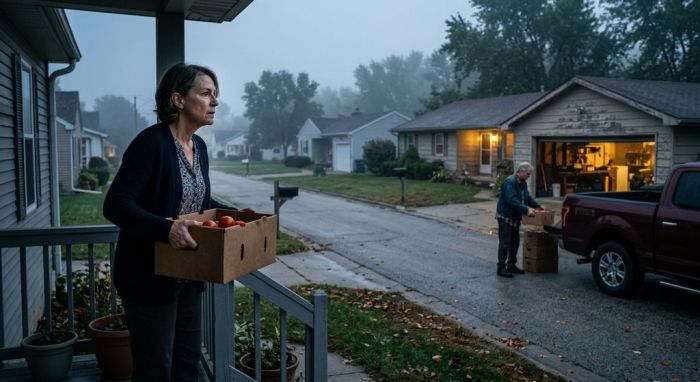
The morning the DEA rolled up Maple Hollow Court with their guns drawn, I was standing on my own porch holding a half-empty crate of tomatoes I was never going to sell. For about thirty seconds, while they came up the Mercers' driveway, I felt sorry for Ruth Mercer. I honestly did. She had brought me a casserole when my Frank died, and she had stood beside me at the graveside when no one else knew what to say. Then I remembered the invoice. I remembered the way my grandson Noah described the sound the crates made, and the dead farm that was supposed to be growing our vegetables, and the sorriness dried up like dew on a hot driveway.
I have lived on Maple Hollow Court in Clearwater, Ohio, for thirty-one years. It is the kind of street where the same family has owned the blue house on the corner since 1972, where kids still sell lemonade from card tables, and where you can leave your recycling bin out an extra day and trust it will still be there. After Frank passed, the house felt too big for one woman, but I could not leave it. Too many memories lived in those walls. So I stayed, and I filled my days with part-time bookkeeping for Rolfe's Lumberyard and a vegetable garden I babied like a third child. I thought I knew every window on every house around me. I thought I knew the people in them. That was before the Mercers.
The Mercers moved in four years ago. Carl and Ruth, both in their late sixties, both retired from what Carl called "thirty-two years of honest assembly-line work" at a plant down near Middletown. They were friendly in the good, old-fashioned way — Ruth on the porch with coffee, Carl fixing a sprinkler head for a widow two doors down for free. Then, two summers back, they announced their big project. They were starting a little farm box operation, they said, right out of their garage. Fresh vegetables from a small family farm down near Milan, delivered every Saturday morning, cash only, first come first served. "We're not trying to get rich," Carl told me over the fence, smiling. "We just want to stay busy and feed our neighbors." And the street ate it up. By the third week, the Mercers had forty subscribers, and I was one of them.
Little things bothered me early, but I told myself I was just a suspicious old woman. Ruth claimed to spend her mornings in her garden, yet her hands were always smooth, never a speck of dirt under a nail. The "farm down near Milan" carried a post office box on its labels, and the township address I looked up one bored afternoon turned out to be a gravel lot behind a shuttered feed store. When I asked Ruth once how the tomatoes survived the trip, she laughed and said Carl had "a special crating method." I laughed along with her, because that is what you do on a street like ours. You do not accuse a neighbor who brings you casseroles. But I noticed the weekly pickup was always sold out by 7:30 in the morning, even in the season when real farm stands are drowning in zucchini. And it was always cash.
The real trouble started with Noah. My daughter Dana's boy, twelve years old, sharp as a tack and just starting to get tall — that age where he wants to be useful but does not yet know how much of the world he actually sees. He spent weekends with me, and on one of those weekends he helped Carl carry crates from the garage to the pickup truck while I weeded my beans. When Noah came in for lunch, he was quiet in the way that means he is working something out. "Grandma," he said finally, wiping ketchup off his chin, "those vegetable crates are really heavy. And they clank." I told him vegetables in jars clank, and he gave me a look that said he was not a baby anymore. "They clanked like glass," he insisted. "Like bottles. Lots and lots of bottles." I said Carl probably canned his own tomatoes. Noah shrugged and asked if he could have his allowance early. But he did not let it go, and neither, in the end, did I.
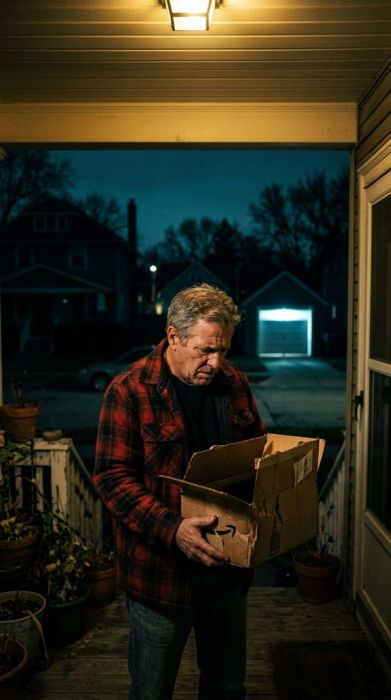
Two weeks later, on a Thursday, a delivery driver left a cardboard box on my porch by mistake — a Mercer's Meadow box, the same hand-stamped green script, but this one was heavy the way a full watermelon is heavy, and the corner had torn open. I carried it inside to run it next door, but I was raised to be curious the way other people are raised to be punctual, and I peeked. Under a nest of dry straw and three perfect tomatoes sat a manila envelope, water-stained, with a printed shipping manifest stapled to the front. It was addressed to a company in Youngstown with a name I did not recognize. The line for contents said "Hillside Grown Produce — 12 units." The line for total said "$4,300.00." No farmer I have ever known invoices twelve boxes of vegetables at four thousand dollars. My bookkeeper's brain, the same one that balances Rolfe's ledgers, quietly handed me a number and then started screaming.
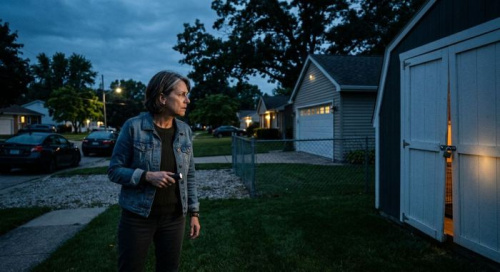
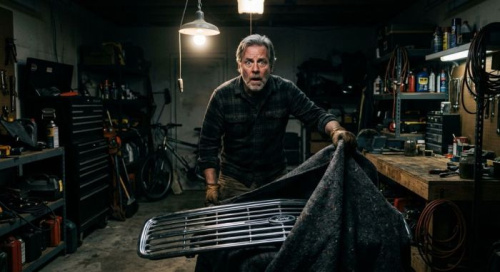
So I did the thing you are never supposed to do on a friendly street: I started paying attention on purpose. I watched from my kitchen window with my coffee. The maroon pickup with out-of-state plates began showing up at the Mercers' at six in the morning on Saturdays, always parked behind the garage, always with a driver who never got out, never waved, never once carried a box of tomatoes anywhere. Ruth started popping by my house at odd hours with questions that were not questions — "You still doing the books over at Rolfe's?" and "Do the trucks on our street park long, do you think?" — her eyes drifting to my windows every time she said it. Then came the afternoon I walked past their open garage door to return the misdelivered box, and I saw the so-called growing operation myself: no greenhouse, no hoop house, no potting bench, no soil anywhere. Just row after row of identical cardboard boxes stacked to the ceiling, and a drain in the middle of the concrete floor that made no sense at all for a garage on a hill.
I told myself I would give Ruth a chance. I cornered her gently at church supper, over the good macaroni and cheese, and asked how the farm was doing. "Blessed," she said, with a smile that did not reach her eyes. "Just blessed." I mentioned I had always wanted to see the farm, maybe drive out with Noah on a Saturday, pick peaches. That was the moment something behind her face went hard. "Oh, honey," she said, too sweet and twice as loud, "the farm is a mess right now, you wouldn't enjoy it." Two days later, my car would not start. The mechanic found a clean slice through a fuel line that he said he had never seen happen naturally, and he asked if I had had words with anyone lately. I laughed it off. But I checked my locks that night, and then I checked them again, and I slept with the kitchen light on.
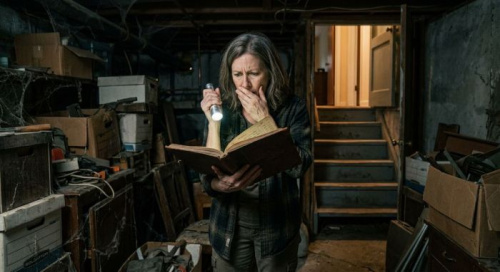
That is when I remembered Art Peck, two houses down, who lost his wife the same year I lost Frank and who had spent thirty years with the Ohio Bureau of Criminal Investigation before retiring. He was the man you went to when a raccoon got into your attic, because he would calmly climb up there and handle it. I brought him coffee and I told him everything — the invoice, the empty farm, the clanking crates, my wounded fuel line. Art listened with his hands folded, and when I finished, he did not laugh and he did not tell me I was being a silly old woman. He got up and locked his own door, which he had never done in all the years I had known him. Then he said something that turned my blood cold: "Maggie, that address in Milan? I have been looking at that same little post office box for six months. You are not the first person on this street to notice. Now let's find out what is really inside those boxes."
With Art's help, I stopped being a scared widow and became, for the first time in my life, a witness. I dug out my old camera and set it in the front bedroom window, angled down the drive. I wrote down license plates in a little spiral notebook I kept in my apron pocket, the way I used to keep grocery lists. And when Art introduced me to a task force agent named Corrigan, a woman with kind eyes and a no-nonsense handshake, I agreed to something that scared me worse than anything Carl or Ruth could ever do: I agreed to keep my subscription going, to keep my Saturday box coming, and to let them mark mine so they could follow it. I was not brave that month, not the way people are in movies. I was scared every single day. But I was angry, too — angrier than I had been since the day I buried Frank — and I held on to that.
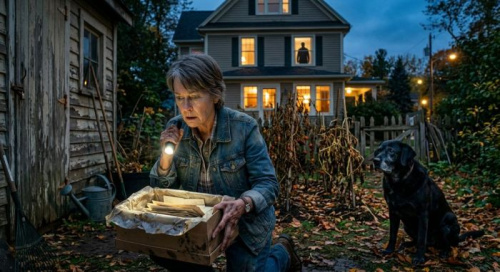
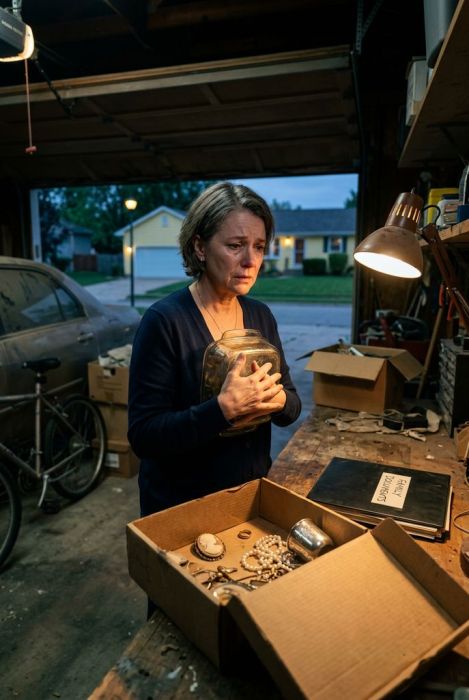
The Saturday before the raid, I got my box a day early, delivered by a nervous driver who looked at me like I had done something wrong. That box was heavier than it had any right to be, and when I opened it in the kitchen, under the squash and the straw, there was a bundle sealed in brown paper that I did not open and did not touch. Even a bookkeeper's daughter from Clearwater, Ohio, knows better than to handle a sealed bundle in a box that is supposed to hold green beans. I called Corrigan, and she told me to put it in a cupboard and not tell anyone, which I did, and which I have never told my neighbors to this day. Some things a good street does not need to know.
The next Saturday was pickup day. It was a beautiful Ohio morning, the kind that makes you believe in farmers markets and friendly streets, and by seven o'clock there were twenty cars lined up along the curb, neighbors with canvas bags and folded dollar bills, chatting like a party. I was on my porch with my own crate, pretending to sort tomatoes, when the whole street changed at once. Corrigan's people came up the driveway so quiet and so fast that for one second it looked like a church picnic gone sideways, and then the guns were out and orders were being shouted and Carl Mercer was on the ground beside his own maroon pickup, and Ruth was standing in the garage doorway with her hands going up before anyone even told her to. I saw the driver who never got out finally get out, in handcuffs. And I saw the look Ruth gave me across the lawn — a look with no shame in it, only calculation, the look of a woman already counting angles in her head.
What they found, when the news broke the next morning on the local paper's website, made the whole county sit down hard. The Mercers had never grown anything except suspicion. Their "farm" was the gravel lot behind the feed store, and their boxes had been carrying, in neat layers under the produce, cartons of pills and bundled cash for a distribution network that ran across three states. For two years, while we traded recipes at church dinners and waved at their truck, our neighbors had been using our good, trusting street as the loading dock for a business that ruined people's lives. The county was kind to me — I gave my statement twice, and Agent Corrigan personally called to thank me — but the kindness that mattered most came from the street itself.
There was a terrible, hush-voiced week, and then something unexpected happened. Instead of closing in on itself, the neighborhood opened up. Elaine from the blue corner house organized a meeting at the church hall, and for two hours we did the thing Americans do when they have been fooled — we talked about it. We talked about the signs we had ignored, the calls we had waved off, the way we had convinced ourselves that suspicion was rudeness. A genuine farmers market started at the church on Saturday mornings, run by the same families who had once stood in line at the Mercers' garage, and I am not ashamed to say I cried the first time I bought a tomato there and the girl handed it to me like it was precious. Because it was not a secret, not a shipment, not a crated lie. It was just a tomato. It was a normal thing, and it felt like a miracle.
Carl Mercer took a plea deal. Ruth followed a month later. I do not know where either of them is now, and I do not want to. What I know is this. In the six months since that Saturday, three families on Maple Hollow Court have put up motion lights, two of my neighbors now lock their garage doors from the inside, and Noah — my sharp, clank-hearing Noah — got the biggest cookie at the farmers market and a handshake from a woman whose name he will never know. The Mercers lost their house, their truck, their church pew, and every friend they ever made on this street. I lost a casserole and gained a neighborhood that finally understands that the safest streets are the ones where people pay attention.
I am still a widow in a house that is too big for me, and I still talk to Frank when I am out in the garden. But I sleep better now than I did in the whole year before. When my tomatoes come in, I knock on doors and hand them out, the way a neighbor on a good street does. And these days, when someone new brings me a casserole, I thank them with a smile — and I watch their hands.