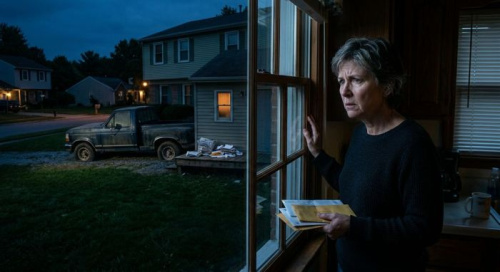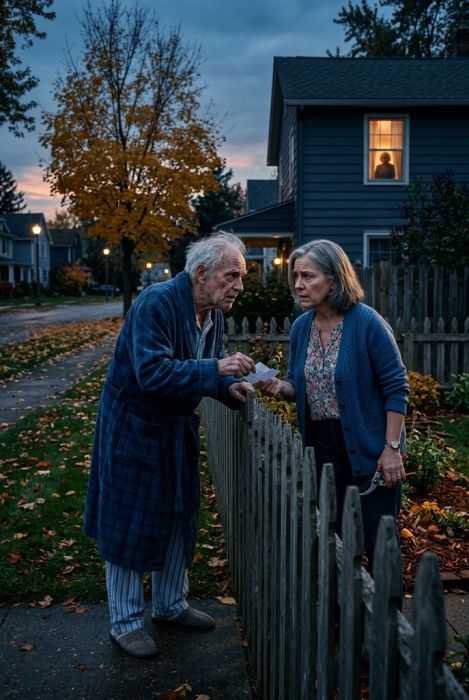
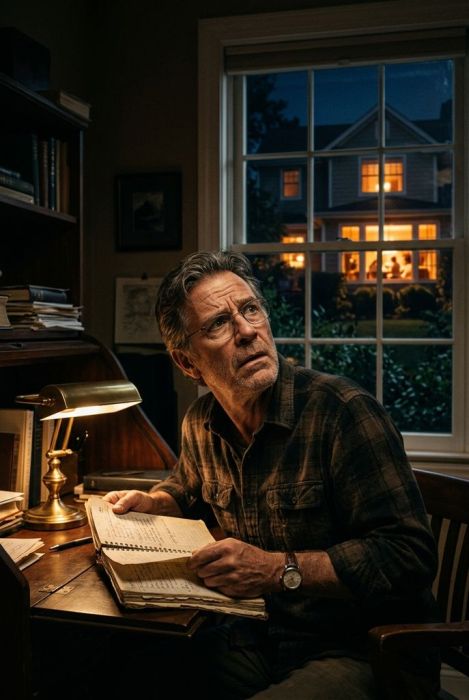
The first time I noticed something wrong, it wasn't a scream or a broken window. It was the quiet sound of my brother Eddie crying in his truck outside my house, at one in the morning, with the engine off and his forehead against the steering wheel.
I had lived on Wisteria Drive for twenty-two years, ever since my Margaret and I bought the little brick house with the peeling porch we patched ourselves. Our street was the kind of place where people waved from their driveways and left their keys in unlocked cars. The kind of place where nothing ever happened, and that was exactly the point.
The man next door was the reason that feeling had always held. Uncle Ray, everybody called him, though he wasn't anybody's uncle but the whole street's. Raymond Callahan, a retired veteran who had served two tours across the ocean and came home carrying the whole neighborhood on his shoulders. He trimmed the widow's hedge. He replaced Mrs. Bell's porch railing. He organized the block party every August and made sure the kids got ice cream.
And every Friday night, year round, Uncle Ray hosted what he called his charity poker nights.
It was innocent enough at first. A handful of men around his kitchen table with a pyramid of plastic chips and a bowl of pretzels. Uncle Ray always said the modest house kitty went to the veterans' fund, and nobody ever bothered to check. Why would they? He was the most trusted man on Wisteria Drive.
I never played. I'm a cautious man by nature, raised by a father who counted every nickel twice before letting it go. Maggie was gone three years now, cancer took her fast, and the house felt twice as empty for it. Eddie was the one who gravitated to Uncle Ray's game, my baby brother, ten years younger, soft-hearted and softer-willed, freshly divorced and drowning in a sadness he refused to name.
He started going to those poker nights around Christmas. I remember thinking it was good for him, that it got him out of his empty apartment and into warm rooms with friendly faces. The trouble began, the way most quiet trouble begins, with money.
Eddie had always been careless with it. But after a few weeks of Friday nights at Uncle Ray's, he started asking me to spot him. Fifty here, a hundred there, always with a sheepish promise to pay me back by the end of the week. The end of the week would come and go, and he'd ask me again.
I didn't push him. That's the part that sticks with me, that keeps me up. I love my brother more than almost anything, and I let my worry for him turn into silence, because pressing a grown man about money felt like something I had no right to do.
Then the evening his truck appeared outside my house, engine off, forehead resting on the steering wheel, everything I had let myself ignore came roaring back into focus. I tapped on his window. When he finally rolled it down, his eyes were red and he wouldn't look at me.
"I just need six hundred, Jim. Just until Thursday."
"You said you needed a hundred on Tuesday."
"Yeah. And I got it, and it's gone."
"Where does it go, Eddie?"
He finally looked at me, and that's when I knew I was in over my head. "I'm not in a good spot, Jim."
The truth, when he finally told it, was worse than I had built in my head. Those charity poker nights weren't the neighborhood's friendly little games. They had grown, quietly, into something that ate men. Real money changed hands. Markers were signed. Uncle Ray loaned men cash from a metal cashbox he kept in the basement, and he did it with the sunny smile of a man offering to help a friend move a sofa.
That first Friday Eddie won four hundred dollars, and he remembered it like a soldier remembers his first taste of clean air. It was the easiest money he had ever touched, and it felt like love. By his third visit, he had lost it all and borrowed more to chase it, and the chasing never stopped.
I wanted to be furious with Uncle Ray. I wanted to march over there and shake the truth out of him. But what I felt, standing there in the cold, was a slow, familiar dread. The kind you feel when you realize the floor you've been standing on your whole life has been hollow underneath.
"How much do you owe him, Eddie?"
He told me. Fourteen thousand dollars.
Fourteen thousand. A sum that for my brother might as well be the moon. He had signed a marker to Uncle Ray, a piece of paper that said if he couldn't pay, his house would be, and I don't need to tell you whose name was on it.
I told him we'd figure it out. I told him not to go to that house again, ever. He nodded and drove home, and I understood that I had crossed some invisible line into a country I did not know how to navigate.
I should have gone to the police that night. But life is rarely clean, and Uncle Ray had been the backbone of this street for decades. Nobody would take the word of a worried older brother over the word of a beloved veteran with a smart and a flag on his porch.
And Eddie, God love him, Eddie went back anyway.
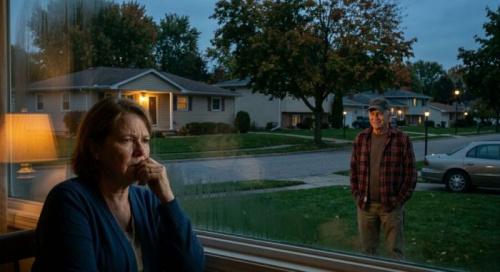
He swore he wouldn't. A week later, on a Tuesday night, I saw his truck parked in the shadows where Wisteria bends toward the old church, and I watched him slip into Uncle Ray's side yard like a boy sneaking somewhere he knew he shouldn't be.
I cornered him Sunday, outside Mass, in that awkward way families do when they're pretending not to talk about the thing they're all thinking about.
"I saw you at his house Tuesday, Eddie."
"It was the last time, I promise."
"That's what you said two weeks ago."
He rubbed his jaw. "Uncle Ray says I can work it off. I help him out a couple nights, and he knocks a hundred off the marker."
I didn't like that. I didn't like the practiced ease of a man repeating words that were handed to him. A retired veteran who ran poker nights didn't need my younger brother's help for anything. What he needed was a hold. Men are never more useful than when they think they're working their way free.
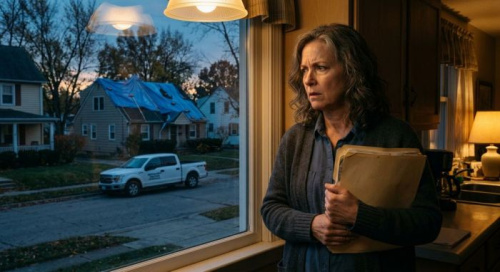
I went home that night and did something I had never done in my entire careful life. I opened my brother's file, the one full of canceled checks, and I wrote down every dollar I had handed him since the leaves turned. I laid it on the kitchen table beneath the light we used to eat dinner by, and I stared at it until I saw the shape of it.
Not a gambling problem, though it was that too. A pattern. The debts always landed on the working men, the tired ones, the ones with a house and a fragile marriage and a soft heart. And Uncle Ray always held their markers long enough for the interest to climb, then gently suggested they help out to work it off.
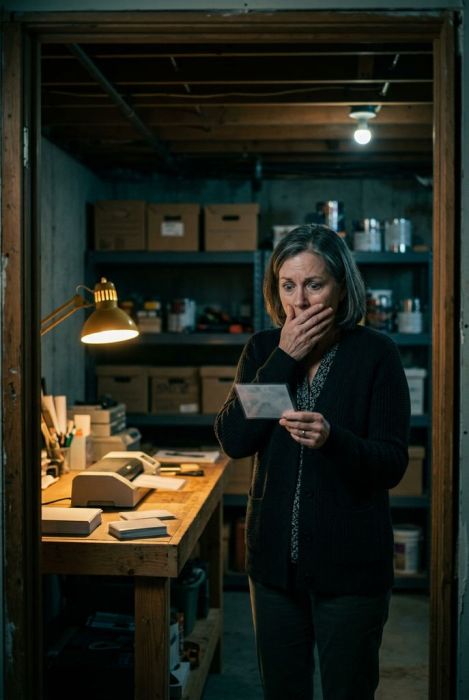
That was when I understood the ledger he kept in the basement said houses, not debts. I had read it once by accident, years ago, when I helped him haul an old furnace out through the cellar hatch, and I had let myself forget it because it was easier to forget than to ask questions about a man everybody loved.
It said Houses We Own.
I think that was the night I stopped being afraid of him, though I wasn't brave yet. I was just awake.
I didn't go to the police right away. I'm not proud of it. I went first to the only other man on Wisteria Drive who had ever made me uneasy in a useful way, a retired county detective named Frank Henson who lived two houses down and kept to himself. Frank had never once gone to Uncle Ray's poker nights, no matter how often he was invited, and I had always wondered why.
Frank listened to the whole thing without interrupting, the way a detective does. When I was done, he leaned back in his armchair a long moment.
"You know what he was calling it when he moved here? A retired veteran. He is a veteran. He also did eleven years in Nevada on a fraud and gambling sheet before he got his act together and moved to Ohio. Half the street knows him as a saint. The only records that remember the truth are in three different states and the federal system."
I sat very still. "You knew."
"I had my suspicions. You can't watch a man be that beloved without wondering what he's paying to hide. But I never had a reason to go looking, until a worried older brother with a folder showed up on my porch."
He told me we weren't going to beat Uncle Ray in a street fight, because Uncle Ray had been winning those for thirty years. What we were going to do was be smarter than his old racket expected anyone to be. Frank made a couple of quiet calls to a statewide gaming task force, and he gave me the name of an agent who had been waiting for exactly one thing: someone with enough nerve to say the name of the man running the game.
The plan asked very little of me, which was the whole point to a careful man. It only asked me to do what I had always done. Watch. Listen. Keep a record.
The trap was simple, and it was beautiful the way simple things are beautiful. Frank got word through the task force that a new player wanted in, a stranger with deep pockets and no ties to the street, someone Uncle Ray's greed would not be able to resist. Every Friday for a month, the whale sat at Uncle Ray's table and lost just the right amount, never too much, never too little, until Uncle Ray convinced himself the whale was a fool with money to burn. The task force recorded every marker signed, every loan, every whispered arrangement about who owed what and what they would give up if they couldn't pay.
And me? I did the one thing I had been doing wrong my whole life, except now I did it on purpose. I kept my mouth shut. I watched my brother stay home. I watched the light burn in Uncle Ray's basement late into the night, and I did not once let myself be dragged across that lawn, not even when he came to my door one evening with his eagle cap and that old, easy smile.
"Jim," he said, "you look tired. You and Eddie should come sit at my table Friday."
"Eddie's done with cards, Ray."
His smile didn't waver, but his eyes went somewhere else for half a second. "That's a shame. Tell him I've still got his marker, if he wants to work it off."
"Leave him alone, Ray."
"Jim, now, I'm only trying to help the boy."
The word boy did it. I saw, clear as anything, that he had never thought of Eddie as a person in his life. Eddie was a ledger entry with a beating heart. I smiled back at him, the way you smile at a man you are not ready to fight, and I said, "We'll see."
He brought me a plate of brownies the next day, the way he did for everyone, and I thanked him, and I thought about that marker sitting in his basement, and I did not eat a single one.
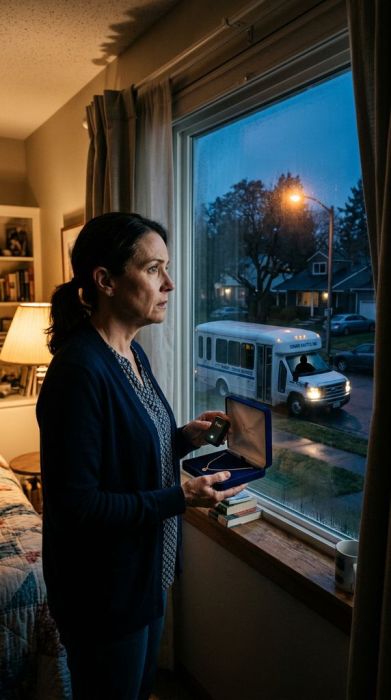
The raid came on a Thursday in March, before the sun was fully up. Frank stood on my porch with his hand on my shoulder and told me to watch from the window, that I had earned it, and that whatever happened next belonged to the law, not to me.
I watched the cars roll in without their lights, watched men in jackets climb Uncle Ray's porch, watched the knock that came before the door opened. I watched them lead Raymond Callahan out into the cold morning in handcuffs, his bald eagle cap left behind on the steps, his smile finally, finally gone.
The task force took the metal cashbox and the ledger that said Houses We Own. They took a filing cabinet full of markers with the names of men I'd known since before my Margaret died. They took the copies of deeds that had clearly been doctored, the payoff schedules, the threatening notes that had been mailed from a post office ten miles away so no one would trace them to the beloved man on Wisteria Drive.
Uncle Ray's criminal record, the one that had followed him quiet through three states, caught up with him all at once. It turns out you can only hide a fraud and gambling sheet for so long before a statewide task force gets a name and a whale and a reason.
Eddie cried again when it was over, but it was a different kind of crying, the clean kind. He cleared his debts through a legal settlement the task force arranged, since the markers were the proceeds of an illegal operation and worth about as much as the paper they were printed on. He stopped sitting in his truck with the engine off. He started sleeping through the night for the first time in a year.
The neighborhood changed after that. It had to. People were quieter at the mailboxes, and nobody had an uncle anymore. But something else happened, something I have to believe is real, because I saw it with my own careful eyes. People started paying attention. They started locking their doors, not out of fear of strangers, but out of a quiet, new wisdom. They started asking questions when a man was too generous to make sense.
As for me, I keep the photo of Margaret on my mantel, and I keep a single ledger entry I photocopied the day the task force laid it all out for me to see. It's the one with Eddie's name, and the address of the house he almost gave away, and it's the reason I sleep easier than I have in years.
A beloved neighbor can be the safest thing on your street. It takes remarkably little to learn which kind you're living next to. And if he ever asks you to come sign your name at his table, for charity, with a smile and a warm kitchen and a bowl of pretzels — I want you to walk away, and never look back, until you're standing in front of a man who doesn't keep a ledger that says houses.