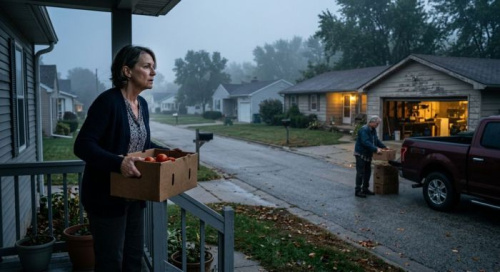
It started with a name the whole block had silently agreed never to say out loud. Chloe Mercer. For six months, everyone on Larkspur Lane told the same polite, rehearsed story: that the teenager next door had run away to live with some boy in another state, and that it was nobody's business but her parents'. They repeated it over glasses of sweet tea at the block party, as if the matter were closed.
I never believed a word of it.
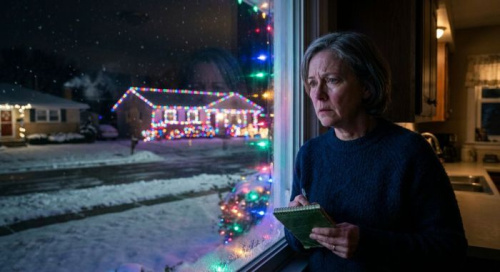
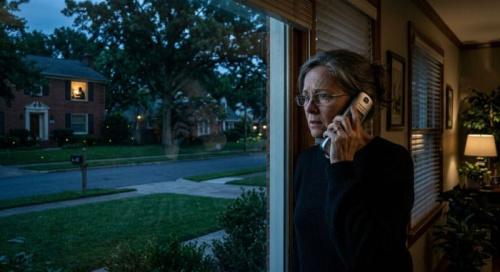
My name is Barbara Hart, and at fifty-eight I'd lived on this street long enough to know the difference between a family grieving a runaway and a family performing one. Gerald and Diane Mercer weren't grieving. They were careful. And there's a world of difference between those two things.
The Mercers had moved into 30 Larkspur Lane three springs ago, a quiet couple with a daughter who was the first to help me carry my groceries. Chloe was sixteen when they came, with a nervous laugh and a way of glancing at her father before she spoke. Gerald ran the bookkeeping for a string of small businesses across town. Diane sold real estate and had everybody's number memorized, including mine.
They were the picture of a normal American family. And that, more than anything, is what started to unnerve me.
Over those first two years, Chloe became a fixture in my life. She'd come over after school to help me weed my flower beds, and she'd sit on my porch swing while I shelled peas, telling me about her dreams of going to college for nursing. Her father wanted her to study accounting, she said once, with that nervous glance toward the window. He had big plans for her. Those plans were the first seed of worry I buried and forgot.
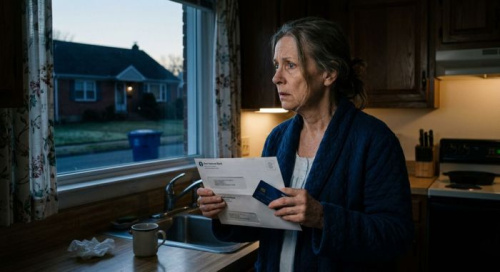
The trouble began in early May, when Chloe simply stopped being seen. No more waving from the driveway. No more friendly hello at the mailboxes. Her bike stayed chained to the porch railing, untouched, which struck me as wrong for a girl who'd supposedly run off. When I asked Diane where the girl had gotten to, she smiled a little too quickly and said Chloe had decided to go live with her aunt in Reno for the summer, to "find herself."
By July, that had quietly become "she ran off with a boy we never approved of." By September, it was "we think she's fine, she checks in when she can."
But I watched those two people closely, and I noticed something that kept me up at night. Parents whose daughter had truly vanished from their lives didn't move through their days with such confident calm. They didn't remodel the kitchen over a missing child. They didn't laugh at neighborhood jokes like nothing had changed.
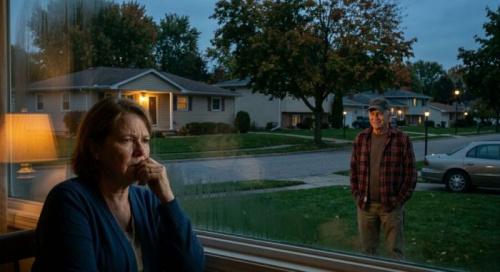
The closer I looked, the more the little things piled up. Gerald, who had always been perpetually cheerful, now answered questions about Chloe with a rehearsed patience, like an actor who'd memorized his lines. Diane avoided eye contact whenever her daughter's name came up. And once, when I mentioned that I'd heard the local police never took a missing person's report, Gerald's easy smile flickered for just a heartbeat before he set it back in place.
Gerald and Diane acted like a weight had been lifted. And a mother's instinct, even a mother of a neighbor, told me that was the wrong reaction entirely.
I might have let it go, the way the rest of the block did. But then the rain came.
That October, a freak storm rolled through and dumped more water on our county in three days than we'd seen in a decade. Every house on Larkspur Lane with a basement or a crawl space flooded, mine included. The Mercers, conveniently and famously, were "away for the weekend" when the worst of it hit, and their place took on more water than anyone's.
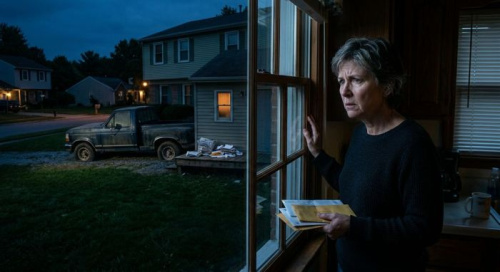
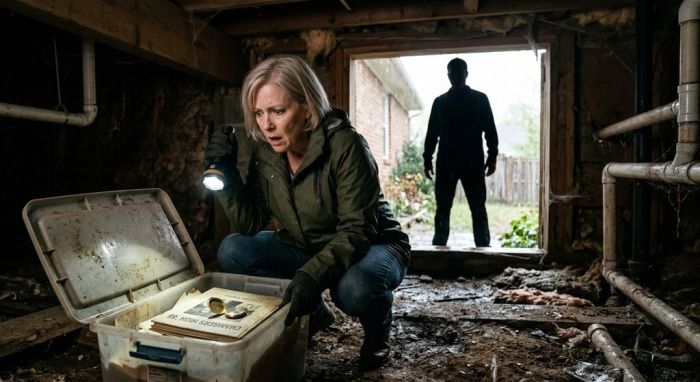
I offered to check on their house while they were gone. It was the neighborly thing to do, and I'd always kept a spare key because I fed their cat during trips. When I waded down to their crawl space with a flashlight to see how bad the flooding was, I nearly turned back at the smell.
The water had receded just enough to leave mud everywhere. And half-submerged near the support beam, jammed beneath the heating ducts, was a plastic storage bin with a cracked lid. It hadn't been there the last time I was in that crawl space, a year earlier, when I'd helped Diane store her Christmas decorations. Someone had hid it deliberately, deep in the shadows, away from any casual glance.
I crouched down and pried off the lid.
Inside, wrapped in a trash bag to keep it dry, was everything I would have sworn belonged to a girl who had vanished into thin air. A high school yearbook with Chloe's smiling photo on the sophomore page. A tarnished silver locket with an engraving I couldn't quite make out. A bundle of letters tied with a ribbon. And a single, folded train ticket stub from the Greyhound station downtown.
I didn't take anything. I had the presence of mind for that much. But I flipped open the yearbook, and in that dripping, stinking crawl space, my heart went cold.
On the inside cover, in Chloe's round, hopeful handwriting, was a note: "Dear whoever finds this — he never bought me a real ticket. He'll say I ran away. Don't believe him."
I should have gone to the police right then. I know that now. But I had spent my whole life trusting people and being burned for it, and I wanted to be certain before I set the world on fire. So I went to the one person on Larkspur Lane who I knew would take me seriously.
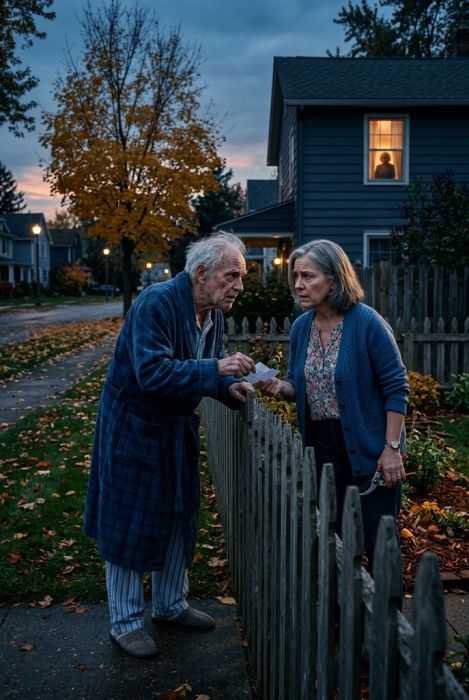
Howard Bell lived three houses down, a retired detective from the city force who'd spent thirty years looking at liars. He was in his seventies now, widowed twice, and the only man on the street I'd ever seen read a stack of newspapers cover to cover. When I knocked on his door that evening, shaking, he took one look at my face and set down his coffee.
"Sit down, Barbara. Tell me everything."
I told him about the bin in the crawl space, the yearbook, the note. He listened without interrupting, and when I was done he pulled out a worn notebook and started writing.
"You say the ticket was a Greyhound stub," he said. "Let me make a call."
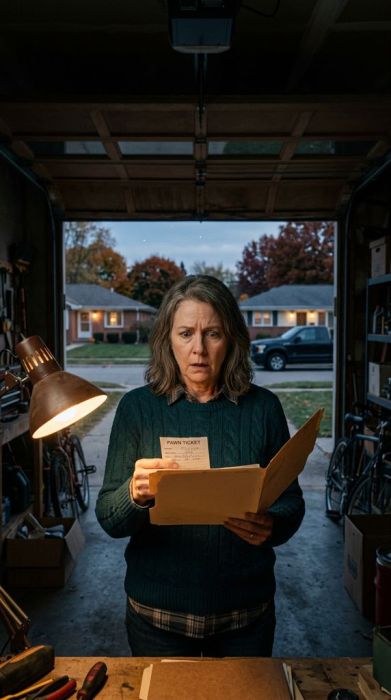
What Howard found in the next three days changed the direction of my whole life. The ticket in that bin wasn't just unused. It had never even been purchased from that station in the first place. The number on the stub didn't match any fare ever sold in our county. Gerald Mercer, a man who balanced books for a living, had created a fake receipt for a bus journey his daughter never took.
And once Howard started pulling threads, the whole tapestry began to unravel.
It turned out Chloe had never left town at all. She'd discovered, weeks before she disappeared, that her father had been skimming money from nearly every business he kept the books for — doctoring ledgers, forging signatures, siphoning thousands into accounts under names nobody knew. When she told him she was going to the police, Gerald didn't hit her. He was smarter than that, and crueler. He painted her as a troubled runaway, told Diane and everyone else she'd gone to Reno, and spread the lie so thoroughly that the girl had no safe house left on that street.
Chloe, terrified and out of options, had done the only thing a sixteen-year-old could think of. She'd run. Not to another state, but to a rundown motel on the edge of town, paying cash for a room under a fake name, waiting for the moment her father's lies finally caught up with him.
The evening the pieces clicked into place, I sat in Howard's kitchen and listened to him dial the county prosecutor. "We've got a missing minor who was never actually missing," he said into the phone, "and a father who's been laundering money under the neighborhood's nose for three years. Come and get them both."
The arrest happened on a Thursday, two days after that phone call. Gerald Mercer was taken from his own front porch in handcuffs, still wearing the khakis he'd mowed the lawn in, insisting loudly to anyone who would listen that his daughter had run away from home and he was the victim here. But the ledgers I'd helped Howard find, and the testimony Diane finally gave once she understood the depths of her husband's betrayal, told a different story entirely.
The neighbors gathered that morning, curtains twitching, and for the first time in months nobody pretended. They watched the squad car pull away, and they looked at me with something I hadn't seen from them in a very long time. Respect.
But the moment that stayed with me, the one I'll carry for the rest of my life, came three days later.
I drove to the motel on the edge of town with a social worker and Howard at my side. When Chloe Mercer opened the door, thin and hollow-eyed from months of hiding, and saw the retired detective and the neighbor lady who'd never given up on her, she didn't say a word. She just wrapped her arms around me and wept into my shoulder like she'd been drowning and I'd thrown her a rope.
Gerald was convicted on seventeen counts of fraud, forgery, and financial exploitation. The businesses he'd drained went back to their owners. And a girl who everyone on Larkspur Lane had silently written off as a runaway was finally safe, living with her maternal grandmother in Ohio, sending me a postcard every single month.
Diane left town not long after, taking nothing but the truth she'd finally admitted to herself. Sometimes, when I see the "for sale" sign still planted in front of 30 Larkspur Lane, I think about all the things that house was hiding in plain sight.
But mostly, I think about Chloe. About how a whole street can convince itself a child vanished for no reason, and how one stubborn old neighbor and one retired detective refused to let a lie stand.
If you ever hear that a teenager next door just up and ran away with no explanation, no farewell, and parents who seem oddly relieved — trust your instincts. Say her name out loud. Because some of the most dangerous secrets in America aren't hidden in basements or behind locked doors. They're hidden behind the most normal-looking houses on the most peaceful streets you've ever seen.