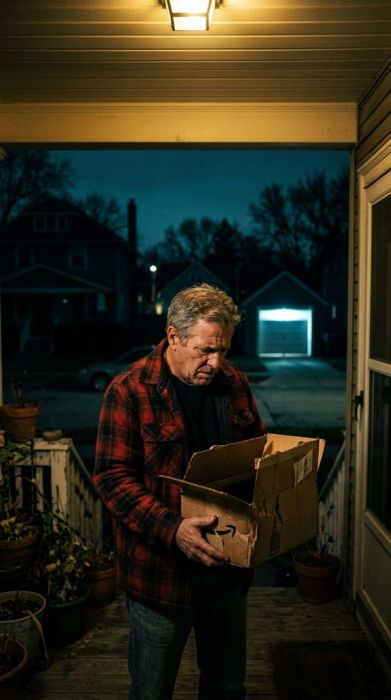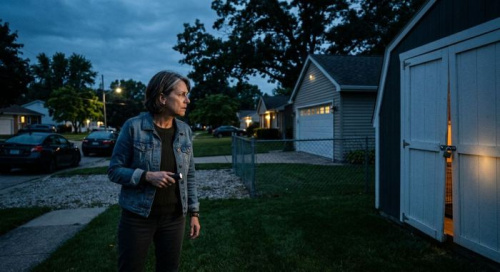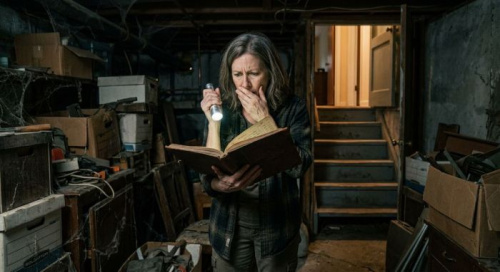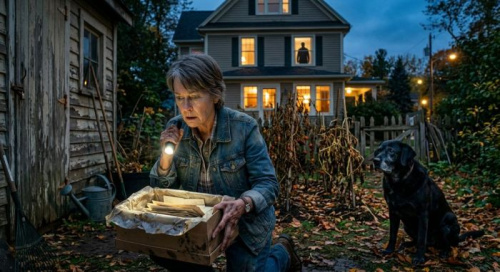
The first time I noticed something wrong at 42 Maple Lane, it was two in the morning and I couldn't sleep. I'd gone to the kitchen for a glass of water, the way you do when you're forty-seven and your back keeps you up and your mind won't stop running through the next day's tasks. I stood at the sink, staring out at the street, and that's when I heard it.
A scraping sound. Low and rhythmic. Like something heavy being dragged across concrete.
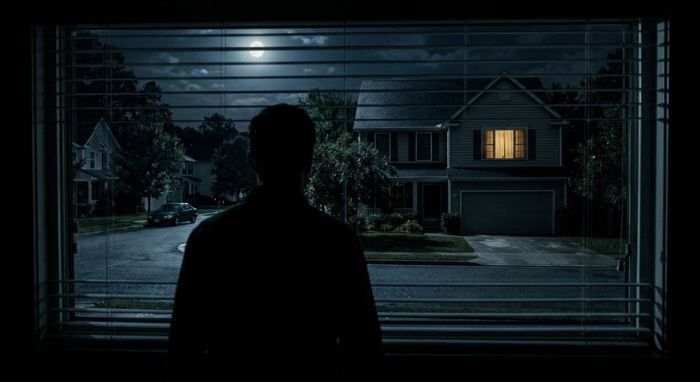
I parted the blinds and looked across the street. Mark Delaney's house sat dark and quiet like it always did. The garage door was closed. No lights on. Nothing moving. But the sound kept going, faint but distinct in the stillness of a suburban night. I told myself it was probably a tree branch scraping against his roof. Old Mr. Delaney had that big oak near the garage. That had to be it.
I went back to bed and eventually fell asleep.
In the morning, I saw Mark outside watering his petunias. He looked up and gave me that gentle wave of his, the one he always gave. A slow, friendly raise of the hand, palm open. The wave of a retired high school history teacher who had spent thirty years being approachable and kind. I waved back and forgot about the scratching sound entirely.
That was my first mistake.
The neighborhood of Willow Creek Estates was the kind of place where nothing bad happened. Built in the early nineties, it sat on the edge of a small town in upstate New York, about forty minutes from Albany. The houses were mostly colonials and split-levels with well-kept lawns and basketball hoops in the driveways. Kids rode their bikes in figure-eights on the cul-de-sac. On summer evenings, the smell of barbecue drifted from backyard to backyard like a shared secret.
Mark Delaney had lived at 42 Maple Lane for twenty-two years. He moved in with his wife, Ellen, back in 2004, back when the neighborhood was still young and families were just settling in. Ellen died of ovarian cancer in 2019. I remember the funeral. It was a small gathering at St. Mary's, maybe thirty people. Mark stood at the grave site with that same quiet composure he always carried, his shoulders squared, his face calm but sad. He shook everyone's hand afterward and thanked them for coming.
He was a good man. Everyone said so.
After Ellen passed, Mark kept to himself more than before. That was understandable. Grief changes people. He still came out to tend his yard, still waved at the mailman, still said hello to the joggers who passed his house. But he didn't socialize much. He didn't come to the block parties. He didn't join the neighborhood watch. He stayed inside his home, with the blinds drawn, living a life that no one thought to question.
The scratching sounds became more frequent over the next few weeks.
I started noticing them around midnight, sometimes later. A persistent scraping that seemed to come from beneath the garage. I mentioned it to my wife, Diane, over breakfast one Saturday.
"You hear that sound at night?" I asked. "From across the street?"
Diane looked up from her coffee. "What sound?"
"Like scraping. Dragging. Coming from Mark's garage."
She shook her head. "I sleep like a rock, you know that. Maybe it's an animal. Raccoons get under those old garages all the time."
She was probably right. The neighborhood had plenty of raccoons. Opossums too. I let it go.
But then came the night of the first scream.
It was a Thursday in early October. The leaves had started turning, and the air carried that crisp edge that tells you winter is coming. I was watching the late news, volume low so I wouldn't wake Diane. Around eleven-thirty, I heard something that made the hairs on my arms stand up.
A woman's voice. Muffled. Brief. Coming from somewhere outside.
I muted the television and sat perfectly still, listening. The house was silent except for the hum of the refrigerator. I waited. Nothing. I walked to the front door and stepped onto the porch. The street was empty. The streetlights cast soft orange pools on the asphalt. Mark's house was dark.
I stood there for five minutes. Nothing moved.
I went back inside and convinced myself it was a television from someone's open window. Maybe the Morrisons two houses down had their bedroom TV on too loud. That happened sometimes.
But I didn't sleep well that night.
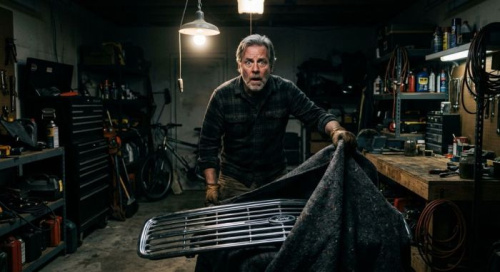
The next morning, I made a point to walk past Mark's house on my way to get the mail. His garage door was open for once, and I could see inside. It was immaculate. Tools hung on pegboards in perfect rows. A workbench sat against the back wall, clean and organized. A tarp covered something on the floor near the far corner. A motorcycle, probably. Mark had mentioned once that he restored old motorcycles as a hobby.
He came out of the house through the side door and smiled when he saw me.
"Morning, Tom," he said. "Beautiful day, isn't it?"
"Sure is, Mark," I said. "Getting that bike ready for spring?"
He looked at me for a moment, his smile holding steady. "Something like that."
He closed the garage door and went back inside.
I remember thinking that his hands were clean. Too clean for someone who had been working on a motorcycle. No grease under the fingernails. No dirt on his clothes. He was wearing a plaid shirt and khakis, like he was about to go to brunch.
Something about it bothered me, but I couldn't say what.
Two weeks later, a twelve-year-old girl named Emma Torres disappeared from the next street over.
The news hit the neighborhood like a thunderclap. Emma had been walking home from a friend's house, four blocks away. She never made it. The police came in force. Officers went door to door, asking questions, taking notes. A search party combed the woods behind the development. Helicopters circled overhead.
I stood on my front lawn, watching the chaos unfold, and I felt a cold knot tighten in my stomach.
When the officers reached our street, I was the one who directed them to Mark's house. I don't know why. Maybe it was the scratching. Maybe it was the scream. Maybe it was the tarp on the garage floor and his impossibly clean hands. I told the officers everything I had noticed. They listened politely, wrote it all down, and thanked me for my time.
They interviewed Mark that afternoon. I watched from my window as two detectives stood on his porch. Mark spoke to them calmly, his hands in his pockets, his expression open and cooperative. The whole conversation lasted maybe ten minutes. The detectives shook his hand and left.
They didn't search his garage.
I couldn't believe it. I called the police department the next day and asked if they had followed up on my report. The officer on the phone assured me they had investigated all leads thoroughly. Mark Delaney had no criminal record. He had been a schoolteacher for thirty years. His neighbors described him as a kind and gentle man. There was simply no reason to suspect him.
I felt like I was losing my mind.
Diane told me I was getting too involved. "The police know what they're doing, Tom. You're not a detective. Let them handle it."
But I couldn't let it go. The scratching at night had stopped since Emma disappeared. That fact gnawed at me. If it was an animal, why would it stop so suddenly? If it was a tree branch, why hadn't the wind ever caused it before?
I started watching Mark's house more carefully. I bought a pair of binoculars and kept them on the nightstand. I stayed up later than I should have, sitting in the dark living room, my eyes fixed on the windows across the street.
Mark's routine was predictable. He left the house every morning at nine to buy groceries or run errands. He returned within an hour. He spent the rest of the day inside, rarely emerging. His lights went off at ten every night. He never had visitors. He never received packages. He was a ghost living in a house that should have been full of life.
Three weeks after Emma disappeared, I noticed something strange. Mark had started making trips to the hardware store. Not just once, but three times in a single week. I saw the receipts sticking out of his grocery bag one morning. Concrete mix. Lumber. PVC piping.
I called the police again. I told them about the hardware store purchases. The officer sighed on the other end of the line.
"Sir, we've looked into Mr. Delaney. He's not a suspect. Please stop calling."
That night, I made a decision. I was going to find out what was in that garage myself.
It was a stupid idea. I know that now. But the thought of Emma Torres, of her parents sitting in their living room with her photos on the mantel, of a twelve-year-old girl who might be just a few hundred feet away from me — I couldn't live with myself if I did nothing.
I waited until one in the morning. Diane was sound asleep. I put on dark clothes and slipped out the back door. The neighborhood was silent. The moon was half-full, casting just enough light to see by. I crossed the street and crept along the side of Mark's house, staying close to the shadows.
The garage had a small window on the side, frosted glass, impossible to see through. But there was also a basement window near the ground level, set into a small well. I crouched down and peered through the grime-caked glass.
I saw stairs. Concrete stairs leading down. And at the bottom, a light.
I pressed my face closer to the glass. The light was dim, coming from a single bulb. I could make out the bottom of the stairs, a narrow corridor, and what looked like a door. A heavy door, painted gray, with a deadbolt on the outside.
My heart was pounding so hard I thought it might wake the entire street.
And then I heard it. A voice. Faint. Young. Coming from somewhere deep beneath the house.
"Please."
I scrambled backward, my feet slipping on the damp grass. I ran back to my house, locked the door behind me, and leaned against it, gasping. I didn't sleep for the rest of the night.
At seven in the morning, I called the police one last time. I told them I had heard a voice coming from Mark Delaney's basement. I told them I had seen a locked door. I told them I was certain Emma Torres was in that house.
The dispatcher said they would send someone out.
Two hours passed. No one came.
I called again. They told me an officer would be dispatched when available. I was beginning to understand that the police had written me off as a hysterical neighbor with an overactive imagination.
So I did the only thing I could think of. I called the local newspaper.
The reporter I spoke to was a young woman named Sarah Chen. She listened to my story without interrupting. When I finished, she asked for Mark's address and said she would look into it.
Sarah showed up on Maple Lane that afternoon with a photographer. She knocked on Mark's door. He answered, polite as ever. She asked him a few questions about the neighborhood, about Emma Torres, about his background. He answered calmly, even cheerfully. He posed for a photograph on his front porch, smiling in the afternoon sun.
The article ran the next day. It was a human-interest piece about the residents of Willow Creek Estates and how the disappearance of Emma Torres had affected them. There was a photo of Mark standing in front of his well-maintained lawn, looking every bit the retired schoolteacher. He was quoted saying, "This community is like a family. We all look out for each other."
But Sarah had done something smart. She had included a small paragraph at the end of the article mentioning that one neighbor had reported hearing unusual sounds from the Delaney property. It was buried deep in the text, but it was there.
And someone read it.
That night, my doorbell rang. I opened it to find a woman I had never seen before. She was in her late fifties, with graying hair and tired eyes. She looked like she hadn't slept in days.
"Are you the one who heard the sounds?" she asked.
"Yes," I said.
"My daughter went missing two years ago," she said. "Her name is Rebecca. She was twenty-three. She lived in a town about thirty miles from here. The police never found her."
She reached into her purse and handed me a photograph. A young woman with long brown hair and a wide smile.
"Her car was found abandoned near a highway rest stop," the woman said. "The case went cold. But I never stopped looking."
I looked at the photograph, then at the woman's desperate eyes. I didn't have the heart to tell her that the police hadn't believed me either.
"I'll keep looking," I said.
The next day, Sarah Chen called me. "I checked county records," she said. "Mark Delaney purchased fifty pounds of quick-dry concrete three times in the past month. I also found that he bought a property near the Catskills six months ago. A rural cabin. He paid cash."
"Why would a retired teacher need a secret cabin?"
"That's what I'm trying to figure out."
Sarah published a follow-up article the next morning. This time, she didn't bury the lede. The headline read: "Neighbor Raises Questions About Retired Teacher's Late-Night Activity." She included the hardware store receipts, the abandoned car from the Rebecca Miller case, and the fact that Mark Delaney had purchased a remote cabin in the Catskills six months earlier.
The article went viral in our small corner of the internet. Local news picked it up. Then state news. By noon, there were news vans parked on Maple Lane.
Mark Delaney didn't come out of his house.
At three in the afternoon, a judge signed a search warrant.
I watched from my front porch as a convoy of police vehicles rolled onto our quiet street. There were marked units, unmarked sedans, and a van from the forensic unit. Officers in tactical gear surrounded the house. A detective used a bullhorn to order Mark to come out.
The front door opened. Mark stepped onto the porch, his hands raised. He was wearing the same kind of plaid shirt and khakis he always wore. He looked confused, almost hurt.
"This is a misunderstanding," he called out. "I'm just a retired teacher. I've done nothing wrong."
They handcuffed him and led him away.
The search of his house took four hours. I stayed on my porch the entire time, unable to move, unable to look away. Diane sat beside me, holding my hand.
At seven-fifteen in the evening, the lead detective walked across the street and climbed the steps to my porch. He was a heavyset man with a gray mustache and eyes that had seen too much.
"Mr. Gardner," he said. "I owe you an apology."
He told me what they had found. Beneath the garage, behind that heavy gray door, there was a room. Eight feet by ten feet. Concrete walls. A single mattress on the floor. A bucket for waste. And inside that room, alive but severely malnourished, was Emma Torres.
She had been there for twenty-three days.
They also found evidence suggesting that a second room had been recently sealed. When they excavated the concrete, they found human remains. Two bodies. One matched the description of Rebecca Miller, the young woman who had disappeared two years earlier. The other was unidentified, a woman in her thirties who had likely been there for much longer.
Mark Delaney, the retired history teacher who waved at everyone and kept his lawn immaculate, had been kidnapping and holding women captive in his garage for years. He had built a dungeon beneath his home, soundproofed and hidden so well that no one ever suspected a thing.
The scratching sounds I had heard at night were his victims trying to dig their way out.
The trial lasted six weeks. Mark was convicted on multiple counts of kidnapping, false imprisonment, and first-degree murder. He was sentenced to life in prison without the possibility of parole.
Emma Torres spent six months in physical therapy and counseling. She's seventeen now. I see her sometimes, walking through the neighborhood with her mother. She doesn't talk much. But she smiles on good days.
The unidentified remains in Mark's garage were never named. They belonged to a woman who had been missing for so long that no one was looking for her anymore.
I still live at 44 Maple Lane. Diane and I keep the porch light on at night. I wave at my neighbors, and they wave back. But I notice things now. The way a garage door stays closed a little too long. The sounds that come from houses after midnight. The small inconsistencies that most people dismiss.
I used to think the quietest houses on the street were the safest. Now I know better.
The house at 42 Maple Lane has been sold twice since Mark's arrest. Neither buyer stayed long. The last time I walked past it, the windows were boarded up and a For Sale sign had fallen over in the yard. The grass was overgrown. The petunias were dead.
And late at night, if the wind is right, I still imagine I can hear scratching from beneath the garage.