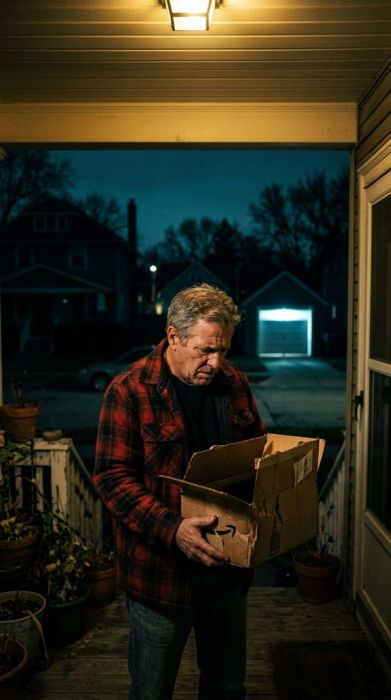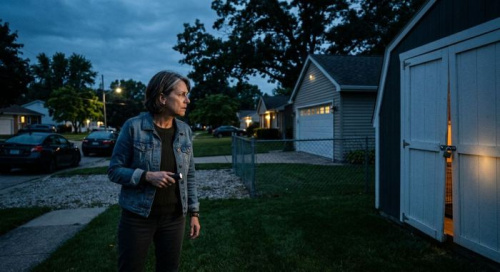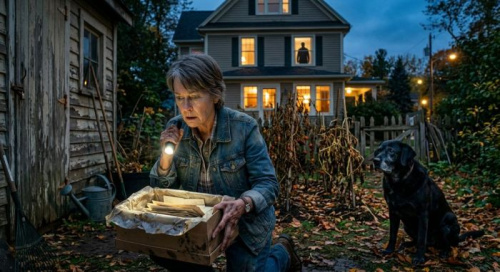
The first thing Claire Patterson noticed about the house at 18 Willow Way was the curtains. Not that they were pretty — they weren't. They were heavy, beige, and always pulled tight from ceiling to sill. Every window, every single one, covered like the house was perpetually in mourning. Claire had lived at 21 Willow Way for three years now, ever since her husband Tom passed, and in all that time, she'd never once seen those curtains open.
She'd mentioned it to her daughter Rachel during one of their Sunday phone calls. "The woman at number 18, she never opens her curtains."
"Maybe she values her privacy, Mom."
"At three in the afternoon?"
Rachel had laughed. "You're becoming one of those neighborhood watch people. You know that, right?"
But Rachel didn't live here. Rachel lived three states away in Phoenix with a husband and two kids and a life that didn't include noticing how a house could feel perfectly normal from the street yet somehow wrong in ways you couldn't quite name.
The woman herself seemed normal enough. Her name was Margaret Harlow, at least according to the mailman who'd been delivering to Willow Way for seventeen years. She was in her late fifties, maybe early sixties, with gray hair cut short and practical, and she wore sweater sets and sensible shoes. She drove a beige Toyota Camry, changed her oil on schedule, and kept her lawn as neat as anyone else on the block.
But she never had company. Not once. Claire had been to every block party, every Fourth of July barbecue, every neighborhood potluck since she'd moved in. Margaret Harlow never attended. When Claire had brought over a casserole during her first week — the neighborly thing to do — Margaret had opened the door exactly six inches, smiled tightly, thanked her, and closed it again. The casserole dish was returned three days later, washed clean, left on the porch at 6 AM.
And then there were the vans.
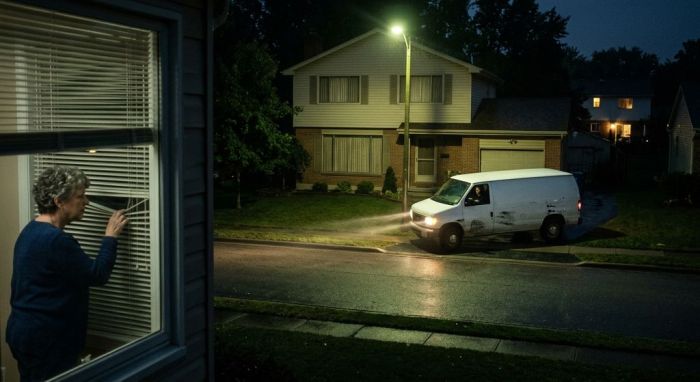
They started arriving around the time the oak trees lost their leaves last October. White vans, no markings, no company logos. They'd pull into Margaret's driveway around nine or ten at night and leave before sunrise. Claire noticed because she'd wake up sometimes — grief does that to you, wakes you at odd hours — and she'd see the van's headlights sweep across her bedroom ceiling.
At first, she thought it might be a medical transport. Maybe Margaret had a sick relative she was caring for. That made sense. That was kind. Claire almost convinced herself.
But then she saw the girls.
It was a Thursday night in November, just after Thanksgiving. Claire couldn't sleep — the holiday had been quiet and lonely, and she'd had too much wine with her frozen turkey dinner. She was standing at her kitchen window, drinking tea, when a white van pulled into Margaret's driveway. The side door slid open, and a young woman stepped out. She looked maybe eighteen, maybe younger. She was Asian, thin, wearing a coat that seemed too light for the November cold. Another young woman followed. Then another. Three of them, all young, all thin, all moving with their heads down.
Margaret met them at the side door — not the front door — and ushered them inside quickly. The whole thing took maybe thirty seconds.
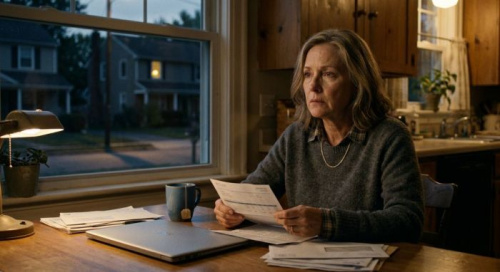
Claire stood frozen, her tea growing cold in her hands.
The next morning, she called the police. Not 911 — she wasn't that dramatic. She called the non-emergency line and asked to speak with someone about a welfare check.
Officer Danvers arrived an hour later. He was young, maybe thirty, with the kind of earnest patience that made Claire feel like she was being humored. She explained what she'd seen. The vans. The girls. The odd hours.
"Ma'am, has there been any noise? Any signs of disturbance or distress?"
"No, but — "
"The woman who lives there, Margaret Harlow. She's a volunteer at St. Mary's church downtown. Runs their homeless outreach program. Very respected woman."
Claire felt her cheeks flush. "I'm not accusing her of anything. I just thought — "
"We checked it out last year actually. Someone else reported suspicious activity." Danvers shrugged. "Turns out she runs a transitional home for young women. Women escaping difficult situations. Abuse, trafficking, that sort of thing. It's all above board."
"Oh."
"She probably keeps it quiet for their privacy. You understand."
Claire nodded and thanked him and went back inside. She felt foolish. Of course. A transitional home. That explained everything. The vans, the odd hours, the need for privacy. Margaret wasn't hiding something sinister. She was helping people.
But that night, Claire couldn't sleep again.
She stood at her window, watching the dark silhouette of 18 Willow Way, and she thought about those girls. Three of them, young and thin, heads down, coats too light for November. They'd moved like shadows, like they'd been trained to move unseen.
If Margaret was running a shelter for trafficking victims, why were new girls arriving at ten o'clock at night in unmarked vans? Why did the curtains stay closed twenty-four hours a day? Why did she never see the girls outside, never see them getting fresh air or walking to the corner store?
A transitional home would have counselors, social workers, case managers. A transitional home would have proper signage, referrals from the county, a paper trail.
Something about it itched at the back of Claire's mind, like a tag in a shirt you couldn't stop feeling.
Over the next few weeks, she started keeping notes. Just a small spiral notebook she kept in the kitchen drawer. She wrote down the dates and times of van arrivals. The license plate numbers she could read. Once, when a van arrived earlier than usual — around seven in the evening — she grabbed her phone and pretended to be checking her mail while she watched from her porch.
The driver was a man she'd never seen before. Mid-forties, heavy build, bald. He wore a windbreaker and moved with the casual confidence of someone who'd done this many times before. He didn't look at her. He didn't look at anything except the side door where Margaret appeared, took something from his hand — an envelope, maybe — and disappeared back inside.
Three girls got out again. Different ones this time. Two were Hispanic, one was Black. They looked even younger than the first group. Sixteen, maybe seventeen.
The van drove away. The side door closed. The house went dark by nine-thirty.
Claire's hands were shaking.
She called her daughter that night. "Rachel, I need you to listen to me without telling me I'm being paranoid."
"Mom, what's going on?"
"I think something bad is happening at 18 Willow Way. And I don't know what to do about it."
Rachel listened. She didn't interrupt. When Claire finished, there was a long silence on the line.
"Mom, have you called anyone else?"
"The police already told me she's running a shelter."
"Then call someone else. Call the FBI if you have to. But be careful. If you're right — if there's really something going on — those people aren't going to be happy if they find out someone's watching."
The next morning, Claire drove to the library and used a computer there. She searched for Margaret Harlow and St. Mary's homeless outreach. She found a newsletter from two years ago that mentioned Harlow as a volunteer. Not a director. Not a coordinator. A volunteer who helped serve meals on Tuesdays.
She searched for "transitional home Willow Way" and found nothing.
She searched for "Margaret Harlow trafficking shelter" and found nothing.
She sat back in the hard library chair and stared at the screen.
The police officer had looked it up. He'd said it was all above board. But what if he'd just taken Margaret's word for it? What if he'd called her, asked her, and she'd given him a story that sounded good enough?
Claire drove home slowly. When she turned onto Willow Way, she saw another white van in Margaret's driveway. Mid-afternoon. Unusual.
She pulled into her own driveway and got out of the car. The van was idling, exhaust puffing into the cold December air. She could see the driver — a different man, younger, with a baseball cap pulled low.
And then she heard it.
A scream. Muffled, cut short, coming from inside Margaret's house.
Claire's blood went cold.
She walked inside her own home, locked the door, and called the FBI's human trafficking tip line. She gave them everything. The dates. The license plates. The descriptions of the girls. The scream she'd just heard.
"Ma'am, we're going to need you to stay where you are and not approach the property. Can you do that?"
"Yes."
"We'll have someone there within the hour."
They were faster than that. Forty-one minutes later, three unmarked SUVs pulled onto Willow Way without sirens, without lights. Men and women in tactical gear surrounded 18 Willow Way. Claire watched from behind her living room curtains, her phone pressed to her ear, Rachel on the line.
"Mom? Mom, what's happening?"
"They're raiding the house."
She heard the crash of the door being forced open. Shouting. A woman screaming — Margaret, it sounded like. Then more shouting, orders being barked.
And then they started bringing them out.
The girls came first. One by one, wrapped in blankets, led gently by FBI agents. Claire counted them. Seven. Seven young women, some crying, some staring blankly ahead, all of them looking like they'd forgotten what daylight felt like.
Then Margaret came out in handcuffs, her sweater set askew, her face red and twisted. She was shouting something about misunderstandings, about helping people, about how dare they.
No one was listening to her.
Two more men were brought out — the driver from the van and another man Claire had never seen before. They were both handcuffed, both silent, both keeping their eyes fixed on the ground.
The last thing they brought out was a laptop, a stack of notebooks, and a folder full of photographs that made one of the young FBI agents turn away and take a long breath.
Claire learned the full story over the following weeks, pieced together from news reports and a victim advocate who called to thank her.
Margaret Harlow had been running a human trafficking operation for nearly six years. She used her volunteer work at St. Mary's as cover, identifying vulnerable young women — runaways, homeless teens, victims of abuse — and offering them a place to stay. A fresh start. A safe house.
Instead, she drugged them, photographed them, and sold them. The unmarked vans belonged to a network that stretched across three states. The men who drove them were buyers or transporters. The photographs in that folder were listings.
Margaret had been on law enforcement's radar before, but she'd always managed to talk her way out of it. She was too old, too respectable, too church-going to be a monster. Her neighbors vouched for her. Her priest vouched for her. The police had checked on her and found nothing because she'd shown them exactly what they expected to see.
Claire testified at Margaret's trial. She sat in the witness box, looked at the woman who'd lived across the street for six years, and felt nothing but a cold, hard certainty.
"You used your kindness as a weapon," Claire said quietly. "And everyone believed you because you looked like someone who could never hurt anyone."
Margaret Harlow was sentenced to life in federal prison without the possibility of parole.
The house at 18 Willow Way sat empty for a long time. The curtains stayed closed. Eventually, a For Sale sign went up, but it stayed there for months. No one wanted to buy the house where seven young women had been held captive.
Claire still lives at 21 Willow Way. She still can't sleep most nights. But now when she wakes at 3 AM, she doesn't look out the window anymore.
She learned that the quietest houses, the most ordinary neighbors, the people who seem the most harmless — they're often the ones hiding the darkest truths.
And she learned that when something feels wrong, even if you can't explain it, you owe it to yourself to listen.